Overview
- The oldest known cave art is a hand stencil from Muna Island in Sulawesi, Indonesia, dated by laser-ablation uranium-series methods to at least 67,800 years ago, while the oldest figurative scene—a depiction of humans hunting a pig at Leang Karampuang—dates to at least 51,200 years ago, demonstrating that sophisticated artistic traditions accompanied Homo sapiens during their dispersal through Southeast Asia.
- Uranium-thorium dating of calcite crusts overlying pigment has revolutionized the chronology of cave art, replacing stylistic assumptions with absolute minimum ages and revealing that non-figurative cave art in Spain may predate the arrival of modern humans in Europe by more than 20,000 years, raising the contested possibility of Neanderthal authorship.
- Cave art traditions span every inhabited continent and encompass figurative animal depictions, hand stencils, geometric signs, and complex narrative scenes, yet no single interpretive framework—hunting magic, shamanism, structuralism, or information exchange—has achieved consensus, and current scholarship increasingly treats each painted cave as a site-specific cultural expression rather than an instance of a universal symbolic system.
Cave art and rock art constitute the most visually dramatic evidence of symbolic behavior in the human past. Painted, engraved, and stenciled onto the walls and ceilings of limestone caves and open rock shelters across every inhabited continent, these images range from naturalistic depictions of animals and human figures to abstract geometric signs whose meanings remain the subject of intense scholarly debate. The oldest securely dated example—a hand stencil from Muna Island in Sulawesi, Indonesia, with a minimum age of 67,800 years—demonstrates that the practice of marking rock surfaces with pigment extends deep into the Middle Paleolithic, accompanying Homo sapiens from the earliest phases of their dispersal through island Southeast Asia.7 The oldest known figurative narrative scene, from Leang Karampuang in the same region, dates to at least 51,200 years ago and depicts therianthropic figures interacting with a large wild pig, revealing a capacity for storytelling and mythological imagination at a remarkably early date.6
For most of the twentieth century, the study of cave art was largely synonymous with the painted caves of Franco-Cantabrian Europe—Lascaux, Altamira, Chauvet, and their contemporaries. Discoveries in Indonesia, Australia, Africa, and South America have now made clear that parietal art (art on cave or rock surfaces) was a global phenomenon, independently arising in multiple populations and persisting across tens of thousands of years. The study of this art draws on archaeology, dating science, cognitive psychology, and ethnographic analogy, and the questions it poses—who made it, when, why, and what it meant to its creators—remain among the most compelling in the human sciences.10, 23
The dating revolution
The modern study of cave art chronology was transformed by the application of uranium-thorium (U-Th) dating to thin calcite crusts that form naturally over painted surfaces. Traditional radiocarbon dating, while invaluable for charcoal-based drawings, cannot date mineral pigments such as iron oxide (ochre) and manganese dioxide, which lack organic carbon. U-Th dating exploits the radioactive decay of uranium-234 to thorium-230 within calcium carbonate formations: because thorium is insoluble in water, any thorium present in a calcite crust must have been produced in situ by the decay of co-precipitated uranium, and the ratio of thorium-230 to uranium-234 therefore provides a reliable clock for the age of the calcite. A calcite layer deposited on top of a painting gives a minimum age for the underlying pigment; a layer beneath it gives a maximum age.1
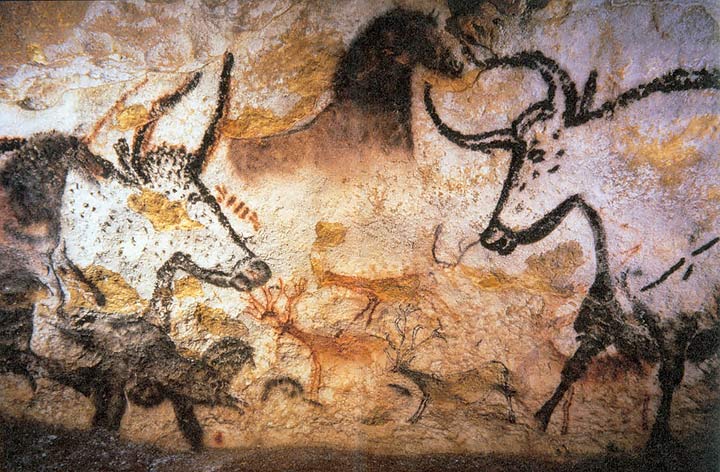

Pike and colleagues applied this technique to cave art in 11 Spanish caves in 2012, obtaining minimum ages for red disks, hand stencils, and claviform signs. A red disk at El Castillo yielded a minimum age of 40,800 years, making it the oldest directly dated cave painting in Europe at that time and placing it at the very beginning of the Aurignacian period, when anatomically modern humans first arrived on the continent.1 In 2018, Hoffmann and colleagues pushed the technique further, reporting minimum ages exceeding 64,800 years for red pigment panels at La Pasiega, a hand stencil at Maltravieso, and painted speleothems at Ardales—all in Spain. These dates predate the arrival of Homo sapiens in Europe by at least 20,000 years and, if correct, imply that the art was created by Neanderthals.2
A further methodological advance, laser-ablation uranium-series (LA-U-series) imaging, was applied by Oktaviana, Aubert, and colleagues to Sulawesi cave art in 2024. By using a focused laser to sample microscopic layers of calcite at high spatial resolution, the technique overcomes some of the averaging effects inherent in conventional micro-milling of bulk samples, and it produced minimum ages substantially older than those obtained by earlier methods at the same sites. A figurative scene at Leang Karampuang was dated to at least 51,200 years ago, and a previously dated hunting scene at Leang Bulu’ Sipong 4 was revised upward from 43,900 to at least 50,200 years ago.6 In 2025, the same team applied LA-U-series dating to a hand stencil on Muna Island, east Sulawesi, obtaining a minimum age of 67,800 years—the oldest directly dated cave art in the world.7
For Chauvet Cave in the Ardèche region of southern France, radiocarbon dating of charcoal drawings and torch marks has established a detailed chronology. A high-precision Bayesian model published by Quiles and colleagues in 2016, integrating more than 250 radiocarbon dates, identified two distinct periods of human activity in the cave: one extending from approximately 37,000 to 33,500 years ago and a second from approximately 31,000 to 28,000 years ago.8 Earlier radiocarbon work by Valladas and colleagues had placed the oldest charcoal drawings at approximately 36,000 years before present, confirming that the complex polychrome paintings of Chauvet are among the oldest in Europe.9
Techniques and materials
Paleolithic artists employed a diverse repertoire of techniques to create images on rock surfaces. The most common method was the direct application of mineral pigment to the wall, using fingers, pads of fur or moss, or rudimentary brushes fashioned from plant fibres or animal hair. Red pigments were obtained from iron oxides, principally ochre (goethite and limonite) and hematite, while yellow was derived from iron oxyhydroxides. Black pigments came from two sources: manganese dioxide, a mineral pigment, and charcoal from burned wood or bone. White was occasionally produced from kaolin clay or calcite.16
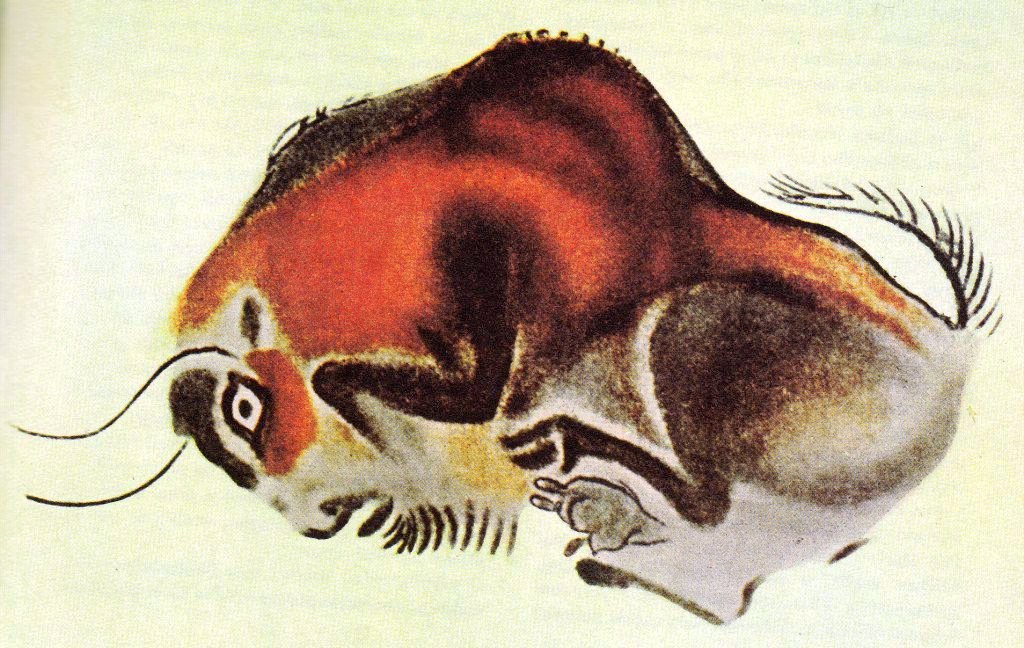

Polychrome painting—the use of multiple pigment colours in a single composition—reached its highest expression in the caves of Altamira and Lascaux. At Altamira, the ceiling of the Great Hall of Polychromes displays bison rendered with engraved outlines, charcoal line-drawing, and infilled areas of red and yellow ochre, with the natural bumps and contours of the rock surface incorporated into the forms to produce a striking three-dimensional effect.16 At Lascaux, artists layered red, yellow, and black pigments, sometimes mixing them with binders, to achieve tonal variation and the impression of volume. Pigments were sometimes applied as dry crayons, sometimes as liquid suspensions blown or daubed onto the surface.16
Engraving—the incision of lines into the rock surface with a pointed flint tool—was frequently combined with painting. Many Paleolithic images were first engraved in outline and then coloured, and some caves, such as the Grotte de Cussac in the Dordogne, contain extensive programs of engraving without accompanying paint. Hand stencils, among the most widespread motifs in global rock art, were created by a distinct technique: the artist placed one hand flat against the rock surface and used a tube or the mouth to blow a suspension of pigment around the hand, producing a negative outline when the hand was removed.20 Analysis of bone fragments filled with pigment found at Altamira suggests that hollow bird bones may have served as airbrush-like tubes for this purpose.20 Positive handprints, created by coating the palm with pigment and pressing it against the wall, are much rarer, accounting for roughly 10 percent of all documented hand images.20
The physical conditions under which cave art was produced are themselves significant. Deep cave galleries are entirely dark, and the creation of images in these spaces required artificial lighting—stone lamps burning animal fat or wooden torches, remnants of which have been found on the floors of many decorated caves. The decision to place art in remote, difficult-to-access chambers, sometimes requiring crawling through narrow passages, strongly suggests that the location was as important as the image and that the experience of encountering art in darkness was integral to its meaning.10
Common motifs
The subjects depicted in Paleolithic cave art are far from random. Across the decorated caves of Europe, certain animal species appear with disproportionate frequency: horses, bison, and aurochs (wild cattle) dominate, followed by deer, ibex, and mammoth. Predators such as lions, bears, and hyenas appear less frequently but are rendered with striking naturalism, as in the famous Panel of the Lions at Chauvet, where a pride of cave lions is depicted in a dynamic hunting posture.8, 9 Notably, the animals most often depicted in cave art do not correspond to the animals most commonly hunted for food. At Lascaux, for example, faunal remains from associated occupation deposits are overwhelmingly dominated by reindeer, yet only a single reindeer appears among the cave’s approximately 600 painted figures.16 This discrepancy suggests that the selection of subjects was governed by symbolic or narrative criteria rather than dietary importance.
Hand stencils are the most geographically widespread motif in world rock art, appearing in caves and rock shelters in Europe, Indonesia, Australia, South America, and Africa. A comprehensive study by Garate and colleagues documented 752 hand stencils across Upper Paleolithic sites in the Iberian Peninsula, France, and elsewhere, finding that negative stencils (produced by blowing pigment around a hand) account for approximately 89 percent of all hand images, with red pigment predominating.20 Hand size analysis has revealed that the artists who produced stencils included not only adult males but also women and children, indicating that the creation of hand stencils was not restricted to a single demographic group.24 The hand stencil at Muna Island in Sulawesi, dated to at least 67,800 years ago, is distinctive for its deliberately reshaped fingertips, which create a claw-like appearance—suggesting intentional transformation of the human hand into something non-human.7
Geometric and abstract signs constitute a third major category of cave art motifs. Von Petzinger and Nowell systematically catalogued non-figurative signs across nearly 370 European Paleolithic rock art sites and identified just 32 recurring sign types, including dots, lines, circles, triangles, spirals, claviforms, and tectiforms. Remarkably, approximately two-thirds of these sign types were already in use during the Aurignacian period (approximately 40,000 to 28,000 years ago), suggesting that the repertoire of abstract signs was established early and maintained with considerable consistency across the continent for more than 20,000 years.14 The deliberate repetition of a limited set of signs across vast distances and long timeframes implies intentional communication rather than casual doodling, though whether the signs constituted a proto-writing system, mnemonic devices, or territorial markers remains unresolved.14
Major cave art sites and their minimum ages1, 5, 6, 7, 8
| Site | Region | Minimum age | Key motifs | Dating method |
|---|---|---|---|---|
| Liang Metanduno, Muna Island | Sulawesi, Indonesia | ≥67,800 ya | Hand stencil | LA-U-series |
| La Pasiega | Cantabria, Spain | ≥64,800 ya | Red linear motif | U-Th |
| Leang Karampuang | Sulawesi, Indonesia | ≥51,200 ya | Figurative pig & human figures | LA-U-series |
| Leang Bulu’ Sipong 4 | Sulawesi, Indonesia | ≥50,200 ya | Therianthropic hunting scene | LA-U-series |
| Leang Tedongnge | Sulawesi, Indonesia | ≥45,500 ya | Warty pig | U-Th |
| El Castillo | Cantabria, Spain | ≥40,800 ya | Red disk, hand stencils | U-Th |
| Chauvet-Pont d’Arc | Ardèche, France | ~37,000 ya | Lions, rhinoceroses, horses | Radiocarbon |
| Lascaux | Dordogne, France | ~17,000 ya | Horses, aurochs, deer | Radiocarbon |
| Altamira | Cantabria, Spain | ~14,000–22,000 ya | Polychrome bison | U-Th / Radiocarbon |
The Neanderthal cave art debate
Among the most contentious questions in contemporary archaeology is whether Neanderthals independently created cave art. The 2018 study by Hoffmann and colleagues reporting minimum U-Th ages exceeding 64,800 years for red pigment panels at three Spanish sites—a red linear motif at La Pasiega, a hand stencil at Maltravieso, and painted speleothems at Ardales—placed these images squarely in the Neanderthal period, predating the arrival of anatomically modern humans in Iberia by at least 20,000 years.2 If the dating and attribution are correct, these panels represent the earliest evidence of parietal art anywhere in the world created by a species other than Homo sapiens, and they would imply that the cognitive prerequisites for symbolic mark-making were shared across at least two hominin lineages.
The Hoffmann results have been challenged on multiple fronts. White and colleagues published a detailed methodological critique in 2019, arguing that the U-Th dates may not reliably reflect the age of the underlying art because of open-system behavior in the calcite samples—specifically, the potential for uranium leaching or thorium mobility, which would produce spuriously old ages.12 They also questioned whether the dated calcite layers were in direct stratigraphic contact with the pigment rather than adjacent to it. Additional critics have noted that the motifs in question—red smears, dots, and lines—are not unambiguously artificial and could represent natural mineral deposits or accidental markings.12
The broader case for Neanderthal symbolic behavior does not rest on the Hoffmann dates alone. Zilhão and colleagues documented perforated and pigment-stained marine shells at two Spanish cave sites, Cueva de los Aviones and Cueva Antón, in stratigraphic contexts associated with Neanderthal lithic assemblages dated to approximately 50,000 years ago—well before any plausible modern human presence in Iberia.13 The complexity of the pigment mixtures found in these shells, including intentional combinations of red and yellow iron compounds with manganese dioxide, suggests deliberate preparation of cosmetic or decorative substances.13 Whether these lines of evidence collectively establish Neanderthal symbolic capacity comparable to that of Homo sapiens, or instead reflect a more limited form of aesthetic behavior, remains an open and vigorously debated question.
Southeast Asian traditions
The discovery and dating of cave art in Sulawesi, Indonesia, has fundamentally rewritten the geography of early artistic traditions. The Maros-Pangkep karst region of southern Sulawesi contains hundreds of limestone caves decorated with hand stencils, figurative animal depictions, and therianthropic (part-human, part-animal) imagery. Although these sites had been known to local communities and documented by archaeologists since the 1950s, they were long assumed to be relatively recent on the basis of stylistic comparison with Holocene rock art traditions elsewhere in island Southeast Asia.3
This assumption was overturned in 2014, when Aubert and colleagues applied U-Th dating to speleothem deposits overlying painted surfaces at Leang Timpuseng and other Maros-Pangkep sites. A hand stencil at Leang Timpuseng yielded a minimum age of 39,900 years, and a figurative depiction of a babirusa (pig-deer) at the same site was dated to at least 35,400 years, placing them among the oldest known cave paintings in the world at that time.3 In 2019, Aubert and colleagues reported a complex hunting scene at Leang Bulu’ Sipong 4 depicting small therianthropic figures apparently pursuing large animals, with a minimum age of 43,900 years—the oldest known narrative scene in art.4 Brumm and colleagues in 2021 dated a naturalistic warty pig (Sus celebensis) at Leang Tedongnge to at least 45,500 years ago, temporarily establishing it as the oldest figurative cave art worldwide.5
The application of the more precise LA-U-series method in 2024 and 2025 pushed these dates substantially older. The figurative scene at Leang Karampuang is now dated to at least 51,200 years ago, and the hunting scene at Leang Bulu’ Sipong 4 to at least 50,200 years ago.6 Most dramatically, a hand stencil from Liang Metanduno on Muna Island in eastern Sulawesi, with its deliberately reshaped claw-like fingertips, has been dated to at least 67,800 years ago, making it the oldest directly dated cave art of any kind.7 These findings demonstrate that Sulawesi was home to one of the world’s richest and most enduring artistic cultures, with origins extending to the earliest phase of human occupation of the island.
Rock art traditions worldwide

While the European and Southeast Asian cave art traditions are the oldest securely dated, rock art is found on every inhabited continent and spans an enormous range of cultural contexts and time periods. In the Saharan region of North Africa, the plateau of Tassili n’Ajjer in southeastern Algeria contains one of the densest concentrations of rock art in the world, with more than 15,000 engravings and paintings distributed across hundreds of rock shelters. The imagery spans several thousand years and is conventionally divided into chronological phases: the Round Head period (approximately 7550 to 5050 BCE), characterised by large human figures with featureless circular heads; the Pastoral or Bovidian period (approximately 4500 to 2000 BCE), depicting domesticated cattle, herders, and scenes of camp life; and later Horse and Camel periods reflecting the progressive aridification of the Sahara.18 The Tassili n’Ajjer paintings provide an extraordinary visual record of the transition from a wet, habitable Sahara to the hyperarid desert of today, and were inscribed as a UNESCO World Heritage Site in 1982.18
In Australia, Aboriginal rock art traditions are among the longest-lived in the world, though precise dating remains challenging because many open-air rock surfaces do not form the protective calcite crusts required for U-Th dating. Finch and colleagues dated a naturalistic painting of a kangaroo from the Kimberley region of Western Australia to approximately 17,300 years ago by radiocarbon-dating mud wasp nests overlying and underlying the pigment, establishing it as the oldest securely dated rock painting in Australia.25 The same team dated Gwion Gwion (Bradshaw) style anthropomorphic figures in the Kimberley to approximately 12,000 years ago.17 Indirect evidence for older rock art activity in Australia includes ochre-smeared limestone fragments from Carpenter’s Gap in archaeological layers dated to approximately 41,000 years ago, though these do not constitute dated paintings.17
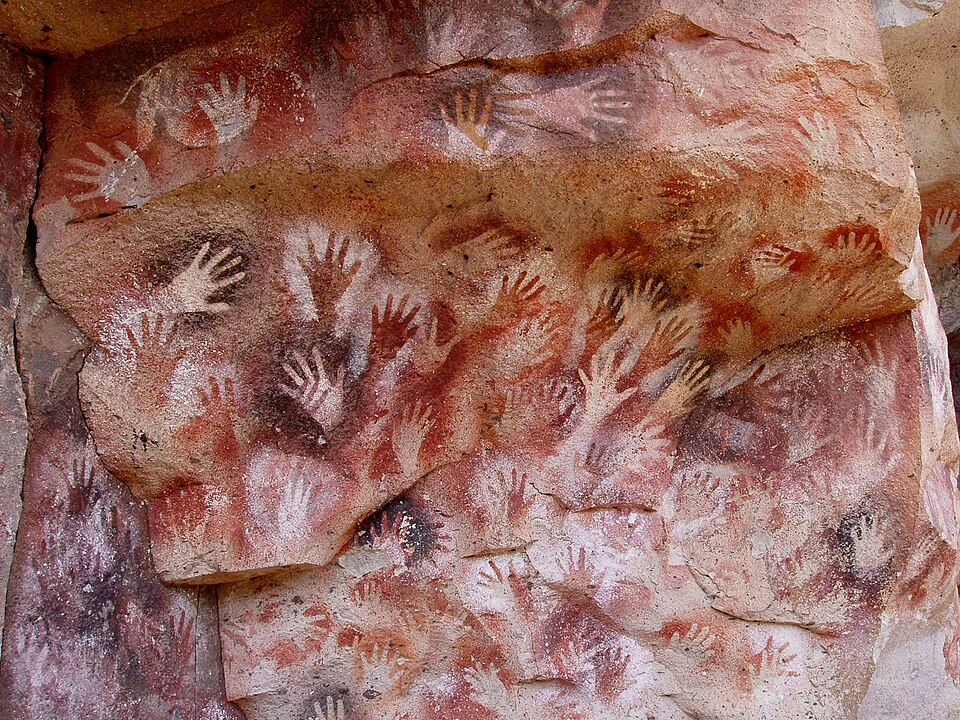
In South America, the Cueva de las Manos (Cave of Hands) in the canyon of the Río Pinturas in Patagonia, Argentina, contains an extraordinary assemblage of hand stencils and hunting scenes. The art is dated to between approximately 13,000 and 9,300 years ago, with most hand stencils falling in the range of 9,300 to 7,300 years ago.19 The stencils were created by the same technique used in European and Indonesian caves—blowing pigment through a tube around a hand placed against the rock—and the site contains more than 2,000 individual hand images in red, white, yellow, and black pigments.19 The independent development of identical stenciling techniques on multiple continents, by populations with no plausible historical contact, suggests either deep shared ancestry for the practice or convergent invention arising from the simplicity and universality of the technique itself.
Theories of interpretation
The question of why Paleolithic people created cave art has generated a succession of interpretive frameworks, none of which has achieved lasting consensus. The earliest systematic theory, developed by the Abbé Henri Breuil in the early twentieth century and elaborated in his 1952 synthesis Four Hundred Centuries of Cave Art, proposed that cave paintings served as sympathetic hunting magic: by depicting an animal on a cave wall, the artist believed he could magically influence the success of the hunt. Breuil pointed to images of animals pierced by lines interpreted as spears or arrows as evidence for this interpretation.16 The hunting magic hypothesis fell out of favour when analyses of faunal remains from cave sites demonstrated that the animals most commonly painted were not the animals most commonly eaten, undermining the direct connection between art and subsistence.16
In the 1960s and 1970s, the French prehistorian André Leroi-Gourhan proposed a structuralist interpretation in which the arrangement of animal species within caves followed a systematic spatial grammar reflecting a fundamental binary opposition between male and female principles. In his model, horses and stags represented maleness, while bison, aurochs, and mammoths represented femaleness, and the spatial distribution of these species within the cave—with central panels dominated by the bison-horse pair and peripheral areas by ibex and deer—encoded a coherent cosmological schema.21 Although Leroi-Gourhan’s statistical approach was influential and pioneered the systematic study of cave art composition, subsequent reanalysis showed that his binary scheme could not be consistently applied across all decorated caves, and the theory is now regarded as an important but ultimately overgeneralized framework.21
The shamanic or neuropsychological hypothesis, developed by David Lewis-Williams and Jean Clottes in the 1990s and 2000s, proposed that cave art was produced by individuals in altered states of consciousness—induced by sensory deprivation in deep cave environments, prolonged rhythmic activity, fasting, or the ingestion of psychoactive substances. Lewis-Williams argued that the three stages of trance hallucination documented in neuropsychological research—geometric entoptic phenomena, meaningful iconic imagery, and full hallucinatory scenes—correspond to the three categories of image found in cave art: geometric signs, animal figures, and therianthropic composites.10, 11 The model draws on ethnographic parallels with San (Bushmen) rock art in southern Africa, which is known from historical and anthropological sources to have been produced in the context of trance rituals. Critics have noted that the shamanic hypothesis is difficult to falsify, that the ethnographic analogy between San and Paleolithic societies may be inappropriate, and that the neuropsychological universals invoked by Lewis-Williams are too general to explain the specific iconographic choices of individual caves.10
More recently, approaches emphasising social function and information exchange have gained ground. Conkey proposed in 1980 that decorated caves may have served as aggregation sites where dispersed bands of hunter-gatherers periodically assembled for social, economic, and ritual purposes, and that the art functioned as a medium for communicating group identity, territorial claims, and shared mythological narratives.15 This perspective shifts attention from the psychology of the individual artist to the social context in which art was produced and consumed, and it aligns with the observation that many decorated caves are located at ecologically strategic points in the landscape—river junctions, seasonal migration routes, or boundaries between ecological zones.15 Current scholarship increasingly recognises that no single theory is likely to explain the full diversity of cave art across its vast temporal and geographic range, and that different sites may have served different functions for different communities at different times.
Cave art and Upper Paleolithic cognition
The creation of cave art requires a suite of cognitive capacities that, taken together, indicate minds operating at a level of complexity indistinguishable from those of modern humans. Figurative representation—the ability to translate a three-dimensional animal seen in the landscape into a two-dimensional image on a rock surface—requires mental rotation, visual abstraction, and the coordination of fine motor skills. Therianthropic imagery, such as the composite human-animal figures at Leang Bulu’ Sipong 4 and Hohlenstein-Stadel, implies the capacity for counterfactual thought: the ability to combine conceptual categories (human and animal) that do not exist as a natural unity, an ability closely linked to the cognitive underpinnings of language, analogy, and religious belief.4, 10
The planning and execution of cave art also demonstrate advanced forms of what cognitive scientists call prospective cognition—the ability to plan multi-step sequences of future action. Producing a polychrome painting in a deep cave required the advance preparation of pigments, the manufacture or procurement of lighting equipment, the transport of materials into the cave, and the coordination of execution in a dark, confined space. The consistency of geometric sign types across thousands of years and thousands of kilometres, as documented by von Petzinger and Nowell, implies not only individual cognitive sophistication but also robust mechanisms for cultural transmission—the social learning processes by which techniques, motifs, and their associated meanings were passed from one generation to the next.14
The deep African roots of symbolic behavior, documented through ochre processing at Blombos Cave by at least 100,000 years ago and shell bead manufacture by at least 82,000 years ago, suggest that the cognitive prerequisites for cave art were in place long before the oldest known painted caves.22, 23 The question of why figurative cave art appears in the archaeological record tens of thousands of years after the earliest evidence of symbolic capacity may reflect not a sudden cognitive leap but rather the intersection of cognitive potential with favourable demographic, ecological, and social conditions—larger populations, greater network connectivity, and the encounter with suitable cave environments during the dispersal of Homo sapiens through island Southeast Asia and into Europe.23 Cave art, in this view, is not the origin of the symbolic mind but one of its most spectacular and enduring expressions.
References
A high-precision chronological model for the decorated Upper Paleolithic cave of Chauvet-Pont d’Arc, Ardèche, France
Radiocarbon dating of the Chauvet Cave: further results and implications for the origins of art in Europe
Making the abstract concrete: the place of geometric signs in French Upper Paleolithic parietal art
The identification of prehistoric hunter-gatherer aggregation sites: the case of Altamira
Reevaluating hand stencil phenomena in cave art: a step forward towards the characterization of symbolic patterns during the Upper Palaeolithic
Rethinking the structural analysis of Palaeolithic art: new perspectives on Leroi-Gourhan’s structuralism
Human age demographics and subjective hand stencil identification: a new approach to determining the age of prehistoric hand stencil artists
A’naturalistic’ kangaroo dated to 17,300 years ago from the Kimberley region, Western Australia