Overview
- The Bantu expansion was a multi-millennial demographic and linguistic spread in which Bantu-speaking agricultural peoples migrated from a homeland in the Nigeria-Cameroon borderland across sub-Saharan Africa beginning approximately 5,000 years ago, ultimately establishing Bantu languages as the dominant language family across most of central, eastern, and southern Africa — a geographic range spanning some 9 million square kilometers.
- The expansion was enabled by a combination of agricultural innovation (initially yam and oil palm cultivation, later supplemented by iron-working technology and Asiatic cereal crops including bananas and Asian rice) that gave Bantu-speaking farmers a demographic advantage over indigenous hunter-gatherer and pastoralist populations, though the process involved not only displacement but extensive interaction, intermarriage, and cultural exchange.
- Linguistic phylogenetic reconstruction and ancient DNA evidence have revealed that the expansion proceeded through at least two major routes — a western path through the equatorial rainforest and an eastern path through the Great Lakes region into East and southern Africa — with multiple waves of movement, back-migration, and local admixture producing the complex mosaic of genetic and linguistic diversity observable across Bantu-speaking populations today.
The Bantu expansion is among the most consequential demographic events in the history of the African continent and one of the most extensively studied episodes of human migration and cultural diffusion in world prehistory. Over a period of roughly three thousand years, beginning approximately 3000 BCE, populations speaking Bantu languages spread from a homeland in the grassland-forest margins of what is now southeastern Nigeria and western Cameroon across virtually all of sub-Saharan Africa south of a line running from the Bight of Biafra to the coast of Kenya, establishing Bantu languages across an area of approximately 9 million square kilometers and profoundly reshaping the genetic, linguistic, and cultural landscape of the continent.1, 2 Today, Bantu languages constitute by far the largest branch of the Niger-Congo language family, comprising more than 500 distinct languages spoken by an estimated 350 million people — roughly a third of Africa’s population — from Cameroon to South Africa and from the Atlantic coast to the Indian Ocean.14, 1
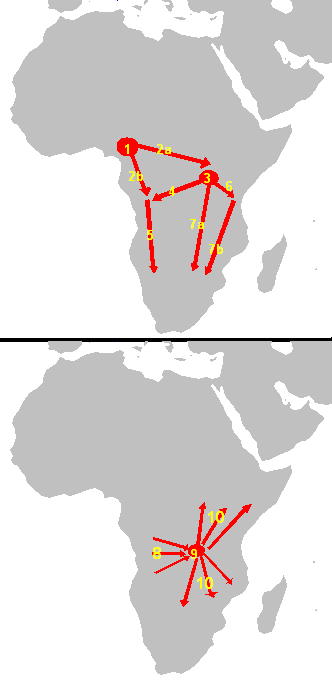

Linguistic evidence and the Bantu homeland
The concept of a Bantu expansion originated with comparative linguistics. In the mid-19th century, scholars recognized that hundreds of languages spoken across central, eastern, and southern Africa shared fundamental similarities in vocabulary, grammar, and phonological structure — similarities too systematic to be explained by chance or borrowing. The term “Bantu” itself (from a widespread root meaning “people”) was coined by Wilhelm Bleek in the 1860s to describe this language family, and subsequent generations of linguists refined the classification and reconstructed Proto-Bantu, the hypothetical ancestor language from which all modern Bantu languages descended.14, 1
Vansina’s landmark 1995 reassessment of the linguistic evidence established that the Proto-Bantu homeland lay in the savanna-forest ecotone of the Nigeria-Cameroon borderland, in the region of the Grassfields of western Cameroon and adjacent areas of southeastern Nigeria. The reconstructed vocabulary of Proto-Bantu includes terms for yam cultivation, oil palm exploitation, and pottery making but lacks terms for cereal agriculture or iron-working, suggesting that the earliest Bantu-speaking communities were forest-margin cultivators who relied on vegetative crops and foraging before acquiring metallurgical knowledge.1 Grollemund and colleagues applied Bayesian phylogenetic methods to a dataset of 409 Bantu languages, producing a language family tree whose root was firmly placed in the Grassfields region of Cameroon, with an estimated divergence date of approximately 4,000 to 5,000 years before present.4
Routes and chronology of expansion
The geographic routes and temporal sequence of the Bantu expansion have been debated since the mid-20th century, with scholars proposing various combinations of western, eastern, and southern pathways. Phillipson’s early synthesis proposed a two-route model: an initial western expansion through the equatorial rainforest of the Congo Basin, followed by a later eastern movement through the Great Lakes region of East Africa, with both streams subsequently converging and spreading southward.7 This basic framework has been substantially refined but not fundamentally overturned by subsequent linguistic, archaeological, and genetic research.
Grollemund and colleagues demonstrated that habitat type significantly influenced both the route and pace of Bantu dispersals. The expansion through the equatorial rainforest was slow and channeled along river corridors, reflecting the difficulty of adapting savanna-adapted agricultural systems to the dense forest environment. In contrast, expansion across the open savannas of eastern and southern Africa was comparatively rapid, consistent with the greater ease of establishing familiar farming practices in grassland and woodland habitats.4 Bostoen and colleagues provided paleoclimatic context, showing that periods of forest contraction during Middle to Late Holocene dry phases opened savanna corridors through the equatorial forest, facilitating southward movement by farming populations that would otherwise have been impeded by dense canopy environments unsuitable for their agricultural practices.6
The archaeological record broadly corroborates the linguistic chronology. The earliest archaeological sites associated with Bantu-speaking populations in central Africa date to approximately 3000-2500 BCE and are characterized by distinctive pottery traditions, polished stone tools, and evidence of forest clearing for cultivation.13 De Maret documented a progression of related ceramic traditions spreading southward through the Congo Basin and eastward into the Great Lakes region between approximately 1000 BCE and 500 CE, providing material evidence for the demographic expansion reconstructed from linguistic data.13 Iron-working technology, which appears in the archaeological record of sub-equatorial Africa from approximately the 1st millennium BCE, was clearly adopted by Bantu-speaking populations during or shortly after their initial expansion, though whether iron technology was an independent African innovation or was acquired through contact with other metalworking traditions remains debated.11
Agriculture, iron, and demographic advantage
The demographic success of Bantu-speaking populations is generally attributed to their possession of food-producing technologies — agriculture and, later, iron-working — that gave them significant population-density advantages over the hunter-gatherer and pastoralist populations they encountered. Early Bantu farmers cultivated yams, oil palm, and other forest-margin crops, and as they expanded into new environments they adopted additional cultigens including pearl millet, sorghum, and finger millet from East African agropastoralist populations, as well as Asiatic crops — most notably the banana and Asian rice — that arrived on the East African coast through Indian Ocean trade networks beginning in the 1st millennium CE.2, 1
The acquisition of iron-working technology, achieved by many Bantu-speaking groups during the 1st millennium BCE, provided further advantages. Iron tools improved agricultural efficiency by enabling more effective forest clearance and soil cultivation, while iron weapons offered military advantages in conflicts over territory and resources.11 Schmidt documented that early iron-smelting traditions in the Great Lakes region of East Africa achieved remarkably sophisticated technological levels, with furnaces capable of producing carbon steel through preheating techniques that were not paralleled in European metallurgy until the modern era.11 Ehret argued that the combination of agricultural productivity and metallurgical capability allowed Bantu-speaking communities to sustain population densities far exceeding those of the foraging and herding peoples they encountered, creating a demographic engine that drove the expansion across the continent over millennia.2
Genetic evidence and population interactions
Genetic studies have provided increasingly detailed reconstructions of the demographic processes underlying the Bantu expansion, revealing a complex picture of migration, admixture, and interaction that challenges any simple model of population replacement. Patin and colleagues analyzed genome-wide data from populations across central Africa and demonstrated that present-day Bantu-speaking populations carry genetic signatures of admixture with the indigenous hunter-gatherer populations they encountered, with the proportion of hunter-gatherer ancestry varying geographically — higher in regions where Bantu farmers settled among existing populations and lower in regions where expansion was rapid and unimpeded.5
The impact of the Bantu expansion on pre-existing populations was highly variable. In the equatorial forests of central Africa, Bantu-speaking farmers interacted extensively with Pygmy hunter-gatherer populations. Verdu and colleagues demonstrated through genetic analysis that these interactions involved sustained gene flow in both directions, with Pygmy populations adopting Bantu languages while contributing substantial genetic ancestry to their Bantu-speaking neighbors — a pattern of linguistic replacement without full genetic replacement that illustrates the complex interplay between cultural and demographic processes.15 In East Africa, Bantu-speaking populations encountered and interacted with Nilotic pastoralists and Cushitic-speaking agropastoralists, producing genetically and culturally mixed communities visible in the archaeological and genetic records.12, 8
Skoglund and colleagues’ analysis of ancient DNA from eastern and southern African archaeological sites spanning the past 8,000 years confirmed that the genetic ancestry now predominant across Bantu-speaking populations was largely absent from eastern and southern Africa before approximately 2,000 years ago, appearing rapidly in the archaeological record in a pattern consistent with substantial population movement rather than purely cultural diffusion.9 However, the same ancient DNA data revealed that indigenous foraging populations persisted alongside and admixed with incoming farmers for centuries or millennia, indicating that the expansion was not a single wave of population replacement but a protracted process of demographic interaction, intermarriage, and gradual cultural and genetic assimilation.9
Impact on indigenous populations
The arrival of Bantu-speaking farming communities transformed the demographic and cultural landscape of sub-Saharan Africa in ways that are still visible in the distribution of modern populations. Hunter-gatherer populations that had occupied eastern and southern Africa for tens of thousands of years were progressively marginalized, absorbed, or displaced by the expanding farming frontier. The Khoisan-speaking peoples of southern Africa, the Hadza and Sandawe of Tanzania, and the various Pygmy populations of the central African rainforest represent the surviving remnants of a formerly continent-wide mosaic of hunter-gatherer diversity that was profoundly reduced by the Bantu expansion.5, 9
The process was neither uniform nor uniformly violent. In some regions, hunter-gatherer populations appear to have been rapidly displaced or absorbed, while in others they coexisted with farming communities for extended periods, adopting elements of agricultural subsistence while maintaining distinct cultural identities and contributing genetic ancestry to the expanding Bantu-speaking populations.15, 5 The click consonants found in several southeastern Bantu languages — a phonological feature borrowed from Khoisan languages — provide linguistic evidence for sustained contact and bilingualism between Bantu-speaking farmers and Khoisan-speaking foragers in southern Africa.14, 10
Legacy and significance
The Bantu expansion fundamentally shaped the linguistic, genetic, and cultural geography of sub-Saharan Africa. The sheer scale of the process — spanning three millennia, covering 9 million square kilometers, and establishing a language family now spoken by a third of Africa’s population — makes it one of the most significant episodes of human migration in world history, comparable in scope to the Indo-European expansion across Eurasia or the Austronesian expansion across the Pacific and Indian Oceans.1, 2
The expansion also demonstrates the power of agricultural innovation as a driver of demographic change. The Bantu-speaking farmers who spread across Africa were not conquerors in any military sense but rather participants in a slow demographic process driven by differential population growth: communities with food-producing economies could sustain higher population densities than foraging communities in the same environments, and over centuries and millennia this demographic advantage translated into the gradual expansion of farming populations and farming languages across the continent.2, 6 Understanding the Bantu expansion is therefore essential not only for African history but for the broader study of how agricultural technologies, demographic pressures, and linguistic identity interact to reshape human populations at continental scales.1, 4
References
An African Classical Age: Eastern and Southern Africa in World History, 1000 B.C. to A.D. 400
Y-chromosome variation among Sudanese: restricted gene flow, concordance with language, geography, and history
Middle to Late Holocene paleoclimatic change and the early Bantu expansion in the rain forests of western Central Africa