Overview
- The Kuiper belt is a circumstellar disc of icy planetesimals extending from Neptune's orbit at 30 AU to roughly 50 AU, containing the dwarf planets Pluto, Eris, Haumea, Makemake, Quaoar, and Gonggong along with at least hundreds of thousands of smaller bodies.
- Predicted by Kenneth Edgeworth in 1943 and 1949 and by Gerard Kuiper in 1951, the belt remained hypothetical until David Jewitt and Jane Luu discovered the first member, 1992 QB₁ (now 15760 Albion), in August 1992 after a five-year survey.
- The belt is structured into a dynamically cold classical population, a dynamically hot population, mean-motion resonant groups including the Plutinos in 3:2 resonance with Neptune, and an extended scattered disc; this architecture is best explained by the outward migration of the giant planets in the Nice model.
The Kuiper belt is a vast disc-shaped reservoir of icy planetesimals that orbits the Sun beyond the planet Neptune, extending from approximately 30 astronomical units (AU) to about 50 AU. It is the largest discrete population of small bodies in the solar system and the source region of the short-period comets that periodically enter the inner planetary region. The belt contains the dwarf planet Pluto, the dwarf planets Haumea, Makemake, and Quaoar, and the related body Eris in the more distant scattered disc, together with hundreds of thousands of smaller objects ranging from a few hundred kilometres in diameter down to the limit of telescopic detection.4, 16 Predicted theoretically in the 1940s and 1950s but not observed until 1992, the belt has since become one of the most active areas of solar system research, providing a dynamical fossil record of the early migration of the giant planets and a window onto the primordial conditions of planetesimal accretion in the outer solar nebula.6, 13
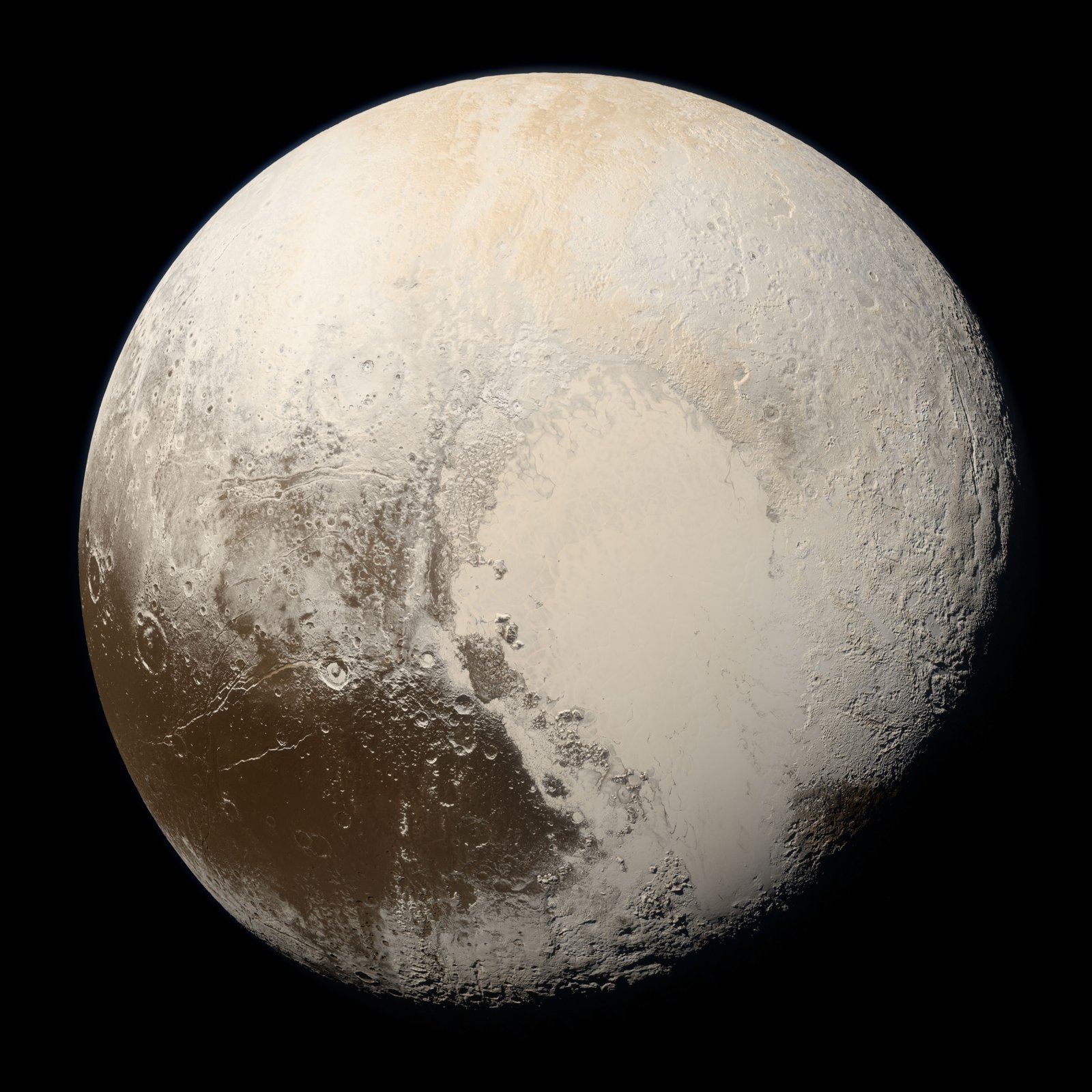

The Kuiper belt is structurally and dynamically distinct from the more familiar main asteroid belt between Mars and Jupiter. It is roughly twenty times as wide and between twenty and two hundred times as massive, although the present-day belt is itself a remnant: dynamical models indicate that the original mass of the trans-Neptunian disc was several Earth masses and that more than 99 percent of that material was ejected during the migration of Uranus and Neptune in the first hundreds of millions of years of solar system history.6, 8, 25 The objects that remain are arranged in characteristic dynamical sub-populations whose orbits encode the migration history of the outer planets and whose surfaces, sampled in detail for the first time by NASA's New Horizons spacecraft in 2015 and 2019, preserve some of the most pristine icy material in the solar system.11, 12
Prediction and discovery
The existence of a population of small bodies beyond the orbit of Neptune was first proposed by the Irish astronomer Kenneth Essex Edgeworth. In a 1943 note in the Journal of the British Astronomical Association, Edgeworth argued that the solar nebula in the region beyond Neptune would have been too thinly distributed to assemble a major planet but should instead have given rise to a great many smaller condensations, some of which could become comets when perturbed onto orbits crossing the inner solar system.1 He developed the idea more fully in a 1949 paper in the Monthly Notices of the Royal Astronomical Society, writing that it was "not unreasonable to suppose" that the outer region of the solar system was occupied by a "large number of comparatively small clusters" forming a "vast reservoir of potential comets."2
The Dutch-American astronomer Gerard Kuiper revisited a related idea in 1951 in a chapter on the origin of the solar system. Kuiper proposed that a disc of small icy bodies once existed between roughly 38 and 50 AU but argued that gravitational perturbations from Pluto, which at the time was thought to be Earth-sized, would have long since cleared this region of any surviving population.3 The historical irony is that the structure now known as the Kuiper belt does exist much as Edgeworth had imagined, while Kuiper himself had explicitly argued that no such belt should remain at the present epoch. Some researchers and historians prefer the compound name Edgeworth-Kuiper belt to acknowledge this dual prediction, but the shorter name has become standard usage in the literature.25
A more quantitative case for a present-day belt was made by the Uruguayan astronomer Julio Fernández in 1980. Fernández analysed the dynamics of the short-period comets, whose orbits lie close to the ecliptic plane and which therefore could not plausibly originate in the spherical Oort cloud, and concluded that the source region must be a flattened disc of icy bodies between roughly 35 and 50 AU.5 This argument provided the dynamical motivation for systematic telescopic searches that began in the late 1980s. After more than five years of patient observation with the University of Hawaii 2.2-metre telescope on Mauna Kea, David Jewitt and Jane Luu detected a faint object moving slowly against the background stars on the night of 30 August 1992. Designated 1992 QB₁ and later named 15760 Albion, the object orbits the Sun at a mean distance of approximately 44 AU and provided the first direct confirmation that the Kuiper belt exists.4 Jewitt and Luu reported the discovery in Nature in 1993 under the title "Discovery of the candidate Kuiper belt object 1992 QB₁," and within a few years dozens of additional members had been identified by other observers.4, 9
Extent, total mass, and population
The Kuiper belt's inner edge lies at approximately 30 AU, the semi-major axis of Neptune, and its dense main region extends to roughly 50 AU. Beyond about 50 AU the surface density of objects falls abruptly in a feature known as the Kuiper cliff; surveys by Trujillo and colleagues and by Bernstein and collaborators have established that this drop is real rather than an observational artefact, although its physical cause remains a matter of debate.9, 10 The belt is not perfectly thin: typical inclinations of the dynamically excited population reach 20 to 30 degrees relative to the ecliptic, so that the belt has a vertical thickness of several AU at its outer edge.23
By the early 2020s, more than four thousand individual trans-Neptunian objects had been catalogued, although this number represents a small fraction of the underlying population. Extrapolations from deep imaging surveys indicate that the belt contains roughly one hundred thousand objects larger than 100 km in diameter and an estimated several hundred million objects larger than 10 km.9, 10, 18 Despite the enormous number of bodies, the total mass of the present-day belt is small. The most recent estimates place the total mass between roughly one and three percent of the mass of the Earth, a value that has been independently constrained by the absence of detectable gravitational perturbations on the orbits of the outer planets, on the spacecraft trajectories of the Pioneer and Voyager missions, and on the orbits of the largest known belt members themselves.10, 25
This present-day mass is at least two orders of magnitude smaller than the mass required by collisional and accretional models for the bodies that the belt contains. The largest objects in the belt cannot have formed from the present low-density disc on any reasonable timescale, because their growth times would exceed the age of the solar system. The implication is that the belt was once much more massive and that the great majority of its original mass was removed early in solar system history. The mechanism most consistent with the dynamical structure of the surviving population is the outward migration of Neptune through a primordial planetesimal disc, the central element of the Nice model.6, 8
Dynamical classes
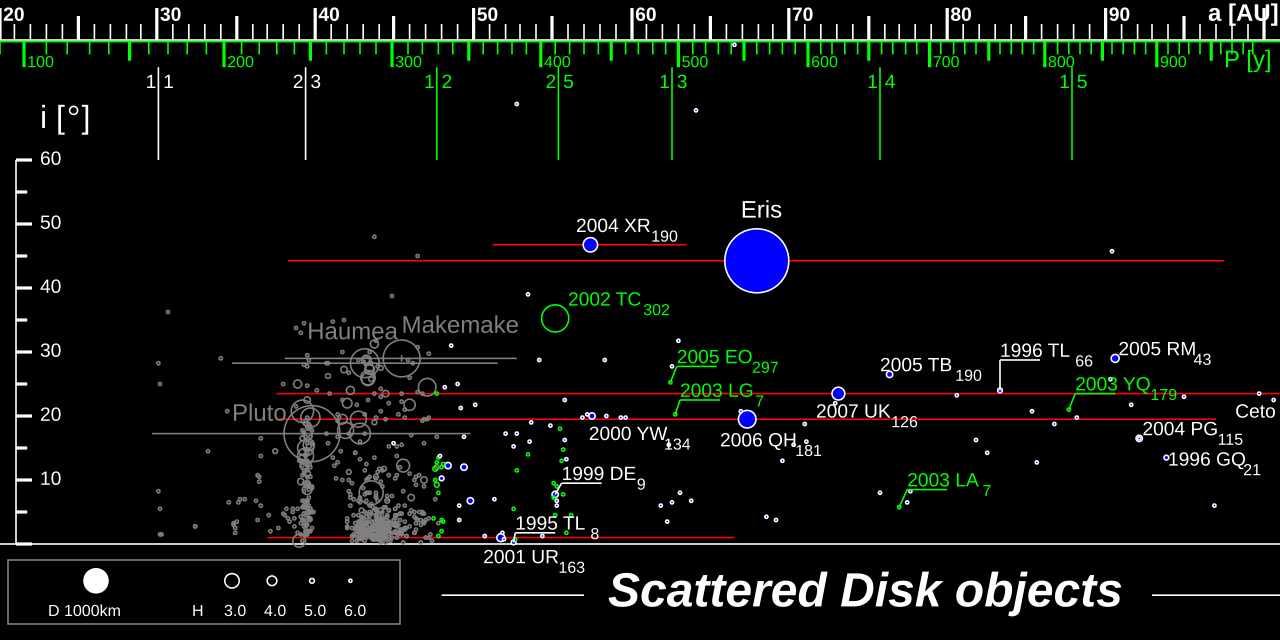

The Kuiper belt is not a homogeneous disc. Its members are grouped into several distinct dynamical classes defined by their orbital semi-major axes, eccentricities, inclinations, and resonant relationships with Neptune. The standard classification scheme, developed by Brett Gladman, Brian Marsden, and Christa VanLaerhoven and adopted in the IAU's 2008 monograph The Solar System Beyond Neptune, divides the trans-Neptunian region into resonant objects, the classical belt, the scattered disc, and a population of detached objects with very high perihelia.23
The classical Kuiper belt contains the majority of catalogued objects. Its members have semi-major axes between approximately 39.5 and 47.7 AU, lie outside any of the major mean-motion resonances with Neptune, and have eccentricities low enough that they never approach Neptune closely. Within the classical belt there is a striking dynamical bimodality. The dynamically cold classical population has orbital inclinations smaller than about 5 degrees and near-circular orbits, while the dynamically hot classical population has inclinations extending up to roughly 30 degrees and somewhat larger eccentricities.23, 16 The terms hot and cold refer to the kinetic excitation of the orbits, not to physical temperature: a dynamically hot orbit is one in which the body's velocity relative to a perfectly circular reference orbit is large.
The two classical sub-populations differ not only dynamically but physically. Cold classical objects are statistically redder in colour, are more frequently found in nearly equal-mass binary pairs, and have a steeper size distribution dominated by smaller bodies. Hot classical objects span a broader range of colours, contain a much smaller fraction of binaries, and host the largest classical members, including Quaoar and Makemake.16, 18 These differences point to distinct origins: the cold population is widely interpreted as having formed near its present location and survived in place, while the hot population is thought to have formed in the inner region of the primordial planetesimal disc, between roughly 15 and 30 AU, and to have been transported outward and excited by the migration of Neptune.6, 16
The resonant Kuiper belt objects occupy mean-motion resonances with Neptune, regions of orbital phase space in which the ratio of the object's orbital period to Neptune's is a simple fraction. The most populous resonance is the 3:2, in which the object completes two orbits for every three orbits of Neptune; members of this resonance are called Plutinos after their archetype, Pluto. The second most populous is the 2:1 resonance at approximately 47.8 AU, whose members are sometimes called Twotinos. Less populous resonances include the 4:3, 5:3, 5:4, 7:4, and 5:2.23 Resonant capture protects an object's orbit from close encounters with Neptune even when its eccentricity is large enough that the orbit nominally crosses Neptune's, because the resonant geometry ensures that the object is always far from Neptune at its closest approach to the Sun. Pluto is the most famous example of this protective mechanism: its perihelion at 29.7 AU lies inside Neptune's orbit, but the 3:2 resonance prevents the two bodies from ever coming closer to one another than about 17 AU.23, 24
The scattered disc consists of objects on highly eccentric and often highly inclined orbits with perihelia in the range of about 30 to 40 AU and aphelia extending from a few tens to many hundreds of AU. Scattered disc members interact gravitationally with Neptune at perihelion and have orbits that evolve chaotically over long timescales; they are the principal source of the Centaurs and the short-period (Jupiter-family) comets.23, 25 Eris, the most massive known dwarf planet beyond Neptune, is a scattered disc object, as are the dwarf planets Gonggong, Sedna, and 2012 VP₁₁₃. Beyond the scattered disc, a further population of detached objects with perihelia greater than about 40 AU is dynamically decoupled from Neptune. The most distant known members of this population, Sedna and 2012 VP₁₁₃, have perihelia near 76 and 80 AU respectively and are thought to belong to the inner Oort cloud rather than to the Kuiper belt proper.17
Orbital architecture and the Nice model
The dynamical structure of the Kuiper belt records the early evolution of the giant planet system. In a series of three companion papers published in Nature in 2005, Kleomenis Tsiganis, Alessandro Morbidelli, Rodney Gomes, and Harold Levison proposed what is now called the Nice model, after the French city where much of the work was conducted. The model holds that Jupiter, Saturn, Uranus, and Neptune originally formed in a much more compact configuration, with semi-major axes ranging from approximately 5.5 to 17 AU, surrounded by a massive disc of icy planetesimals that extended from beyond the outermost planet to about 35 AU.6, 7, 8
Gravitational interactions between the planets and the planetesimal disc caused the planets' orbits to migrate slowly. After several hundred million years, Jupiter and Saturn crossed their mutual 2:1 mean-motion resonance, triggering an abrupt instability that sent Uranus and Neptune into eccentric orbits and scattered the planetesimal disc throughout the solar system. Most of the disc material was either accreted by the giant planets, ejected into interstellar space, or sent inward to bombard the terrestrial planets. A small fraction was emplaced in the regions corresponding to today's Kuiper belt, scattered disc, and outer asteroid belt.6, 7
The Nice model accounts for several otherwise puzzling features of the outer solar system: the eccentricities and inclinations of the giant planets, the capture of Jupiter's and Neptune's Trojan populations, the existence and population of the irregular satellites of the giant planets, and the dynamical structure of the Kuiper belt itself.6, 7 A companion paper by Gomes and colleagues argued that the giant-planet instability could also explain the apparent spike in lunar impact ages around 3.9 billion years ago known as the Late Heavy Bombardment, although the reality and timing of that event have been called into question by more recent work on the lunar crater chronology.8 The model has been refined in subsequent years to incorporate a possible fifth giant planet that was ejected during the instability and to better match the precise distribution of orbital inclinations in the cold and hot classical populations, but its central insight, that the present-day Kuiper belt is a sculpted remnant of a once much more massive disc, has become the standard framework for outer solar system formation.6, 8, 25
Dwarf planets and the largest members
The Kuiper belt and the adjacent scattered disc contain all of the recognised dwarf planets of the outer solar system. The 2006 IAU resolution that defined the dwarf planet category recognised Pluto, Eris, Haumea, and Makemake as dwarf planets; several other large bodies, including Quaoar, Gonggong, Sedna, and Orcus, are widely accepted as dwarf planets on physical grounds even though they have not been formally added to the IAU list.14, 15
Pluto is the archetype of the population. It orbits the Sun at a mean distance of 39.5 AU on an inclined and eccentric path, with an orbital period of 248 years, and has an equatorial diameter of 2,377 km as measured directly by New Horizons.11 It is locked in the 3:2 mean-motion resonance with Neptune and is the largest member of the Plutino class. Eris, discovered in 2005 by Mike Brown, Chad Trujillo, and David Rabinowitz, has nearly the same diameter as Pluto (2,326 km) but is roughly 27 percent more massive, owing to a substantially higher density of about 2.4 g cm-3; its orbit is much more eccentric, ranging from 38.1 to 97.5 AU with a period of 561 years, placing it firmly in the scattered disc.14
Haumea and Makemake were both discovered in 2005. Haumea is a remarkable object: it is one of the fastest-rotating known equilibrium bodies, completing one rotation in just 3.92 hours, and the centripetal force from this rapid rotation has stretched it into a triaxial ellipsoid roughly 2,100 by 1,680 by 1,074 km in size. It has two known moons (Hi'iaka and Namaka), a family of smaller collisional fragments that share its orbit and surface composition, and a thin ring discovered through stellar occultation observations in 2017.21 Makemake is a slightly smaller classical Kuiper belt object with a diameter of about 1,430 km and a methane-rich surface that resembles Pluto's. Quaoar, discovered in 2002 by Brown and Trujillo, is a roughly 1,100-km classical KBO whose ring system, announced in 2023 by Pereira and colleagues from a series of stellar occultation campaigns, is unusual in that it lies far outside the body's classical Roche limit.20 Gonggong, discovered in 2007 and now recognised as a scattered disc dwarf planet of about 1,230 km diameter, is in the 3:10 mean-motion resonance with Neptune.15, 16
Largest known Kuiper belt and scattered disc dwarf planets11, 14, 15, 16, 20, 21
| Object | Diameter (km) | Semi-major axis (AU) | Orbital period (yr) | Dynamical class | Discovery |
|---|---|---|---|---|---|
| Pluto | 2,377 | 39.5 | 248 | Plutino (3:2) | 1930 |
| Eris | 2,326 | 67.7 | 561 | Scattered disc | 2005 |
| Haumea | ~1,560 (mean) | 43.1 | 284 | Classical (hot) | 2004–2005 |
| Makemake | ~1,430 | 45.4 | 306 | Classical (hot) | 2005 |
| Gonggong | ~1,230 | 67.5 | 554 | Scattered (3:10) | 2007 |
| Quaoar | ~1,110 | 43.7 | 289 | Classical (hot) | 2002 |
| Sedna | ~1,000 | 506 | ~11,400 | Detached / inner Oort | 2003 |
| Orcus | ~910 | 39.4 | 247 | Plutino (3:2) | 2004 |
The diversity of physical properties across this small sample is striking. Densities range from below 1 g cm-3 for some smaller bodies to nearly 2.5 g cm-3 for Eris, indicating substantial variation in the rock-to-ice ratio of the original planetesimal population. Surface compositions span pure water ice (Haumea), methane and nitrogen ice (Pluto, Eris, Makemake), and complex organic tholins responsible for the strong red colours of many smaller members.16, 24
Size distribution and the small-body population
The size distribution of Kuiper belt objects is one of the principal observational constraints on theories of planetesimal formation and collisional evolution. For bodies larger than approximately 100 km in diameter, surveys including the work of Trujillo and colleagues, Bernstein and colleagues, and the Outer Solar System Origins Survey have measured a steep cumulative distribution that follows a power law of the form N(>D) ∝ D-q with an exponent q close to 4.9, 10, 18 Below a transition size somewhere between 30 and 100 km in diameter, the distribution flattens dramatically to an exponent of roughly 2 to 3. This break, identified by Bernstein and colleagues in 2004 from deep Hubble Space Telescope imaging, is interpreted as the boundary between two regimes: above the break, the distribution preserves a primordial signature of how planetesimals originally accreted, while below the break, the distribution has been reshaped by mutual collisions over the age of the solar system.10, 18
The location of the break is significant for theories of planetesimal formation. If planetesimals formed gradually by the accretion of much smaller particles, the size distribution should be smooth with no preferred scale; the existence of a break at tens of kilometres has been taken as evidence that planetesimals instead formed quickly through a gravitational collapse mechanism, such as the streaming instability, in which dense clumps of pebbles in a turbulent gas disc undergo runaway collapse to produce bodies in the 10 to 100 km size range directly.13, 18 The discovery by New Horizons that Arrokoth is itself a contact binary of two roughly equal lobes that merged at a relative velocity of only a few metres per second provides direct in situ support for this scenario, because the gentle merger geometry implies that the two lobes formed close together within a single collapsing cloud rather than encountering one another at random from independent orbits.13
Approximate orbital distribution of selected Kuiper belt and scattered disc objects23
The scatter diagram illustrates the principal dynamical groupings of the trans-Neptunian region. The cluster of low-inclination points between 42 and 47 AU corresponds to the cold classical belt; the higher-inclination points scattered through the same semi-major axis range are hot classical objects. The vertical strings of points at 39.5 and 47.8 AU mark the 3:2 (Plutino) and 2:1 (Twotino) resonances. The two extreme high-eccentricity points at 67 AU represent the scattered disc dwarf planets Eris and Gonggong, whose nominal semi-major axes lie far outside the classical belt proper.
In situ exploration: New Horizons
The Kuiper belt was studied exclusively by remote observation until the arrival of NASA's New Horizons spacecraft. Launched on 19 January 2006, New Horizons made its closest approach to Pluto on 14 July 2015, passing 12,472 km above the dwarf planet's surface and returning the first high-resolution images and spectra of any Kuiper belt body.11 The mission revealed a world far more geologically active than its small size and great distance from the Sun had suggested. Pluto's surface is dominated by a 1,000-km-wide nitrogen ice plain informally named Sputnik Planitia, the western lobe of the heart-shaped feature visible in the most familiar approach images. The plain is convecting on a million-year timescale, producing polygonal cells with no impact craters, and its margins are bordered by water-ice mountains 3 to 5 km high. Pluto's atmosphere, composed primarily of molecular nitrogen with traces of methane and carbon monoxide, was found to extend much farther from the planet than expected and to display a complex layered haze structure illuminated against the night sky after closest approach.11, 24
Pluto's largest moon, Charon, was found to be equally diverse: its northern polar region carries a large, dark, reddish deposit informally named Mordor Macula, attributed to the photochemical processing of methane vented from Pluto's atmosphere and condensed onto the cold polar surface, while its mid-latitudes are crossed by a system of tectonic chasms hundreds of kilometres long. The diameter of Pluto was measured directly to be 2,377 ± 4 km, slightly larger than the best ground-based estimates and confirming Pluto as the largest known Kuiper belt object.11, 24
After leaving the Pluto system, New Horizons continued outward for another three and a half years to encounter a small classical Kuiper belt object designated 2014 MU₆₉, discovered using the Hubble Space Telescope by Marc Buie and the New Horizons search team in 2014 specifically to provide the spacecraft with a second target. Closest approach occurred on 1 January 2019 at a distance of just 3,500 km from the surface, when the object was 43.4 AU from the Sun. The encounter set a new record for the most distant flyby of any solar system body. In November 2019 the object was renamed Arrokoth, a Powhatan/Algonquin word for "sky."12, 13
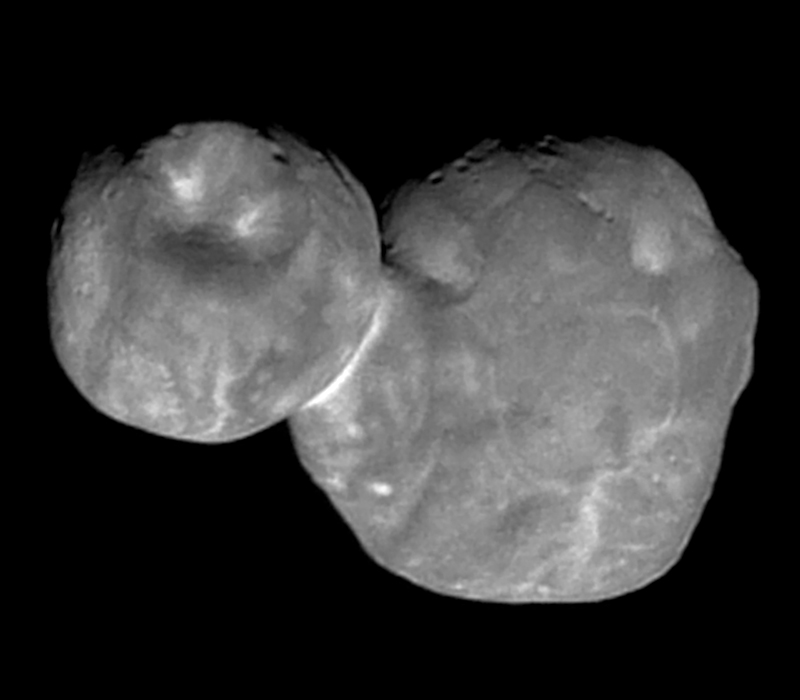

Arrokoth is approximately 36 km long along its longest axis and consists of two distinct lobes joined at a narrow neck. The larger lobe, Wenu, has approximate dimensions of 20.1 by 19.8 by 13.7 km and is noticeably flattened; the smaller lobe, Weeyo, measures roughly 15.0 by 14.4 by 13.6 km. The two lobes have nearly identical colours and spectra, indicating that they formed from the same primordial material, and the geometry of their contact implies a merger velocity of only a few metres per second, comparable to a slow walking pace. Arrokoth has very few craters and no detectable variation in surface colour across its hemisphere, suggesting that its surface has been preserved essentially unaltered since its formation 4.5 billion years ago, making it one of the most pristine objects ever directly imaged in the solar system.12, 13
Composition, surfaces, and rings
Kuiper belt objects are composed of a mixture of rock, water ice, and more volatile ices including methane, nitrogen, carbon monoxide, and ammonia. The surface compositions of individual bodies have been characterised primarily through near-infrared spectroscopy, which is sensitive to the absorption features of these ices, and more recently through the James Webb Space Telescope, whose mid-infrared sensitivity has revealed organic and volatile chemistry that was inaccessible from the ground.16 The surfaces of the larger bodies are dominated by methane (Pluto, Eris, Makemake) or by water ice (Haumea, Quaoar, Orcus), while smaller objects display a wide range of red to neutral colours interpreted as the result of progressive irradiation of organic material by cosmic rays and solar ultraviolet light.16, 24
The internal structures of the largest Kuiper belt bodies are inferred from their bulk densities. Pluto's density of about 1.86 g cm-3 implies an interior of roughly 70 percent rock and 30 percent ice by mass and is consistent with a differentiated body with a rocky core, an icy mantle, and possibly a subsurface liquid water ocean maintained by radiogenic heating. Eris, with a density of about 2.43 g cm-3, must contain an even higher proportion of rock. Several smaller bodies have measured densities below 1 g cm-3, indicating that they are highly porous rubble piles rather than solid objects.15, 24
One of the most surprising recent discoveries about Kuiper belt bodies is the presence of ring systems. The first ring around a small body was found in 2014 around the Centaur (10199) Chariklo, a body that originated in the Kuiper belt and has been scattered onto a Saturn-crossing orbit, by Braga-Ribas and colleagues using a stellar occultation campaign.19 A ring around Haumea was reported by Ortiz and colleagues in 2017, and rings around the dwarf planet Quaoar were reported by Pereira and colleagues in 2023; the Quaoar rings lie far beyond the body's classical Roche limit, the radius within which tidal forces are expected to prevent material from accreting into a moon, and their existence challenges standard theories of ring stability.20, 21 The mechanisms by which small icy bodies in the cold and tenuous outer solar system come to possess ring systems remain an active area of theoretical investigation.
Source of comets and exchange with the inner solar system
The Kuiper belt is the principal source of the short-period comets, those whose orbital periods are less than 200 years and whose orbits lie close to the ecliptic plane. The dynamical pathway leading from the belt to the inner solar system runs through a transitional population called the Centaurs: bodies on unstable orbits with semi-major axes between Jupiter and Neptune that have been scattered out of the Kuiper belt by gravitational interactions with Neptune and that will eventually either be ejected from the solar system, captured into a stable orbit, or scattered inward to become Jupiter-family comets.5, 22, 25 The dynamical lifetimes of Centaurs are typically only a few million years, far shorter than the age of the solar system, which means that the Centaur population must be continuously replenished from a long-lived reservoir; the scattered disc, with its slow but steady leak of objects driven by chaotic interactions with Neptune at perihelion, supplies the required flux.23, 25
The cumulative number of comets that have entered the inner solar system from the Kuiper belt over the age of the solar system is enormous, and the dynamical pathway from the scattered disc through the Centaurs to the Jupiter-family comets has been characterised in detail in the modelling work of Levison and Duncan and others, who showed that small bodies are handed inward from planet to planet through successive close encounters until their orbits cross those of the inner planets.22, 25 The flux of comets supplied by this pathway has been invoked as a contributor of volatiles to the inner planets, although the relative role of cometary versus asteroidal volatile delivery to Earth remains debated and lies beyond the scope of this article.
Scientific significance and current research
The Kuiper belt occupies a unique position in solar system science. As a population of objects too small and too cold to have undergone significant geological evolution, its members preserve a more direct record of the conditions of the early solar nebula than any of the planets. As a dynamical structure shaped by the migration of the giant planets, the belt provides one of the few observational tests of the early dynamical history of the outer solar system. As the source region of the short-period comets, it links the present flux of small bodies into the inner solar system to the primordial population of icy planetesimals.16, 25
Current research in Kuiper belt science is dominated by deep wide-field surveys, in situ measurements from the still-operating New Horizons spacecraft, and high-resolution spectroscopy of the largest bodies with the James Webb Space Telescope. The Outer Solar System Origins Survey (OSSOS), the Dark Energy Survey, and the upcoming Vera C. Rubin Observatory Legacy Survey of Space and Time are expected to multiply the number of catalogued trans-Neptunian objects by an order of magnitude over the next decade and to provide the statistical foundation needed to test refined versions of the Nice model and competing scenarios for the migration of the giant planets.18, 25 Detailed compositional studies of the largest dwarf planets, beginning with the JWST programme that revealed ethane, acetylene, and other light hydrocarbons on the surfaces of Sedna, Gonggong, and Quaoar, are beginning to map the variation of organic chemistry across the outer solar system and to constrain the temperature and composition gradients of the original protoplanetary disc.16, 24
The continuing exploration of the Kuiper belt has thus transformed it from a theoretical curiosity into a central component of solar system science. The objects discovered between 1992 and the present, the spacecraft observations of Pluto and Arrokoth, and the dynamical modelling that ties the belt's structure to the migration history of the giant planets together provide a coherent picture of the outer solar system that was unimaginable when Edgeworth and Kuiper first speculated about the existence of trans-Neptunian icy bodies more than seventy-five years ago.1, 2, 3, 11, 12
References
Initial results from the New Horizons exploration of 2014 MU69, a small Kuiper belt object
The solar nebula origin of (486958) Arrokoth, a primordial contact binary in the Kuiper belt
The size, shape, density and ring of the dwarf planet Haumea from a stellar occultation
From the Kuiper belt to Jupiter-family comets: the spatial distribution of ecliptic comets
Geologically diverse Pluto and Charon: implications for the dwarf planets of the Kuiper belt