Overview
- Stellar nurseries are regions within giant molecular clouds where gravitational collapse overcomes thermal and magnetic pressure, fragmenting cold, dense gas into protostars through a process governed by the Jeans instability criterion, with the resulting stellar masses following a remarkably universal initial mass function.
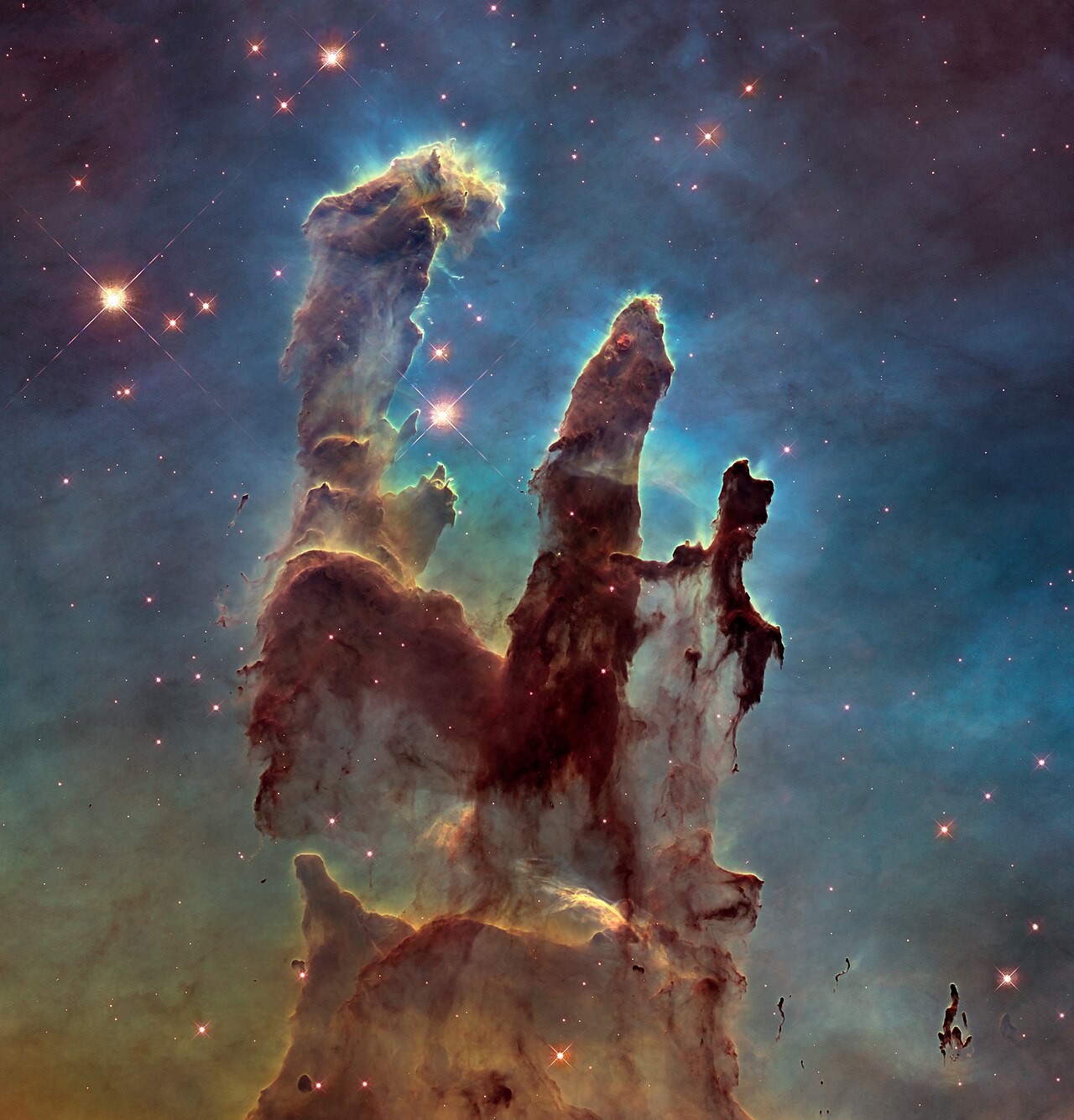
- Iconic nebulae such as the Orion Nebula and the Eagle Nebula's Pillars of Creation represent different stages of this process, from deeply embedded protoclusters visible only at infrared and radio wavelengths to HII regions where massive young stars have begun ionizing and sculpting their natal gas.
- Observations from the James Webb Space Telescope, the Atacama Large Millimeter Array, and other facilities have revealed that star formation is a dynamic interplay of gravity, turbulence, magnetic fields, radiation, and stellar feedback, with triggered star formation in compressed shells and pillar structures contributing to the sequential birth of new stellar generations.
Stellar nurseries are the regions of the interstellar medium where new stars are born. They are found within the cold, dense interiors of giant molecular clouds — vast complexes of molecular hydrogen, dust, and trace molecules that can span tens to hundreds of light-years and contain thousands to millions of solar masses of material.1, 2 The process by which diffuse gas collapses to form luminous, hydrogen-fusing stars is one of the central problems in astrophysics, involving a complex interplay of gravity, thermal pressure, magnetic fields, turbulence, radiation, and chemistry that operates across spatial scales ranging from tens of parsecs (the size of entire cloud complexes) down to a few astronomical units (the scale of protoplanetary disks).

The study of stellar nurseries has been transformed over the past two decades by observatories operating at infrared, submillimetre, and millimetre wavelengths — notably the Spitzer Space Telescope, the Herschel Space Observatory, the Atacama Large Millimeter Array (ALMA), and most recently the James Webb Space Telescope (JWST) — which can penetrate the dense dust that renders these regions opaque at visible wavelengths.14, 16, 17 These observations have revealed a picture of star formation that is simultaneously more orderly and more turbulent than earlier models suggested: orderly in that stars form preferentially within filamentary structures that pervade molecular clouds, and turbulent in that the dynamics of these filaments and the clouds that host them are dominated by supersonic gas motions rather than quasi-static equilibrium.
Giant molecular clouds
Giant molecular clouds (GMCs) are the largest coherent structures in the interstellar medium and the exclusive sites of star formation in the present-day universe. A typical GMC in the Milky Way has a mass of 104 to 106 solar masses, a diameter of 15 to 100 parsecs (approximately 50 to 300 light-years), and a mean density of roughly 100 to 300 hydrogen molecules per cubic centimetre — still an extraordinarily good vacuum by terrestrial standards but roughly a thousand times denser than the diffuse interstellar medium.2 The temperature within GMCs is extremely low, typically 10 to 20 kelvin, maintained by a balance between cosmic ray heating and cooling by molecular line emission, primarily from carbon monoxide (CO).
The Milky Way contains approximately 6,000 GMCs at any given time, with a total molecular gas mass of roughly 1 to 2 billion solar masses concentrated in the spiral arms and the central molecular zone.2 GMCs are not static structures; they are born from the convergence of atomic gas flows in spiral arms or from compressive events such as supernova blast waves, and they are destroyed on timescales of 20 to 30 million years by the feedback from the massive stars that form within them.1, 13
Within GMCs, the gas is highly structured. Observations from the Herschel Space Observatory revealed that molecular clouds are pervaded by networks of elongated structures called filaments, with characteristic widths of approximately 0.1 parsecs (roughly 20,000 astronomical units). Stars form preferentially along the densest filaments, at locations where the filament's linear density exceeds a critical threshold of approximately 16 solar masses per parsec, above which the filament becomes gravitationally unstable and fragments into a chain of dense cores.11, 16
Gravitational collapse and the Jeans instability
The fundamental physical criterion for the onset of gravitational collapse in a gas cloud was formulated by Sir James Jeans in 1902. The Jeans instability arises when the self-gravitational energy of a region of gas exceeds its thermal energy (internal pressure), causing the region to contract rather than remain in equilibrium. For a uniform, isothermal gas of density ρ and temperature T, the critical mass above which collapse occurs — the Jeans mass — is proportional to T3/2 ρ−1/2. At the typical conditions within a molecular cloud core (temperature of 10 K and density of 104 to 105 molecules per cubic centimetre), the Jeans mass is on the order of a few solar masses, broadly consistent with the characteristic mass scale of observed stars.1, 15, 18
In practice, the simple Jeans analysis must be modified to account for several additional physical effects. Supersonic turbulence, which is ubiquitous in molecular clouds, creates a spectrum of density fluctuations that can locally enhance the density far above the mean value, reducing the effective Jeans mass and allowing collapse to proceed in regions that would be stable if the gas were quiescent.1 Magnetic fields, threaded through the gas and coupled to it via charged particles, provide an additional source of support (magnetic pressure) that can delay or prevent collapse. The interplay between turbulence and magnetic fields in determining which regions of a cloud collapse and which do not is a central and still incompletely resolved question in star formation theory.1, 15
Once a region exceeds its Jeans mass and begins to contract, the collapse is initially approximately isothermal because the gas is optically thin to its own cooling radiation and can efficiently radiate away the gravitational potential energy released. During this isothermal phase, the collapsing region can fragment into smaller sub-regions, each of which may independently satisfy the Jeans criterion and collapse to form a separate star. This hierarchical fragmentation process is believed to be responsible for the fact that stars almost always form in clusters or groups rather than in isolation.1, 5
As the central density increases during collapse, the gas eventually becomes optically thick to infrared radiation and can no longer cool efficiently. At this point (at densities of roughly 1010 to 1013 molecules per cubic centimetre), the collapse slows and a quasi-hydrostatic object called the first core or first hydrostatic core forms. This first core is a transient phase; it continues to accrete material from its surrounding envelope and eventually reaches temperatures high enough to dissociate molecular hydrogen (approximately 2,000 K), triggering a second collapse that leads to the formation of the true protostellar core.15
Protostars and their evolution
A protostar is a young stellar object that has not yet begun hydrogen fusion in its core. It derives its luminosity primarily from the gravitational potential energy released as material accretes from the surrounding envelope and disk. The protostellar phase is conventionally divided into classes based on the shape of the spectral energy distribution (SED) at infrared wavelengths, a classification scheme introduced by Charles Lada in the 1980s and refined by subsequent workers.14, 15
Class 0 protostars are the youngest and most deeply embedded objects, still surrounded by massive envelopes that contain more mass than the central protostar itself. They are detectable only at far-infrared and submillimetre wavelengths, where the thermal emission from the cold envelope peaks. Class 0 objects drive powerful bipolar molecular outflows that carry away angular momentum and allow accretion to proceed.15
Class I protostars have dissipated a significant fraction of their envelopes but remain heavily reddened by dust. They are detectable at mid- to far-infrared wavelengths and typically show evidence for both an accretion disk and a residual envelope. The transition from Class 0 to Class I occurs on a timescale of roughly 100,000 to 200,000 years.14
Class II objects, corresponding to the classical T Tauri stars (for low-mass stars) or Herbig Ae/Be stars (for intermediate-mass stars), have shed their envelopes entirely and are surrounded by a circumstellar disk from which they continue to accrete at a diminishing rate. Their SEDs show excess infrared emission from the warm disk superimposed on a roughly stellar photosphere. The Class II phase lasts approximately 2 to 3 million years.9, 14
Class III objects are pre-main-sequence stars whose disks have been largely dissipated by accretion, photoevaporation, and planet formation. They correspond to the weak-line T Tauri stars and emit little excess infrared radiation beyond their photospheric emission.9
Evolutionary classes of young stellar objects14, 15
| Class | Age (approx.) | Envelope | Disk | Wavelength range |
|---|---|---|---|---|
| 0 | <100,000 yr | Massive | Forming | Submillimetre / far-IR |
| I | ~200,000 yr | Residual | Prominent | Mid- to far-IR |
| II (T Tauri) | ~1–3 Myr | None | Optically thick | Near-IR / optical |
| III (weak-line T Tauri) | ~3–10 Myr | None | Thin / depleted | Optical |
T Tauri stars and Herbig-Haro objects
T Tauri stars, named after the prototype T Tauri in the constellation Taurus, are low-mass (less than approximately 2 solar masses) pre-main-sequence stars undergoing contraction toward the main sequence. First recognised as a distinct class by Alfred Joy in 1945, they are characterised by irregular photometric variability, strong emission lines (particularly hydrogen Balmer lines, calcium H and K, and forbidden lines of oxygen and nitrogen), and excess infrared emission from their circumstellar disks.9
Classical T Tauri stars (CTTSs) are actively accreting material from their disks. The accretion process is mediated by the star's magnetic field, which truncates the inner disk at a radius of a few stellar radii and channels the infalling gas along magnetic field lines onto the stellar surface, where it impacts at roughly free-fall velocities and creates hot accretion spots. This magnetospheric accretion model, developed in the 1990s, explains the observed ultraviolet and optical excess emission, the veiling of photospheric absorption lines, and the broad emission line profiles seen in CTTSs.9 Typical accretion rates for CTTSs are on the order of 10−8 solar masses per year, though rates vary widely and can show episodic bursts (FU Orionis events) during which the accretion rate increases by orders of magnitude.
Herbig-Haro (HH) objects are small, bright nebulae associated with the bipolar jets and outflows driven by protostars and T Tauri stars. They were first catalogued independently by George Herbig and Guillermo Haro in the early 1950s. HH objects are produced when supersonic jets from young stars (travelling at velocities of 100 to 500 kilometres per second) slam into the ambient interstellar medium or into slower-moving material previously ejected by the same source, creating shock fronts where the kinetic energy of the jet is converted into thermal energy and radiated as emission lines.10
The jets that produce HH objects are remarkably collimated, with opening angles of only a few degrees, and can extend over distances of several parsecs from their driving source. They are launched from the innermost regions of the accretion disk, within a few astronomical units of the protostar, through a magnetohydrodynamic process in which magnetic field lines anchored in the rotating disk extract angular momentum from the accreting material and redirect it into a collimated outflow along the rotation axis. The bipolar nature of these jets (both poles emit simultaneously) and their knotty, episodic structure (reflecting variations in the ejection velocity or accretion rate over time) make them powerful diagnostics of the accretion process that is otherwise hidden within the opaque inner disk.10
Iconic stellar nurseries
Several stellar nurseries have become particularly well-studied and serve as benchmarks for understanding the star formation process at various stages and in various environments.
The Orion Nebula (M42), located at a distance of approximately 400 parsecs (1,300 light-years), is the nearest region of active massive star formation and the most intensively studied stellar nursery in the sky. The visible nebula is an HII region — a cavity of gas ionized by the ultraviolet radiation of the Trapezium cluster, a group of four luminous O and B stars at the nebula's center. Behind the visible nebula lies the Orion Molecular Cloud, a massive complex containing approximately 105 solar masses of gas and thousands of young stellar objects at various evolutionary stages.6 The Orion Nebula Cluster (ONC), embedded within and around the Trapezium, contains approximately 2,000 to 3,000 young stars spanning a range of masses from brown dwarfs to the 30-solar-mass O star Theta-1 Orionis C. Studies of the ONC have provided some of the most detailed measurements of the initial mass function, protoplanetary disk frequencies, and the effects of massive star feedback on lower-mass stars and their disks.6, 7
The Eagle Nebula (M16), located at approximately 1,700 parsecs, is famous for the "Pillars of Creation," the dense columns of molecular gas and dust that were spectacularly imaged by the Hubble Space Telescope in 1995 and again by JWST in 2022. The pillars are sculptured by the ionizing radiation and stellar winds from the massive stars of the young cluster NGC 6611 at the center of the nebula. The tips of the pillars are sites of ongoing low-mass star formation, where dense globules (evaporating gaseous globules, or EGGs) are being exposed as the surrounding lower-density gas is photoevaporated.8 JWST observations at near- and mid-infrared wavelengths penetrated the dust within the pillars to reveal newly formed protostars and their jets, providing direct evidence that star formation continues within these structures even as they are being destroyed by the radiation of nearby massive stars.8
The Taurus molecular cloud, at a distance of approximately 140 parsecs, is the nearest large star-forming region and has been instrumental in defining the properties of low-mass star formation. Unlike Orion, Taurus contains no massive stars and forms stars in a distributed, relatively quiescent mode, with small groups of T Tauri stars scattered throughout a network of filamentary molecular gas. The comparison between Taurus and Orion illustrates the range of environments in which star formation occurs, from the crowded, feedback-dominated conditions in massive clusters to the isolated, low-density conditions in clouds that form only low-mass stars.9, 14
The Carina Nebula, one of the largest and most luminous HII regions in the Milky Way at a distance of approximately 2,300 parsecs, contains over 70 O-type stars and the enigmatic luminous blue variable Eta Carinae. JWST early release observations of the Carina Nebula in 2022 revealed a stunning landscape of pillars, jets, and protostellar outflows at the interface between the ionized cavity and the surrounding molecular cloud, including dozens of previously undetected Herbig-Haro objects and protostellar candidates.17
The initial mass function
One of the most striking empirical results in astrophysics is that the distribution of stellar masses at birth — the initial mass function (IMF) — appears to be remarkably similar across a wide range of star-forming environments. The IMF was first quantified by Edwin Salpeter in 1955, who found that the number of stars formed per unit mass interval decreases as a power law with increasing mass, N(m) ∝ m−2.35, for stars more massive than about one solar mass. Subsequent work by Miller and Scalo, Kroupa, and Chabrier refined the IMF at lower masses, finding that the power-law slope flattens below approximately 0.5 solar masses and turns over into a broad peak or plateau near 0.2 to 0.3 solar masses, below which the number of objects declines into the brown dwarf regime.4
The near-universality of the IMF across environments as different as the dense Orion Nebula Cluster and the sparse Taurus star-forming region, and even across different galaxies, implies that the process that sets stellar masses is robust against variations in the large-scale properties of the parent cloud. Two broad classes of theoretical explanation have been proposed. The first, developed particularly by Padoan and Nordlund, argues that supersonic turbulence in molecular clouds creates a lognormal probability distribution of gas densities, and that the dense tail of this distribution maps directly onto the lognormal-like shape of the IMF, with the Salpeter power-law slope at high masses arising from the statistical properties of turbulent fragmentation.1, 5
The second class of explanation, associated with competitive accretion models developed by Bonnell and Bate, proposes that protostars initially form with roughly similar low masses and subsequently compete for gas within the shared potential well of a cluster, with those near the center of the potential accreting preferentially and growing to higher masses. In this picture, the IMF is not determined at the moment of core formation but rather through the subsequent dynamics of accretion within a cluster environment.5 The relative contributions of turbulent fragmentation and competitive accretion remain debated, and both mechanisms likely operate to some degree.
The characteristic mass of the IMF — the mass at which the distribution peaks — is thought to be related to the Jeans mass in the thermodynamic conditions that prevail during the transition from the isothermal to the adiabatic phase of protostellar collapse. Larson pointed out that this transition occurs at a density and temperature where the Jeans mass is approximately 0.3 solar masses, remarkably close to the observed peak of the IMF, suggesting that the thermal physics of the gas sets the fundamental mass scale for star formation.18
Stellar feedback and triggered star formation
The massive stars that form within stellar nurseries profoundly influence their environment through several feedback mechanisms: ionizing ultraviolet radiation, stellar winds, radiation pressure on dust grains, and ultimately supernova explosions. These feedback processes operate on different timescales and spatial scales, and their combined effect is to regulate the efficiency of star formation within molecular clouds and, eventually, to destroy the parent cloud entirely.13
The most immediate feedback mechanism is photoionization. When a massive O or B star forms within a molecular cloud, its copious ultraviolet radiation ionizes the surrounding hydrogen gas, creating an expanding HII region whose temperature (approximately 10,000 K) is roughly a thousand times higher than that of the surrounding molecular gas. The resulting pressure difference drives a shock front into the neutral medium, compressing the gas and potentially triggering new star formation in the compressed shell — a process known as triggered star formation.12
Several modes of triggered star formation have been identified both theoretically and observationally. In the "collect and collapse" scenario, the expanding shell of an HII region sweeps up molecular gas into a dense layer that eventually becomes gravitationally unstable and fragments into new star-forming cores. In the "radiation-driven implosion" scenario, ionizing radiation impinges on a pre-existing dense clump or globule, compressing it from the outside and accelerating its collapse. The pillar structures seen in regions like the Eagle Nebula and the Carina Nebula are thought to arise when dense clumps resist the erosion of ionizing radiation and are left standing as elongated columns as the surrounding lower-density gas is photoevaporated; star formation at the tips of these pillars may represent radiation-driven implosion in action.8, 12
Stellar winds from massive stars inject mechanical energy into the surrounding medium at rates of 1035 to 1037 ergs per second, creating wind-blown bubbles that expand into the molecular cloud and can interact with and enhance the effects of photoionization. After a few million years, the most massive stars end their lives as core-collapse supernovae, releasing approximately 1051 ergs of kinetic energy in a single event. Supernova blast waves can compress nearby molecular gas and trigger new episodes of star formation, a mechanism that has been invoked to explain the spatial and temporal patterns of star formation in OB associations, where successive generations of stars appear to have formed in a propagating sequence.13
The overall efficiency of star formation in molecular clouds — the fraction of the cloud's mass that is converted into stars before the cloud is disrupted — is remarkably low, typically only 1 to 10 percent. Feedback from massive stars is widely regarded as the primary mechanism responsible for this low efficiency, as it heats, ionizes, and disperses the bulk of the cloud's gas before it has time to collapse and form stars.1, 3, 13
Modern observations and JWST discoveries
The past decade has seen transformative advances in observational capabilities that have reshaped understanding of stellar nurseries. The Herschel Space Observatory (2009–2013), operating at far-infrared and submillimetre wavelengths, provided the first large-scale, high-resolution maps of the cold dust emission in nearby molecular clouds, revealing the ubiquitous filamentary structure discussed above and establishing the filament paradigm as a central element of star formation theory.11, 16
The Atacama Large Millimeter/submillimeter Array (ALMA), which achieved full operations in 2013, brought unprecedented angular resolution and sensitivity at millimetre wavelengths, enabling the study of protostellar disks, outflows, and core fragmentation at scales of tens of astronomical units in nearby star-forming regions. ALMA observations have revealed that protoplanetary disks exhibit rings, gaps, and spiral structures at remarkably early stages, suggesting that the conditions for planet formation are established while the protostar is still actively accreting.19
The James Webb Space Telescope, launched in December 2021 and operational from mid-2022, has opened new windows into stellar nurseries with its combination of infrared sensitivity, angular resolution, and field of view. JWST's near-infrared camera (NIRCam) and mid-infrared instrument (MIRI) can penetrate dust columns that are opaque even at the near-infrared wavelengths accessible to the Hubble Space Telescope, revealing protostars, jets, and disks that were previously invisible.17 Early JWST observations of the Carina Nebula, the Pillars of Creation in M16, the Orion Bar, and the Tarantula Nebula in the Large Magellanic Cloud have revealed hundreds of previously unknown young stellar objects, including some of the lowest-mass protostars and brown dwarfs yet detected in these regions.8, 17
Radio surveys at centimetre wavelengths continue to contribute through the detection of molecular masers, radio recombination lines, and thermal free-free emission from ionized jets. The Karl G. Jansky Very Large Array (VLA) and the European VLBI Network have been used to measure trigonometric parallaxes of masers associated with star-forming regions across the Milky Way, providing the most accurate distance measurements to stellar nurseries and enabling precise calibration of their physical properties.3
Together, these multi-wavelength observations are converging on a picture of star formation in which molecular clouds are dynamically evolving, turbulence-dominated structures within which gravity acts on the densest filaments and cores to produce stars, while feedback from newly formed massive stars simultaneously stimulates and ultimately terminates star formation in the surrounding gas. The challenge for the coming decade will be to integrate these observations into a quantitative, predictive theory of star formation that can account for the observed star formation rate in the Milky Way, the universality of the initial mass function, and the diversity of stellar nurseries from quiescent Taurus-like clouds to the extreme environments of starburst galaxies at high redshift.1, 3, 19
References
From Filamentary Networks to Dense Cores in Molecular Clouds: Toward a New Paradigm for Star Formation