Overview
- Ecological speciation is the process by which divergent natural selection between environments drives the evolution of reproductive isolation, so that adaptation to different ecological conditions directly causes the formation of new species.
- Threespine stickleback fish, Darwin's finches, and lake-dwelling cichlids provide some of the most compelling evidence, demonstrating that divergence in traits under ecological selection — such as body shape, jaw morphology, and feeding ecology — is causally linked to reduced gene flow between diverging populations.
- Ecological speciation can occur across all geographic contexts — allopatric, parapatric, and sympatric — and is distinguished from other modes of speciation by its causal mechanism rather than by geography, with the critical feature being that reproductive isolation arises as a consequence of ecologically based divergent selection.
Definition and conceptual framework
Ecological speciation is the process by which reproductive isolation between populations evolves as a direct or indirect consequence of divergent natural selection arising from differences in their ecological environments. Unlike models of speciation in which reproductive isolation accumulates as a byproduct of genetic drift or neutral divergence in geographic isolation, ecological speciation posits that adaptation to different environments is itself the primary driver of speciation.1, 3 The concept was synthesised most comprehensively by Schluter in his ecological theory of adaptive radiation and subsequently expanded by Nosil into a detailed theoretical and empirical framework.
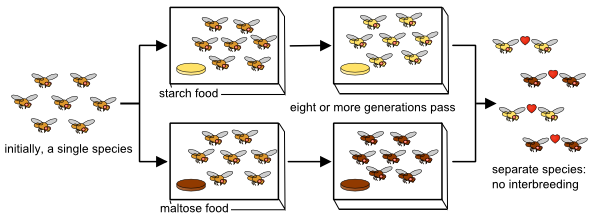

Ecological speciation requires three components. First, there must be an ecological source of divergent selection — a difference in the environment, resource base, or biotic interactions experienced by two populations. Second, that divergent selection must drive the evolution of phenotypic differences between the populations. Third, the phenotypic divergence must cause reproductive isolation, either directly (when the traits under ecological selection also affect mating) or indirectly (when ecological divergence reduces contact between populations or generates selection against hybrids that are ecologically intermediate).1, 2
Importantly, ecological speciation is defined by its mechanism, not by its geography. It can occur in allopatry, parapatry, or sympatry. Two populations adapting to different environments on separate continents are undergoing ecological speciation if their divergent ecological adaptations are what generates reproductive isolation. Equally, two populations in the same lake that specialize on different food resources and evolve reduced interbreeding as a consequence are also undergoing ecological speciation. The unifying feature is that ecological differences drive the reproductive barrier.1, 10
Mechanisms of reproductive isolation
Ecological speciation can produce reproductive isolation through several distinct mechanisms, which are not mutually exclusive and often operate simultaneously. Nosil identified three major categories: immigrant inviability, ecologically based sexual selection, and selection against hybrids.1
Immigrant inviability occurs when individuals that move between habitats suffer reduced survival because they are ecologically adapted to their natal environment and poorly adapted to the alternative. If a stickleback fish adapted to a benthic lifestyle in shallow, vegetation-rich lake margins migrates into the open-water (limnetic) zone, it will be a less efficient forager than the limnetic residents and more vulnerable to predation, reducing its fitness and probability of contributing to the gene pool of the limnetic population. This differential survival of immigrants acts as a barrier to gene flow without requiring any difference in mating preferences or genetic compatibility.1, 13 Nosil, Vines, and Funk demonstrated immigrant inviability in Timema walking-stick insects, showing that immigrants between host-plant populations suffered dramatically higher predation rates than residents, because their cryptic coloration was mismatched to the alternative host plant.13
Ecologically based sexual selection occurs when the traits favoured by ecological selection also influence mate choice. If adaptation to different environments causes divergence in body size, coloration, courtship behaviour, or the timing of reproduction, and if these traits are used in mate recognition, then ecological divergence directly produces assortative mating. In Darwin's finches, beak morphology is both an ecologically functional trait (adapted to specific food resources) and a cue used in mate recognition, so divergence in beak size under ecological selection simultaneously generates a prezygotic barrier to interbreeding.7, 8
Selection against hybrids provides a postzygotic mechanism for ecological speciation. When two ecologically divergent populations produce hybrids, those hybrids may possess intermediate phenotypes that are poorly suited to either parental environment. A stickleback with morphology intermediate between benthic and limnetic forms, for example, may be an inferior competitor in both habitat types. This environment-dependent hybrid fitness disadvantage reduces the reproductive success of hybrids and selects against gene flow between the diverging populations, strengthening reproductive isolation.4
Threespine stickleback fish
The threespine stickleback (Gasterosteus aculeatus) is arguably the most thoroughly studied system for ecological speciation. Following the retreat of glaciers at the end of the Pleistocene, marine sticklebacks independently colonised numerous freshwater lakes in British Columbia, where they repeatedly evolved into pairs of ecologically divergent species: a limnetic form adapted to open-water planktivory, with a streamlined body, numerous fine gill rakers for filtering zooplankton, and a small mouth; and a benthic form adapted to feeding on invertebrates in the lake-bottom sediment, with a deeper body, fewer and coarser gill rakers, and a larger mouth.2, 5
Schluter and Nagel demonstrated that the repeated evolution of benthic-limnetic species pairs in independent lakes constitutes parallel speciation — the independent origin of the same pattern of reproductive isolation in response to the same ecological conditions. If the reproductive isolation observed between benthic and limnetic sticklebacks arose by chance or through neutral genetic divergence, it would be highly unlikely to evolve repeatedly in the same configuration across multiple independent lake populations. The parallelism provides strong evidence that ecologically based divergent selection is the causal driver of reproductive isolation.5
Hatfield and Schluter provided direct experimental evidence that hybrid fitness is environment-dependent. Hybrids between benthic and limnetic sticklebacks, raised in semi-natural enclosures in both littoral and open-water habitats, displayed reduced growth rates compared with the parental species in both environments. The hybrids' intermediate morphology rendered them competitive inferiors in both niches, demonstrating that ecological selection against hybrids is a genuine mechanism of reproductive isolation in this system.4
At the genomic level, Chan and colleagues identified the Eda gene (encoding ectodysplasin) as a major locus underlying the repeated reduction of lateral bony plates in freshwater stickleback populations worldwide. The same ancestral low-plate allele has been independently selected in hundreds of freshwater populations, demonstrating that adaptation from standing genetic variation in the marine ancestor facilitates rapid, parallel ecological divergence.6, 11
Darwin's finches
Darwin's finches on the Galapagos Islands provide another classic example of ecological speciation. The approximately eighteen species of Galapagos finches descended from a single South American ancestor and have diversified primarily in beak morphology, which is closely tied to diet and feeding ecology. Peter and Rosemary Grant's long-term field studies on the island of Daphne Major documented natural selection acting on beak size in real time. During the severe drought of 1977, the supply of small, soft seeds declined sharply, and natural selection favoured individuals with larger, deeper beaks that could crack the remaining hard seeds. Average beak depth in the population of Geospiza fortis increased measurably within a single generation.7
The Grants' four-decade study showed that ecological selection on beak morphology is both strong and fluctuating, with the direction of selection varying across years in response to rainfall, seed availability, and the competitive environment. When a competitor species, G. magnirostris, colonised Daphne Major and monopolised the large-seed niche, selection on G. fortis shifted toward smaller beaks — ecological character displacement in action.8 Because beak morphology also functions as a mate-recognition cue (finches preferentially pair with individuals whose beak size matches their own), ecological divergence in beak size translates directly into assortative mating, providing a clear mechanistic link between ecological adaptation and the evolution of reproductive isolation.7, 8
Phytophagous insects and host-plant shifts
Host-plant shifts in phytophagous (plant-eating) insects provide some of the most abundant evidence for ecological speciation, because insects that colonise a new host plant immediately face divergent selection on a suite of ecologically relevant traits including host-plant preference, detoxification of plant defensive chemicals, phenology of development, and cryptic coloration for predator avoidance. Funk demonstrated that in leaf beetles (Chrysomelidae), adaptation to different host plants drove the parallel evolution of reproductive isolation across multiple species, with the degree of reproductive isolation between beetle populations correlating with the ecological divergence between their host plants rather than with geographic distance or time since divergence.14
The role of ecological adaptation in generating reproductive isolation in host-shifting insects is multifaceted. Habitat isolation occurs when adapted individuals prefer to feed and mate on their natal host plant, reducing encounter rates with individuals from other host-associated populations. Temporal isolation arises when different host plants induce different developmental schedules, so that adults from different host-plant populations emerge and mate at different times. Immigrant inviability and selection against hybrids further reduce gene flow, as individuals on the wrong host plant suffer elevated mortality from mismatched adaptations.1, 16 Funk, Nosil, and Etges argued that the multiple, reinforcing barriers generated by host-plant adaptation make phytophagous insects particularly prone to ecological speciation.16
Ecological opportunity and speciation rate
Ecological speciation is intimately connected to the concept of ecological opportunity — the availability of unexploited resources or habitats that can be partitioned among diverging populations. When ecological opportunity is abundant, as in the colonisation of new environments or in the aftermath of mass extinction, the potential for ecologically divergent selection is greatest, and speciation rates tend to be elevated.2, 15
Yoder and colleagues reviewed the conditions that generate ecological opportunity and its relationship to speciation. They identified three primary sources: colonisation of new geographic regions (island colonisation, range expansion into unoccupied territory), extinction of competitors (opening niches previously occupied by other species), and the evolution of key innovations that allow a lineage to exploit resources in a fundamentally new way. In all three cases, the resulting ecological opportunity provides the raw material for divergent selection, and if that selection generates reproductive isolation, ecological speciation follows.15
The cichlid fishes of the African Great Lakes illustrate the connection between ecological opportunity and the tempo of ecological speciation. In Lake Victoria, approximately 500 cichlid species evolved in fewer than 15,000 years, making it one of the fastest rates of speciation recorded in any vertebrate group. The lake offered a diverse array of unexploited ecological niches, and cichlid lineages possessed key innovations — including a functionally versatile pharyngeal jaw apparatus — that allowed them to exploit those niches. Barluenga and colleagues documented sympatric ecological speciation in the much smaller Nicaraguan crater lake Apoyo, where two cichlid species diverged in body shape, jaw morphology, and diet within the confines of a single small lake, providing strong evidence that ecological divergence alone can drive speciation without geographic isolation.9
Ecological speciation versus alternative mechanisms
Not all speciation is ecological. Reproductive isolation can also evolve through non-ecological mechanisms, including the accumulation of genetic incompatibilities by drift in allopatric populations (mutation-order speciation), sexual selection that diverges in arbitrary directions unrelated to ecology, and polyploidy in plants. Schluter distinguished ecological speciation from these alternatives by its defining criterion: reproductive isolation must arise as a consequence of divergent natural selection between environments, not merely in correlation with it.3
The distinction between ecological and non-ecological speciation is important but can be difficult to draw in practice. Rundle and Nosil proposed several criteria for diagnosing ecological speciation: a demonstrated ecological source of divergent selection, phenotypic divergence between populations in traits relevant to that selection, a link between those traits and reproductive isolation, and evidence that the pattern is not better explained by non-ecological mechanisms.12 When all four criteria are met, as in stickleback benthic-limnetic pairs and Timema walking-stick insect host races, the case for ecological speciation is strong.
The relative importance of ecological versus non-ecological speciation remains an active area of research. Schluter's review of the evidence concluded that ecological speciation is probably the most common mode of speciation in nature, on the grounds that most species differ ecologically as well as reproductively and that the most detailed case studies consistently reveal ecological divergence as a primary contributor to reproductive isolation.3 However, the extent to which this conclusion generalises across the tree of life — particularly in groups such as deep-sea organisms, cave fauna, or cryptic species complexes where ecological divergence may be subtle or difficult to detect — remains to be determined.1, 10
References
Reproductive isolation caused by natural selection against immigrants from divergent habitats