Overview
- Evolutionary theory makes specific, testable predictions about the existence and location of transitional fossils, and the repeated confirmation of these predictions — including Tiktaalik in Devonian strata, Archaeopteryx in Jurassic limestone, and walking whales in Eocene deposits — provides powerful evidence for common descent.
- Neil Shubin's team predicted and discovered Tiktaalik roseae by targeting late Devonian freshwater sediments of the right age and depositional environment on Ellesmere Island, finding a fish with proto-tetrapod features including a mobile neck, functional wrist, and ribs capable of supporting the body.
- The cetacean fossil record now documents a remarkably complete series of transitional forms from the terrestrial artiodactyl Indohyus through the amphibious Ambulocetus and Rodhocetus to the fully aquatic Basilosaurus and Dorudon, each recovered from the predicted Eocene strata and geographic regions.
One of the most powerful tests of evolutionary theory is its ability to predict the existence and location of fossils not yet discovered. If all living organisms share common ancestry through descent with modification, then organisms with intermediate characteristics between known groups should have existed, and their remains should be found in geological strata of the appropriate age and depositional environment.14 Darwin himself acknowledged in 1859 that the imperfection of the fossil record was the "most obvious and gravest objection" to his theory, but he predicted that continued exploration would fill many of the apparent gaps.14 Since then, palaeontological discoveries have repeatedly confirmed these predictions, recovering transitional forms in precisely the strata where evolutionary theory predicted they should occur.
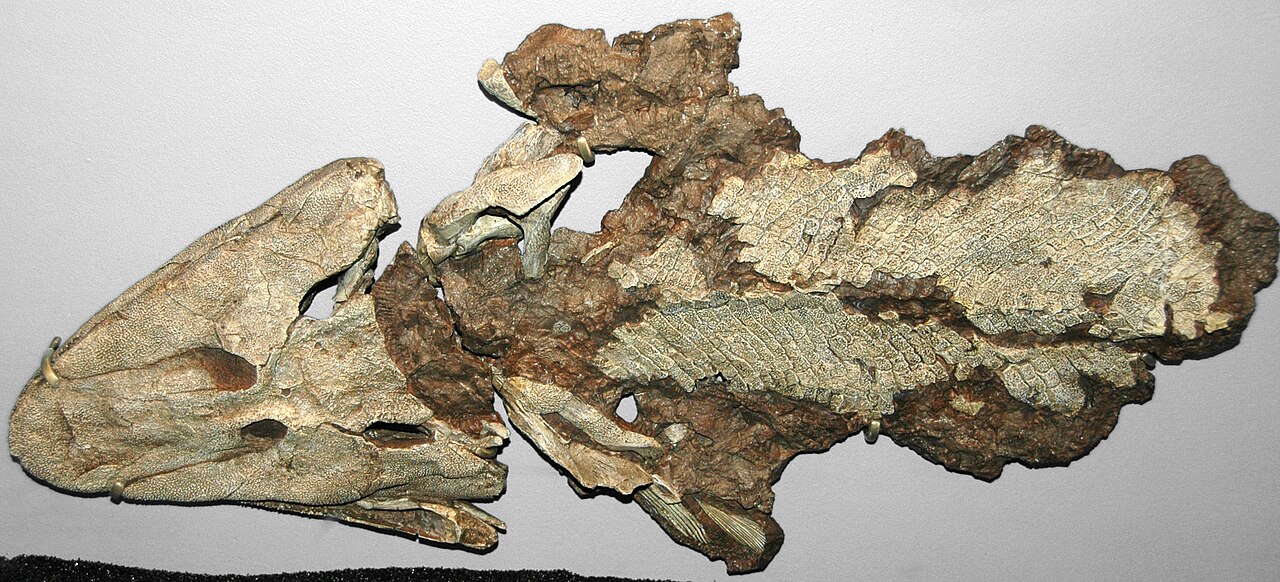
_(Fram_Formation,_Upper_Devonian;_Ellesmere_Island,_Arctic_Canada)_1_(49755118288).jpg)
Tiktaalik: the predicted fish-tetrapod intermediate
The discovery of Tiktaalik roseae in 2004 on Ellesmere Island in the Canadian Arctic is one of the clearest examples of a fossil predicted and found by evolutionary reasoning. By the late 1990s, palaeontologists had established that the transition from lobe-finned fishes to four-limbed vertebrates (tetrapods) occurred during the Late Devonian period, approximately 385 to 365 million years ago. The most fish-like known tetrapodomorph was Panderichthys, dated to approximately 385 million years ago, while the most tetrapod-like early forms, Acanthostega and Ichthyostega, were known from approximately 365-million-year-old deposits in East Greenland.18
Neil Shubin, Edward Daeschler, and Farish Jenkins reasoned that a transitional form between Panderichthys and Acanthostega should exist in freshwater sedimentary rocks of approximately 375 million years in age. They identified the Fram Formation on Ellesmere Island as exposing the right type of sediment from the right time period, and after several field seasons of prospecting, they recovered multiple specimens of Tiktaalik roseae.1, 3
Tiktaalik possesses a remarkable mosaic of fish and tetrapod features. It retains fish characteristics including scales, fin rays, and a lower jaw with a dentary bone configuration typical of fish. But it also possesses features previously known only in tetrapods: a mobile neck (the first in the fish-to-tetrapod lineage), a flat, broad skull with dorsally positioned eyes, ribs that overlap and could support the body against gravity, and — most dramatically — a pectoral fin with internal bones homologous to the humerus, radius, and ulna of a tetrapod forelimb, including a functional wrist capable of load-bearing.1, 2 Later analysis of the pelvic girdle revealed that Tiktaalik's hindquarters were also more tetrapod-like than expected, with an enlarged pelvis and hindlimb that could have contributed to substrate locomotion, suggesting that the transition to weight-bearing limbs began in the hindlimbs as well as the forelimbs before the fish-tetrapod transition was complete.15
The significance of Tiktaalik extends beyond its anatomy to the method by which it was found. It was not a lucky accident but the result of a targeted search guided by evolutionary predictions about what kind of organism should exist, when it should have lived, and in what type of environment its remains should be preserved. The success of this predictive approach is strong evidence for the reliability of evolutionary theory as a framework for understanding the history of life.3
Archaeopteryx and the dinosaur-bird transition
The discovery of Archaeopteryx lithographica in the Solnhofen limestone of Bavaria in 1861, just two years after the publication of On the Origin of Species, was one of the earliest and most celebrated vindications of Darwin's prediction that transitional forms would be found. Archaeopteryx possesses an unmistakable combination of reptilian and avian features: it has teeth, clawed fingers, and a long bony tail like a small theropod dinosaur, but it also has asymmetric flight feathers, a wishbone (furcula), and wing proportions consistent with powered or gliding flight.4
The Late Jurassic age of the Solnhofen limestone (approximately 150 million years ago) places Archaeopteryx in precisely the geological window where evolutionary theory predicted a dinosaur-bird intermediate should occur: after the diversification of theropod dinosaurs in the Triassic and Jurassic but before the radiation of modern bird lineages in the Cretaceous.4, 5, 6 Subsequent discoveries in the Mesozoic of China have dramatically expanded the roster of feathered dinosaurs and early birds, revealing a continuum of forms from entirely non-avian theropods with simple filamentous integumentary structures to near-modern birds with fully developed flight apparatus. Anchiornis huxleyi, Microraptor, and Confuciusornis are among the many genera that fill out this transition with increasing resolution.7
The dinosaur-bird transition exemplifies how evolutionary predictions generate a research programme. Once the theropod ancestry of birds was established through cladistic analysis of skeletal characters, specific predictions followed about what features should appear in successive transitional forms: first simple integumentary filaments, then more complex branched feathers, then asymmetric vaned feathers capable of aerodynamic function, then fully modern flight feathers. The fossil record has confirmed this predicted sequence with remarkable fidelity.5, 7
The cetacean transition from land to sea
The evolutionary origin of whales from terrestrial mammals is documented by one of the most complete transitional fossil series known. Molecular phylogenetics established in the 1990s that cetaceans (whales, dolphins, and porpoises) are nested within Artiodactyla (even-toed ungulates), most closely related to hippopotamuses.9 This phylogenetic placement predicted that the earliest whale ancestors should be found in early Eocene deposits (approximately 55 to 50 million years ago) in regions where artiodactyl-like mammals are known to have been diverse, and that these ancestors should possess anatomical features intermediate between terrestrial artiodactyls and aquatic cetaceans.
The fossil record has confirmed these predictions with extraordinary precision. Indohyus, a small raccoon-sized artiodactyl from the early Eocene of Kashmir, possesses dense limb bones (osteosclerosis) consistent with wading behaviour and an involucrum — a thickened bony lip on the tympanic bulla of the ear — that is unique to cetaceans among living mammals, linking it to the whale lineage.9 Pakicetus, from the early Eocene of Pakistan (approximately 50 million years ago), was a wolf-sized terrestrial predator with elongated limbs, an involucrum, and dental characteristics linking it to later cetaceans.16
Ambulocetus natans ("the walking whale that swims"), from the early-to-middle Eocene of Pakistan (approximately 49 million years ago), was a crocodile-like animal roughly 3 metres long with large hindlimbs and feet adapted for both walking on land and paddling in water, representing an amphibious stage in the transition.8 Rodhocetus, from slightly younger Eocene deposits, shows further aquatic adaptations including shortened hindlimbs, a more flexible spine, and modifications of the vertebral column for undulatory swimming.12
By the late Eocene, approximately 37 to 34 million years ago, the transition was nearly complete. Basilosaurus and Dorudon were fully aquatic, with elongated bodies, paddle-like forelimbs, tiny vestigial hindlimbs too small for locomotion, and tail flukes for propulsion.10, 12 The retention of vestigial hindlimbs in these late Eocene whales — complete with a femur, patella, tibia, and in some specimens individual toe bones — is explicable only as an evolutionary remnant of the terrestrial ancestor's functional walking legs. Bone microstructure analysis across this series confirms a progressive shift from dense, compact bone (consistent with wading and bottom-walking) to spongy, cancellous bone (consistent with open-water swimming), tracking the transition from land to sea in the very tissue of the skeleton.11
Other predicted and discovered transitional forms
The fish-tetrapod, dinosaur-bird, and artiodactyl-whale transitions are among the most celebrated, but they are far from the only cases. The fossil record now documents transitional series for many major evolutionary transitions. The origin of mammals from synapsid reptiles is recorded in a graded series of therapsid fossils spanning the Permian and Triassic periods, showing the progressive acquisition of mammalian features including a single lower jaw bone, three middle ear ossicles, differentiated teeth, and a secondary palate.17
The origin of snakes from limbed lizard ancestors is supported by Cretaceous fossils such as Najash rionegrina and Pachyrhachis, which possess both snake-like skulls and vestigial hindlimbs, as predicted by the phylogenetic placement of snakes within Squamata.13 In human evolution, the series from Sahelanthropus through Ardipithecus, multiple Australopithecus species, and early Homo documents the stepwise acquisition of bipedalism, reduced canines, brain expansion, and stone tool use over a span of approximately six million years, with each new discovery narrowing the gaps and confirming predictions derived from the existing phylogenetic framework.17
The predictive power of evolutionary theory
The repeated discovery of transitional fossils in the predicted geological strata is significant not merely because it fills gaps in the fossil record but because it demonstrates the predictive power of evolutionary theory. A theory that can specify in advance the type of organism that should exist, the approximate geological age at which it should have lived, the depositional environment in which its remains should be preserved, and the geographic region in which those remains should be found — and then have those predictions confirmed by discovery — meets the highest standards of scientific testability.3, 14
Each transitional fossil also generates new predictions. The discovery of Tiktaalik predicted the existence of even more fish-like tetrapodomorphs in slightly older deposits and more tetrapod-like forms in slightly younger deposits, predictions that continue to guide field research. The discovery of walking whales predicted specific dental, auditory, and postcranial features in their immediate ancestors and descendants, predictions that have been confirmed by subsequent finds. This self-reinforcing cycle of prediction and discovery is a hallmark of a successful scientific theory, and it distinguishes evolutionary biology from frameworks that explain observations after the fact but do not generate testable predictions about what will be found next.3, 12
References
New specimens of Anchiornis huxleyi (Theropoda: Paraves) from the late Jurassic of northeastern China
The origin of snakes: revealing the ecology, behavior, and evolutionary history of early snakes using genomics, phenomics, and the fossil record