Overview
- The geothermal gradient — the rate at which temperature increases with depth below Earth's surface — averages approximately 25–30 degrees Celsius per kilometre in continental crust, but varies from less than 10 to more than 100 degrees Celsius per kilometre depending on tectonic setting, crustal composition, and proximity to magmatic heat sources.
- The gradient is driven by heat flowing outward from Earth's interior, generated primarily by the radioactive decay of uranium, thorium, and potassium in the crust and mantle, supplemented by residual heat from planetary accretion and core crystallisation.
- Regional variations in the geothermal gradient control the depth at which metamorphic reactions occur, the generation and migration of petroleum, the feasibility of geothermal energy extraction, and the maximum depth of mining operations — making it a fundamental parameter in both Earth science and resource geology.
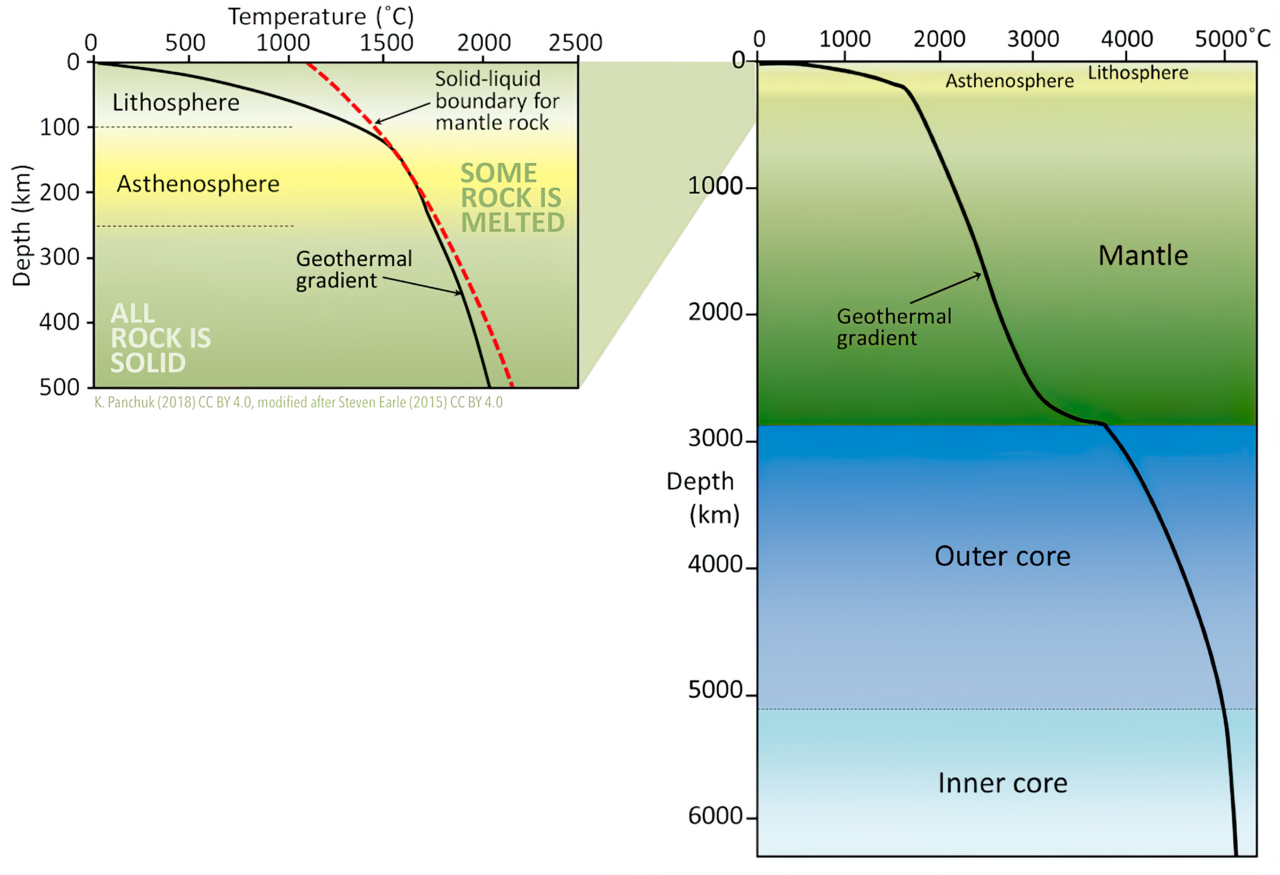
The geothermal gradient is the rate at which temperature increases with depth below the Earth's surface. Measurements from boreholes around the world show that the average geothermal gradient in continental crust is approximately 25–30 degrees Celsius per kilometre, though values range from less than 10 degrees Celsius per kilometre in ancient, thermally stable cratonic shields to more than 100 degrees Celsius per kilometre in volcanically active regions and geothermal fields.1, 10 The gradient is the surface expression of the outward flow of heat from Earth's interior, and its magnitude at any location reflects the interplay of heat production in the underlying crust and mantle, the thermal conductivity of the rocks through which heat is conducted, and the presence or absence of convective heat transport by fluids or magma.3, 6

Sources of Earth's internal heat
The heat that drives the geothermal gradient originates from two principal sources: the radioactive decay of long-lived isotopes and the residual heat from Earth's formation and differentiation. The decay of uranium-238, uranium-235, thorium-232, and potassium-40 in crustal and mantle rocks generates approximately 20 terawatts of the total terrestrial heat flux of roughly 47 terawatts, with the remainder attributed to primordial heat stored during accretion and to latent heat released by the ongoing crystallisation of the inner core.3, 4 Radioactive heat production is concentrated in the continental crust, where granitic and sedimentary rocks contain far higher concentrations of uranium, thorium, and potassium than the underlying mantle. As a result, a substantial fraction of the continental geothermal gradient is generated within the crust itself rather than being conducted upward from the mantle.4, 5
The thermal conductivity of crustal rocks determines how efficiently this heat is transported toward the surface. Rocks with high thermal conductivity, such as quartzite and rock salt, conduct heat more effectively and consequently exhibit lower geothermal gradients for the same heat flux, while low-conductivity rocks such as shale and mudstone impede heat flow and produce steeper gradients.6 In sedimentary basins, the thick accumulation of low-conductivity sediments can act as a thermal blanket, elevating temperatures at depth and steepening the near-surface gradient — a phenomenon of considerable importance for petroleum generation and geothermal energy.6, 13
Regional and tectonic variations
The geothermal gradient varies systematically with tectonic setting. Continental cratons and ancient shield areas, such as the Canadian Shield and the West African Craton, exhibit low heat flow (30–45 milliwatts per square metre) and correspondingly low geothermal gradients (15–20 degrees Celsius per kilometre), reflecting their thick, cold, and depleted lithospheric roots.1, 7 Active continental rifts and volcanic zones display far higher values: the Basin and Range Province of the western United States records heat flow of 80–120 milliwatts per square metre and geothermal gradients of 40–80 degrees Celsius per kilometre, reflecting the thin lithosphere and upwelling hot mantle beneath extending crust.16 Oceanic crust follows a systematic age-dependent pattern, with very high heat flow and steep gradients near mid-ocean ridges where new lithosphere is being created, declining as the plate ages, thickens, and cools during lateral transport away from the ridge.1, 10
Localised anomalies in the geothermal gradient can arise from convective heat transfer by groundwater circulation, proximity to shallow magma chambers, or anomalous concentrations of radioactive elements in the crust. In geothermal fields such as Larderello in Italy, The Geysers in California, and Taupo in New Zealand, circulating hydrothermal fluids transport heat from deep magmatic sources to the near-surface far more efficiently than conduction alone, producing extremely steep apparent gradients that may exceed 100 degrees Celsius per kilometre in the upper few kilometres.2, 15
Implications for metamorphism and petrology
The geothermal gradient is a fundamental control on the pressure-temperature paths followed by rocks as they are buried or exhumed, and thus determines which metamorphic mineral assemblages develop at a given depth. Under a normal continental gradient of 25–30 degrees Celsius per kilometre, rocks buried to 20 kilometres reach temperatures of 500–600 degrees Celsius, entering the amphibolite facies of regional metamorphism. At higher-than-normal gradients, such as those found in volcanic arcs or continental rift zones, these temperatures are reached at much shallower depths, producing low-pressure, high-temperature metamorphic assemblages characterised by minerals such as andalusite and sillimanite.11 Conversely, in subduction zones where cold oceanic lithosphere descends rapidly into the mantle, geothermal gradients are depressed to 5–10 degrees Celsius per kilometre, and rocks reach great pressures while remaining relatively cool — the conditions that produce the high-pressure blueschist and eclogite facies assemblages diagnostic of ancient subduction environments.11, 9
Petroleum generation and basin analysis
In sedimentary basins, the geothermal gradient governs when, where, and how much petroleum is generated from organic-rich source rocks. Kerogen in source rocks begins to generate liquid hydrocarbons (oil) at temperatures of approximately 60–120 degrees Celsius (the oil window) and generates predominantly gas at temperatures above 150–200 degrees Celsius.12, 13 The depth at which these temperatures are reached depends directly on the local geothermal gradient: in a basin with a gradient of 30 degrees Celsius per kilometre, the oil window lies at 2–4 kilometres depth, while in a high-heat-flow basin with a gradient of 50 degrees Celsius per kilometre, it may be encountered at only 1.2–2.4 kilometres.12 Basin thermal modelling, incorporating measured heat flow, thermal conductivity of basin-fill sediments, and burial history reconstructed from subsidence analysis, is a standard tool in petroleum exploration for predicting source rock maturity and the timing of hydrocarbon generation and expulsion.13
Mining constraints and geothermal energy
The geothermal gradient imposes practical limits on the depth of underground mining. At the TauTona and Mponeng gold mines in South Africa's Witwatersrand Basin, which reach depths exceeding 3.5 kilometres, rock temperatures exceed 60 degrees Celsius, requiring massive refrigeration systems to maintain workable conditions for miners.14 The gradient at Witwatersrand averages approximately 10–12 degrees Celsius per kilometre — well below the global average owing to the ancient, low-heat-production rocks of the Kaapvaal Craton — yet even this modest gradient produces formidable temperatures at the extreme depths of these mines.14, 1
Conversely, regions of elevated geothermal gradient represent opportunities for geothermal energy extraction. Conventional hydrothermal systems exploit naturally circulating hot water in high-heat-flow regions, while enhanced geothermal systems (EGS) aim to extract heat from hot dry rock by engineering fluid circulation through artificially fractured subsurface reservoirs.8, 15 The MIT-led assessment of EGS potential in the United States estimated that the thermal energy stored in rocks at accessible drilling depths (3–10 kilometres) represents a resource base orders of magnitude larger than current annual energy consumption, though economic extraction at scale remains a technological challenge.8 Understanding the geothermal gradient — its magnitude, its causes, and its local variations — thus remains central to both the Earth sciences and to the practical exploitation of Earth's thermal resources.8, 15
References
The future of geothermal energy: impact of enhanced geothermal systems (EGS) on the United States in the 21st century
An introduction to thermochronological techniques, resolution, and application to problems in tectonic geomorphology
Basin analysis: principles and application to petroleum play assessment (3rd edition)
Geothermal energy: review of resources, applications, sustainability, and environmental impacts