Overview
- Ophiolites are slabs of ancient oceanic crust and uppermost mantle that have been thrust onto continental margins during tectonic collisions, preserving a cross-section of the ocean floor that geologists can study on land.
- The classic ophiolite sequence runs from bottom to top through mantle peridotite, layered gabbro, a sheeted dike complex, pillow basalts, and deep-sea sediments — a stratigraphy codified at the 1972 Penrose Conference and confirmed by deep-sea drilling.
- The Oman (Semail) ophiolite, the world’s largest and best-exposed example, has been the proving ground for most modern ideas about mid-ocean ridge magmatism, melt transport, and crustal accretion.
Overview
An ophiolite is a distinctive assemblage of mafic and ultramafic rocks that represents a displaced fragment of ancient oceanic lithosphere — oceanic crust together with a sliver of the uppermost mantle — that has been transported onto a continental margin and preserved above sea level. The term derives from the Greek ophis (serpent) and lithos (stone), a reference to the green, scaly texture of serpentinized peridotite that characterises the mantle section of these sequences.2 Because the ocean floor is normally recycled back into the mantle through plate tectonics, ophiolites represent rare windows into a part of the Earth that would otherwise be inaccessible. They record the composition, structure, and processes of the oceanic lithosphere at the time of their formation, providing direct evidence for seafloor spreading and the dynamics of mid-ocean ridges.

Ophiolites occur on every continent and range in age from Cambrian to Cenozoic, though most well-studied examples were generated during the Mesozoic when ocean basins were particularly active.2 Their identification and interpretation transformed the earth sciences during the 1960s and 1970s, providing crucial physical confirmation for the theory of plate tectonics at a moment when the field was still contested. Today they remain among the most intensively studied rock sequences in geology, with ongoing drilling projects extracting cores from their interiors to resolve questions about mantle melting, crustal accretion, and the chemical exchange between the ocean and the solid Earth.
The Penrose sequence
Before the 1970s, geologists recognised that certain suites of ultramafic and mafic rocks — found in mountain belts from the Alps to the Appalachians — bore a suspicious resemblance to rocks dredged from the ocean floor. The connection was formalized in December 1972 at a Penrose Field Conference held in the Troodos Mountains of Cyprus, where an international group of petrologists, structural geologists, and marine scientists agreed on a standard definition and stratigraphic template for ophiolites.1 The resulting statement, published in Geotimes, described an idealised ophiolite as a specific vertical succession of rock types interpreted as a cross-section through young oceanic lithosphere.
The Penrose sequence, reading from the base upward, begins with harzburgite and lherzolite — coarse-grained peridotites that represent the depleted upper mantle from which magma has been partially extracted.1 These rocks are commonly altered to serpentinite by reaction with seawater-derived fluids, producing the greenish masses that gave the rock group its name. Above the peridotite lies a zone of layered gabbro, a coarse-grained igneous rock formed by the slow crystallisation of basaltic magma in a shallow magma chamber beneath the spreading axis.2 The layering — alternating bands of plagioclase-rich and pyroxene-rich rock — reflects the sequential settling of minerals as the magma cooled, in a process analogous to what geophysical models predict for mid-ocean ridge magma chambers.
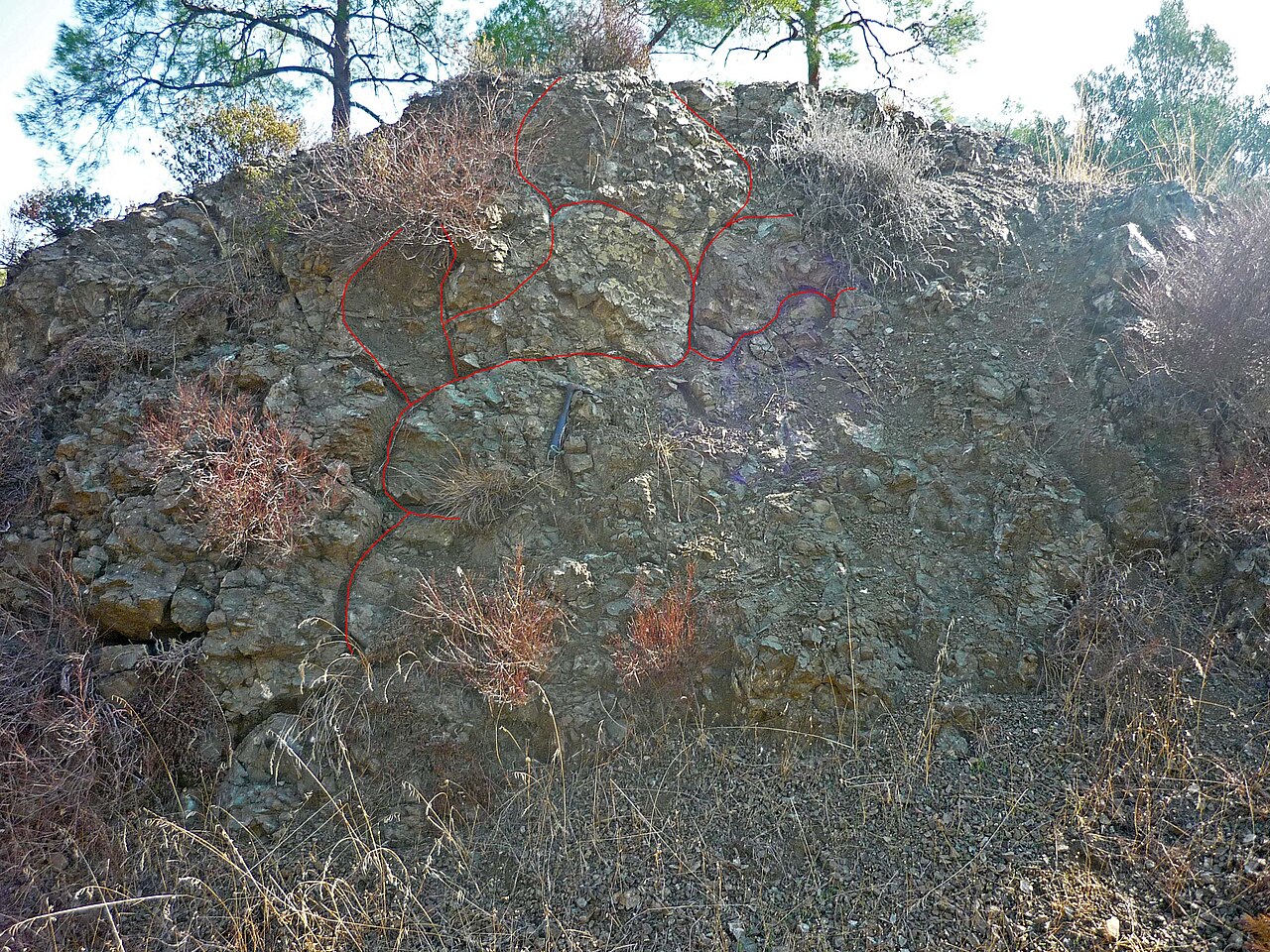
Overlying the gabbros is the diagnostic heart of any ophiolite: the sheeted dike complex. This zone consists almost entirely of basaltic dikes intruded so closely together that each dike was, in turn, split down its centre by the next injection of magma from below.12 The result is a rock mass in which virtually every contact is a chilled margin against another dike, with no host rock visible between them. This one-sided chilling — demonstrable in outcrop — is unambiguous evidence of repeated, focused magma injection at a spreading centre, and its presence in an ophiolite is the strongest structural argument that the sequence formed at a divergent plate boundary.12 Above the sheeted dikes, pillow basalts form the uppermost igneous layer. These are extrusive lavas that erupted directly onto the seafloor; the rapid quenching of lava by cold seawater produces the characteristic pillow shapes — bulbous, tube-like masses with glassy rims and radial fracture patterns — first described and experimentally reproduced in the late 1960s.11 Capping the igneous sequence are deep-sea sediments, typically red or grey pelagic cherts and carbonates that accumulated on the seafloor far from any continental source of terrigenous material.1
The Penrose definition was explicitly an idealised template; real ophiolites are rarely complete. Tectonic dismemberment during emplacement strips away sections, and erosion removes others. Nevertheless, the sequence provided the community with a common vocabulary and a null hypothesis against which individual examples could be compared.2
Formation and emplacement
Ophiolites originate at mid-ocean ridges or in back-arc and fore-arc basins above subduction zones, where mantle upwelling and decompression melting generate basaltic magma that builds new oceanic crust.7 The process of transferring this oceanic lithosphere onto a continent is called obduction, a term introduced to complement the more familiar concept of subduction. Obduction is mechanically puzzling: oceanic lithosphere is denser than continental crust and should preferentially sink into the mantle rather than ride up over it. Several scenarios have been proposed to explain how it happens in practice.
The most widely accepted model involves the initiation of subduction at or near a mid-ocean ridge, trapping a young, buoyant sliver of oceanic lithosphere between the downgoing slab and the continental margin.7 Because young oceanic crust has not yet cooled sufficiently to become dense enough to sink readily, it can be thrust onto the adjacent continent as the two plates converge. The ophiolite rides up along major thrust faults, sometimes travelling hundreds of kilometres from its point of origin before coming to rest. The weight of the overthrust slab depresses the underlying continental crust, creating a foreland basin that rapidly fills with sediment eroded from the newly elevated ophiolite massif — a stratigraphic signal that helps geologists date the emplacement event.5
Obduction is geologically brief. Studies of the Oman ophiolite indicate that the entire sequence — from formation at a spreading axis to emplacement on the Arabian continental margin — was accomplished in fewer than ten million years during the Late Cretaceous.3 Once stranded on a continent, ophiolites are subject to erosion, metamorphic overprinting along their basal thrust zones, and chemical alteration by meteoric and hydrothermal fluids, all of which progressively obscure their original character.
Key examples
The Troodos ophiolite of Cyprus is perhaps the most historically significant ophiolite in the world. Occupying much of the island’s interior, it was the site of the 1972 Penrose Conference and remains the type example against which the standard sequence is measured.4 Formed approximately 90 million years ago during the Late Cretaceous, the Troodos sequence is unusually intact, preserving all major units from serpentinised harzburgite at its base through sheeted dikes, pillow basalts, and a thin veneer of deep-sea sediments.4 Seismic surveys of the Troodos have confirmed that its crustal thickness — roughly five to six kilometres — matches that of normal oceanic crust measured by ocean-floor refraction studies, a critical verification of the ophiolite-as-oceanic-crust interpretation.4 Geochemical analysis of the volcanic rocks, however, reveals a trace-element signature more consistent with a suprasubduction zone origin than with a simple mid-ocean ridge setting, making Troodos a central exhibit in the debate over ophiolite diversity.13
The Semail (Oman) ophiolite, extending across northeastern Oman and the United Arab Emirates, is the largest and best-exposed ophiolite on Earth, covering roughly 30,000 square kilometres with a thickness of up to 15 kilometres.3 It formed at a fast-spreading ridge in a branch of the Tethys Ocean during the Cenomanian–Turonian stages of the Cretaceous (approximately 95–96 Ma) and was emplaced onto the Arabian Platform shortly thereafter.3 The Semail ophiolite has been the focus of intensive research for decades and continues to yield new insights through the Oman Drilling Project, an international effort that has drilled multiple continuous cores through the lower crust and uppermost mantle sections, recovering material that cannot be obtained anywhere else on land.15 The sheer scale of the Semail exposure allows structures that would be cryptic in smaller ophiolites — mantle flow fabrics, melt channels, dunite bodies interpreted as frozen magma conduits — to be mapped in three dimensions across tens of kilometres.3
The Bay of Islands ophiolite complex in western Newfoundland, Canada, was instrumental in establishing ophiolites as markers of ancient ocean basins and suture zones in the Appalachian system. Emplaced during the Ordovician (approximately 480 Ma) onto the Laurentian continental margin as the Iapetus Ocean closed, the Bay of Islands complex preserves all major ophiolite units, including spectacular exposures of layered gabbros and a well-developed sheeted dike complex.5 Its recognition as a piece of Iapetan oceanic crust confirmed that the proto-Atlantic Ocean had existed and been destroyed, validating a key prediction of plate tectonic theory for Paleozoic orogenic belts.5
The Josephine ophiolite of the Klamath Mountains in northwestern California and southwestern Oregon represents a Late Jurassic oceanic crust fragment emplaced during the accretion of terranes onto the western margin of North America.6 It is notable for preserving evidence of slow-spreading ridge processes, including highly heterogeneous crustal thickness and abundant mantle rocks exposed at the seafloor — a contrast to the thicker, more uniform crust typical of fast-spreading centres like the Semail ophiolite.6 The Josephine ophiolite has contributed importantly to understanding the range of crustal architectures that ophiolites can represent, cautioning against any single model of oceanic crust formation.
Ophiolites and plate tectonics theory
The recognition of ophiolites as fragments of oceanic lithosphere arrived at precisely the moment when plate tectonics needed terrestrial confirmation. By the mid-1960s, Vine and Matthews had demonstrated that symmetric magnetic anomalies flanking mid-ocean ridges required seafloor spreading,14 but the ocean floor itself remained inaccessible to direct geological mapping at the scales needed to verify the model’s structural predictions. Ophiolites filled that gap. The sheeted dike complex, in particular, is a structure with no plausible explanation other than repeated injection of magma at a divergent boundary; its occurrence in mountain belts from Newfoundland to Oman to Cyprus was taken as confirmation that oceans had opened and closed in the geological past, validating the Wilson cycle hypothesis for the episodic creation and destruction of ocean basins.
The impact on the study of ancient orogenic belts was profound. Before ophiolites were understood, the ultramafic and mafic rocks found in collision zones — the so-called ophiolitic mélange — were interpreted as products of unusual in-situ magmatism or as cumulates from large layered intrusions. Reinterpreting them as suture zones — the scars of vanished oceans — reorganised the entire framework of Paleozoic paleogeography. The Appalachians, the Caledonides, the Urals, the Tethyan belt, and the Central Asian orogenic system all contain ophiolitic remnants that now serve as markers of ancient subduction zones and continent–continent collision boundaries.2 This interpretive shift would not have been possible without the standard ophiolite sequence established at Penrose as a diagnostic template.
Supra-subduction zone ophiolites
A major complication to the simple “ophiolite equals mid-ocean ridge crust” equation emerged during the 1980s, when geochemists began systematically comparing the trace-element and isotopic compositions of ophiolitic lavas with those of known ridge basalts. Many ophiolites, including Troodos and the Semail, have volcanic sections enriched in certain elements — notably the large-ion lithophile elements and the light rare earth elements — and depleted in others in ways characteristic of lavas erupted above subducting slabs, not at open-ocean spreading centres.8 These supra-subduction zone (SSZ) ophiolites appear to have formed in fore-arc or back-arc settings where the influence of a subducting slab modified the chemistry of the mantle wedge and its partial melts.
Pearce and colleagues formalized this distinction in 1984, recognising that the tectonic setting of ophiolite formation could range from slow-spreading mid-ocean ridges through back-arc basins to fore-arc environments, each leaving a distinct geochemical fingerprint in the volcanic rocks.8 The SSZ interpretation carries significant implications for understanding obduction: a fore-arc ophiolite forms in precisely the geometry — above an initiating subduction zone — that models predict would most easily allow oceanic lithosphere to be thrust onto a continent, explaining why SSZ ophiolites are disproportionately represented in the geological record relative to their likely abundance in the modern oceans. The complication is that SSZ ophiolites are not representative of typical deep-ocean crust; using them to infer the average composition or structure of oceanic lithosphere introduces systematic bias. Modern ophiolite research therefore treats each example as requiring independent geochemical characterisation before its paleotectonic setting can be assigned.
Economic importance
Ophiolites are economically significant for two principal mineral resources: chromite and copper (along with associated base metals). Chromite — the chief ore of chromium — occurs in ophiolitic peridotites as podiform (pod-shaped) masses concentrated in dunite channels interpreted as frozen conduits through which primitive melt migrated upward from deeper mantle sources.10 Podiform chromite deposits are mineralogically distinct from the stratiform chromite layers found in large layered intrusions such as the Bushveld Complex; they tend to be smaller but can be very high-grade and are often the only source of chromite in regions lacking large Archean cratons. The Semail ophiolite hosts numerous podiform chromite deposits that were mined through much of the twentieth century.10
The connection between ophiolites and copper is ancient and etymologically embedded in the name of Cyprus itself. The Latin word cuprum, from which modern European languages derive their word for copper, was a contraction of aes Cyprium — “metal of Cyprus” — because the island was the Roman world’s primary copper source.9 That copper came from massive sulphide deposits formed at the seafloor by hydrothermal vents that circulated through the volcanic section of what is now the Troodos ophiolite. These volcanogenic massive sulphide (VMS) deposits form when seawater penetrates fractured oceanic crust, is heated by the underlying magma system, leaches metals from the rock, and discharges at the seafloor as a metal-laden hydrothermal fluid that precipitates sulphide minerals on contact with cold ambient seawater.9 Cyprus copper deposits were worked by at least the Bronze Age and remained economically significant into the twentieth century. Analogous VMS deposits occur in ophiolites worldwide, making ophiolitic terranes important targets in mineral exploration. The hydrothermal circulation that creates these ore bodies is also a major driver of chemical exchange between the ocean and the crust, influencing the global cycling of elements including calcium, magnesium, sulphur, and many trace metals — a dimension of ophiolite research that connects economic geology to ocean floor geology and global geochemistry.
Ongoing research
The central questions in ophiolite research today revolve around the mechanisms of melt transport through the mantle and lower crust, the thermal structure of the axial magma system, and the nature of hydrothermal exchange between the crust and the overlying ocean. The Oman Drilling Project, active since 2016, has recovered continuous drill cores through all levels of the Semail ophiolite, including sections of the lower crust previously known only from surface exposures subject to weathering and deformation.15 These cores reveal that the boundary between the sheeted dike complex and the underlying gabbros is far more gradational and structurally complex than the Penrose idealisation suggests, with interleaved zones of coarse gabbro and fine-grained intrusive rocks indicating a dynamic axial magma chamber rather than a simple steady-state lens.15
A parallel research thread concerns the potential of ophiolitic peridotites for carbon sequestration. The serpentinisation reaction — by which olivine and pyroxene in mantle peridotite react with water to form serpentine minerals — generates strongly alkaline fluids and releases significant heat, and the process can permanently mineralise atmospheric carbon dioxide as carbonate minerals within the rock.2 Peridotite bodies in Oman and elsewhere are already drawing down small but measurable quantities of CO2, and proposals to accelerate this process by drilling into and flooding peridotite aquifers have attracted serious scientific and commercial interest. Whether ophiolites ultimately prove to be significant in the global carbon cycle or primarily in the historical narrative of plate tectonics, they remain one of geology’s most productive field laboratories — locations where the deep interior of a plate, normally hidden beneath kilometres of ocean water and sediment, can be walked across, sampled, and drilled at leisure.
References
The Semail ophiolite of Oman and UAE: an introduction with an abbreviated geological guide
The Oman drilling project: unlocking the secrets of the lower oceanic crust and upper mantle