Overview
- The small shelly fauna (SSF) are assemblages of tiny, diverse, mineralized animal fossils — typically millimeter-scale shells, spines, tubes, and sclerites — that first appear in the earliest Cambrian (Fortunian Stage, ~539–529 Ma) and represent the oldest widespread evidence of biomineralization in animals.
- Key taxa include Cloudina and Namacalathus from the terminal Ediacaran, and Cambrian forms such as Anabarites, Protohertzina, Aldanella, and the enigmatic tommotiids, many of which cannot be confidently assigned to modern phyla.
- The SSF bridge the gap between the soft-bodied Ediacaran biota and the large-bodied animals of the Cambrian explosion, recording the initial diversification of skeletal biomineralization across multiple independent lineages using different mineral chemistries.
Definition and significance
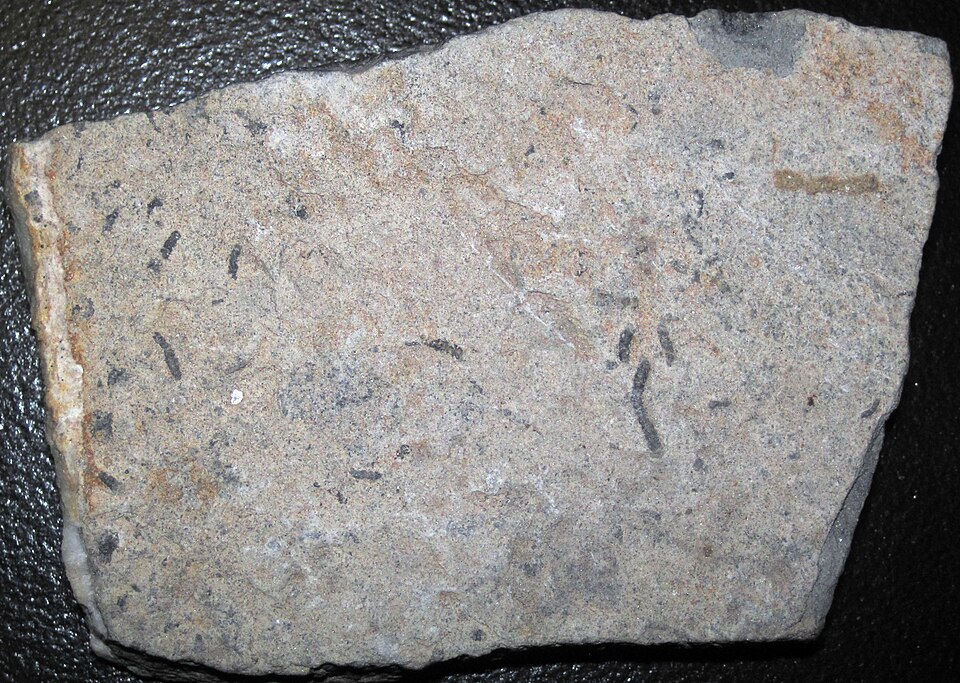
The term “small shelly fauna” (SSF), also called “small shelly fossils,” refers to diverse assemblages of tiny mineralized fossils — typically ranging from a few hundred micrometers to a few millimeters in size — that characterize the earliest Cambrian sedimentary record. These fossils include tubes, caps, spines, scales, plates, and coiled shells composed of calcium carbonate, calcium phosphate, or silica.1, 6 First recognized as a coherent assemblage in the 1970s through acid-dissolution studies of Early Cambrian limestones in Siberia, Mongolia, and China, the SSF represent the earliest widespread biomineralization event in animal evolution, predating the appearance of the large-bodied animals traditionally associated with the Cambrian explosion by roughly 10–20 million years.1, 16
_(45453979394).jpg)
Ediacaran precursors
Biomineralization did not begin abruptly at the Cambrian boundary. The terminal Ediacaran period (approximately 550–539 Ma) saw the appearance of the earliest known skeletal organisms, most notably Cloudina and Namacalathus. Cloudina is a small tubular organism composed of nested, funnel-shaped calcium carbonate shells, found worldwide in Ediacaran reef and carbonate platform settings.2, 3 Its phylogenetic affinities remain uncertain — it has been variously compared to cnidarians, polychaete worms, and other groups — but it is significant as the oldest known organism to produce a mineralized skeleton, and it bears some of the oldest evidence of predatory borings, suggesting that predation pressure may have been one driver of early biomineralization.3, 12, 15
Namacalathus, from the Nama Group of Namibia (approximately 549–543 Ma), is a goblet-shaped organism attached to the substrate by a stem, with a hollow, perforated cup made of calcium carbonate. Its morphology suggests a filter-feeding ecology, and it has been tentatively placed among stem-group lophotrochozoans, though its exact relationships are debated.5 Together with Cloudina, Namacalathus demonstrates that the capacity for skeletal biomineralization evolved in the latest Ediacaran, before the dramatic diversification of skeletal forms in the earliest Cambrian.4, 12
The Fortunian assemblage
The base of the Cambrian system (approximately 539 Ma) is defined by the first appearance of the trace fossil Treptichnus pedum, but the accompanying body fossil record is dominated by small shelly fossils rather than the large trilobites and brachiopods that appear later.16 The earliest Cambrian (Fortunian Stage) SSF assemblages are characterized by simple tubular and cap-shaped forms. Anabarites is a distinctive three-lobed tube of calcium carbonate that appears near the base of the Cambrian in Siberia, Mongolia, and China, and is one of the index fossils for the earliest Cambrian biozone.1, 16 Protohertzina, small phosphatic spines interpreted as grasping elements of chaetognaths (arrow worms) or similar predatory organisms, is another characteristic Fortunian element, suggesting that predation was already a significant ecological force.1, 15
The slightly younger Tommotian Stage (an informal stage used primarily for Siberian sequences) sees a dramatic increase in SSF diversity. Tommotiid sclerites — phosphatic plates of varying shape — become abundant and are now understood to have been assembled into multi-element external skeletons (scleritomes) covering the bodies of their bearers.7 Some tommotiids, particularly Eccentrotheca and Camenella, have been placed along the stem lineage of brachiopods based on detailed comparisons of sclerite arrangement and shell microstructure, providing a rare link between the enigmatic SSF and a well-known living phylum.8
Taxonomic diversity and the problem of disarticulation
One of the central challenges in studying the SSF is that many of these fossils represent disarticulated sclerites or skeletal elements from larger composite skeletons. An animal that bore dozens or hundreds of distinct sclerite types across its body would, after death and disarticulation, contribute numerous morphologically distinct fossils to the sediment, each potentially assigned to a different taxon.1, 6 This taphonomic bias inflates apparent taxonomic diversity and makes it difficult to reconstruct the whole organisms from their scattered remains.
The problem has been partially resolved by the discovery of articulated specimens in exceptional preservation sites. Halkieriids, for example, were long known only from isolated sclerites, but the discovery of complete Halkieria evangelista from the Sirius Passet Lagerstätte of Greenland revealed a slug-like animal with a dorsal coat of sclerites and a shell at each end, resembling both molluscs and brachiopods.1 Similarly, the reconstruction of tommotiid scleritomes has been made possible by rare finds of partially articulated specimens that reveal how individual sclerite types were arranged on the living animal.7, 8
Multiple origins of biomineralization
A remarkable feature of the SSF is the diversity of mineral chemistries employed. Different lineages independently evolved the ability to secrete skeletons of calcium carbonate (both aragonite and calcite), calcium phosphate (apatite), and silica.9, 13 This polyphyletic origin of biomineralization suggests that the chemical conditions of Early Cambrian oceans — including rising calcium ion concentrations, changing seawater saturation states, and possibly increased oxygen availability — provided a permissive environment in which multiple lineages convergently evolved skeletal hard parts.9, 14
Andrew Knoll has argued that the specific mineral chemistry adopted by each lineage depended on the pre-existing biochemistry of calcium regulation in its cells: lineages that managed intracellular calcium primarily through carbonate chemistry evolved carbonate skeletons, while those using phosphate-based calcium regulation evolved phosphatic skeletons.13 The near-simultaneous appearance of diverse biomineralization strategies across unrelated lineages is difficult to explain by genetic innovation alone and points to an environmental trigger — most likely a combination of changing ocean chemistry, rising oxygen levels, and escalating predation pressure — that crossed a threshold enabling and favoring skeleton formation.9, 14, 15
Ecological implications
The appearance of mineralized skeletons in the SSF marks a fundamental shift in marine ecology. Predatory borings in Cloudina shells represent some of the oldest direct evidence of predation in the fossil record, and the subsequent diversification of defensive skeletal morphologies — spines, thick shells, sclerite armor — during the earliest Cambrian is consistent with an escalating predator-prey arms race.3, 10, 15 The Cambrian explosion itself, with its dramatic diversification of body plans and ecological strategies, can be viewed as the culmination of trends that began with the SSF: the innovation of hard parts opened new ecological niches, enabled new modes of predation and defense, and fundamentally restructured marine food webs.10, 11
Microstructure and the mechanics of early biomineralization
Study of shell microstructure in SSF taxa has revealed that the earliest skeletal organisms employed a range of mineralization strategies at the ultrastructural level. Porter demonstrated that many Cambrian SSF taxa secreted shells composed of aragonite needles, calcitic prisms, or laminated phosphatic layers, with microstructural organization varying between lineages in ways that reflect phylogenetic affinity rather than environmental conditions alone.19 The tommotiid sclerites, for example, display a distinctive layered microstructure of phosphatic lamellae alternating with organic-rich interlayers, a pattern consistent with periodic, biologically controlled secretion rather than passive mineral precipitation.7, 19
The relationship between seawater chemistry and the mineral phase adopted by early skeletal organisms has been examined quantitatively. Porter found a statistically significant correlation between the dominant calcium carbonate polymorph in SSF shells (aragonite versus calcite) and the inferred Mg/Ca ratio of contemporaneous seawater: organisms that evolved skeletons during “aragonite sea” intervals tended to secrete aragonite, while those originating during “calcite sea” intervals favored calcite.20 This pattern suggests that the ambient seawater chemistry constrained the mineral phase available to early biomineralizers, even though the process of skeleton formation was biologically mediated.20, 14
Phosphatized embryos and the Doushantuo fauna
Although not traditionally included among the SSF, the phosphatized microfossils of the Doushantuo Formation (Ediacaran, approximately 600–570 Ma) in South China provide a crucial earlier chapter in the record of animal-grade biological complexity. These fossils include structures interpreted as animal embryos at various cleavage stages, preserved by early diagenetic phosphatization in exquisite cellular detail.17 While the phylogenetic interpretation of some Doushantuo microfossils remains debated — some may represent algae or non-metazoan holozoans rather than true animals — they demonstrate that phosphatic preservation of sub-millimeter biological structures was possible well before the Cambrian, and they establish the taphonomic window through which SSF are recovered.17, 4 Macroevolutionary analysis of the earliest Cambrian by Kouchinsky and colleagues showed that the diversification of mineralized skeletons proceeded in two pulses: an initial radiation of simple tubes and sclerites in the Fortunian, followed by a second, more diverse radiation of complex multi-element skeletons in Cambrian Stage 2 through Stage 4.18
Biostratigraphic utility
Despite the taxonomic difficulties posed by disarticulation, small shelly fossils are invaluable for biostratigraphy of the earliest Cambrian, a period for which trilobites — the traditional Cambrian index fossils — are absent. SSF-based biozones provide the primary correlation framework for Lower Cambrian strata worldwide, with distinctive assemblages such as the Anabarites trisulcatus zone, the Purella antiqua zone, and the Lapworthella zones used to correlate sections across Siberia, China, Australia, and elsewhere.1, 16 The SSF thus serve a dual role in paleontology: they record the dawn of animal biomineralization and provide the chronological framework for understanding it.4
References
Namacalathus from the Nama Group of Namibia: implications for Ediacaran skeletal organisms
Skeletal reefs, tubular skeletal organisms, and biomineralization in the latest Ediacaran