Overview
- The naturalistic fallacy, identified by G. E. Moore in Principia Ethica (1903), is the alleged error of defining the property of moral goodness in terms of any natural property such as pleasure, evolutionary fitness, or desire-satisfaction — an error exposed by Moore’s ‘open question argument,’ which holds that for any proposed natural definition of ‘good,’ it remains a meaningful and non-trivial question whether things possessing that natural property really are good.
- The naturalistic fallacy is closely related to but distinct from Hume’s is–ought gap, which holds that no purely descriptive premises about how the world is can, by logic alone, entail normative conclusions about how it ought to be — a principle that challenges attempts to ground morality in science, evolution, or natural law.
- The fallacy has significant implications for the moral argument for God’s existence: if moral properties cannot be reduced to natural properties, theists argue this supports a transcendent ground for morality, while critics respond that divine command theory commits an analogous error by defining goodness in terms of God’s will.
The naturalistic fallacy is a concept in metaethics that designates the alleged error of identifying the property of moral goodness with any natural property — that is, any property whose instantiation can be established through empirical observation or scientific inquiry.1 The term was coined by G. E. Moore in Principia Ethica (1903), where it served as the foundation for his argument that “good” is a simple, indefinable, non-natural property, incapable of analysis into more basic components. The naturalistic fallacy and the closely related is–ought gap identified by David Hume remain central to debates about the foundations of morality, the relationship between science and ethics, and the viability of both secular and theistic approaches to grounding moral claims.1, 2
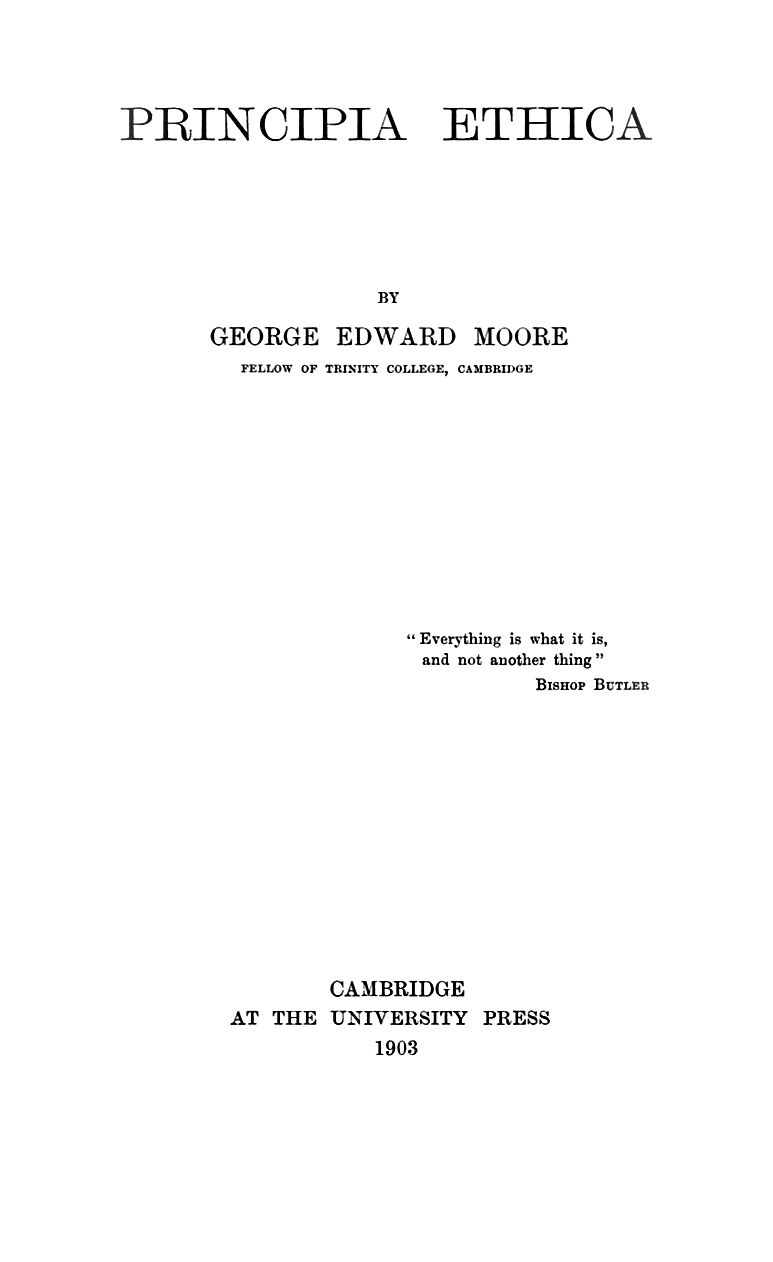

Moore’s open question argument
Moore’s central contention was that every attempt to define “good” in terms of some natural property — pleasure, evolutionary fitness, what is desired, what satisfies human needs — fails, and fails for a single reason: for any proposed definition, it remains a meaningful, open question whether things possessing the defining property really are good. If good simply meant “pleasant,” then the question “This is pleasant, but is it good?” would be trivially equivalent to “This is pleasant, but is it pleasant?” — a closed question admitting of no genuine inquiry. Yet the question plainly is not trivial; a competent speaker can meaningfully wonder whether everything pleasant is good, which shows that “good” and “pleasant” do not mean the same thing.1
Moore applied this argument against every form of ethical naturalism available to him. Against hedonists like Jeremy Bentham, who identified goodness with pleasure, Moore argued that the open question demonstrates the non-identity of good and pleasant. Against evolutionists like Herbert Spencer, who identified goodness with what is “more evolved” or what promotes evolutionary fitness, Moore pointed out that one can coherently ask whether what promotes survival really is good.1 Against metaphysical ethicists who defined goodness in terms of some supernatural property — conformity to God’s will, for example — Moore held that the same fallacy applies: it remains an open question whether what God commands is good. Moore thus treated the fallacy as encompassing both naturalistic and supernaturalistic reductions of moral goodness, though the “naturalistic fallacy” label has stuck primarily to the naturalistic versions.1, 3
Moore concluded that goodness is a simple, non-natural property, known by a kind of direct intellectual intuition. Just as the color yellow cannot be analyzed into simpler components but is known directly by sensory experience, goodness cannot be analyzed into natural components but is known directly by moral intuition.1 This conclusion established Moore as a founding figure of ethical non-naturalism and moral intuitionism, positions that continue to have sophisticated defenders in contemporary metaethics.14
Hume’s is–ought gap
Although Moore coined the phrase “naturalistic fallacy,” the underlying insight has roots in a passage of David Hume’s A Treatise of Human Nature (1739–1740) that has become one of the most cited in the history of moral philosophy. Hume observed that in “every system of morality” he had encountered, the author proceeds for some time establishing factual claims about God, human nature, or society, and then suddenly shifts from “is” and “is not” to “ought” and “ought not” — a transition that is made without explanation and that, Hume suggested, requires one. The passage implies that no set of purely descriptive premises can, by logic alone, entail a normative conclusion: you cannot derive an “ought” from an “is.”2
The is–ought gap and the naturalistic fallacy are related but distinct. The is–ought gap is a claim about logical entailment: descriptive premises do not logically entail normative conclusions. The naturalistic fallacy is a claim about property identity: moral goodness is not identical to any natural property. A philosopher might accept the is–ought gap (acknowledging that you cannot deduce moral conclusions from factual premises alone) while rejecting Moore’s specific diagnosis (denying that goodness is a non-natural property). Conversely, one might accept Moore’s non-naturalism while acknowledging that the is–ought gap as Hume formulated it is more modest than Moore’s sweeping claim.11 Together, however, the two arguments constitute a formidable challenge to any project of grounding morality in nature, science, or empirical observation.
Challenges from moral naturalism
The naturalistic fallacy has not gone unchallenged. Ethical naturalists have responded to Moore in several ways. One influential line of argument, developed by David Brink and other Cornell realists, distinguishes between meaning and reference. Even if “good” and “pleasure” differ in meaning (which is what the open question argument shows), they might nonetheless refer to the same property, just as “water” and “H₂O” differ in meaning but denote the same substance. On this view, Moore’s argument establishes only that “good” cannot be given a synonymous definition in natural terms, not that goodness fails to be a natural property.5
Philippa Foot offered a different naturalistic strategy in Natural Goodness (2001), arguing that moral evaluations of human beings are logically continuous with evaluations of other living organisms. Just as a defective wolf is one that fails to function as wolves characteristically do, a morally defective human is one who fails to exhibit the characteristic excellences of the human life form. On this view, “good” as applied to humans is no more mysterious than “good” as applied to wolves or oak trees, and no non-natural property need be invoked.9 R. M. Hare, taking a different approach entirely, argued that the open question argument proves only that “good” has a prescriptive or evaluative meaning that cannot be captured by purely descriptive terms — a conclusion compatible with his own prescriptivist metaethics, which treats moral judgments as universal prescriptions rather than descriptions of non-natural properties.12
These responses have kept the debate alive for over a century. While few contemporary metaethicists accept Moore’s specific conclusion that goodness is a simple non-natural quality known by intuition, the open question argument remains a live challenge to reductive forms of naturalism, and the broader point — that moral concepts resist straightforward reduction to descriptive ones — continues to shape the field.14
Evolution and the naturalistic fallacy
Attempts to derive moral norms from evolutionary biology have been a recurrent target of the naturalistic fallacy charge. Herbert Spencer’s nineteenth-century social Darwinism, which treated the direction of evolution as a guide to moral progress, was one of Moore’s original examples of the fallacy.1 In the twentieth century, E. O. Wilson’s Sociobiology (1975) proposed that the social sciences and ethics could be “biologicized” — that understanding the evolutionary origins of moral sentiments would illuminate the content of morality itself.6 Critics argued that Wilson’s program conflated the causal explanation of moral beliefs (why we have them) with their justification (whether they are correct), committing the naturalistic fallacy by sliding from facts about evolutionary origins to conclusions about moral truth.7
Michael Ruse has offered a more philosophically sophisticated evolutionary account, arguing that evolution has endowed human beings with moral sentiments that function as if they tracked objective moral truths, even though in fact no such truths exist. On Ruse’s view, the naturalistic fallacy is best understood not as a logical error to be avoided but as a deep truth about the relationship between facts and values: evolution explains why we have the moral intuitions we do without vindicating those intuitions as tracking any mind-independent moral reality.8 Peter Singer, by contrast, has argued that while the genetic origins of moral sentiments do not determine their content, the evolutionary expansion of moral concern — from kin to tribe to nation to species — provides a factual framework within which moral reasoning can operate, without committing the naturalistic fallacy because the normative conclusions are grounded in rational reflection rather than biological imperatives alone.7
Implications for theistic ethics
The naturalistic fallacy figures prominently in debates between secular and theistic approaches to morality. Proponents of the moral argument for God’s existence have argued that the irreducibility of moral properties to natural properties supports the existence of a transcendent moral lawgiver. If goodness cannot be identified with any natural property, then its source must lie outside nature — in God or a divine moral order. C. S. Lewis, William Lane Craig, and other apologists have used this reasoning to argue that objective morality requires a theistic foundation: without God, there is no adequate explanation for the existence of non-natural moral truths.16
Critics have responded that this argument is vulnerable to the same logic that Moore deployed against naturalism. If the open question argument shows that goodness cannot be identified with any natural property, it equally shows that goodness cannot be identified with any supernatural property, including conformity to God’s will. The question “God commands this, but is it good?” is no less open than “This is pleasant, but is it good?” — a point that connects the naturalistic fallacy directly to the Euthyphro dilemma.1, 4 If good is defined as what God commands, then Moore’s argument applies: it remains a meaningful question whether what God commands is good, which shows that the two concepts are not identical. J. L. Mackie pressed this point in Ethics: Inventing Right and Wrong (1977), arguing that the failure of both naturalistic and supernaturalistic definitions of goodness supports an error theory: moral claims purport to describe objective features of reality, but no such features exist.4
The natural law tradition, rooted in the work of Thomas Aquinas, attempts to navigate between these positions. Aquinas held that natural law is grounded in human nature as created by God: the basic goods that human beings naturally pursue (life, knowledge, sociability, reproduction) are goods because God designed human nature to pursue them, and practical reason can discern these goods without direct appeal to divine revelation.10 Critics have argued that this account either commits the naturalistic fallacy (by identifying goodness with what human nature tends toward) or collapses into divine command theory (by making the goodness of natural goods dependent on God’s creative intent). Defenders reply that natural law theory does not define goodness in terms of natural tendencies but rather holds that practical reason grasps basic goods as self-evidently worth pursuing — a position that sidesteps the is–ought gap by locating moral knowledge in practical rather than theoretical reason.15
Significance and continuing debate
The naturalistic fallacy and the is–ought gap remain foundational to metaethics, shaping the options available to anyone who seeks to ground morality in something outside moral intuition itself. Whether moral properties are natural, non-natural, supernatural, or illusory; whether moral knowledge is a form of perception, reasoning, or sentiment; whether the evolutionary origins of moral beliefs tell us anything about their truth — all of these questions are framed, in part, by the challenges that Moore and Hume articulated.14
The practical stakes are substantial. If the naturalistic fallacy is genuine, then no amount of scientific information about human nature, evolutionary history, or neurological function can, by itself, establish a moral conclusion. Science can inform moral reasoning by revealing the consequences of different courses of action, but it cannot replace moral reasoning by identifying goodness with any empirically discoverable property.11, 16 This conclusion does not settle whether morality requires a theistic foundation, a Moorean non-naturalism, or some other metaethical framework. What it does establish is a constraint on any adequate moral theory: the constraint that the evaluative cannot be simply read off the descriptive, that the gap between “is” and “ought” must be acknowledged even if it cannot be eliminated, and that the question of what makes something good is never answered merely by saying what it is.1, 13