Overview
- Apocalyptic literature is a genre of ancient Jewish and Christian writing characterised by revelatory visions, symbolic imagery, angelic mediators, cosmic dualism between good and evil, and a deterministic view of history moving toward a climactic divine intervention -- with the Book of Daniel and the Book of Revelation as its two canonical exemplars.
- The genre emerged in the Second Temple period (roughly 300 BCE to 100 CE) during times of political crisis and foreign domination, building on earlier prophetic traditions while introducing distinctive new elements including pseudonymous authorship, elaborate animal symbolism, periodisation of history, and belief in bodily resurrection and final judgement.
- Beyond Daniel and Revelation, a substantial body of non-canonical apocalyptic texts -- including 1 Enoch, 4 Ezra, 2 Baruch, and the Apocalypse of Abraham -- shaped Jewish and early Christian theology, influencing beliefs about angels, demons, the afterlife, messianic expectation, and the end of the present age.
Apocalyptic literature constitutes one of the most influential and frequently misunderstood genres in the biblical tradition. The term derives from the Greek word apokalypsis, meaning "unveiling" or "revelation," and denotes a class of texts in which a supernatural being discloses heavenly secrets to a human recipient, typically through visions rich in symbolic imagery.1 The genre flourished during the Second Temple period of Judaism (roughly 300 BCE to 100 CE), a time of repeated political crises — Seleucid persecution, Roman occupation, and the destruction of the Jerusalem Temple — that provoked urgent questions about divine justice and the fate of the faithful.7, 8
The two canonical apocalypses, Daniel in the Hebrew Bible and Revelation in the New Testament, represent only a fraction of a much larger body of apocalyptic writing. Texts such as 1 Enoch, 4 Ezra, 2 Baruch, and the Apocalypse of Abraham developed theological concepts — bodily resurrection, final judgement, angelic hierarchies, cosmic dualism, messianic expectation — that profoundly shaped both rabbinic Judaism and early Christianity.5, 6

Defining the genre
Scholars have debated the precise definition of apocalyptic literature for over a century. The most widely cited definition was formulated by the Society of Biblical Literature Apocalypse Group in 1979 and refined by John J. Collins: "a genre of revelatory literature with a narrative framework, in which a revelation is mediated by an otherworldly being to a human recipient, disclosing a transcendent reality which is both temporal, insofar as it envisages eschatological salvation, and spatial, insofar as it involves another, supernatural world."1
Collins distinguishes between "historical" apocalypses, which survey world history in symbolic form and culminate in divine judgement (Daniel 7–12 is the paradigmatic example), and "otherworldly journey" apocalypses, in which the visionary is transported through the heavens or the underworld (as in sections of 1 Enoch).1 The genre is also characterised by pseudonymous authorship and by a deterministic philosophy of history in which the sequence of ages has been fixed in advance by God.1, 8
It is important to distinguish between apocalyptic literature as a literary genre and apocalypticism as a broader social and theological movement. Not all texts influenced by apocalyptic ideas are formal apocalypses, and not all apocalypses reflect the same social situation or theological programme.1, 7
Origins and historical roots
Paul Hanson influentially argued that apocalyptic eschatology developed from within Israelite prophecy itself, specifically from the visionary wing of post-exilic prophecy represented by Third Isaiah (Isaiah 56–66) and Zechariah 9–14.7 Other scholars have emphasised the influence of Persian (Zoroastrian) dualism.10 Norman Cohn traced the roots of apocalyptic faith to ancient Near Eastern combat myths.10
Paolo Sacchi proposed that the earliest apocalyptic ideas, found in the Astronomical Book and Book of the Watchers in 1 Enoch, pre-date the Maccabean crisis and reflect a distinctive priestly tradition.8 The consensus recognises that apocalypticism drew on multiple sources — prophetic eschatology, wisdom traditions, mythological motifs, and possibly Persian religious ideas.1
The Book of Daniel
The Book of Daniel is the only fully developed apocalypse in the Hebrew Bible. Chapters 1–6 contain court tales, while chapters 7–12 present symbolic visions surveying world history.3
The vision of four successive kingdoms in Daniel 2 and Daniel 7 is widely understood as a review of history from the Babylonian Empire through the Seleucid dynasty, with the "little horn" identified as Antiochus IV Epiphanes.3, 9 The "one like a son of man" (Daniel 7:13-14) has been interpreted as a symbol for faithful Israel, an angelic figure, or a messianic individual.3
Daniel 10–12 traces Ptolemaic and Seleucid history with precision that convinces most scholars the text was composed around 164 BCE.3, 9 Daniel 12:2–3 contains the clearest statement of bodily resurrection in the Hebrew Bible.3, 16
1 Enoch and the Enochic tradition
The collection known as 1 Enoch is the most important non-canonical apocalyptic text. The complete text survives only in Ethiopic, although Aramaic fragments were found among the Dead Sea Scrolls.6 The book comprises five major sections: the Book of the Watchers (chapters 1–36), the Similitudes of Enoch (chapters 37–71), the Astronomical Book (chapters 72–82), the Book of Dreams (chapters 83–90), and the Epistle of Enoch (chapters 91–108).5, 6
The Book of the Watchers (third century BCE) narrates the descent of rebellious angels who mate with human women and teach humanity forbidden arts. This myth provides an etiology for the origin of evil that strongly influenced later demonology.6 The Astronomical Book presents a 364-day solar calendar reflecting priestly concerns about liturgical timing.2, 8
The Similitudes of Enoch introduced the "Son of Man" as a pre-existent heavenly being who will execute judgement on behalf of the righteous — a concept that may have influenced New Testament Christology.1, 6
4 Ezra, 2 Baruch, and the post-70 CE crisis
The destruction of the Second Temple by Rome in 70 CE provoked a second wave of Jewish apocalyptic writing. 4 Ezra and 2 Baruch, both composed in the late first century CE, were pseudonymously attributed to figures from the destruction of the first Temple in 586 BCE.12
4 Ezra is structured around seven visions in which Ezra agonises over divine justice. The willingness to voice radical doubt makes it one of the most theologically sophisticated works of the Second Temple period.12, 1
2 Baruch emphasises that the heavenly Jerusalem is preserved by God and that the righteous will be transformed in the resurrection. Both texts articulate the doctrine of two ages — the present corrupt age (olam ha-zeh) and the glorious age to come (olam ha-ba) — that became fundamental to rabbinic eschatology.12, 16
The Book of Revelation
The Book of Revelation is the only full apocalypse in the New Testament. Written around 95 CE, it opens with letters to seven churches in the Roman province of Asia before presenting visions of heavenly worship, divine judgement, cosmic war, the fall of "Babylon" (Rome), and the establishment of a new heaven and new earth.4, 14
Revelation draws extensively on the imagery of Daniel, Ezekiel, Isaiah, and Zechariah while transforming it into a distinctively Christian theological vision. The "one like a son of man" of Daniel 7 is identified with the risen Christ (Revelation 1:13-16); Ezekiel's living creatures reappear around the divine throne (Revelation 4:6-8).4
Unlike most Jewish apocalypses, Revelation is not pseudonymous. The political dimension has received increasing scholarly attention; Gorman and others argue the text critiques Roman imperial ideology.4, 11 The number 666 (Revelation 13:18) is most commonly interpreted as the gematria of "Nero Caesar."4, 14
Apocalypticism at Qumran
The Dead Sea Scrolls discovered at Qumran dramatically expanded scholarly understanding of Jewish apocalypticism. The community preserved copies of 1 Enoch, Daniel, and Jubilees, along with compositions including the War Scroll (1QM), describing an eschatological battle between the "Sons of Light" and the "Sons of Darkness."2
The community believed they were living in the last days and expected two messianic figures — a priestly Messiah of Aaron and a royal Messiah of Israel.2, 15 The Community Rule (1QS) describes a cosmic dualism between the "Spirit of Truth" and the "Spirit of Falsehood."2
Key theological themes
Despite their diversity, apocalyptic texts share recurring theological themes that distinguish them from other biblical genres.
Cosmic dualism. Apocalyptic texts operate with a sharp distinction between God and the angelic hosts on one side and Satan (or Belial, Mastema, Azazel) and the demonic powers on the other. This dualism provides a framework for understanding suffering and injustice.1, 10
Determinism and periodisation. History follows a divinely predetermined sequence of ages leading to a fixed consummation. The four-kingdom scheme in Daniel, the seventy weeks of years (Daniel 9:24-27), and the ten-week apocalypse in 1 Enoch 93 all express the conviction that God has established the timetable of history in advance.1, 3
Resurrection and afterlife. Apocalyptic literature was the primary context in which the doctrine of bodily resurrection developed in Judaism. Daniel 12:2, the Similitudes of Enoch, and 4 Ezra progressively articulated the expectation that the dead would be raised, judged, and assigned to eternal reward or punishment.16, 1
Messianic expectation. Many apocalyptic texts include a messianic figure. The Davidic messiah, the heavenly Son of Man, the priestly messiah, and the prophetic messiah represent distinct but sometimes overlapping conceptions that provided the conceptual background for early Christian claims about Jesus.15
History of interpretation
The interpretation of apocalyptic texts has followed several major approaches: the historicist method reads the symbols as a coded chronology of church history; the futurist approach understands them as predictions of events still in the future; the preterist reading interprets them as references to events contemporary with the author; and the idealist approach reads them as symbolic depictions of the perennial struggle between good and evil.13, 14
Modern scholarship recognises that apocalyptic texts were meaningful to their original audiences as responses to concrete historical circumstances, while acknowledging that their symbolic richness has enabled them to speak to new situations. Craig Koester has argued for a "prophetic" reading that combines attention to the original context with recognition of the capacity of the text to address recurring patterns of injustice.14
Significance and legacy
Apocalyptic literature exerted an influence on Judaism and Christianity that far exceeds the modest space it occupies in the biblical canon. Bodily resurrection, final judgement, Satan as a cosmic adversary, the messianic age, the two ages of history, and angelic hierarchies — all first articulated in apocalyptic texts — became foundational doctrines in both traditions.1, 16 The proclamation of the kingdom of God by Jesus, the Pauline expectation of an imminent parousia, and the early Christological interpretations of the Son of Man all presuppose the conceptual world created by Jewish apocalypticism.
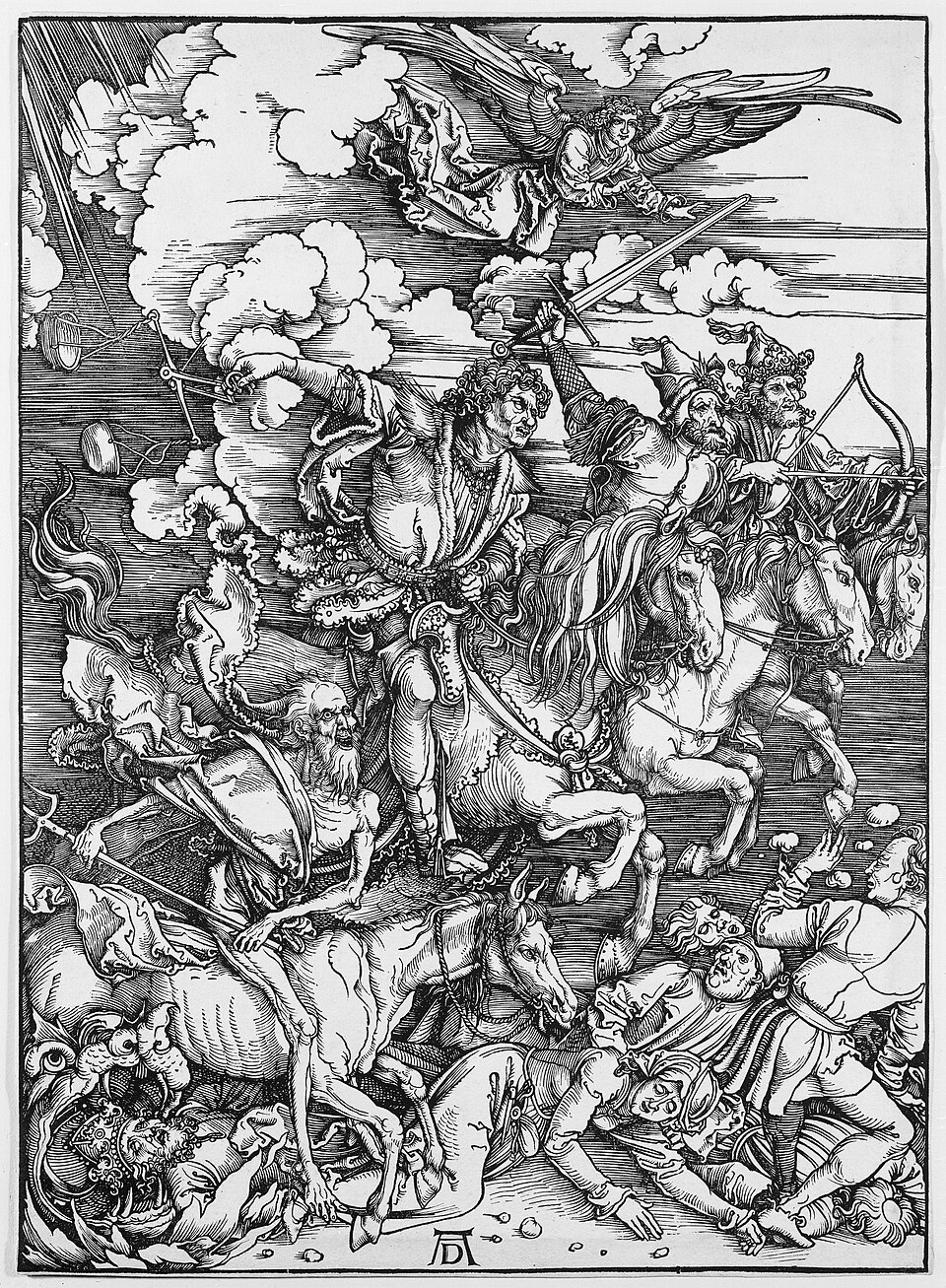
Apocalyptic imagery — the four horsemen, the mark of the beast, Armageddon, the millennium, the new Jerusalem — entered the cultural vocabulary of societies shaped by the Bible and has been adapted, secularised, and reinterpreted in literature, art, and political rhetoric for two millennia.13, 14 Understanding the origins, conventions, and theological purposes of apocalyptic literature remains essential for any historically responsible interpretation of these texts and the traditions they continue to shape.
References
Resurrection, Immortality, and Eternal Life in Intertestamental Judaism and Early Christianity