Overview
- Thirteen letters in the New Testament are attributed to Paul of Tarsus, but only seven contain language, theology, and historical details that are internally consistent with one another; the remaining six differ from those seven in vocabulary, sentence structure, theological emphasis, and the historical situations they presuppose.
- The Pastoral Epistles (1 Timothy, 2 Timothy, and Titus) contain over 300 words not found in the other Pauline letters, use a different set of connective particles and function words, and address an ecclesiastical hierarchy of bishops, elders, and deacons that does not appear in the undisputed letters.
- The letters themselves provide the primary evidence for these distinctions: where the undisputed Paul writes short, argumentative sentences with frequent digressions, the disputed letters employ long, liturgical periods; where the undisputed Paul speaks of present suffering and imminent return, several disputed letters speak of a cosmic Christ enthroned in the heavenly places and a salvation already accomplished.
Thirteen letters in the New Testament identify Paul of Tarsus as their author. Each opens with a salutation naming Paul, and several include co-senders such as Timothy, Silvanus, or Sosthenes. These thirteen letters — Romans, 1 Corinthians, 2 Corinthians, Galatians, Ephesians, Philippians, Colossians, 1 Thessalonians, 2 Thessalonians, 1 Timothy, 2 Timothy, Titus, and Philemon — constitute the Pauline corpus, the largest body of text attributed to a single named author in the New Testament. All thirteen claim Pauline authorship in their opening lines. The internal evidence of the letters themselves, however, reveals substantial differences among them — in vocabulary, sentence structure, theological content, and historical setting — that divide the corpus into distinct groups.
Seven of the thirteen letters share a consistent vocabulary, argumentative style, and set of theological concerns: Romans, 1 Corinthians, 2 Corinthians, Galatians, Philippians, 1 Thessalonians, and Philemon. These seven are commonly designated the "undisputed" letters because their internal features are mutually consistent. The remaining six — Ephesians, Colossians, 2 Thessalonians, 1 Timothy, 2 Timothy, and Titus — differ from the undisputed seven in measurable ways. This article presents the texts themselves: the self-identifications each letter contains, the vocabulary and stylistic features that distinguish the groups, the theological positions each letter articulates, and the historical situations each presupposes.4
The thirteen letters and their self-identification
Every letter in the Pauline corpus opens with a statement identifying Paul as its author. The undisputed letters present these identifications in characteristic ways. Romans begins: "Paul, a servant of Jesus Christ, called to be an apostle, set apart for the gospel of God" (Romans 1:1, NRSV). First Corinthians opens: "Paul, called to be an apostle of Christ Jesus by the will of God, and our brother Sosthenes" (1 Corinthians 1:1, NRSV). Galatians begins with an emphatic defense of apostolic authority: "Paul an apostle — sent neither by human commission nor from human authorities, but through Jesus Christ and God the Father, who raised him from the dead" (Galatians 1:1, NRSV). Philippians names Paul and Timothy together: "Paul and Timothy, servants of Christ Jesus, to all the saints in Christ Jesus who are in Philippi, with the bishops and deacons" (Philippians 1:1, NRSV). First Thessalonians names three co-senders: "Paul, Silvanus, and Timothy, to the church of the Thessalonians" (1 Thessalonians 1:1, NRSV). Philemon opens: "Paul, a prisoner of Christ Jesus, and Timothy our brother, to Philemon our dear friend and co-worker" (Philemon 1, NRSV).

The disputed letters use similar salutations. Ephesians opens: "Paul, an apostle of Christ Jesus by the will of God, to the saints who are in Ephesus and are faithful in Christ Jesus" (Ephesians 1:1, NRSV). First Timothy begins: "Paul, an apostle of Christ Jesus by the command of God our Savior and of Christ Jesus our hope, to Timothy, my loyal child in the faith" (1 Timothy 1:1–2, NRSV). Second Thessalonians opens identically to 1 Thessalonians: "Paul, Silvanus, and Timothy, to the church of the Thessalonians" (2 Thessalonians 1:1, NRSV). All thirteen letters thus present themselves as written by Paul. The question of authorship arises not from the salutations — which are uniform in their Pauline attribution — but from the content that follows them.
The undisputed seven: internal consistency
The seven undisputed letters — Romans, 1 Corinthians, 2 Corinthians, Galatians, Philippians, 1 Thessalonians, and Philemon — share a network of cross-references, common vocabulary, consistent theological positions, and a recognizable argumentative style. They reference the same journeys, the same companions, and the same controversies. Paul's conflict with rival apostles in Galatia (Galatians 1–2) connects to the collection for Jerusalem described in 1 Corinthians 16 and 2 Corinthians 8–9 and completed in Romans 15:25–28. Timothy appears as a co-sender or emissary in 1 Corinthians 4:17, 2 Corinthians 1:1, Philippians 1:1, 1 Thessalonians 1:1, and Philemon 1. The prison setting referenced in Philippians 1:7, Philippians 1:13–14 and Philemon 1, Philemon 9–10 is consistent across both letters.
Stylistically, these seven letters are characterized by short, energetic sentences; frequent use of rhetorical questions; sudden digressions; and the adversative particle alla ("but") used to introduce sharp contrasts. Paul's Greek in these letters is vigorous but syntactically rough, marked by anacolutha (sentences that begin with one grammatical construction and shift to another mid-stream), parenthetical insertions, and chains of prepositional phrases that reflect a mind moving faster than the pen. Romans 3:21–28, Galatians 2:15–21, and 1 Corinthians 1:18–31 exemplify this style: dense, argumentative, and frequently interrupting itself.4
Theologically, the undisputed letters center on a set of recurring concepts: justification by faith apart from works of the law (dikaiosyne, "righteousness"; pistis, "faith"), the present experience of the Spirit as a foretaste of future salvation, the imminent return of Christ (parousia), the body of Christ as a metaphor for the community of believers, and the cross as the central symbol of God's power in weakness. These themes appear across all seven letters with consistent vocabulary and conceptual framework.4
Vocabulary and function words
The most quantifiable differences between the undisputed and disputed letters involve vocabulary. P. N. Harrison's 1921 study The Problem of the Pastoral Epistles documented that 1 Timothy, 2 Timothy, and Titus collectively contain 306 words not found elsewhere in the Pauline corpus. Of these, 175 appear nowhere else in the New Testament. Harrison calculated that the ratio of new words per page of Greek text in the Pastorals was dramatically higher than in any of the undisputed letters.1
Raw hapax legomena (words occurring only once in a corpus) are an imperfect measure of authorship because any author's vocabulary varies with subject matter and audience. A 2018 reassessment by Jermo van Nes applied linear regression analysis to control for letter length and subject variation. The results indicated that 1 and 2 Timothy contain significantly more hapax legomena than the undisputed letters even after controlling for these variables. When proper-noun hapaxes, words drawn from quotations, and compound words reducible to common lexemes were excluded, the statistical significance diminished but did not disappear for the Pastorals.2
More diagnostic than rare words, however, are function words — the conjunctions, particles, prepositions, and connective phrases that a writer uses unconsciously and that tend to remain stable across different subjects. The undisputed Paul frequently uses ara ("therefore"), dio ("therefore"), ara oun ("so then"), and the disclosure formula ou thelo hymas agnoein ("I do not want you to be ignorant"). These markers are absent or rare in the Pastoral Epistles. Conversely, the Pastorals employ expressions not found in the undisputed letters: pistos ho logos ("the saying is sure," used five times across 1 Timothy, 2 Timothy, and Titus), eusebeia ("godliness" or "piety," used ten times in the Pastorals and never in the undisputed Paul), and hygiainousa didaskalia ("sound teaching" or "healthy doctrine").1, 3
Selected vocabulary differences between undisputed and disputed Pauline letters1, 3, 4
| Feature | Undisputed letters | Pastoral Epistles |
|---|---|---|
| dikaiosyne (righteousness) | 57 occurrences across Romans, Galatians, Philippians, 2 Corinthians | 4 occurrences, used in a moral rather than forensic sense |
| pistis (faith) | Used as relational trust in Christ; "the faith of/in Christ" | Used as a body of doctrine; "the faith" as a fixed deposit |
| eusebeia (godliness/piety) | Not used | 10 occurrences (1 Tim 2:2, 3:16, 4:7, 4:8, 6:3, 6:5, 6:6, 6:11; 2 Tim 3:5; Titus 1:1) |
| pistos ho logos (the saying is sure) | Not used | 5 occurrences (1 Tim 1:15, 3:1, 4:9; 2 Tim 2:11; Titus 3:8) |
| hygiainousa didaskalia (sound teaching) | Not used | Used in 1 Tim 1:10, 2 Tim 4:3, Titus 1:9, 2:1 |
| ara oun (so then) | Frequent: Romans 5:18, 7:3, 8:12, 9:16, 9:18, 14:12, 14:19; Galatians 6:10; 1 Thessalonians 5:6 | Not used |
| en Christo (in Christ) | Approximately 73 occurrences; central theological formula | Rare; replaced by en Christo Iesou in fixed phrases |
The vocabulary differences between Ephesians and the undisputed letters follow a different pattern. Ephesians does not introduce as many new words as the Pastorals do, but it uses Pauline vocabulary in unfamiliar combinations and introduces terms drawn from a more cosmic theological register: ta epourania ("the heavenly places"), used five times in Ephesians and nowhere in the undisputed Paul; oikonomia ("plan" or "dispensation"), used in a cosmic sense rather than Paul's typical use of the word for stewardship; and to mysterion ("the mystery"), which in the undisputed Paul refers to God's plan for Jews and Gentiles (Romans 11:25) but in Ephesians expands to encompass the cosmic unification of all things in Christ (Ephesians 1:9–10, Ephesians 3:3–6, Ephesians 5:32).4
Sentence structure and literary style
The syntactic differences between the undisputed and disputed letters are visible at the level of individual sentences. The undisputed Paul writes in short, punchy clauses. He asks questions, answers them, raises objections, and responds — a style drawn from the Greco-Roman diatribe. Romans 6:1–2 illustrates: "What then are we to say? Should we continue in sin in order that grace may abound? By no means!" (NRSV). Galatians 3:1–5 fires off five rapid rhetorical questions in succession. The sentence breaks are frequent and the tone is combative.4
The letter to the Ephesians presents a markedly different syntactic profile. Ephesians 1:3–14 is, in the Greek text, a single sentence spanning twelve verses. The passage reads in part:
Blessed be the God and Father of our Lord Jesus Christ, who has blessed us in Christ with every spiritual blessing in the heavenly places, just as he chose us in Christ before the foundation of the world to be holy and blameless before him in love. He destined us for adoption as his children through Jesus Christ, according to the good pleasure of his will, to the praise of his glorious grace that he freely bestowed on us in the Beloved. In him we have redemption through his blood, the forgiveness of our trespasses, according to the riches of his grace that he lavished on us. With all wisdom and insight he has made known to us the mystery of his will, according to his good pleasure that he set forth in Christ, as a plan for the fullness of time, to gather up all things in him, things in heaven and things on earth.Ephesians 1:3–10, NRSV
The sentence continues for four more verses. This is liturgical prose, built from stacked prepositional phrases ("in Christ," "in love," "in the Beloved," "in him," "in Christ") and relative clauses that cascade forward without the abrupt breaks characteristic of the undisputed letters. Ephesians contains nine sentences exceeding fifty words in its six chapters. By comparison, the seven undisputed letters, which are collectively far longer, contain approximately nine such sentences total.4
Colossians displays similar tendencies. The Colossian hymn (Colossians 1:15–20) is a single, flowing period built from participial and relative clauses:
He is the image of the invisible God, the firstborn of all creation; for in him all things in heaven and on earth were created, things visible and invisible, whether thrones or dominions or rulers or powers — all things have been created through him and for him. He himself is before all things, and in him all things hold together. He is the head of the body, the church; he is the beginning, the firstborn from the dead, so that he might come to have first place in everything. For in him all the fullness of God was pleased to dwell, and through him God was pleased to reconcile to himself all things, whether on earth or in heaven, by making peace through the blood of his cross.Colossians 1:15–20, NRSV
The Pastoral Epistles differ from both the undisputed letters and from Ephesians/Colossians. Their sentences are neither the short diatribal bursts of the undisputed Paul nor the long liturgical periods of Ephesians. Instead, they employ a more conventional, even prosaic Greek, with straightforward declarative sentences, lists of virtues and vices, and practical instructions about church organization. The style is administrative rather than argumentative or doxological.1, 4
Theological differences across the corpus
The theological content of the Pauline letters varies across the three groups in ways that extend beyond vocabulary and style. Several areas of theological emphasis differ between the undisputed and disputed letters.
Justification and salvation. In the undisputed letters, Paul articulates justification as a present act of God accomplished through faith. Romans 3:21–28 states:
But now, apart from law, the righteousness of God has been disclosed, and is attested by the law and the prophets, the righteousness of God through faith in Jesus Christ for all who believe. For there is no distinction, since all have sinned and fall short of the glory of God; they are now justified by his grace as a gift, through the redemption that is in Christ Jesus. … For we hold that a person is justified by faith apart from works prescribed by the law.Romans 3:21–24, 28, NRSV
Galatians 2:15–16 makes the same argument in more compressed form: "We ourselves are Jews by birth and not Gentile sinners; yet we know that a person is justified not by the works of the law but through faith in Jesus Christ" (NRSV).
Ephesians 2:4–6 presents salvation in a different tense and framework:
But God, who is rich in mercy, out of the great love with which he loved us even when we were dead through our trespasses, made us alive together with Christ — by grace you have been saved — and raised us up with him and seated us with him in the heavenly places in Christ Jesus.Ephesians 2:4–6, NRSV
In the undisputed letters, believers have died with Christ in baptism but will be raised in the future (Romans 6:3–5: "we will certainly be united with him in a resurrection like his"). In Ephesians, the resurrection of the believer has already occurred: God "raised us up with him and seated us with him in the heavenly places." Salvation is presented as an accomplished cosmic event rather than an ongoing process to be completed at the parousia. The shift in tense — from future resurrection in the undisputed Paul to past-tense resurrection in Ephesians — represents a different understanding of where the believer stands in relation to the end of time.4
Eschatology. The undisputed Paul expects the imminent return of Christ. 1 Thessalonians 4:15–17 states:
For this we declare to you by the word of the Lord, that we who are alive, who are left until the coming of the Lord, will by no means precede those who have died. For the Lord himself, with a cry of command, with the archangel's call and with the sound of God's trumpet, will descend from heaven, and the dead in Christ will rise first. Then we who are alive, who are left, will be caught up in the clouds together with them to meet the Lord in the air; and so we will be with the Lord forever.1 Thessalonians 4:15–17, NRSV
Paul uses the first person plural: "we who are alive, who are left" — placing himself among those who expect to survive until the parousia. 2 Thessalonians 2:1–4 takes a different stance on the timing:
As to the coming of our Lord Jesus Christ and our being gathered together to him, we beg you, brothers and sisters, not to be quickly shaken in mind or alarmed, either by spirit or by word or by letter, as though from us, to the effect that the day of the Lord is already here. Let no one deceive you in any way; for that day will not come unless the rebellion comes first and the lawless one is revealed, the one destined for destruction.2 Thessalonians 2:1–4, NRSV
Where 1 Thessalonians presents the return of Christ as imminent — expected within the lifetime of the author — 2 Thessalonians introduces a sequence of events that must occur first: a rebellion, the revelation of a "lawless one," his exaltation in the temple, and his eventual destruction. The effect is to push the parousia further into the future by interposing unfulfilled preconditions. These two eschatological frameworks coexist within letters attributed to the same author and addressed to the same community.4
Christology. In the undisputed letters, Paul's christological language centers on the crucified and risen Christ: "We proclaim Christ crucified" (1 Corinthians 1:23, NRSV); "I decided to know nothing among you except Jesus Christ, and him crucified" (1 Corinthians 2:2, NRSV). The cross is the focal point of Paul's theology. In Colossians, the christological framework expands to a cosmic register:
He is the image of the invisible God, the firstborn of all creation; for in him all things in heaven and on earth were created, things visible and invisible, whether thrones or dominions or rulers or powers — all things have been created through him and for him.Colossians 1:15–16, NRSV
Colossians 2:9–10 adds: "For in him the whole fullness of deity dwells bodily, and you have come to fullness in him, who is the head of every ruler and authority" (NRSV). The language of cosmic preeminence, fullness (pleroma), and dominion over spiritual hierarchies ("thrones, dominions, rulers, powers") does not appear in the undisputed letters. The undisputed Paul speaks of Christ as the one "through whom are all things and through whom we exist" (1 Corinthians 8:6, NRSV), but does not develop the elaborate cosmic hierarchy present in Colossians and Ephesians.4
Ecclesiology and church order
The letters differ substantially in how they describe the organization of the Christian community. In the undisputed letters, Paul addresses congregations as charismatic communities where authority flows from spiritual gifts. 1 Corinthians 12:4–11 lists prophecy, tongues, healing, and interpretation of tongues as gifts distributed by the Spirit. The community exercises authority collectively: "When you come together, each one has a hymn, a lesson, a revelation, a tongue, or an interpretation" (1 Corinthians 14:26, NRSV). Paul mentions episkopoi ("overseers" or "bishops") and diakonoi ("deacons" or "ministers") only once in the undisputed letters, in the salutation of Philippians 1:1, without any description of their qualifications or duties.
The Pastoral Epistles present a community organized around a formal ecclesiastical hierarchy. 1 Timothy 3:1–13 specifies detailed qualifications for bishops and deacons:
The saying is sure: whoever aspires to the office of bishop desires a noble task. Now a bishop must be above reproach, married only once, temperate, sensible, respectable, hospitable, an apt teacher, not a drunkard, not violent but gentle, not quarrelsome, and not a lover of money. He must manage his own household well, keeping his children submissive and respectful in every way — for if someone does not know how to manage his own household, how can he take care of God's church? He must not be a recent convert, or he may be puffed up with conceit and fall into the condemnation of the devil. Moreover, he must be well thought of by outsiders, so that he may not fall into disgrace and the snare of the devil. Deacons likewise must be serious, not double-tongued, not indulging in much wine, not greedy for money; they must hold fast to the mystery of the faith with a clear conscience.1 Timothy 3:1–9, NRSV
Titus 1:5–9 provides parallel instructions for appointing elders (presbyteroi) and bishops in every town:
I left you behind in Crete for this reason, so that you should put in order what remained to be done, and should appoint elders in every town, as I directed you: someone who is blameless, married only once, whose children are believers, not accused of debauchery and not rebellious. For a bishop, as God's steward, must be blameless; he must not be arrogant or quick-tempered or addicted to wine or violent or greedy for gain; but he must be hospitable, a lover of goodness, prudent, upright, devout, and self-controlled. He must have a firm grasp of the word that is trustworthy in accordance with the teaching, so that he may be able both to preach with sound doctrine and to refute those who contradict it.Titus 1:5–9, NRSV
The Pastorals presuppose a community in which offices have become institutionalized: the bishop must not be a "recent convert" (implying a community old enough to have generations of members), must manage his household well as a prerequisite for managing the church, and must be "well thought of by outsiders" (suggesting a community concerned with its public reputation in the broader society). This institutional structure — fixed offices with formal qualifications, concern for respectability, the concept of "sound doctrine" as a body of teaching to be guarded — does not appear in the undisputed letters, where Paul addresses communities still in the process of formation and where authority is exercised through charismatic gifts rather than institutional appointment.4
The role of women across the corpus
The instructions about women's roles differ between the undisputed and disputed letters in ways that bear on the question of common authorship. In the undisputed letters, Paul names women as co-workers and leaders in the communities he addresses. Romans 16:1–2 introduces Phoebe as a diakonos ("deacon" or "minister") of the church at Cenchreae and a prostatis ("benefactor" or "patron") of many, including Paul himself. Romans 16:7 greets "Andronicus and Junia, my relatives who were in prison with me; they are prominent among the apostles, and they were in Christ before I was" (NRSV). Junia is named as "prominent among the apostles" — a designation that places a woman within the apostolic circle.
Galatians 3:28 articulates a principle of equality: "There is no longer Jew or Greek, there is no longer slave or free, there is no longer male and female; for all of you are one in Christ Jesus" (NRSV). 1 Corinthians 11:2–16, while imposing a head-covering requirement, presupposes that women are praying and prophesying in the assembly — activities of public leadership. 1 Corinthians 7 addresses questions of marriage and celibacy with a pattern of symmetrical instruction: "The wife does not have authority over her own body, but the husband does; likewise the husband does not have authority over his own body, but the wife does" (1 Corinthians 7:4, NRSV). The reciprocal framing applies the same obligations to husbands and wives.
The Pastoral Epistles present a different framework. 1 Timothy 2:11–15 states:
Let a woman learn in silence with full submission. I permit no woman to teach or to have authority over a man; she is to keep silent. For Adam was formed first, then Eve; and Adam was not deceived, but the woman was deceived and became a transgressor. Yet she will be saved through childbearing, provided they continue in faith and love and holiness, with modesty.1 Timothy 2:11–15, NRSV
The instruction prohibits women from teaching or exercising authority over men and grounds this prohibition in the order of creation and the narrative of the fall. The passage represents women's salvation as linked to childbearing. Ephesians 5:22–24 provides instructions about household relationships:
Wives, be subject to your husbands as you are to the Lord. For the husband is the head of the wife just as Christ is the head of the church, the body of which he is the Savior. Just as the church is subject to Christ, so also wives ought to be, in everything, to their husbands.Ephesians 5:22–24, NRSV
The Ephesians passage lacks the reciprocal framing of 1 Corinthians 7. It establishes a hierarchical analogy between Christ's headship over the church and the husband's headship over the wife. These instructions exist within the same corpus as Galatians 3:28 ("no longer male and female"), Romans 16:7 (Junia the apostle), and 1 Corinthians 11:5 (women prophesying in the assembly). The texts present these different positions under the same authorial name.4
Historical setting and situational evidence
The undisputed letters are embedded in a network of historical details that can be cross-referenced against the narrative of Acts and against one another. Paul's travel plans in Romans 15:22–29 (to visit Rome on his way to Spain after delivering the collection in Jerusalem) connect with the collection described in 1 Corinthians 16:1–4 and 2 Corinthians 8–9. The confrontation with Peter at Antioch (Galatians 2:11–14) connects with the council at Jerusalem described differently in Acts 15. The seven undisputed letters can be placed within a plausible chronological framework spanning approximately 50–58 CE, from 1 Thessalonians (the earliest) to Romans (among the latest).4
The Pastoral Epistles presuppose a historical situation that does not fit within the framework established by the undisputed letters and Acts. First Timothy presupposes that Paul left Timothy in Ephesus while he himself traveled to Macedonia (1 Timothy 1:3). Titus presupposes that Paul left Titus behind in Crete (Titus 1:5) and that Paul plans to winter in Nicopolis (Titus 3:12). Second Timothy presupposes that Paul is in prison in Rome (2 Timothy 1:16–17) and that he has been abandoned by most of his companions (2 Timothy 4:10–11, 2 Timothy 4:16). None of these situations corresponds to events described in the undisputed letters or in the narrative of Acts. Fitting them into Paul's biography requires positing a release from the Roman imprisonment described at the end of Acts (Acts 28:30–31), further missionary travels not recorded in any surviving source, and a second Roman imprisonment ending in execution — a sequence for which no independent evidence exists.4, 8
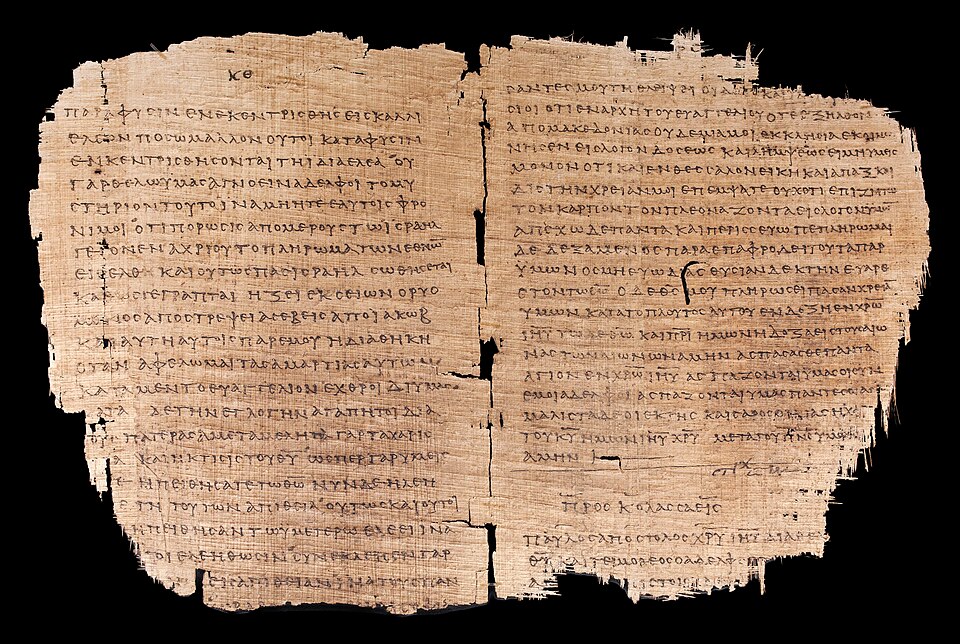
The letter to the Ephesians presents its own situational puzzle. Paul spent approximately three years in Ephesus (Acts 19:8–10, Acts 20:31) and had extensive personal relationships there. The letter, however, contains no personal greetings to any named individual — unusual for a writer who, in Romans alone (a letter to a community he had never visited), greets over twenty-five people by name (Romans 16:1–16). Several early manuscripts of Ephesians, including the Chester Beatty Papyrus P46 (c. 200 CE) and Codex Sinaiticus and Codex Vaticanus (both 4th century), omit the words "in Ephesus" from Ephesians 1:1, reading instead "to the saints who are also faithful in Christ Jesus." This has led to the suggestion that the letter was originally a circular letter not addressed to any specific congregation.5, 6
Second Thessalonians contains an unusual self-referential passage. In 2 Thessalonians 2:2, the author warns against being deceived "by letter, as though from us" (hos di' hemon), suggesting that forged letters were circulating under Paul's name. The letter then concludes: "I, Paul, write this greeting with my own hand. This is the mark in every letter of mine; it is the way I write" (2 Thessalonians 3:17, NRSV). The emphatic authentication — insisting that the recipient verify the handwriting in "every letter of mine" — reads, when placed alongside the warning about forgeries, as either Paul guarding against pseudepigraphy or as a pseudepigrapher attempting to forestall suspicion. The passage is self-attesting in a way that the undisputed letters are not: Romans, 1 Corinthians, Galatians, and the other undisputed letters do not include instructions for verifying their authenticity.
Manuscript evidence for the Pauline corpus
The oldest extensive manuscript of the Pauline letters is Papyrus 46 (P46), a codex dated to approximately 200 CE, now divided between the Chester Beatty Library in Dublin and the University of Michigan Library. P46 contains, in the following order: Romans (beginning with chapter 5, the earlier chapters being lost), Hebrews, 1 Corinthians, 2 Corinthians, Ephesians, Galatians, Philippians, Colossians, and the beginning of 1 Thessalonians (the rest being lost due to missing pages at the end of the codex).5
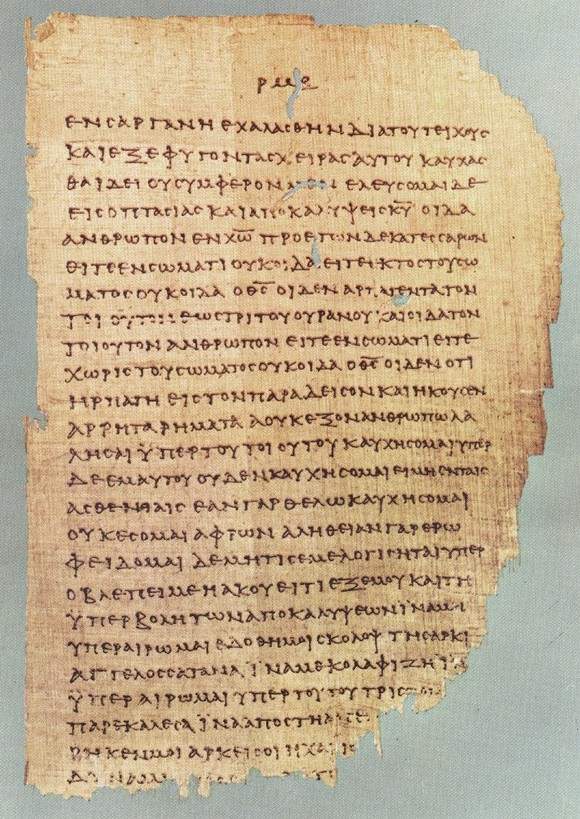

The Pastoral Epistles — 1 Timothy, 2 Timothy, and Titus — are absent from P46. The question of whether they were originally included and lost with the missing final pages, or were never part of the collection, depends on calculations of the codex's original size. Based on the pattern of increasing lines per page toward the end of the codex (a practice scribes used to fit remaining text), reconstructions suggest that only 2 Thessalonians and possibly Philemon could have occupied the missing final pages. The Pastoral Epistles, which together would require approximately fifteen additional leaves, would not fit within the estimated original page count.5, 7
The Muratorian Fragment, a late second-century Latin list of accepted books, includes all thirteen Pauline letters. It lists the letters by addressee and counts them: "To the Corinthians, first; to the Ephesians, second; to the Philippians, third; to the Colossians, fourth; to the Galatians, fifth; to the Thessalonians, sixth; to the Romans, seventh. … Moreover, one to Philemon, and one to Titus, and two to Timothy."12 The inclusion of the Pastorals in this second-century list indicates that they were circulating as Pauline letters by that date. Irenaeus of Lyon (c. 180 CE) quotes from 1 Timothy and Titus as Pauline.10 Eusebius of Caesarea (c. 325 CE) lists all thirteen Pauline letters among the accepted (homologoumena) books of the New Testament.11
The absence of the Pastorals from P46, the oldest surviving Pauline collection, alongside their presence in the second-century Muratorian Fragment and in Irenaeus, places the earliest attestation of the Pastorals as Pauline in the late second century, while the earliest physical manuscript of the Pauline collection does not include them. The other disputed letters — Ephesians, Colossians, and 2 Thessalonians — are present in P46 alongside the undisputed letters and are attested in the same early sources.5, 7, 11
Literary relationships among the disputed letters
Several of the disputed letters display literary dependence on one another and on the undisputed letters. Ephesians and Colossians share extensive verbal parallels. Approximately one-third of the words in Colossians appear in Ephesians, and the two letters share several nearly identical phrases. Colossians 3:12–13 ("As God's chosen ones, holy and beloved, clothe yourselves with compassion, kindness, humility, meekness, and patience. Bear with one another and, if anyone has a complaint against another, forgive each other," NRSV) parallels Ephesians 4:2, Ephesians 4:32. The household codes of Colossians 3:18–4:1 and Ephesians 5:22–6:9 follow the same structure and address the same pairs (wives/husbands, children/parents, slaves/masters) in the same order, though Ephesians expands each section considerably.4
The relationship between the two texts can be characterized precisely: where Colossians is brief, Ephesians expands; where Colossians lists, Ephesians elaborates with theological reflection. Colossians 4:16 instructs: "When this letter has been read among you, have it read also in the church of the Laodiceans; and see that you read also the letter from Laodicea" (NRSV). This reference to a now-lost "letter from Laodicea" has generated the suggestion that Ephesians, with its absence of personal greetings and its lack of "in Ephesus" in early manuscripts, may be either the letter to Laodicea or a later composition that draws on Colossians and generalizes its content for wider circulation.4
Second Thessalonians reproduces substantial sections of 1 Thessalonians with minor variation. The thanksgiving section of 2 Thessalonians 1:3 ("We must always give thanks to God for you, brothers and sisters, as is right") closely parallels 1 Thessalonians 1:2 ("We always give thanks to God for all of you"). The prayer of 2 Thessalonians 1:11–12 parallels 1 Thessalonians 3:11–13. The instruction about idleness in 2 Thessalonians 3:6–12 expands on 1 Thessalonians 4:11–12. The degree of verbal overlap between the two letters is substantially higher than between any other pair of Pauline letters, including pairs addressed to the same community (such as 1 and 2 Corinthians, which share relatively little exact wording). This pattern is consistent with a writer using 1 Thessalonians as a template.4, 9
The three groups within the corpus
The evidence presented in the preceding sections divides the thirteen Pauline letters into three groups based on internal characteristics. The following table summarizes the distinguishing features of each group.
Internal characteristics of the three groups within the Pauline corpus1, 4
| Feature | Undisputed (Rom, 1–2 Cor, Gal, Phil, 1 Thess, Phlm) | Deutero-Pauline (Eph, Col, 2 Thess) | Pastoral Epistles (1–2 Tim, Titus) |
|---|---|---|---|
| Sentence structure | Short, diatribal, frequent rhetorical questions | Long, liturgical periods (Eph 1:3–14 is one sentence in Greek) | Conventional, prosaic, administrative |
| Vocabulary | Consistent connective particles (ara oun, dio); dikaiosyne in forensic sense | Cosmic vocabulary (pleroma, ta epourania); shares ~1/3 of Colossians' words with Ephesians | 306 words not in other Pauline letters; eusebeia, hygiainousa didaskalia, pistos ho logos |
| Eschatology | Imminent parousia; "we who are alive" (1 Thess 4:15) | Delayed by preconditions (2 Thess 2:1–4); realized in Eph 2:6 ("raised us up") | Fading; focus on preserving "sound doctrine" until an unspecified future |
| Christology | "Christ crucified" (1 Cor 1:23); cross as center | Cosmic Christ, "image of the invisible God," preexistent agent of creation (Col 1:15–16) | "Christ Jesus our hope" (1 Tim 1:1); less developed christological reflection |
| Ecclesiology | Charismatic community; gifts of the Spirit; episkopoi mentioned once (Phil 1:1) | Church as cosmic body with Christ as head (Eph 1:22–23; Col 1:18) | Institutionalized offices: bishops, elders, deacons with formal qualifications |
| Women's roles | Phoebe the diakonos; Junia the apostle; women pray and prophesy | Wives "subject to" husbands (Eph 5:22–24; Col 3:18) | "I permit no woman to teach" (1 Tim 2:12); silence required |
| Historical setting | Cross-referencing travels: Corinth, Ephesus, Jerusalem collection (c. 50–58 CE) | "In Ephesus" absent from earliest MSS of Ephesians; 2 Thess follows 1 Thess closely | Travels with no parallel in Acts or undisputed letters; presupposes second Roman imprisonment |
| Manuscript evidence | Present in P46 (c. 200 CE) | Eph, Col, and partial 1 Thess present in P46 | Absent from P46; first attested in Irenaeus (c. 180 CE) and Muratorian Fragment |
The division into these three groups rests on the internal evidence of the letters themselves: their vocabulary, their syntax, their theological positions, the historical situations they presuppose, and their presence or absence in the earliest surviving manuscript of the Pauline corpus. Each of the thirteen letters identifies Paul as its author in its opening lines. The differences documented above exist within a corpus that presents itself as the work of a single writer. The texts, placed side by side, display these features without requiring any external interpretive framework to make the differences visible.1, 4, 5
Alternative explanations within the texts
Several features of the letters themselves have been cited as potential explanations for the observed differences. Paul's letters name co-senders: Sosthenes in 1 Corinthians, Timothy in 2 Corinthians, Philippians, Colossians, 1 and 2 Thessalonians, and Philemon. If co-senders contributed to the composition, variation in style across letters with different co-authors would be expected. The undisputed letters themselves, however, also have co-senders, and the stylistic differences between, say, Romans (Paul alone) and 1 Thessalonians (Paul, Silvanus, and Timothy) are far smaller than the differences between any undisputed letter and the Pastoral Epistles.4, 8
Paul refers to the use of a secretary (amanuensis) in at least one letter. Romans 16:22 states: "I Tertius, the writer of this letter, greet you in the Lord" (NRSV). If different secretaries were given varying degrees of freedom in composing the letters, vocabulary and style might shift accordingly. The degree of latitude given to an ancient secretary, however, is debated. The practice ranged from verbatim dictation to composition based on general instructions. Even with maximal secretarial freedom, the theological differences documented above — different eschatologies, different ecclesiologies, different positions on women's roles — would require a secretary operating with substantial independence from the named author.4, 9
The differences in subject matter between the letters also account for some vocabulary variation. A letter about church offices (1 Timothy) will naturally use words absent from a letter about justification by faith (Romans). L. T. Johnson has argued that the linguistic case against the Pastorals is weakened when the three letters are not grouped together but are instead compared individually with undisputed letters on similar topics: 1 Timothy with 1 Corinthians (both addressing congregational problems), Titus with short travel letters, and 2 Timothy with Philippians (both written from prison).8 The vocabulary overlap increases under these pairings, though the function-word differences and the theological distinctions identified above persist across all three Pastorals regardless of how they are grouped.
The internal evidence presented throughout this article — vocabulary statistics, sentence structure, theological content, ecclesiastical development, treatment of women, historical setting, manuscript attestation, and literary dependence — is drawn from the letters themselves. The thirteen letters of the Pauline corpus, read side by side, display these patterns in their own words.1, 2, 3, 4, 5
References
Pauline Language and the Pastoral Epistles: A Study of Linguistic Variation in the Corpus Paulinum
Forged: Writing in the Name of God — Why the Bible's Authors Are Not Who We Think They Are