Overview
- The Books of Samuel and Kings describe David and Solomon as rulers of a powerful united kingdom centered in Jerusalem, with Solomon building the Temple and monumental architecture at Megiddo, Hazor, and Gezer, but the archaeological evidence for the scale of this kingdom remains the subject of one of the most consequential debates in biblical archaeology.
- The Tel Dan Stele, discovered in 1993-1994, contains the phrase 'House of David' (bytdwd) and provides the earliest extrabiblical reference to the Davidic dynasty, while sites such as Khirbet Qeiyafa offer evidence for a fortified settlement in Judah during the early tenth century BCE.
- The central dispute concerns chronology: the conventional chronology dates monumental six-chambered gates at Megiddo, Hazor, and Gezer to Solomon's reign in the tenth century BCE, while the low chronology proposed by Israel Finkelstein redates them to the ninth-century Omride dynasty, fundamentally altering the archaeological picture of what David and Solomon's polity looked like.
The Books of Samuel and Kings present David and Solomon as rulers of a powerful united Israelite kingdom, centered in Jerusalem, that stretched from the border of Egypt to the Euphrates. David is depicted as a warrior-king who conquered Jerusalem from the Jebusites, defeated the Philistines, and established a dynasty. Solomon, his son and successor, is credited with building the Temple in Jerusalem, constructing monumental fortifications at Megiddo, Hazor, and Gezer, maintaining a fleet of merchant ships, and accumulating extraordinary wealth through trade and tribute.1 Kings 9:15–19 The biblical portrait is of a centralized, bureaucratic state with international influence — a golden age that preceded the division of the kingdom into northern Israel and southern Judah after Solomon's death.1 Kings 11:29–39
The question of whether the archaeological and epigraphic evidence supports this portrait — and if so, to what degree — has produced one of the most sustained debates in the archaeology of the ancient Near East. The discussion touches on the reliability of the biblical text as a historical source, the methods by which archaeologists date strata and structures, and the nature of political organization in the tenth-century BCE southern Levant.
The biblical account
The narrative of the united monarchy spans roughly 2 Samuel through 1 Kings 11. David is presented as having risen from humble origins in Bethlehem, served in the court of Saul, and eventually become king over all the tribes of Israel after a period of civil conflict with the house of Saul.2 Samuel 5:1–5 His first major act as king of the united tribes is the conquest of Jerusalem — then a Jebusite stronghold — which he makes his capital, establishing it as both the political and religious center of the kingdom by bringing the Ark of the Covenant into the city.2 Samuel 5:6–10 2 Samuel 6:12–15
David is described as conducting military campaigns against the Philistines, Moabites, Ammonites, Edomites, and Arameans, extending Israelite control across a wide territory.2 Samuel 8:1–14 The text attributes to him a standing army, a court bureaucracy with named officials, and the accumulation of materials intended for a temple that he himself was not permitted to build.1 Chronicles 22:2–5
Solomon's reign, as presented in 1 Kings 1–11, represents the apex of the united monarchy. The text credits Solomon with building the Temple in Jerusalem over a seven-year period and his own palace over thirteen years.1 Kings 6:37–38 1 Kings 7:1 First Kings 9:15 states that Solomon used forced labor to build "the house of the LORD and his own house, the Millo and the wall of Jerusalem, Hazor, Megiddo, Gezer." The text describes Solomon's wealth in extraordinary terms: 666 talents of gold received annually, a throne of ivory overlaid with gold, a fleet of trading ships at Ezion-geber, and diplomatic ties with Egypt and Phoenicia.1 Kings 10:14–22 After Solomon's death, the text narrates the secession of the northern tribes under Jeroboam, ending the united kingdom.1 Kings 12:1–20
The Tel Dan Stele
The most significant extrabiblical evidence bearing directly on the Davidic dynasty is the Tel Dan Stele, discovered by Avraham Biran during excavations at Tel Dan in northern Israel. The first and largest fragment (Fragment A) was found in July 1993 in a secondary context — reused as building material in a later wall. Two additional joining fragments (Fragments B1 and B2) were recovered in June 1994.3, 4
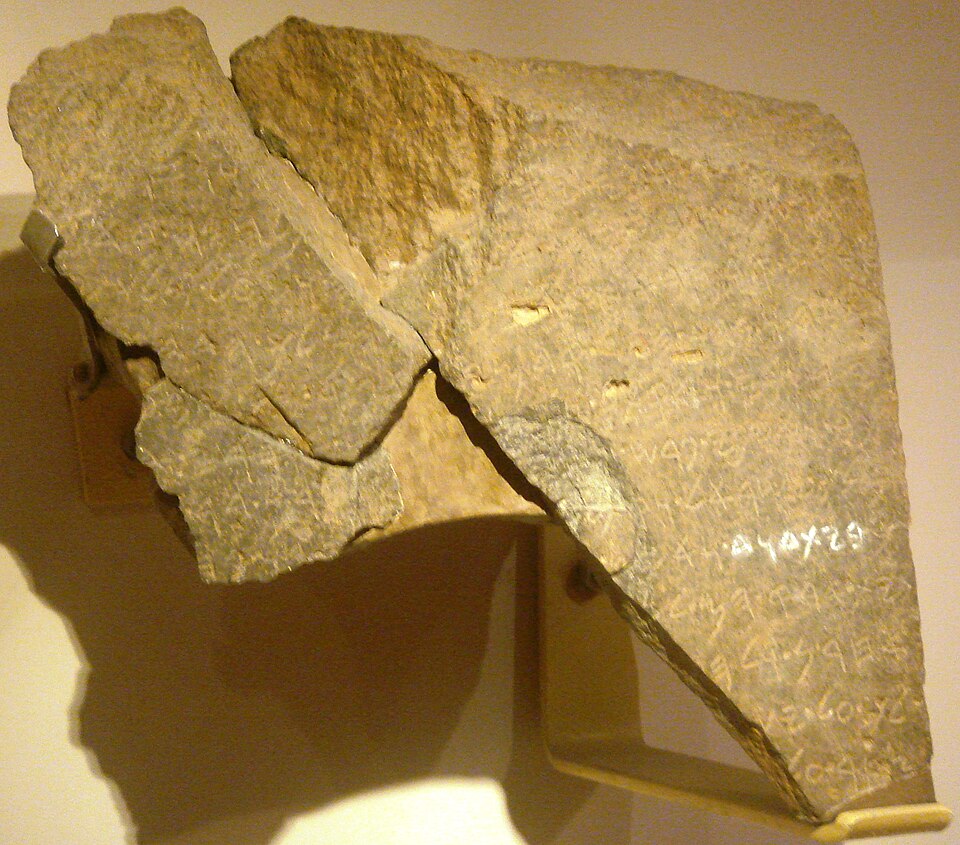

The inscription is written in Old Aramaic and dates to approximately 840 BCE. It is a triumphal royal inscription, almost certainly erected by Hazael, king of Aram-Damascus, though his name does not survive in the extant fragments. The text describes military victories over the kings of Israel and Judah. The crucial lines read, in Biran and Naveh's translation: "I killed [Jo]ram son of [Ahab] king of Israel and I killed [Ahaz]iahu son of [Jehoram] king of the House of David."3, 4 The phrase "House of David" (bytdwd) is the earliest known reference outside the Bible to the Davidic dynasty.
The reading of bytdwd as "House of David" — a dynastic designation for the kingdom of Judah — was immediately recognized as significant and has been accepted by the majority of epigraphers and historians who have examined the inscription.3 Alternative readings were proposed: some scholars suggested that dwd might refer to a place name or a divine epithet rather than the personal name David, or that the word division should be read differently. These alternative interpretations have not gained wide acceptance among specialists in Northwest Semitic epigraphy, and the standard reading remains the scholarly consensus.4
What the Tel Dan Stele establishes is that by the mid-ninth century BCE — within approximately a century of David's presumed reign — the kingdom of Judah was identified by its neighbors as the "House of David," indicating that David was remembered as the founder of the ruling dynasty. The inscription does not describe the size or nature of David's kingdom, confirm any specific events narrated in the Books of Samuel, or say anything about Solomon. It attests to a dynasty, not to the scope of its rule.
Archaeological evidence from Jerusalem
Jerusalem is the city most central to the biblical narrative of the united monarchy, yet its tenth-century BCE archaeological record is surprisingly thin. The site has been continuously occupied for millennia, meaning that later construction — particularly the massive Herodian, Roman, and Ottoman building projects on and around the Temple Mount — has destroyed or buried much of the earlier material. Excavation on the Temple Mount itself, the location the Bible identifies as the site of Solomon's Temple, has been politically and religiously impossible.1, 17
The area that has been most extensively excavated for Iron Age remains is the ridge south of the Temple Mount known as the City of David. This narrow spur of land is the oldest inhabited part of Jerusalem and the area where the biblical text locates David's conquest of the Jebusite city. Two structures in the City of David have figured prominently in the debate over the united monarchy: the Stepped Stone Structure and the Large Stone Structure.
The Stepped Stone Structure is a massive terraced construction on the eastern slope of the City of David ridge, extending approximately 17 metres in height and consisting of a series of stone terraces that supported buildings on the summit above. It was first partially exposed by R. A. S. Macalister and J. G. Duncan in the 1920s, further excavated by Kathleen Kenyon in the 1960s, and investigated again by Yigal Shiloh in the late 1970s and early 1980s. Kenyon dated its construction to the beginning of the Iron Age II period (approximately the tenth century BCE), which would place it in the time of the united monarchy.12 Some scholars have associated the structure with the "Millo" mentioned in the biblical text as one of David's and Solomon's building projects.2 Samuel 5:9 1 Kings 9:15
In 2005, Eilat Mazar began excavations at the summit of the City of David and identified what she termed the "Large Stone Structure" — a set of massive walls constructed of large, roughly dressed stones. Mazar proposed that this structure was a monumental building dating to approximately 1000 BCE, which she identified as the palace of King David described in 2 Samuel 5:11.11 This identification generated significant debate. Israel Finkelstein, Ze'ev Herzog, Lily Singer-Avitz, and David Ussishkin published a detailed critique arguing that the pottery assemblages associated with the Large Stone Structure do not support a tenth-century date and that the structure may instead belong to the ninth or eighth century BCE, or even later.13 Margreet Steiner, who published the final reports of Kenyon's Jerusalem excavations, has also questioned the stratigraphic basis for a tenth-century date for the monumental structures on the ridge.12
The broader picture from Jerusalem is one of limited tenth-century remains. Proponents of a large Solomonic kingdom argue that the paucity of evidence reflects the destruction caused by later building activity rather than an absence of original construction.2 Critics argue that the evidence is thin because tenth-century Jerusalem was a modest settlement, not the capital of a territorial empire.1, 16
The six-chambered gates
The archaeological argument for Solomonic monumental construction has traditionally centered not on Jerusalem but on three cities mentioned together in 1 Kings 9:15: Hazor, Megiddo, and Gezer. At each of these sites, excavators uncovered imposing six-chambered gate complexes — gates consisting of a central passageway flanked by three chambers on each side — along with associated casemate or solid city walls.
The connection between these gates and the biblical text was first proposed by Yigael Yadin in 1958. Yadin had been excavating at Hazor and noted the striking similarity between the gate he uncovered there and the gate previously found at Megiddo. Based on the mention of all three cities in 1 Kings 9:15, Yadin predicted that a similar gate would be found at Gezer — and when he examined the earlier excavation plans from Gezer, he identified a gate structure of the same type that had been only partially recognized by its original excavator.5 Yadin argued that the nearly identical dimensions and design of the three gates — each with an inner passageway width of approximately 4.2 metres and wall thicknesses of approximately 1.6 metres — indicated that they were products of a single, centrally planned building program, precisely as the biblical text describes.5
For decades, the association between these gates and Solomon's building program was widely accepted. The conventional chronology, advocated by scholars such as Yadin, Benjamin Mazar, and later Amihai Mazar, dates the relevant archaeological strata at these sites (Megiddo VA-IVB, Hazor X, Gezer VIII) to the tenth century BCE, aligning them with Solomon's reign.7 Under this framework, the gates serve as powerful archaeological confirmation of the biblical account: a centralized state with the administrative capacity to execute a coordinated building program at three strategically important cities.
The chronological debate
In 1996, Israel Finkelstein of Tel Aviv University published a landmark article proposing what he termed the "low chronology" for the Iron Age in the southern Levant. Finkelstein argued that the ceramic assemblages conventionally dated to the tenth century BCE should be redated to the ninth century, lowering the chronological framework by approximately 50 to 100 years.6 The implications were dramatic: if the low chronology is correct, the monumental gates at Megiddo, Hazor, and Gezer were not built by Solomon but by the Omride dynasty of the northern kingdom of Israel, which flourished in the ninth century and is independently attested in Assyrian and Moabite inscriptions.
Under Finkelstein's low chronology, the tenth century BCE — the period assigned to David and Solomon — corresponds to a phase of relatively modest settlement in the central highlands, with no monumental architecture that can be securely attributed to a Solomonic state. The grand building projects would belong instead to Omri and Ahab, who ruled the northern kingdom of Israel from Samaria and are described in both the biblical text and in Assyrian records as powerful rulers with significant military resources.1, 6
Amihai Mazar of the Hebrew University of Jerusalem published a detailed rebuttal in 1997, defending the conventional chronology and arguing that Finkelstein's ceramic analysis was based on insufficient evidence and failed to account for regional variation in pottery typology across the southern Levant.7 Mazar subsequently proposed a "modified conventional chronology" that accepted some adjustments to the traditional dates while maintaining the essential tenth-century attribution of the monumental strata at Megiddo, Hazor, and Gezer. Under Mazar's framework, the Iron I/IIA transition — the key chronological boundary at issue — falls in approximately 980 BCE, rather than Finkelstein's proposed date of approximately 920–900 BCE.8
Both sides have turned to radiocarbon dating to resolve the dispute. Finkelstein and Eli Piasetzky published a series of studies applying radiocarbon analysis to destruction layers across the Levant, arguing that the results supported a lower date for the Iron I/IIA transition.19, 15 Mazar and his collaborators countered with radiocarbon data from Tel Rehov and other sites that they argued supported the higher chronology.8 By the early 2010s, both camps acknowledged that the radiocarbon evidence had narrowed the gap between the two positions to a few decades — a span that approaches the limits of radiocarbon resolution for this period.15 The debate, however, remains unresolved, because even a difference of a few decades determines whether specific monumental structures fall within the reign of Solomon or within the reign of the Omrides.
Competing chronological frameworks for Iron Age strata6, 7, 8
| Event / transition | Conventional chronology | Modified conventional | Low chronology |
|---|---|---|---|
| Iron I/IIA transition | c. 1000 BCE | c. 980 BCE | c. 920–900 BCE |
| Megiddo VA-IVB | 10th century (Solomon) | 10th century (Solomon) | 9th century (Omrides) |
| Hazor X gate | 10th century (Solomon) | 10th century (Solomon) | 9th century (Omrides) |
| Gezer VIII gate | 10th century (Solomon) | 10th century (Solomon) | 9th century (Omrides) |
| Early-to-late Iron IIA | c. 925–900 BCE | c. 900–880 BCE | c. 850–840 BCE |
Khirbet Qeiyafa
In 2007, Yosef Garfinkel of the Hebrew University of Jerusalem and Sa'ar Ganor of the Israel Antiquities Authority began excavating Khirbet Qeiyafa, a fortified site in the Shephelah (Judean foothills) overlooking the Elah Valley — the location identified in the biblical tradition as the site of David's encounter with Goliath.1 Samuel 17:2 The excavations, which continued through 2013, revealed a heavily fortified urban settlement with casemate walls, two gates, and an organized urban plan.9
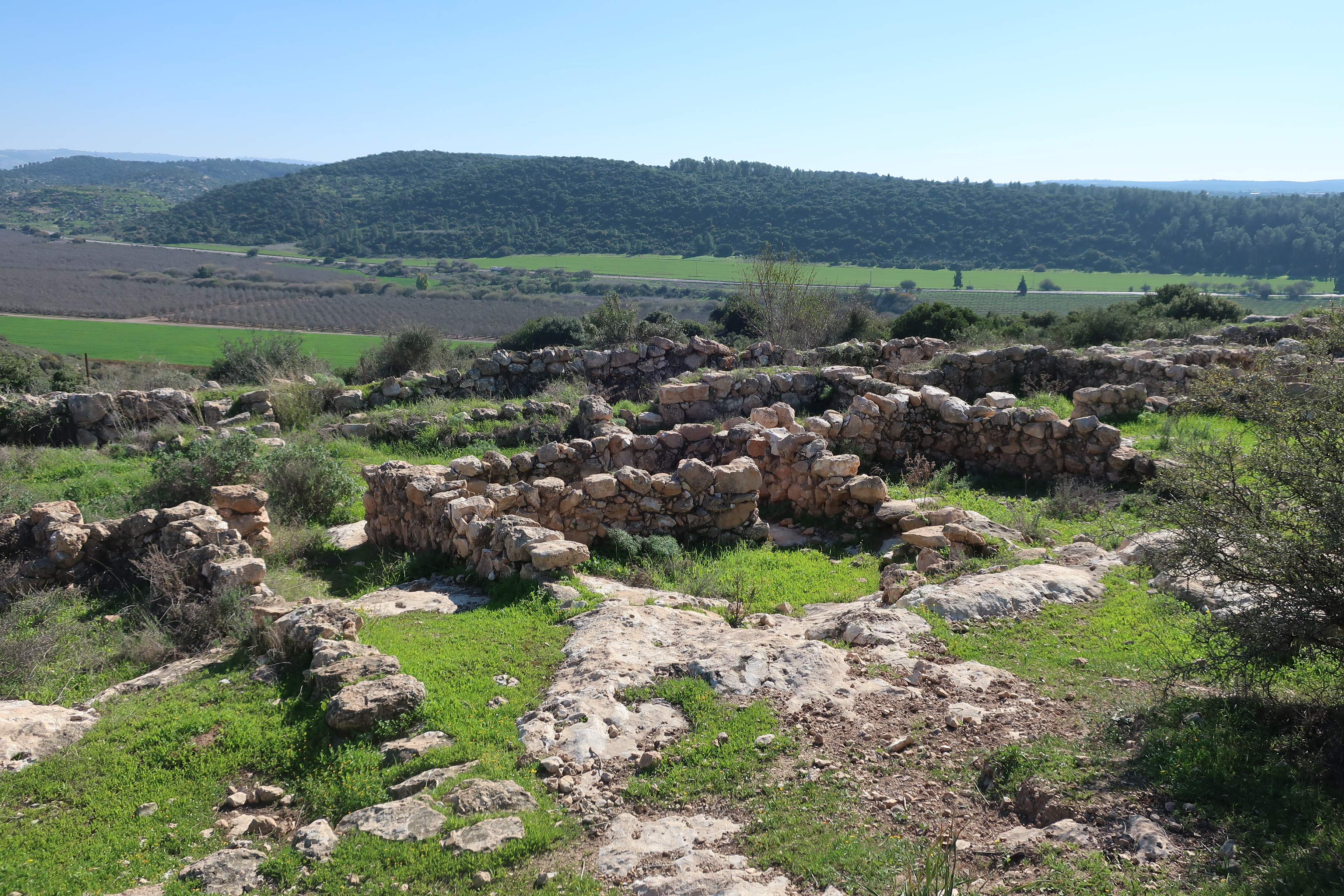

Radiocarbon dating of olive pits from destruction deposits at the site placed the occupation in the late eleventh to early tenth century BCE, approximately 1020–980 BCE.10 This dating is significant because it places the site squarely in the period assigned to David's reign by the conventional chronology. Garfinkel argued that the presence of a fortified, planned settlement of this size in the Shephelah during this period demonstrates that a polity with the administrative and economic capacity to organize such a project existed in Judah during the early tenth century — evidence that is difficult to reconcile with the characterization of David's Judah as a sparsely populated highland chiefdom lacking organizational complexity.10
The identification of the site has been debated. Garfinkel proposed that Khirbet Qeiyafa is biblical Sha'arayim ("two gates"), a town mentioned in the narrative of David and Goliath, based on the site's unusual feature of having two city gates.9 Finkelstein and Alexander Fantalkin offered an alternative interpretation, arguing that the site could be a Canaanite or Philistine settlement rather than a Judahite one, and questioning whether the radiocarbon dates necessarily support the conventional chronological framework.14 The material culture of the site — including the absence of pig bones and the presence of an ostracon (inscribed pottery shard) in a script that may be early Hebrew — has been cited by Garfinkel as evidence of a Judahite cultural identity, though this interpretation also remains contested.9, 14
The scope of the kingdom
Even among scholars who accept the historicity of David and Solomon as real rulers, there is significant disagreement about the nature and extent of their polity. The debate is not simply over whether David and Solomon existed but over whether they ruled a large territorial state as the biblical text describes, a modest highland chiefdom, or something in between.18
Proponents of a substantial united monarchy, such as Kenneth Kitchen, argue that the biblical descriptions of Solomonic wealth and administrative organization are consistent with what is known about other small states in the ancient Near East during the early first millennium BCE. Kitchen points to Egyptian and Mesopotamian parallels for the types of administrative lists, trade relationships, and building programs described in 1 Kings, and argues that the biblical account, while shaped by literary and theological purposes, preserves a reliable core of historical information.2
Finkelstein and Neil Asher Silberman, by contrast, have argued that the united monarchy as described in the Bible is largely a retrospective construction — a seventh-century BCE literary creation produced during the reign of Josiah of Judah, when Judahite scribes projected the grandeur of the northern Omride kingdom back onto the founders of their own dynasty. In this view, David and Solomon were real figures, but they ruled a small, relatively poor highland polity centered on Jerusalem that bore little resemblance to the empire described in 1 Kings.1, 16
The archaeological indicators of state complexity include the presence of monumental architecture, evidence for centralized administration (such as standardized weights, seals, and storage facilities), evidence for a standing military, literacy, and long-distance trade networks. For the tenth century BCE in Judah, these indicators are sparse: monumental architecture is disputed, administrative seals and bullae become common only in the eighth and seventh centuries, and the evidence for literacy in the tenth century is extremely limited.1, 17 The northern kingdom of Israel, by contrast, shows robust evidence for state infrastructure in the ninth century under the Omride dynasty, including the construction of the capital at Samaria, the monumental building at Jezreel, and the international diplomatic and military activity attested by the Kurkh Monolith and the Mesha Stele.1
Amihai Mazar and others have proposed an intermediate position: David and Solomon may have ruled a polity that was more than a village chiefdom but less than the territorial empire described in the biblical text. In a jointly authored volume, Finkelstein and Mazar agreed that David was a historical figure and the founder of a dynasty but diverged sharply on the archaeological evidence for the scale of his kingdom.18
Summary of the evidence
The external evidence for the united monarchy can be summarized as follows. The Tel Dan Stele provides epigraphic confirmation that a dynasty identified as the "House of David" existed in Judah by the mid-ninth century BCE, within roughly a century of David's traditional dates.3, 4 Khirbet Qeiyafa provides evidence for a fortified settlement in the Judean Shephelah during the late eleventh to early tenth century, the period conventionally assigned to David, though the site's political affiliation is debated.9, 10 The monumental six-chambered gates at Megiddo, Hazor, and Gezer are consistent with the Solomonic building program described in 1 Kings 9:15 if the conventional chronology is accepted, but are attributed to the ninth-century Omride dynasty under the low chronology.5, 6 The archaeological record from tenth-century Jerusalem remains limited, with the key monumental structures — the Stepped Stone Structure and the Large Stone Structure — subject to ongoing disputes over their dating and interpretation.11, 12, 13
No extrabiblical text mentions Solomon by name. No inscription from the tenth century BCE describes the construction of the Temple, the administrative organization of the kingdom, or the trade networks attributed to Solomon in 1 Kings. The absence of such documentation does not prove that these things did not exist — the survival of epigraphic material from this period anywhere in the southern Levant is extremely limited — but it means that the biblical account of Solomon's reign cannot be independently confirmed from textual sources outside the Bible.17
What the evidence establishes with reasonable certainty is that a Davidic dynasty existed and was recognized as such by neighboring kingdoms by the mid-ninth century BCE; that the southern Levant during the tenth century contained settlements of varying size and complexity, at least some of which were fortified; and that the question of whether these settlements were organized into a centralized state under Solomonic administration depends on chronological assignments that remain genuinely contested among competent specialists.15, 18 The united monarchy remains one of those biblical periods where the external evidence is sufficient to confirm the broad historical setting — a real dynasty, real places, a real region — but insufficient to confirm or refute the specific claims about the scale and grandeur of the kingdom that the biblical text presents.
References
The Bible Unearthed: Archaeology's New Vision of Ancient Israel and the Origin of Its Sacred Texts
State Formation in Judah: Biblical Tradition, Modern Historical Theories, and Radiometric Dates at Khirbet Qeiyafa
The Palace of King David: Excavations at the Summit of the City of David, Preliminary Report of Seasons 2005–2007
Excavations by Kathleen M. Kenyon in Jerusalem 1961–1967, Vol. III: The Settlement in the Bronze and Iron Ages
David and Solomon: In Search of the Bible's Sacred Kings and the Roots of the Western Tradition
Radiocarbon-Dated Destruction Layers: A Skeleton for Iron Age Chronology in the Levant