Overview
- Inscriptions discovered at Kuntillet Ajrud in the Sinai (c. 800 BCE) and Khirbet el-Qom near Hebron (c. 750 BCE) contain blessings invoking 'Yahweh and his asherah,' providing the earliest extrabiblical evidence that at least some Israelites associated Yahweh with a female divine consort or cultic symbol during the monarchic period.
- The Hebrew Bible mentions asherah approximately forty times, predominantly in the context of Deuteronomistic condemnation of cultic objects placed in Yahweh's temple and at high places throughout Judah and Israel, and the intensity of the polemic implies that Asherah veneration was widespread rather than marginal in pre-exilic Israelite religion.
- Scholarly debate continues over whether the inscriptional phrase 'his asherah' refers to the goddess Asherah as Yahweh's consort, to a wooden cultic object symbolizing her presence, or to a hypostasized divine attribute, with positions ranging from William Dever's maximalist identification of a full divine partnership to Jeffrey Tigay's argument that the inscriptions reflect a cultic symbol rather than an independent deity.
Among the most significant discoveries in the study of ancient Israelite religion are inscriptions from the eighth century BCE that pair the name of Yahweh, the God of Israel, with a figure or object called "his asherah." These inscriptions, found at Kuntillet Ajrud in the northeastern Sinai and Khirbet el-Qom in the Judean hill country, have transformed scholarly understanding of the religious world in which the Hebrew Bible was composed. They suggest that at least some Israelites during the monarchic period understood Yahweh as having a female consort or an associated cultic symbol — a portrait sharply at odds with the strict monotheism championed by the biblical authors.1, 4
The question of what "his asherah" meant to the Israelites who wrote and read these inscriptions remains one of the most actively debated problems in the archaeology of Israelite religion. The answer requires integrating evidence from three distinct domains: the Ugaritic texts discovered at Ras Shamra, which illuminate the goddess Athirat (Asherah) in earlier Canaanite religion; the approximately forty references to asherah in the Hebrew Bible itself; and the archaeological record of Iron Age Judah and Israel, including inscriptions, cultic installations, and hundreds of female figurines.1, 6
Asherah in the ancient Near East
The goddess known as Athirat in Ugaritic and as Asherah in Hebrew appears prominently in the cuneiform alphabetic texts discovered at Ras Shamra (ancient Ugarit) on the Syrian coast, a site excavated from 1929 onward. The texts, catalogued in the standard edition known as KTU (Die keilalphabetischen Texte aus Ugarit), date to roughly the fourteenth to twelfth centuries BCE and preserve extensive mythological narratives in which Athirat functions as the consort of the supreme god El and the mother of the seventy divine sons who constitute the assembly of the gods.3, 2 Her full title in the Baal Cycle is rbt ʾaθrt ym, "Lady Athirat of the Sea," and she is depicted as the chief intercessor before El on behalf of other deities. In the Baal Cycle (KTU 1.4 IV), Athirat approaches El to petition for a palace for Baal, and her intercession proves decisive — El grants the request only after she makes her appeal.2, 11
Athirat's role in the Ugaritic texts is maternal and mediatory rather than warlike. She is distinguished from the more aggressive goddess Anat, who serves as Baal's primary ally in battle. Unlike Anat, Athirat does not appear in combat narratives; her authority derives from her position as El's wife and the progenitrix of the divine family. This profile is significant because in the Hebrew Bible, Yahweh absorbs many of the characteristics of both El and Baal, and the question of whether Yahweh also inherited El's consort is at the heart of the scholarly debate.1, 2
Beyond Ugarit, the goddess Asherah (under various spellings) is attested in texts from Amurru, in the Akkadian form Ashratum, and in an eighteenth-century-BCE text from the Old Babylonian period that calls her the "bride of Anu." The geographic and temporal range of these attestations confirms that Asherah was not a marginal figure but one of the most widely venerated goddesses of the second-millennium Levant and Mesopotamia.9, 11 Whether the Asherah of Iron Age Israel is the direct descendant of this Canaanite goddess, a reinterpretation of her, or merely a cultic symbol that retained her name is a question that the epigraphic and archaeological evidence from Israel itself must address.
Asherah in the Hebrew Bible
The Hebrew word ʾasherah (אֲשֵׁרָה) appears approximately forty times in the Hebrew Bible, in both singular and plural forms. The term is used in two distinguishable senses: as a reference to a cultic object — a wooden pole or stylized tree erected at sanctuaries — and, in a smaller number of passages, as a proper name designating a goddess. The Deuteronomistic literature (Deuteronomy through 2 Kings) overwhelmingly treats asherah as an object to be destroyed, commanding Israel: "You shall not plant any tree as a sacred pole [ʾasherah] beside the altar that you make for the LORD your God" (Deuteronomy 16:21, NRSV). The frequency of the condemnation, however, testifies to the persistence of the practice.1, 7
Several biblical passages move beyond the object and appear to reference a deity. 1 Kings 18:19 refers to "the four hundred prophets of Asherah, who eat at Jezebel's table," a formulation that implies a goddess with a prophetic establishment parallel to Baal's. 2 Kings 21:7 reports that King Manasseh "set a carved image of Asherah" (pesel ha-ʾasherah) in the Temple of Yahweh in Jerusalem — the central sanctuary itself. 2 Kings 23:4 describes Josiah ordering the removal from the Temple of "all the vessels made for Baal, for Asherah, and for all the host of heaven." The Deuteronomistic editors regarded these objects as apostate intrusions into Yahweh worship, but the fact that an image of Asherah could stand in the Jerusalem Temple for decades under a Judean king suggests that contemporaries did not necessarily see it as incompatible with Yahweh worship.7, 4
The cycle of reform and relapse described in Kings reinforces this impression. Asa removes the asherah his grandmother Maacah had made (1 Kings 15:13). Ahab erects an asherah in Samaria (1 Kings 16:33). Josiah destroys the asherah from the Temple, burns it in the Kidron Valley, and demolishes the quarters of the male cult prostitutes "where the women did weaving for Asherah" (2 Kings 23:6–7, NRSV). Gideon is instructed to cut down his father's asherah and build an altar to Yahweh in its place (Judges 6:25–26). The pattern of repeated destruction followed by restoration indicates that Asherah veneration was deeply embedded in Israelite and Judean religious life, not an occasional lapse by a few deviant kings.1, 6
The Kuntillet Ajrud inscriptions
The site of Kuntillet Ajrud (Hebrew: Horvat Teman) is a small fortified structure located in the northeastern Sinai desert, approximately fifty kilometres south of Kadesh-barnea, at the junction of roads leading from the Judean hill country toward Eilat and Egypt. The site was excavated by Ze'ev Meshel of Tel Aviv University in 1975–1976, and the final excavation report was published by the Israel Exploration Society in 2012. Radiocarbon dating and pottery analysis place the main occupation in the first half of the eighth century BCE, roughly 800–750 BCE.5
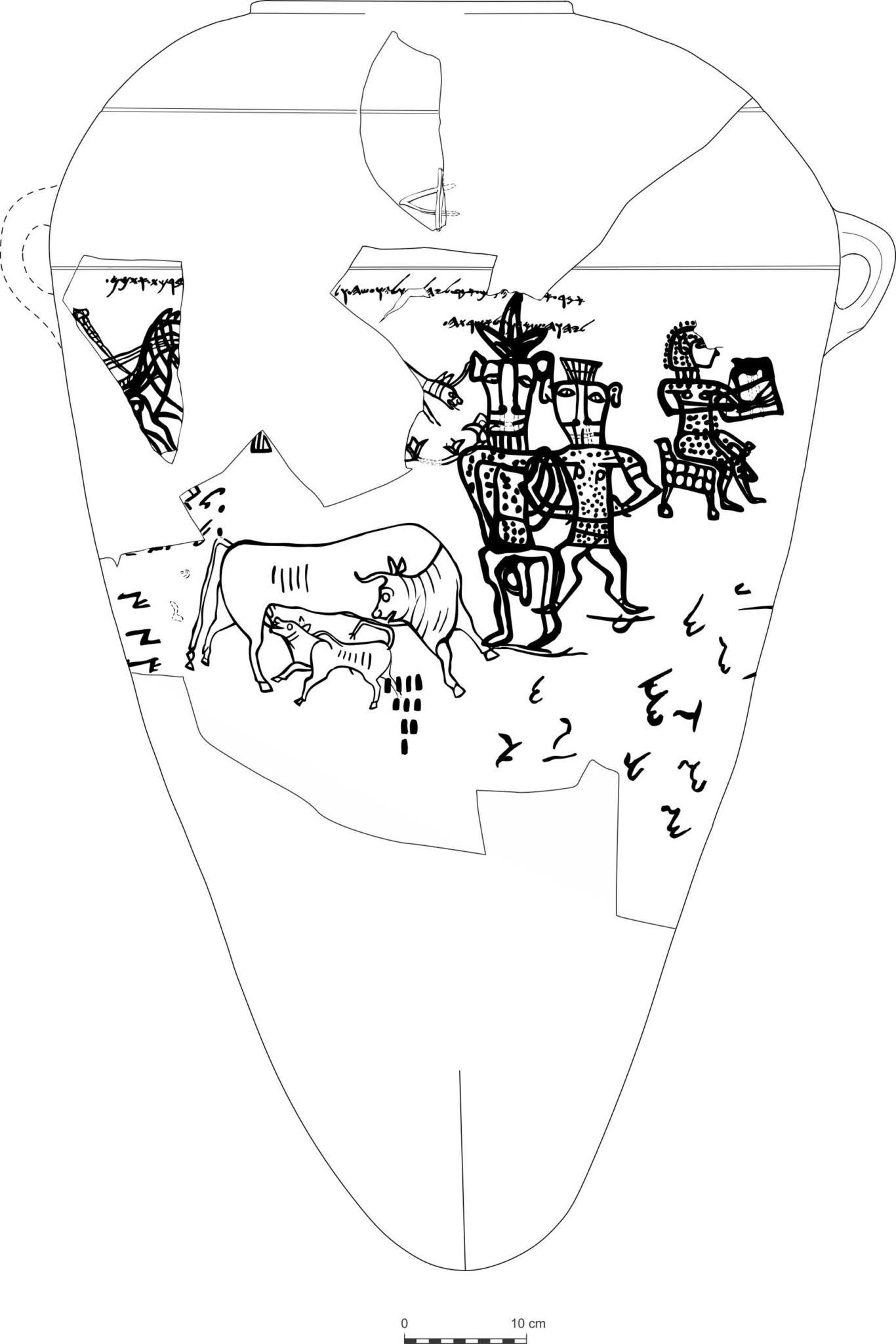

The site yielded two large storage jars (pithoi) bearing painted images and ink inscriptions in Hebrew and Phoenician scripts. The inscriptions on Pithos A include the phrase: "I bless you by Yahweh of Samaria and his asherah" (brkt ʾtkm l-yhwh shmrn w-l-ʾshrth). A second inscription on the same pithos reads: "I bless you by Yahweh of Teman and his asherah." Pithos B contains a fragmentary blessing that also pairs Yahweh with asherah.5, 6 The formulas are epistolary blessings — conventional greetings invoking divine protection — and the pairing of "Yahweh and his asherah" evidently functioned as a standard religious formula in the circles that used this site.
The drawings on Pithos A have generated intense scholarly discussion. Two large standing figures with bovine features, often compared to the Egyptian deity Bes, appear alongside a seated lyre player. Whether these images correspond to the inscription — with the two standing figures representing Yahweh and his asherah — or are unrelated graffiti on a reused vessel remains contested. Meshel himself was cautious about connecting the drawings to the inscriptions, noting that the images may have been painted at different times and by different hands.5 Some scholars, including Pirhiya Beck, have argued that the seated lyre player, rather than either of the standing figures, may represent Asherah, while others have rejected any direct correspondence between the drawings and the accompanying text.6
The most debated grammatical issue concerns the possessive suffix in ʾasheratoh ("his asherah"). In standard Hebrew grammar, a proper noun cannot take a possessive pronominal suffix — one cannot say "his Asherah" any more than one can say "his Ishtar" or "his Baal." This grammatical constraint has led some scholars, including Tigay, to argue that ʾasheratoh cannot be a proper noun and must therefore refer to a cultic object: a sacred pole or image belonging to Yahweh, not a goddess named Asherah.8 Others, including Zevit, have challenged this argument, proposing that the form ʾasheratoh represents a dialectal or archaic construction that does not conform to the later rules of Classical Biblical Hebrew, or that the suffix functions as a genitive ("the asherah of him," meaning "his [associated] Asherah") rather than a true possessive.16 The grammatical question remains unresolved, and it is fair to say that neither the goddess interpretation nor the cultic-object interpretation can be definitively excluded on linguistic grounds alone.6
The Khirbet el-Qom inscription
Khirbet el-Qom is an archaeological site in the Judean Shephelah, approximately fifteen kilometres west of Hebron, identified with biblical Makkedah. In 1967, William Dever documented tomb inscriptions from the site, and his initial publication appeared in the Hebrew Union College Annual in 1969–1970.13 The most significant inscription, designated Inscription 3, was carved on a pillar in Tomb II and dates palaeographically to approximately 750 BCE. The text is difficult to read because the surface was subsequently scored with rough lines, possibly an intentional act of defacement.
The French epigrapher André Lemaire published a reading of the inscription in 1977 that included the word ʾasherah. In Lemaire's reconstruction, the text reads: "Blessed be Uriyahu by Yahweh; from his enemies by his asherah he has saved him."12 This reading places the Khirbet el-Qom inscription in direct parallel with the Kuntillet Ajrud formula: both invoke Yahweh and "his asherah" together in a blessing context. If Lemaire's reading is correct, the formula was not confined to a single remote desert station but was used across a geographic range spanning from the Sinai to the heartland of Judah.6, 12
Not all scholars accept Lemaire's reading. Dever's own original publication of the inscription did not include the word ʾasherah, and the damaged state of the stone allows for alternative reconstructions. Judith Hadley has examined the inscription in detail and concluded that the reading of ʾasherah is probable but not certain, given the extent of the damage.6 Zevit has proposed a slightly different reading that nonetheless supports the presence of a divine feminine figure in the text.16 Despite the epigraphic difficulties, the convergence of the Khirbet el-Qom formula with the Kuntillet Ajrud inscriptions has persuaded most scholars that the association of Yahweh with asherah was not an isolated phenomenon but a feature of Judean religious practice in the eighth century BCE.4, 6
Judean pillar figurines
Hundreds of small terracotta figurines depicting a female form have been recovered from archaeological excavations throughout the kingdom of Judah, dating primarily to the eighth through sixth centuries BCE. These objects, classified by scholars as Judean pillar figurines (JPFs), typically consist of a hand-formed or mould-made head and upper body depicting a woman with prominent breasts, set atop a solid, pillar-shaped lower body formed by hand on a wheel. Thomas Holland established the foundational typology of these figurines in 1977, distinguishing between mould-made heads with detailed facial features and hand-pinched heads with minimal modelling.15
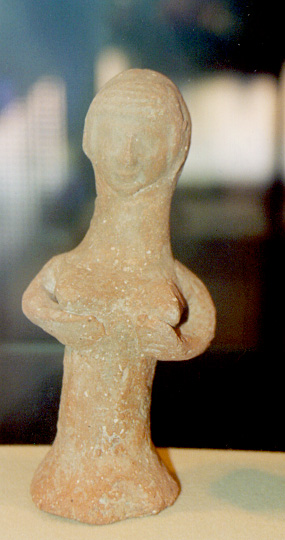

Raz Kletter's comprehensive 1996 study catalogued over eight hundred examples and established their chronological and geographic distribution, demonstrating that they appear almost exclusively within the borders of the kingdom of Judah and cluster in the eighth and seventh centuries BCE, with a sharp terminus at the Babylonian destruction of 586 BCE.14
The identification of these figurines is contested. Dever has argued that many of them represent Asherah, contending that their distribution matches the biblical record of Asherah worship in Judah and that their domestic archaeological contexts — houses, refuse pits, and tombs — indicate popular devotion to the goddess at the household level, outside the control of the centralized Temple cult.4 Kletter, by contrast, concluded that the figurines cannot be securely identified with any specific deity and may represent a range of functions, including votive offerings, apotropaic objects intended to protect mothers and children, or generic symbols of female fertility and nourishment unconnected to a named goddess.14
Keel and Uehlinger, drawing on a broader iconographic analysis of stamp seals and other visual media from Iron Age Israel and Judah, have situated the pillar figurines within a progressive "de-personalization" of female divine imagery during the eighth and seventh centuries. In their reconstruction, the distinctive goddesses depicted in Late Bronze Age and early Iron Age iconography — with specific attributes, postures, and divine symbols — give way to anonymous female figures stripped of individualizing features. The pillar figurines may thus represent the last stage of a long process by which the goddess was reduced from a named and narratively active deity to a generalized symbol of blessing and fertility.10 Whether this process was driven by Deuteronomistic reform, by broader cultural changes, or by some combination of the two remains debated.
The biblical polemic against Asherah
The Deuteronomistic History — the sequence of books from Deuteronomy through 2 Kings, compiled in its final form during or shortly after the Babylonian exile (sixth century BCE) — evaluates every king of Israel and Judah against a single theological standard: fidelity to the exclusive worship of Yahweh at the Jerusalem Temple. Within this framework, the asherah functions as a primary marker of apostasy. The Deuteronomistic editors judge northern kings uniformly as sinners, and among their offenses the maintenance of asherah poles and high places features prominently. Judean kings receive a more varied assessment, but those who tolerate asherah worship are condemned, while those who destroy the asherah — Asa, Hezekiah, Josiah — receive praise.1, 17
The account of Josiah's reform in 2 Kings 23 provides the most detailed description of the eradication of Asherah from Judean religion. Josiah removed the asherah image from the Temple, burned it in the Kidron Valley, beat it to dust, and scattered the dust upon the graves of the common people (2 Kings 23:6). He also destroyed the houses of the male cult prostitutes that were in the Temple, "where the women did weaving for Asherah" (2 Kings 23:7, NRSV). The specificity of these details — the weaving of garments for the goddess, the presence of cultic personnel associated with her worship within the Temple precincts itself — has persuaded many scholars that Asherah veneration was not a peripheral practice tolerated at rural high places but was integrated into the official cultus of the Jerusalem Temple for much of the monarchic period.7, 4
Olyan has argued on the basis of the biblical evidence that the asherah was a legitimate part of the Yahweh cult in both northern and southern kingdoms, in state religion as well as in popular practice, and that opposition to it arose specifically within Deuteronomistic circles during and after the seventh-century reforms.7 If this analysis is correct, the biblical portrayal of Asherah worship as a foreign intrusion or a periodic lapse represents a retrospective judgment imposed by the reforming party onto a religious landscape in which the pairing of Yahweh and Asherah had been normative for centuries. The prophetic and Deuteronomistic condemnation is not evidence that Asherah worship was rare; it is evidence that it was common enough to require sustained and repeated suppression.1, 7
Scholarly debate and current positions
The central question in the study of Yahweh and Asherah can be stated simply: was Asherah worshipped as Yahweh's divine consort in pre-exilic Israel and Judah, or does the epigraphic and archaeological evidence point to something less than a full divine partnership? The scholarly responses to this question span a wide spectrum.
The maximalist position, most fully articulated by William Dever, holds that Asherah was indeed venerated as Yahweh's consort in both official and popular religion. Dever interprets the Kuntillet Ajrud and Khirbet el-Qom inscriptions as referring to the goddess herself, reads the Judean pillar figurines as representations of Asherah, and argues that the biblical polemic against her worship is evidence of a Deuteronomistic minority attempting to suppress a practice that the majority of Israelites considered orthodox. In Dever's reconstruction, "folk religion" — the actual religious practice of ordinary people — included a divine couple, Yahweh and Asherah, and the monotheistic theology of the Hebrew Bible represents the ideology of the winning faction rather than a description of what most Israelites believed.4, 18
The minimalist position, represented most influentially by Jeffrey Tigay, holds that the evidence does not support the identification of Asherah as Yahweh's consort during the monarchic period. Tigay's 1986 study of Hebrew inscriptions and personal names (onomastics) demonstrated that Yahwistic names — names incorporating the divine element yhw or yh — vastly outnumber names incorporating any other divine element in the inscriptional record, and that names compounded with Asherah are extremely rare or absent. Tigay argued that if Asherah had been worshipped as a major deity alongside Yahweh, her name should appear in the onomastic record with far greater frequency. He concluded that "his asherah" in the inscriptions refers to a cultic symbol — a wooden object associated with Yahweh's worship — rather than to a goddess.8
Scholarly positions on the meaning of "his asherah"4, 6, 8
| Position | Representative scholars | Interpretation of "his asherah" |
|---|---|---|
| Maximalist | Dever, Binger | The goddess Asherah as Yahweh's consort |
| Moderate | Olyan, Day, Hadley | A cultic symbol representing the goddess; her identity persists in the object |
| Minimalist | Tigay, Emerton | A cultic object with no surviving connection to a living goddess tradition |
Between these poles, several moderate positions have emerged. Olyan argued that the asherah was a legitimate cultic symbol within the Yahweh cult, and that its association with the goddess Asherah was real but mediated — the wooden pole symbolized Asherah's presence in the sanctuary without necessarily implying that worshippers regarded her as a fully independent deity on par with Yahweh.7 Hadley concluded that the evidence from Kuntillet Ajrud and Khirbet el-Qom is ambiguous and that both the goddess interpretation and the cultic-object interpretation are defensible, though she leaned toward viewing the asherah as a hypostasized symbol — an originally divine figure that had been partially absorbed into the Yahweh cult as a sacred object.6 Mark Smith situated the question within a broader model of convergence, in which Yahweh progressively absorbed the characteristics, epithets, and consort of El (including Asherah) during the transition from the Late Bronze Age to the Iron Age, and the later Deuteronomistic movement represented a deliberate rejection of this earlier syncretism.1
Day has proposed a nuanced reconstruction in which Asherah was indeed Yahweh's consort in the pre-Deuteronomistic period, inheriting this role from the Canaanite tradition in which Athirat was the consort of El and Yahweh had been identified with El. On Day's reading, the goddess was worshipped alongside Yahweh at the Jerusalem Temple from the time of its construction, and her removal by Josiah in the late seventh century constituted a genuine theological innovation, not the restoration of an earlier orthodoxy.11
From polytheism to monotheism
The evidence for the association of Yahweh and Asherah fits within a broader scholarly reconstruction of the development of Israelite religion from polytheism through monolatry (the exclusive worship of one god without denying the existence of others) to monotheism (the assertion that only one god exists). Mark Smith has argued that early Israelite religion was essentially a subset of Canaanite religion, in which Yahweh occupied the position of the high god El and inherited El's consort Asherah, his council of divine beings, and his cosmic mountain. Over the course of the monarchic period, Yahweh also absorbed characteristics of Baal, including storm theophany, kingship language, and the defeat of the cosmic sea.1, 2
The Deuteronomistic reform of the late seventh century and the experience of the Babylonian exile in the sixth century accelerated a process by which the other deities of the Israelite pantheon were eliminated, demoted to the status of angels or demons, or declared non-existent. Asherah's disappearance from the record after the exile is part of this larger development. The pillar figurines vanish from the archaeological record after 586 BCE, the epigraphic formula "Yahweh and his asherah" is not attested in any post-exilic inscription, and the Second Isaiah explicitly denies the existence of any deity other than Yahweh: "I am the LORD, and there is no other; besides me there is no god" (Isaiah 45:5, NRSV).1, 10
The relationship between Yahweh and Asherah, whatever its precise nature during the monarchic period, was thus a casualty of the theological revolution that produced biblical monotheism. The inscriptions from Kuntillet Ajrud and Khirbet el-Qom preserve a snapshot of Israelite religion before this revolution was complete — a moment when the pairing of Yahweh with a female divine consort or cultic symbol was unremarkable enough to appear in conventional blessing formulas.5, 4 The Hebrew Bible preserves the other side of the story: the sustained and ultimately successful campaign to eliminate Asherah from the worship of Yahweh. Read together, the epigraphic and biblical evidence reveals not a timeless monotheism occasionally corrupted by foreign influence, but a dynamic religious tradition that moved from plurality to exclusivity over the course of several centuries.1, 17
References
The Origins of Biblical Monotheism: Israel's Polytheistic Background and the Ugaritic Texts
Kuntillet Ajrud (Horvat Teman): An Iron Age II Religious Site on the Judah-Sinai Border
A Study of Palestinian Iron Age Baked Clay Figurines, with Special Reference to Jerusalem: Cave 1
The Bible Unearthed: Archaeology's New Vision of Ancient Israel and the Origin of Its Sacred Texts