Overview
- The Aksumite Empire (approximately first to seventh centuries CE) was a major trading state centred in the northern Ethiopian highlands and Eritrea that controlled Red Sea commerce, minted its own coinage, erected monumental stelae up to 33 metres tall, and became one of the earliest states in the world to adopt Christianity as its official religion.
- Aksum's prosperity rested on its strategic position linking the Roman Mediterranean, the Indian Ocean, and the African interior, with its port of Adulis serving as a hub for the exchange of ivory, gold, incense, spices, glass, and textiles across a network stretching from Egypt to India and beyond.
- The empire's decline in the seventh and eighth centuries, driven by the rise of Islamic polities that redirected Red Sea trade, environmental degradation, and possibly plague, ended one of Africa's most powerful pre-modern states, but Aksumite cultural and religious legacies endure in the Ethiopian Orthodox Tewahedo Church and in Ethiopian national identity.
The Aksumite Empire (also spelled Axumite) was a powerful trading state that flourished from approximately the first to the seventh century CE in the northern Horn of Africa, centred on the city of Aksum in the highlands of modern-day Eritrea and northern Ethiopia. At its height, Aksum controlled a commercial network linking the Roman Mediterranean with the Indian Ocean world through its Red Sea port of Adulis, making it one of the four great powers of the ancient world alongside Rome, Persia, and China, according to the third-century Persian prophet Mani.2 The empire is distinguished by its monumental stelae (carved stone pillars reaching heights of 33 metres), its own coinage (one of the earliest in sub-Saharan Africa), its adoption of Christianity in the fourth century, and its role as a major conduit for long-distance trade across the ancient world.2, 5
Origins and pre-Aksumite foundations
The Aksumite state did not emerge in a vacuum but built upon centuries of cultural and political development in the northern Horn of Africa. Pre-Aksumite societies, dating from approximately the mid-first millennium BCE, had already developed complex social organisation, monumental architecture, and connections to South Arabian culture across the Red Sea. Archaeological sites such as Yeha in the Tigray region of Ethiopia preserve monumental temples built in a South Arabian architectural style, along with inscriptions in the Sabaean script, attesting to significant cultural interchange between the African and Arabian sides of the Red Sea during this period.12
The relationship between pre-Aksumite communities and South Arabian influence has been a subject of sustained scholarly debate. Earlier interpretations emphasised South Arabian colonisation as the driving force behind state formation in the Horn, but more recent archaeological research has demonstrated that indigenous African developments — including agricultural intensification, local craft specialisation, and independent monumental construction — played an equal or greater role in the emergence of complex societies in the region.1, 12 The transition from pre-Aksumite to Aksumite society, occurring roughly during the first century BCE to first century CE, involved a consolidation of political authority, the development of the Ge'ez script (adapted from South Arabian but distinctly African), and the establishment of Aksum as a permanent urban centre and royal capital.5
Trade and the Red Sea network
Aksum's power rested fundamentally on its control of Red Sea commerce. The port of Adulis (near modern Massawa, Eritrea), located on the western coast of the Red Sea, served as the empire's gateway to maritime trade and is described in considerable detail in the Periplus Maris Erythraei (Periplus of the Erythraean Sea), a first-century CE Greek merchant's guide to the ports and trade goods of the Red Sea and Indian Ocean.7 According to the Periplus, Adulis exported ivory, rhinoceros horn, hippopotamus hide, tortoiseshell, obsidian, and enslaved persons, and imported metals, glassware, wine, olive oil, clothing, and various luxury goods from the Roman Empire, Arabia, and India.7, 10
The Aksumite hinterland provided several commodities of high value in the ancient world. Ivory from African elephants was in constant demand across the Roman Empire for carved objects, furniture inlay, and decorative arts. Gold, obtained from the western Ethiopian lowlands and regions of the upper Nile, added to Aksumite wealth. Incense and aromatic resins from the Horn of Africa and southern Arabia passed through Aksumite-controlled routes.10 Aksum's position at the junction of African, Arabian, and Indian Ocean trade networks gave it a commercial significance disproportionate to its territorial extent, and the wealth generated by trade funded the monumental construction, coinage, and military campaigns that characterised the empire at its height.2, 11
Monumental stelae
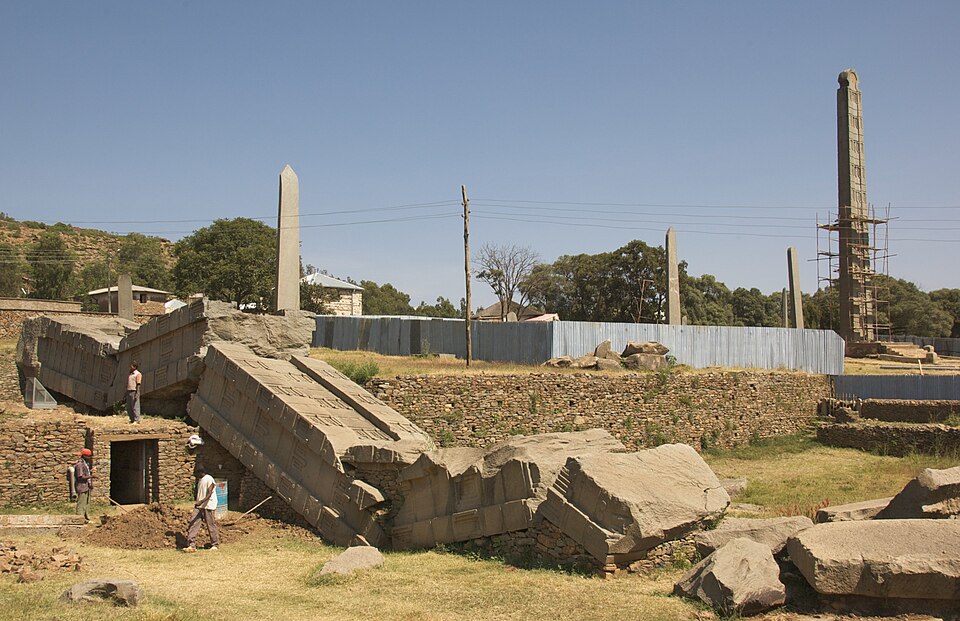
The most visually striking legacy of Aksumite civilisation is its monumental stelae (singular: stele), enormous carved stone pillars erected in the city of Aksum, primarily between the third and fourth centuries CE. The largest of these, now fallen and broken, originally stood approximately 33 metres tall and weighed an estimated 520 tonnes, making it one of the largest single stones ever erected by human effort in the ancient world.6 The tallest still-standing stele, known as the Obelisk of Aksum or King Ezana's Stele, reaches approximately 24 metres.
.jpg)
The stelae are carved from single blocks of nepheline syenite quarried from hills several kilometres from the city centre and transported to their erection sites by means that remain incompletely understood. Their surfaces are carved to represent multi-storey buildings, with false doors, windows, and horizontal timber beams rendered in stone, possibly representing the architectural style of elite Aksumite buildings or royal palaces.5, 6 The stelae are associated with underground burial chambers and are generally interpreted as funerary monuments for Aksumite rulers, though no royal burials have been found undisturbed in association with the largest stelae. The stelae field at Aksum, along with other Aksumite archaeological remains, was designated a UNESCO World Heritage Site in 1980.6
Coinage and political authority
Aksum was one of the first polities in sub-Saharan Africa to mint its own coinage, beginning in the late third century CE under King Endubis and continuing for approximately three centuries. Aksumite coins were struck in gold, silver, and bronze and bore the names and portraits of successive kings, providing one of the few continuous king lists for any ancient African state.4 The gold coins, which followed the weight standard of the Roman solidus, were intended for international trade and have been found as far afield as India, Arabia, and the eastern Mediterranean, demonstrating the geographic reach of Aksumite commerce.2, 4
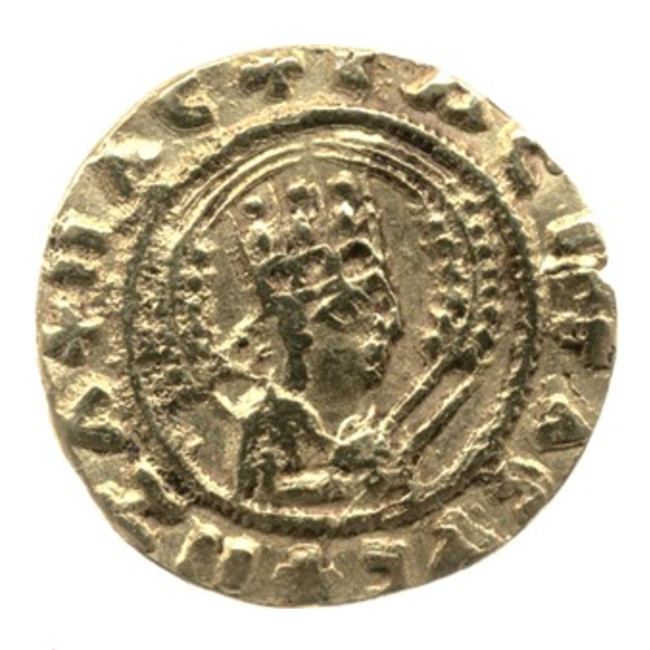

The coinage also provides important evidence for the Christianisation of Aksum. Early coins bear the disc and crescent symbol associated with pre-Christian Aksumite religion, but from the reign of King Ezana (approximately 330–360 CE) onward, the cross appears on coins, marking the adoption of Christianity as the state religion.4 The transition is visible within Ezana's own reign: his earlier inscriptions invoke the South Arabian-influenced god Mahrem, while his later inscriptions and coins are explicitly Christian, addressed to the "Lord of Heaven" and bearing the cross symbol.13
Adoption of Christianity
Aksum's adoption of Christianity in the fourth century CE, traditionally attributed to the influence of Frumentius, a Syrian Christian who became the first bishop of Aksum, made it one of the earliest states in the world to adopt Christianity as its official religion, roughly contemporary with the Roman Empire under Constantine.9 The conversion of King Ezana, attested by his trilingual inscription at Aksum (in Ge'ez, Greek, and South Arabian) which shifts from polytheistic to monotheistic language, represents a genuine turning point in Aksumite history, after which Christian institutions, architecture, and literary culture became central to the empire's identity.13
Aksumite Christianity was oriented toward the Alexandrian (Egyptian) patriarchate and followed Miaphysite Christology, holding that Christ has one united nature (divine and human) rather than two separate natures as defined by the Council of Chalcedon in 451 CE. This theological alignment placed the Ethiopian church in communion with the Coptic Church of Egypt and the Syrian Orthodox Church, and outside the communion of the Chalcedonian churches of Constantinople and Rome.9 The Ethiopian Orthodox Tewahedo Church, a direct descendant of Aksumite Christianity, remains one of the oldest continuously functioning Christian institutions in the world and retains distinctive liturgical practices, a unique biblical canon (including the Book of Enoch and Jubilees), and the Ge'ez language as its liturgical tongue.9
Military power and external relations
Aksum's military capabilities are attested by several major campaigns documented in royal inscriptions. The most significant of these was the Aksumite conquest of the Kingdom of Meroe (Kush) in the mid-fourth century CE, a campaign commemorated in one of Ezana's inscriptions, which describes the defeat of the Noba and Kasu peoples and the destruction of settlements along the Nile.2, 13 Aksumite power also extended across the Red Sea into southern Arabia (modern Yemen), where Aksumite forces intervened repeatedly in the affairs of the Himyarite kingdom during the fifth and sixth centuries.14
The most dramatic of these Arabian interventions occurred in 525 CE, when the Aksumite king Kaleb launched a military expedition across the Red Sea to overthrow the Himyarite king Dhu Nuwas, who had converted to Judaism and was persecuting the Christian community of Najran in southern Arabia. Kaleb's campaign, undertaken with the encouragement of the Byzantine emperor Justin I, resulted in the temporary Aksumite occupation of Himyar and the installation of a Christian client king.14 This episode illustrates the degree to which Aksum functioned as a significant player in the international politics of late antiquity, allied with Byzantium against Sasanian Persia in the broader contest for influence over the Red Sea and Arabian trade routes.14
Society and urbanism
The city of Aksum itself, as revealed by archaeological excavations, was a substantial urban centre with elite residences, churches, markets, craft workshops, and the monumental stelae that defined its skyline. Elite structures were built on raised platforms and featured the distinctive Aksumite architectural style of alternating layers of stone and timber (monkey-head masonry), producing the stepped, multi-storey facades that are depicted in the carved decoration of the stelae.5, 8
The Aksumite economy combined agriculture in the fertile highlands (where wheat, barley, teff, and various legumes were cultivated) with pastoralism (cattle, sheep, and goats) and long-distance trade. Craft production included ironworking, pottery, glass, and stone carving, and the presence of imported goods from across the Roman, Arabian, and Indian Ocean worlds attests to the cosmopolitan character of the Aksumite elite.11 The Ge'ez language, written in a script developed from South Arabian models but with the addition of vowel notation (making it an abugida rather than a pure consonantal alphabet), served as the language of royal inscriptions, church liturgy, and eventually a rich literary tradition including biblical translation, hagiography, and chronicles.5
Decline and legacy
The decline of the Aksumite Empire, a gradual process spanning the seventh to ninth centuries CE, resulted from a convergence of internal and external factors. The rise of Islam and the establishment of Muslim-controlled polities along the Red Sea coast from the seventh century onward progressively redirected trade away from Adulis, depriving Aksum of the commercial revenues that had underwritten its power. The last Aksumite coins were minted in approximately the early seventh century, and Adulis was destroyed — possibly by a Muslim raid — sometime during the same century.3, 16
Environmental degradation may also have contributed to the decline. Prolonged agricultural exploitation of the Ethiopian highlands, combined with possible episodes of reduced rainfall, may have diminished the agricultural productivity that sustained the Aksumite population. Some scholars have also suggested that the Justinianic plague, which devastated the Mediterranean world beginning in 541 CE, may have reached Aksum through its Red Sea trade connections, although direct evidence for plague in the Horn of Africa remains limited.15, 16
Despite the political dissolution of the Aksumite state, its cultural and religious legacies proved remarkably enduring. The Ethiopian Orthodox Tewahedo Church, which traces its origins to Ezana's conversion, preserved Ge'ez as a liturgical language and maintained a distinctive Christian tradition throughout the medieval and modern periods. The city of Aksum remains a sacred centre for Ethiopian Christianity, and the stelae, rock-hewn churches, and monastic traditions of the northern Ethiopian highlands bear witness to the lasting impact of Aksumite civilisation on the cultural landscape of the Horn of Africa.3, 9