Overview
- Ancient Egypt endured as a unified or semi-unified state for over three thousand years (c. 3100–30 BCE), making it one of the longest-lived civilizations in human history, sustained by the Nile River's predictable annual flood cycle and the natural fortress of surrounding deserts.
- Egyptian civilization produced monumental achievements in architecture, writing, medicine, and statecraft — including the Great Pyramids of Giza, the hieroglyphic script, the Edwin Smith Surgical Papyrus, and a centralized bureaucracy governed by divine kingship — that profoundly shaped the ancient Mediterranean world.
- Three principal eras of centralized power — the Old Kingdom (c. 2686–2181 BCE), the Middle Kingdom (c. 2055–1650 BCE), and the New Kingdom (c. 1550–1069 BCE) — were separated by intermediate periods of fragmentation, with the civilization ultimately falling under Persian, Greek, and Roman control before the last pharaonic institutions ceased in 30 BCE.
Ancient Egypt was one of the earliest and longest-lasting complex civilizations in human history, arising along the Nile River in northeastern Africa and enduring as an organized state for more than three thousand years, from the unification of Upper and Lower Egypt around 3100 BCE to the Roman annexation in 30 BCE.1 Across this extraordinary span, Egyptian society produced monumental architecture of unparalleled scale, a sophisticated writing system, elaborate religious and funerary traditions, and innovations in medicine, mathematics, and governance that profoundly influenced the ancient Mediterranean world and continue to shape modern understanding of antiquity.1, 7 Three principal eras of centralized power — the Old Kingdom, Middle Kingdom, and New Kingdom — were separated by intermediate periods of political fragmentation, yet a remarkable cultural continuity in religion, art, language, and royal ideology persisted throughout, making Egyptian civilization among the most stable large-scale polities the world has known.1, 22
The study of ancient Egypt as a modern academic discipline, known as Egyptology, began in earnest only after Jean-Francois Champollion's decipherment of the hieroglyphic script in 1822, an achievement made possible by the discovery of the Rosetta Stone during Napoleon's Egyptian campaign.20, 21 Since then, more than two centuries of archaeological excavation, textual scholarship, and scientific analysis have revealed a civilization of extraordinary depth and sophistication, one whose contributions to architecture, writing, statecraft, and knowledge of the natural world rank among the foundational achievements of human culture.1, 8
Geography and the Nile
The civilization of ancient Egypt was inseparable from the geography that shaped it. Egypt occupied a long, narrow ribbon of habitable land defined by the Nile River as it flowed northward through the eastern Sahara before fanning out into a broad delta on the Mediterranean coast. The country was traditionally divided into two regions: Upper Egypt, the narrow valley stretching roughly 800 kilometres from the First Cataract at Aswan to the apex of the Delta near modern Cairo, and Lower Egypt, the broad, fertile triangular Delta itself.2, 1 Beyond the floodplain on either side lay arid desert — the Libyan Desert to the west and the Eastern (Arabian) Desert to the east — which provided formidable natural barriers against invasion and cultural disruption, contributing to the exceptional stability of Egyptian society over millennia.2, 7
The Nile's annual flood, driven by monsoon rains in the Ethiopian highlands, was the ecological engine of Egyptian civilization. Each year between June and September, the river rose and inundated the floodplain, depositing a layer of rich alluvial silt that renewed the fertility of agricultural land without the need for artificial fertilization.16, 2 This predictable cycle enabled the cultivation of emmer wheat, barley, flax, and papyrus, and sustained population densities far exceeding those of surrounding regions. The Egyptian agricultural calendar was organized around the flood: akhet (inundation), peret (emergence, the growing season), and shemu (harvest, the dry season).1, 2 When the flood was adequate, Egypt prospered; when it failed — whether through unusually low or catastrophically high inundations — famine, social unrest, and political instability could follow, a pattern documented in both the archaeological record and Egyptian literary texts.16
The Nile also served as Egypt's principal transportation artery. The river's northward current carried boats downstream toward the Delta, while the prevailing north-to-south winds allowed vessels to sail upstream under canvas, creating a natural two-way highway that facilitated the movement of goods, people, and administrative communications along the entire length of the kingdom.2 This geographic advantage meant that a centralized state could govern the thousand-kilometre stretch from Aswan to the Mediterranean coast more effectively than might otherwise have been possible in the ancient world.
Egypt's position at the crossroads of Africa, Asia, and the Mediterranean also made it a nexus of long-distance trade and cultural exchange. Overland routes connected the Nile Valley to Nubia and sub-Saharan Africa to the south, to the Levant and Mesopotamia to the northeast, and to the Libyan oases to the west. Maritime routes from the Delta reached Crete, the Aegean, and the ports of the eastern Mediterranean, while Red Sea voyages connected Egypt to the land of Punt (probably located on the coast of modern-day Eritrea or Somalia) and, indirectly, to the trading networks of the Indian Ocean.1, 11 This combination of agricultural self-sufficiency and access to external resources — particularly the gold of the Eastern Desert and Nubia, the cedarwood of Lebanon, and the lapis lazuli of Afghanistan — provided the material foundation for the monumental culture that distinguished Egyptian civilization.7, 11
Predynastic origins and unification
The roots of Egyptian civilization extend deep into the Neolithic period. As the Sahara underwent progressive desiccation after approximately 5500 BCE, populations that had previously sustained themselves through pastoralism and fishing on the once-verdant Saharan grasslands migrated toward the Nile Valley, joining communities already established along the river.23, 3 By approximately 5000 BCE, farming villages cultivating emmer wheat and barley and raising cattle, sheep, and goats had emerged across Upper Egypt and the Fayum region.3 The earliest well-documented predynastic culture is the Badarian (c. 4400–4000 BCE), named after the site of el-Badari in Middle Egypt, whose people produced distinctive rippled pottery, worked copper into small objects, and buried their dead with grave goods suggestive of nascent beliefs about the afterlife.3, 4
The Badarian was succeeded by the Naqada culture, conventionally divided into three phases: Naqada I (Amratian, c. 4000–3500 BCE), Naqada II (Gerzean, c. 3500–3200 BCE), and Naqada III (c. 3200–3000 BCE). Across these phases, Upper Egyptian communities grew progressively larger and more socially stratified. Craft specialization intensified, long-distance trade networks extended into the Levant, Nubia, and the Western Desert, and elite burials became increasingly elaborate, indicating the emergence of hereditary leadership.3, 4 The settlement of Hierakonpolis (ancient Nekhen) in Upper Egypt became a major political and religious centre, with a population that may have reached 5,000 to 10,000 people at its peak around 3400 BCE, making it one of the largest urban centres in the Nile Valley during the predynastic period.4
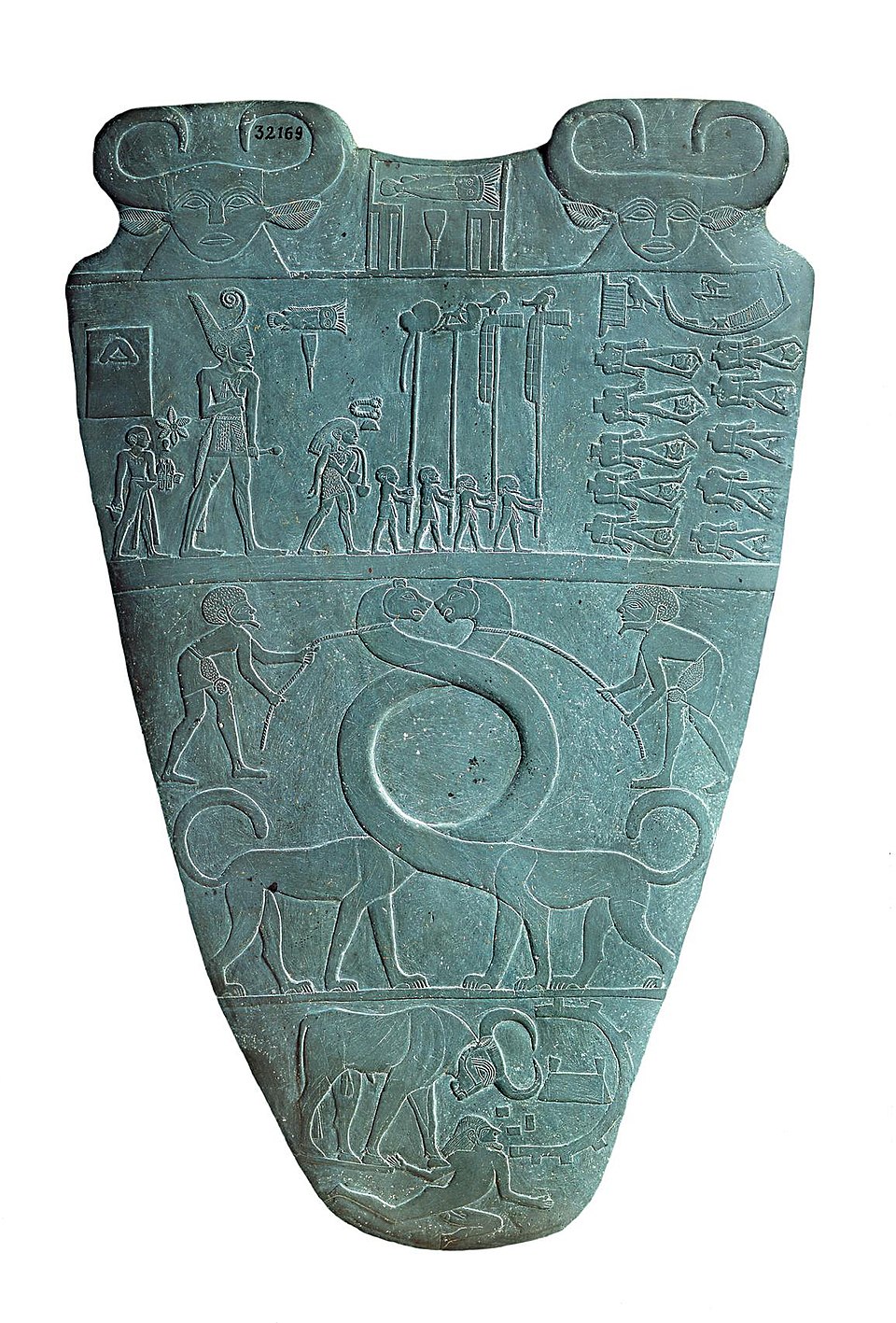
The transition from a landscape of competing chiefdoms to a unified territorial state occurred during the Naqada III period. The Narmer Palette, a ceremonial stone palette discovered at Hierakonpolis and dated to approximately 3100 BCE, depicts a ruler wearing the crowns of both Upper and Lower Egypt and is widely interpreted as commemorating the political unification of the two regions under a single king.4, 1 Whether this unification was achieved through military conquest, as the palette's imagery of smiting enemies might suggest, or through a more gradual process of political consolidation and elite alliance-building, remains a subject of scholarly debate. Evidence of conflict between Upper and Lower Egypt persisting into the Second Dynasty (c. 2890–2686 BCE) suggests that integration may have been protracted and contested rather than the result of a single decisive campaign.4, 7 The newly unified state established its capital at Memphis, near the junction of Upper and Lower Egypt, and the invention of writing — attested by bone and ivory tags from Tomb U-j at Abydos dating to approximately 3200 BCE — provided the administrative tools necessary for governing a territory stretching over a thousand kilometres along the Nile.18, 10

The Old Kingdom
The Old Kingdom (c. 2686–2181 BCE), encompassing the Third through Sixth Dynasties, represents the first great flowering of pharaonic civilization. During this period, the institution of divine kingship reached its fullest expression: the pharaoh was understood not merely as a political ruler but as a living god, the earthly manifestation of the falcon deity Horus, who maintained ma'at — the cosmic order of truth, justice, and harmony — through his very existence.8, 1 This theological conception of kingship provided the ideological foundation for a centralized bureaucratic state that mobilized the resources of the entire Nile Valley for royal building projects of unprecedented scale.22, 7
The most dramatic expression of Old Kingdom power was the construction of monumental pyramids as royal tombs. The Step Pyramid at Saqqara, built for King Djoser of the Third Dynasty around 2670 BCE and attributed to his vizier Imhotep, was the first monumental structure in the world built entirely of stone, rising in six tiers to a height of approximately 62 metres.5, 1 Over the following century, pyramid design evolved rapidly through experimental forms at Meidum and Dahshur until reaching its apogee in the Great Pyramids at Giza during the Fourth Dynasty. The Great Pyramid of Khufu (c. 2560 BCE), originally standing 146 metres tall and comprising an estimated 2.3 million stone blocks with a total mass of roughly 5.75 million tonnes, remained the tallest human-made structure on Earth for nearly four thousand years.5 The precision with which its base was levelled — to within approximately 2 centimetres across its 230-metre sides — and aligned to the cardinal directions reflects sophisticated surveying and astronomical observation.5
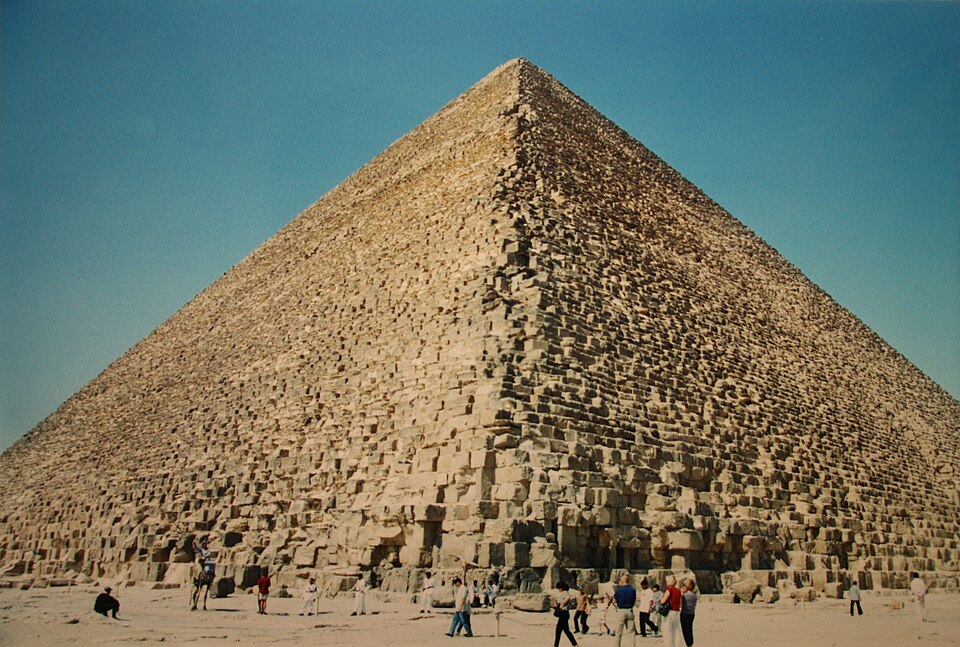

The construction of the pyramids was long attributed in popular imagination to enslaved labourers, a notion traceable to the Greek historian Herodotus. However, excavations by Mark Lehner and Zahi Hawass at the Heit el-Ghurab workers' settlement near Giza have fundamentally revised this picture. The site contained organized housing complexes, large-scale bakeries and breweries, and evidence of a diet rich in beef, fish, and bread — provisions far exceeding what would be expected for an enslaved workforce.6 Skeletal remains showed evidence of medical treatment for injuries, including healed fractures, and workers were buried in modest but purposeful tombs near the pyramids, suggesting that they were valued participants in a national enterprise, likely comprising a rotating labour force of conscripted farmers during the annual flood season supplemented by a core of skilled permanent artisans.6, 5
The Old Kingdom ended in the upheaval of the First Intermediate Period (c. 2181–2055 BCE), when the authority of the central government collapsed and provincial governors known as nomarchs asserted independent power. The causes of this decentralization are debated, but may include a prolonged series of low Nile floods that undermined agricultural productivity and the legitimacy of a kingship whose primary obligation was to ensure cosmic and natural order.16, 1
The Middle Kingdom
Egypt was reunified during the Middle Kingdom (c. 2055–1650 BCE) under the Theban rulers of the Eleventh and Twelfth Dynasties. Mentuhotep II of the Eleventh Dynasty defeated rival claimants and re-established centralized rule from Thebes around 2055 BCE, and the subsequent Twelfth Dynasty moved the capital northward to Itj-tawy, near the entrance to the Fayum.1, 7 The Middle Kingdom is often regarded as a classical age of Egyptian culture: royal power was reasserted but tempered by a more nuanced relationship between king and subjects, literature flourished in what scholars consider the golden age of Egyptian literary production, and Egypt expanded its territorial reach southward into Nubia, constructing a chain of massive mud-brick fortresses at the Second Cataract of the Nile to control trade and access to gold and other resources.1, 7
The pharaohs of the Twelfth Dynasty, particularly Senusret III and Amenemhat III, pursued ambitious programmes of land reclamation and irrigation in the Fayum depression, transforming marshland into productive agricultural territory and significantly increasing the state's resource base.1, 2 Diplomatic and commercial contacts with the Levant, Byblos, and the Aegean intensified during this period, and Egyptian influence extended far beyond the Nile Valley through trade, diplomacy, and military expeditions. The Middle Kingdom also witnessed a transformation in funerary culture: while royal tombs remained substantial, the afterlife was increasingly democratized, with non-royal elites and even members of the middle classes commissioning coffin texts — spells and instructions for navigating the underworld that had previously been restricted to kings.8, 9
The Middle Kingdom gave way to the Second Intermediate Period (c. 1650–1550 BCE), during which a people of Western Asiatic origin known as the Hyksos established the Fifteenth Dynasty in the eastern Delta, ruling from their capital at Avaris. The Hyksos introduced new military technologies to Egypt, including the horse-drawn chariot, the composite bow, and advanced bronze-working techniques, innovations that would transform Egyptian warfare in the period that followed.1, 11 The Theban Seventeenth Dynasty eventually waged a war of reunification against the Hyksos, culminating in their expulsion by Ahmose I around 1550 BCE and the founding of the New Kingdom.1
The New Kingdom
The New Kingdom (c. 1550–1069 BCE) was the era of Egypt's greatest territorial expansion and international prestige. Adopting the military technologies acquired from the Hyksos, the pharaohs of the Eighteenth Dynasty transformed Egypt from a regional Nile Valley power into an imperial state whose influence extended from the Fourth Cataract of the Nile in the south to the Euphrates River in the north.1, 11 Hatshepsut (c. 1473–1458 BCE), one of the few women to rule as pharaoh with full royal titles, presided over a period of prosperity marked by ambitious building programmes, including her mortuary temple at Deir el-Bahri, and a celebrated trading expedition to the land of Punt that returned with myrrh trees, incense, ebony, and gold.1 Her stepson and successor Thutmose III (c. 1458–1425 BCE) conducted at least seventeen military campaigns that brought the empire to its greatest territorial extent.1, 11
The reign of Akhenaten (c. 1353–1336 BCE) witnessed one of the most extraordinary episodes in Egyptian religious history. Akhenaten elevated the worship of the Aten, the solar disc, above all other deities, suppressed the cult of Amun, closed traditional temples, and relocated the royal capital to a newly founded city, Akhetaten (modern Amarna). Whether this represented true monotheism, monolatry, or a politically motivated centralization of religious authority remains debated among Egyptologists.8, 1 The experiment was short-lived: under Akhenaten's successors, including Tutankhamun (who changed his name from Tutankhaten), the traditional polytheistic religion was restored and Akhenaten's monuments were systematically dismantled.1
Ramesses II (c. 1279–1213 BCE), the most prolific builder of the New Kingdom, reigned for sixty-seven years and left his mark across the Egyptian landscape. His rock-cut temples at Abu Simbel in Nubia, with their colossal seated figures of the king carved into the cliff face, rank among the most recognizable monuments of the ancient world.17 The Battle of Kadesh (c. 1274 BCE), fought against the Hittite empire in modern-day Syria, was one of the largest chariot engagements in antiquity. Although the outcome was effectively a military draw, it led approximately fifteen years later to the Egyptian-Hittite peace treaty (c. 1259 BCE), the earliest surviving international peace accord, a copy of which hangs in the United Nations headquarters in New York.19, 1
The later New Kingdom was marked by increasing pressures from the so-called Sea Peoples — a confederation of maritime raiders whose identities and origins remain debated — and by growing tensions between the pharaoh and the powerful priesthood of Amun at Thebes. Ramesses III (c. 1186–1155 BCE) defeated the Sea Peoples in a series of land and naval battles documented on the walls of his mortuary temple at Medinet Habu, but the effort exhausted the state treasury.1, 7 By the end of the Twentieth Dynasty, effective control of Upper Egypt had passed to the high priests of Amun, inaugurating the Third Intermediate Period (c. 1069–664 BCE) and the progressive fragmentation of the Egyptian state.1
Society and religion
Egyptian society was hierarchically organized under the pharaoh, who stood at its apex as both political sovereign and divine intermediary between the human and cosmic orders. Below the king, a literate bureaucratic elite of viziers, provincial governors, scribes, and priests administered the state, collected taxes in kind (primarily grain), managed royal building projects, and oversaw the temple estates that controlled vast tracts of agricultural land.7, 22 The vast majority of the population were farmers who worked the land of the floodplain, contributing their surplus and their labour to the state in a system that, while not slavery in the strict sense, left ordinary Egyptians with limited social mobility. Artisans, soldiers, merchants, and physicians occupied intermediate positions in this stratified but functionally complex society.7, 2
Ancient Egyptian religion was a complex polytheistic system that permeated every aspect of life. The Egyptian pantheon included hundreds of deities, many associated with specific natural phenomena or cosmic functions. Ra (later syncretized with Amun as Amun-Ra) embodied the creative power of the sun; Osiris ruled the realm of the dead and symbolized resurrection and the cyclical renewal of life; Isis, the wife of Osiris, represented magical knowledge and maternal devotion; and Horus, the falcon god, was identified with the living king.8, 1 Central to Egyptian thought was the concept of ma'at, variously translated as truth, justice, cosmic order, or right — both a philosophical principle and a goddess. The pharaoh's primary obligation was to uphold ma'at against the forces of chaos (isfet), and the efficacy of his rule was measured by the degree to which social harmony and natural regularity were maintained.8
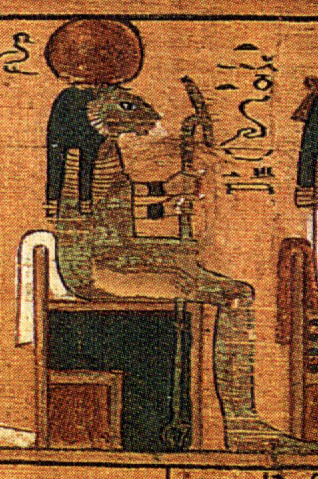
Egyptian funerary practices were among the most elaborate in the ancient world, driven by the belief that death was not an end but a transition to an eternal existence requiring careful preparation. The Egyptians conceived of the human being as comprising several spiritual components, including the ka (life force, which required sustenance through offerings), the ba (personality or animating spirit, depicted as a human-headed bird), and the akh (the transfigured spirit that achieved blessed existence among the gods).9, 8 Mummification — involving the removal of internal organs, desiccation in natron, anointing with oils, and wrapping in linen — developed from the observation that naturally desiccated bodies in the desert sands retained their form, and became increasingly elaborate over time.9 The Book of the Dead, a collection of funerary spells placed in tombs from the New Kingdom onward, provided the deceased with incantations necessary to navigate the underworld and pass judgment before Osiris, in which the heart was weighed against the feather of ma'at to determine worthiness for eternal life.8, 9

Writing and knowledge
The Egyptian hieroglyphic script is among the oldest writing systems in the world. The earliest known examples, discovered on bone and ivory tags in Tomb U-j at Abydos, date to approximately 3200 BCE and appear to record the quantities and geographic origins of commodities, suggesting that writing in Egypt, as in Mesopotamia, arose in the context of economic administration.18, 10 The hieroglyphic system was a complex combination of logographic and phonetic signs: some characters represented whole words or concepts, while others functioned as consonantal phonograms, and still others served as determinatives that clarified the meaning of adjacent signs without being pronounced.10 Alongside the formal hieroglyphic script used for monumental inscriptions and religious texts, the Egyptians developed hieratic, a cursive shorthand version suited to writing on papyrus with a reed pen, which served as the everyday administrative and literary script for most of pharaonic history. From the seventh century BCE onward, an even more abbreviated script called demotic gradually replaced hieratic for secular purposes.10, 1
Ancient Egyptian medical knowledge, preserved in a series of papyri, demonstrates a remarkable blend of empirical observation, rational diagnosis, and magico-religious prescription. The Edwin Smith Papyrus, a copy dating to approximately 1600 BCE but likely derived from a much earlier original, is the oldest known surgical treatise. It describes forty-eight cases of trauma — fractures, dislocations, wounds, and tumours — organized systematically from head to spine, each case structured as an examination, diagnosis, and prognosis classified as favourable, uncertain, or untreatable.13, 14 Its rational, empirical approach, largely free of magical incantations, has led scholars to regard it as a landmark in the history of scientific medicine.14 The Ebers Papyrus (c. 1550 BCE), the most extensive surviving medical text, contains over 800 remedies incorporating more than 300 plant, mineral, and animal ingredients for conditions ranging from intestinal parasites and eye diseases to gynaecological problems, representing one of the earliest pharmacopoeias in the world.12, 15
Egyptian mathematics was primarily practical in orientation, developed to solve problems of land surveying after the annual flood erased field boundaries, to calculate volumes for granary construction, and to manage the logistics of large building projects. The Egyptians used a decimal numeration system and achieved competence in arithmetic, including unit fractions, and practical geometry for computing areas and volumes.1, 7 Their civil calendar of 365 days, divided into twelve months of thirty days each plus five epagomenal days, was the first known calendar to approximate the solar year and remained in use in various forms for millennia, ultimately influencing the Julian and Gregorian calendars.1
In engineering, the Egyptians demonstrated extraordinary mastery of stone quarrying, transport, and construction. They raised massive obelisks, some weighing over 300 tonnes, using ramps, levers, and sledges lubricated with water, and developed effective irrigation technology including the shaduf (a counterweighted lever for lifting water) and extensive basin irrigation systems that channelled and retained floodwaters to maximize agricultural productivity.2, 16
Decline and later periods
The Third Intermediate Period (c. 1069–664 BCE) saw Egypt fragment into competing power centres: a line of pharaohs at Tanis in the Delta and the powerful high priests of Amun at Thebes who effectively controlled Upper Egypt. Libyan-descended dynasties ruled parts of the country, and a Nubian dynasty from the kingdom of Kush briefly reunified Egypt in the eighth and seventh centuries BCE before being driven out by the Assyrians.1, 7 The Late Period (664–332 BCE) saw a final resurgence of native Egyptian rule under the Saite Twenty-Sixth Dynasty, which consciously revived Old Kingdom artistic and religious traditions in a movement scholars term archaism. However, Egypt fell to the Persian Achaemenid Empire in 525 BCE under Cambyses II, and despite brief periods of independence, was reconquered by the Persians in 343 BCE.1
Alexander the Great conquered Egypt from the Persians in 332 BCE and founded the city of Alexandria, which would become one of the greatest centres of learning and commerce in the ancient Mediterranean. After Alexander's death, his general Ptolemy claimed Egypt and established the Ptolemaic dynasty, a Macedonian Greek ruling house that governed Egypt for nearly three centuries while adopting many pharaonic traditions, including divine kingship and temple construction in traditional Egyptian style.1, 11 The Ptolemaic period ended with the death of Cleopatra VII in 30 BCE, following her defeat alongside Mark Antony at the Battle of Actium and the subsequent Roman invasion under Octavian. Egypt became a province of the Roman Empire, and the pharaonic tradition of independent rule, which had endured in various forms for over three thousand years, came to a definitive end.1
Legacy
Knowledge of the hieroglyphic script was lost during the early centuries of the Common Era as the last practitioners of the old writing system died and Egyptian temples fell into disuse. For more than a millennium, the inscriptions on Egypt's monuments were unreadable. The key to their recovery was the Rosetta Stone, a Ptolemaic-era stele inscribed with the same decree in hieroglyphic, demotic, and Greek, discovered by French soldiers in 1799 during Napoleon's Egyptian campaign.20 In September 1822, the French philologist Jean-Francois Champollion announced that he had deciphered the hieroglyphic script, demonstrating that it was a mixed system of phonetic and ideographic signs rather than a purely symbolic code as earlier scholars had assumed. Champollion's breakthrough, built on his knowledge of Coptic (the last descendant of the ancient Egyptian language), opened the entire corpus of Egyptian texts to modern scholarship and inaugurated the discipline of Egyptology.21, 20
The influence of ancient Egypt on subsequent cultures was immense and multifaceted. Greek philosophers and historians, including Herodotus, Plato, and Diodorus Siculus, visited Egypt and transmitted accounts of its antiquity, religion, and learning to the Mediterranean world.11 Egyptian architectural motifs, religious concepts — particularly ideas about the afterlife, divine kingship, and cosmic order — and scientific knowledge were absorbed and transformed by Greek and Roman civilization, and through them by the broader Western tradition.11, 8 The Coptic language, a late form of Egyptian written in a modified Greek alphabet, survived as the liturgical language of the Egyptian Christian church and provided the linguistic bridge that made Champollion's decipherment possible.21 In the modern era, Egypt's monuments — the pyramids, the Sphinx, the temples of Karnak and Luxor, the rock-cut tombs of the Valley of the Kings — remain among the most visited and most recognized cultural landmarks on Earth, testaments to a civilization whose achievements in architecture, art, and statecraft set standards that endured for millennia and continue to inspire wonder.1, 22
The sheer temporal span of ancient Egypt is difficult to overstate. The civilization endured for a period roughly equivalent to the interval separating the present day from the construction of Stonehenge. Cleopatra VII, the last active pharaoh, lived closer in time to the first Moon landing than to the construction of the Great Pyramid of Khufu. This extraordinary continuity — in religious practice, artistic convention, written language, and political ideology — across more than thirty centuries of history, despite periodic upheavals and foreign incursions, reflects the stabilizing influence of the Nile's ecological regime and the deep cultural conservatism that it nurtured.2, 7
References
The Edwin Smith papyrus: a clinical reappraisal of the oldest known document on spinal injuries
When the Sahara was green: Late Pleistocene and Holocene human occupation and environment in northern Africa