Overview
- Mesopotamia, the river valley between the Tigris and Euphrates in modern Iraq, produced the world's first cities, the first writing system, and the first codified law, all developing between roughly 6500 and 500 BCE.
- The Sumerian city of Uruk reached a population of perhaps 40,000 people by 3200 BCE, making it the largest urban settlement on Earth at the time, while the invention of cuneiform writing there transformed how complex societies organized labor and memory.
- A succession of empires—Akkadian, Ur III, Old Babylonian, Assyrian, and Neo-Babylonian—each built on Sumerian foundations, and the textual, architectural, and administrative technologies they developed form the direct ancestors of much of later Western civilization.
The civilizations that rose and fell in the river valley between the Tigris and Euphrates constituted one of the most consequential experiments in human social organization ever conducted. The region, known in ancient Greek as Mesopotamia ("the land between the rivers"), occupies what is today Iraq, northeastern Syria, and parts of Turkey and Iran.3 There, over the course of roughly six thousand years, people invented the city, the state, the professional army, the legal code, the school, and the written word. Understanding Mesopotamia is not merely an exercise in antiquity; it is an investigation into the origins of institutions that still structure daily life in the twenty-first century.14
The Fertile Crescent and the geographic foundation
The physical setting of Mesopotamian civilization was determined above all by its rivers. The Tigris and Euphrates both originate in the mountains of Anatolia and flow southeast toward the Persian Gulf, depositing enormous quantities of alluvial silt as they descend onto the flat plains of what geologists call the Mesopotamian alluvial fan.2 This silt, renewed every year by seasonal flooding, created exceptionally fertile soil in an otherwise arid environment. Annual rainfall in the southern plains averages well below 200 millimeters—far too little for reliable rain-fed farming—but the river floods provided the water needed to sustain agriculture on a large scale if that water could be captured and directed.2, 3
This tension between aridity and river-borne fertility is the central geographic fact of Mesopotamian history. Unlike the Nile, which flooded on a predictable annual schedule, the Tigris and Euphrates flooded irregularly and sometimes catastrophically, making water management both essential and perpetually insecure.3, 14 The need to build, maintain, and coordinate irrigation canals on a large scale created powerful incentives for social organization beyond the village level. As the archaeologist Robert McC. Adams argued in his landmark survey of the region, it was precisely this irrigation imperative that pushed communities toward increasingly hierarchical and centralized political arrangements.2
The broader ecological zone of which Mesopotamia formed a part has long been called the Fertile Crescent—an arc of productive land curving from the Persian Gulf through the Levant to the Nile delta. The wild progenitors of domesticated wheat, barley, lentils, peas, goats, sheep, cattle, and pigs were all native to this zone, making it the most productive theater for the Neolithic transition from foraging to farming anywhere in the Old World.7
The Ubaid period and the roots of complexity
The first culture to show clear signs of the social complexity that would culminate in Mesopotamian urbanism is known as the Ubaid culture, named for the site of Tell al-Ubaid near the ancient city of Ur in southern Iraq. Ubaid communities emerged as early as 6500 BCE and persisted until roughly 3800 BCE, leaving a material signature—a distinctive style of painted pottery—that spread across the entire region from the Persian Gulf to southeastern Anatolia.20 The breadth of this spread indicates that long-distance trade and cultural contact were features of Mesopotamian life long before the first cities appeared.
Excavations at Ubaid-period sites reveal a key social transition: the emergence of a temple as the dominant institution in community life. Early Ubaid temples were modest mudbrick structures elevated on low platforms, but they grew progressively more elaborate over time.7 The temple appears to have served simultaneously as a house of worship, a granary, a center for craft production, and a redistribution point for agricultural surplus—functions that would define Mesopotamian institutional life for millennia.3, 23 Material evidence from Ubaid cemeteries shows differential burial wealth by the late phase of the culture, indicating that social stratification was already underway before the advent of writing or monumental architecture.22
The Uruk period and the world's first cities

Around 4000 BCE, the pace of social change accelerated dramatically in a phenomenon archaeologists call the Uruk expansion. The southern Mesopotamian city of Uruk (biblical Erech, modern Warka) emerged as the dominant center of a network that reached hundreds of kilometers in every direction.1 At its peak around 3200 BCE, Uruk covered approximately 250 hectares and may have housed between 25,000 and 50,000 people, making it by a wide margin the largest urban settlement anywhere on Earth at the time.1, 7
The physical scale of Uruk remains staggering even from an archaeological vantage point. The city contained two great temple complexes: the Eanna precinct, dedicated to the goddess Inanna, and the Anu ziggurat complex, dedicated to the sky god Anu. The Eanna precinct alone contained several monumental limestone temples, an unprecedented use of stone construction in a region where the only natural building material was mud. The stone had to be transported from quarries tens of kilometers away, requiring organized labor of a kind previously unknown.7
The Uruk expansion was not merely the growth of a single city but the projection of an entire economic and administrative system outward into Anatolia, Iran, and the Levant. Archaeological surveys have revealed that Uruk established colonies and trading outposts at sites like Habuba Kabira on the Euphrates in Syria—fully planned urban settlements with Uruk-style architecture, pottery, and administrative tools planted in foreign landscapes.1 The anthropologist Guillermo Algaze has characterized this phenomenon as the world's first identifiable world-system: a core urban economy extracting raw materials and labor from a surrounding periphery using organizational technologies that periphery societies lacked.1
The material markers of the Uruk system include several distinctive artifacts. The beveled-rim bowl—a simple, mass-produced ceramic vessel found in enormous quantities across the entire Uruk sphere—appears to have been a standardized ration container, the physical residue of a centralized economy in which workers were fed from institutional stores.3 Cylinder seals, small carved stone cylinders that could be rolled across wet clay to leave an impression, served as personal identifiers and authentication devices for administrative transactions.18 Their widespread use indicates that the Uruk economy operated through documented exchange on a scale requiring portable, reproducible seals of ownership and authorization.
The invention of writing
The single most consequential intellectual achievement of the Uruk period was the invention of writing. The earliest known writing in the world consists of clay tablets recovered from the Eanna precinct at Uruk and dated to approximately 3300–3100 BCE.4, 5 These tablets, written in what scholars call proto-cuneiform, are not literary documents: they are accounting records. They enumerate quantities of grain, animals, and laborers using pictographic signs and numerical notation.21 Writing, in its earliest form, was not an instrument of poetry or theology but of bureaucratic control.
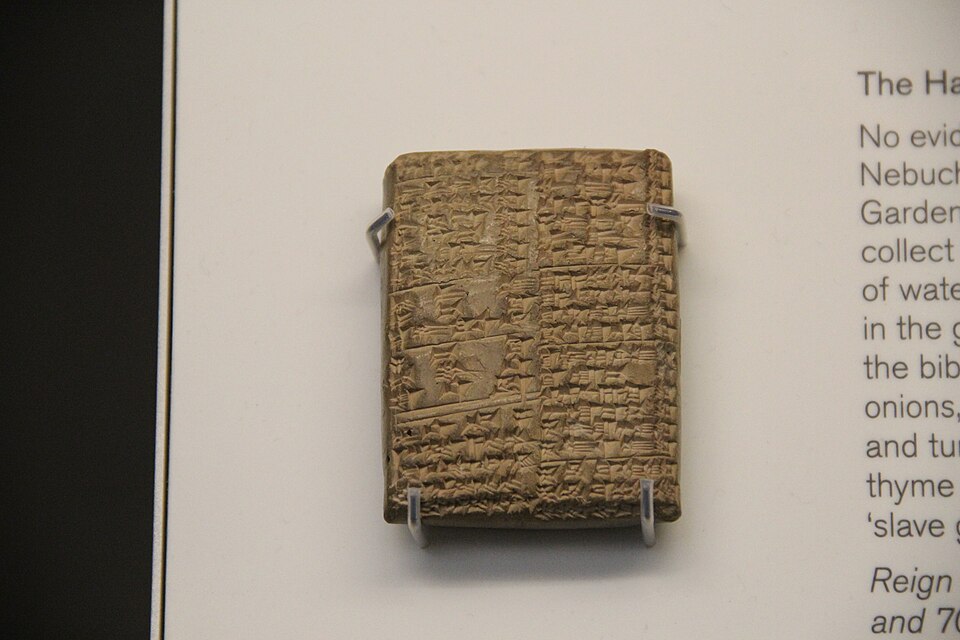

The prehistory of this invention has been illuminated by the work of Denise Schmandt-Besserat, who traced the origin of cuneiform signs to a much older system of small clay tokens used throughout the ancient Near East from at least 8000 BCE.5 These tokens came in a variety of shapes corresponding to different commodities: spheres for grain, cylinders for animals, discs for particular manufactured goods. When sealed inside clay envelopes for transport and storage, the tokens' contents were eventually recorded on the outside of the envelope as impressed marks. Over centuries, this practice evolved into a system of impressed and incised signs on flat tablets, eventually producing the fully developed proto-cuneiform script of late Uruk.4, 5
By the Early Dynastic period (c. 2900–2350 BCE), the script had evolved from pictographic to abstract. Scribes rotated their tablets and began writing with a stylus held at an angle, pressing its wedge-shaped tip into the clay to produce the characteristic wedge-mark strokes that give the script its modern name: cuneiform, from the Latin cuneus (wedge).3 The language recorded in the earliest tablets is Sumerian, an agglutinative language with no known relatives. By the late third millennium BCE, cuneiform had been adapted to write Akkadian (a Semitic language), and over subsequent centuries it was used to record Elamite, Hurrian, Hittite, Ugaritic, and Old Persian, becoming the dominant writing system of the ancient Near East for over three thousand years.23
The social consequences of writing were profound. Literacy created a class of professional scribes who trained in formal schools called edubba ("tablet house") and who mediated between the institutional world of temple and palace administration and the broader population.3, 23 Writing made it possible to store, transmit, and verify information across distances and generations that oral memory could not reliably bridge. It enabled the coordination of labor, the enforcement of contracts, the collection of taxes, and eventually the composition of literature on a scale impossible without it.
Sumerian city-states and early dynastic society
During the Early Dynastic period (c. 2900–2350 BCE), southern Mesopotamia was organized as a landscape of competing city-states, each centered on a major urban core with its own patron deity, temple, and ruling dynasty.6 The major Sumerian cities—Uruk, Ur, Eridu, Lagash, Nippur, Kish, and Umma, among others—were separated by agricultural hinterlands and irrigation networks, and they competed intensely for water rights, agricultural land, and trade routes.6, 3
Eridu, located near the modern city of Nasiriyah in southern Iraq, is traditionally regarded as the oldest city in Mesopotamian literary tradition. The Sumerian King List—a cuneiform document that organizes history as a succession of dynasties—begins with the claim that "kingship descended from heaven" first at Eridu.23 Archaeology confirms Eridu's antiquity: excavations have revealed an unbroken sequence of temples at the site extending from the Ubaid period through the Early Dynastic, with the earliest levels dating to approximately 5400 BCE.7
Lagash, another major city-state in the far south, has produced some of the most detailed administrative records from the Early Dynastic period, including the extensive archives of the Bau temple complex. These records document a large, stratified workforce organized by gender and occupation, receiving rations of grain and oil from institutional stores—a portrait of an economy that was extensively managed by the temple but also included private landholding and independent craftspeople.3
The material wealth concentrated in Early Dynastic cities is dramatically illustrated by the Royal Cemetery at Ur, excavated by Leonard Woolley between 1922 and 1934. Among the approximately 1,840 graves, Woolley identified sixteen "royal tombs" containing extraordinary concentrations of gold, silver, lapis lazuli (imported from Afghanistan), carnelian (from the Indus Valley), and finely worked artifacts.24 More striking still was the evidence for human sacrifice: multiple royal tombs contained the remains of retainers—soldiers, musicians, and attendants—apparently killed to accompany the tomb's primary occupant into the afterlife, indicating a degree of royal power over the lives of subjects that goes far beyond what earlier Ubaid communities displayed.24
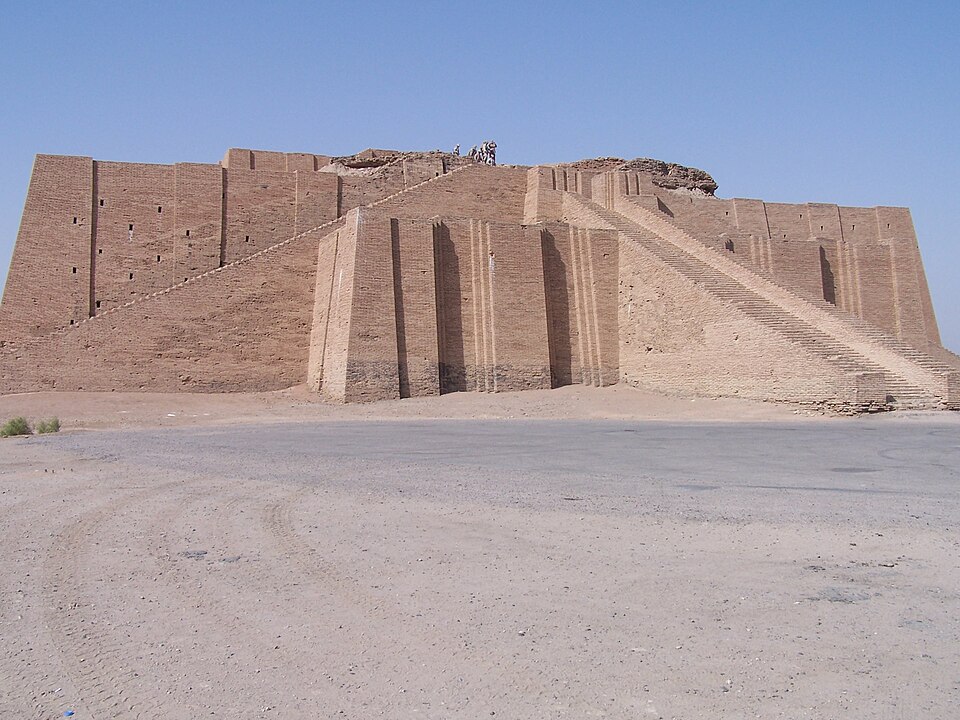
The ziggurat was the most distinctive architectural expression of Mesopotamian religious and political authority. Rising in stepped tiers above the flat alluvial plain, ziggurats were artificial mountains, designed to bring the temple at the summit into proximity with the divine realm above.19 The best-preserved example, the great ziggurat at Ur built by the Ur III king Ur-Nammu around 2100 BCE, stands approximately 30 meters tall at its current height and was originally considerably higher. Its massive mudbrick core is encased in baked bricks set in bitumen, and the exterior walls are inclined slightly inward to create an optical illusion of greater height.19
The Akkadian Empire and Sargon
Around 2334 BCE, a figure known to history as Sargon of Akkad conquered the Sumerian city-states of the south and united them under a single ruler for the first time in Mesopotamian history, founding what is conventionally called the Akkadian Empire.8 Sargon's origins were obscure by design: later traditions describe him as a foundling whose mother set him adrift in a basket on a river, a motif that echoes the birth narrative of Moses and appears to be a literary convention for legitimizing rulers of humble or uncertain origin.8, 14 What is not in doubt is that Sargon—whose name means "true king" in Akkadian—proved to be the most effective military and administrative organizer the ancient world had yet seen.
From his capital Akkad (whose location remains unidentified in the archaeological record), Sargon conducted campaigns that, according to later inscriptions, extended from the Persian Gulf to the Mediterranean coast and possibly to Anatolia and Egypt, though these claims require critical evaluation.8 His innovation was not merely conquest but the imposition of an imperial administrative structure that replaced local rulers with Akkadian governors, standardized weights and measures, and created a unified trading network spanning the entire Near East.8, 3
The Akkadian Empire reached its apogee under Sargon's grandson Naram-Sin (r. c. 2254–2218 BCE), who proclaimed himself "king of the four quarters" and, in an unprecedented act of royal self-deification, added the divine determinative to his name—formally declaring himself a god.8 His victory stele, discovered at Susa and now in the Louvre, depicts him ascending a mountain over the bodies of his enemies, wearing the horned helmet of divinity: it is one of the great masterworks of ancient art and one of the clearest visual declarations of absolute power in the archaeological record.14
The Akkadian Empire collapsed around 2154 BCE, a fall attributed in ancient texts to divine punishment and in modern scholarship to a combination of internal rebellions and, possibly, climate change. A 4.2-kiloyear climatic event—a prolonged drought that reduced rainfall across much of the ancient Near East—has been proposed as a contributing factor in the simultaneous collapse of several Old World civilizations in this period, though the role of climate relative to political and military factors remains debated.14
The Third Dynasty of Ur
Following a period of regional fragmentation under the Gutian rulers from the Zagros mountains, southern Mesopotamia was reunified by Ur-Nammu, founder of the Third Dynasty of Ur (Ur III), around 2112 BCE.9 The Ur III state was not an empire in the Akkadian mold—it did not project power as far afield—but it created the most intensively documented administrative system in the ancient world. Archaeologists have recovered more than 100,000 cuneiform administrative tablets from Ur III sites, the overwhelming majority concerned with the management of agricultural labor, animal husbandry, and craft production.9
The Ur III bureaucracy operated on the principle of centralized labor accounting. Workers were organized into gangs, their daily task assignments recorded by local scribes, and their performance tracked against institutional quotas in a system of accountability that reaches astonishing levels of specificity.9, 3 Grain and wool moved through a redistributive economy in which the state recorded every transaction. The result is a documentary record that allows modern historians to reconstruct the daily rations of workers, the seasonal variation in agricultural tasks, and the management hierarchies of individual temple estates in extraordinary detail.
Ur-Nammu is also credited with the promulgation of the earliest known legal code yet discovered, predating Hammurabi's famous code by three centuries.9 The Ur-Nammu code, preserved in fragmentary form, established compensation standards for bodily injury and regulated marriage and property—evidence that formalized law was already an established instrument of social governance in the twenty-first century BCE. The Ur III state collapsed around 2004 BCE under Amorite and Elamite pressure, an event commemorated in a Sumerian literary genre of city lamentations that document the psychological and cultural shock of institutional destruction.9, 25
The Old Babylonian period and Hammurabi's Code
The first centuries of the second millennium BCE saw the rise of a new political geography dominated by Amorite dynasties. Among these, the dynasty established at Babylon on the middle Euphrates became preeminent under its sixth king, Hammurabi (r. c. 1792–1750 BCE).10 Through a combination of military campaigns and diplomatic maneuvering, Hammurabi eliminated the other major powers of his era—Larsa, Eshnunna, Mari, and Assyria—creating an empire that briefly unified most of Mesopotamia under Babylonian authority.
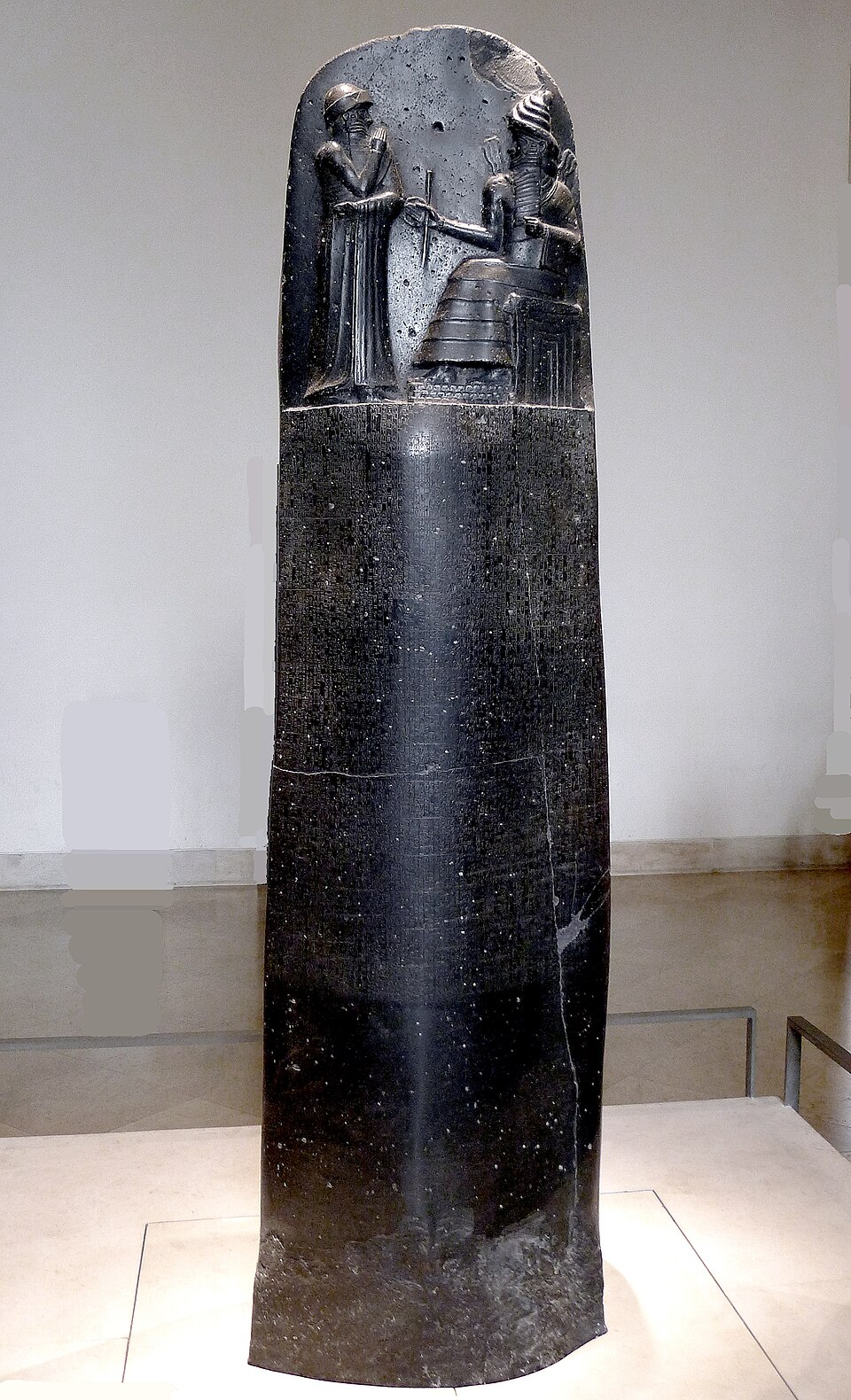

Hammurabi is remembered above all for his law code, promulgated late in his reign and preserved on a 2.25-meter basalt stele discovered at Susa in 1901 and now housed in the Louvre.10 The stele bears 282 case laws preceded by a prologue that identifies Hammurabi as chosen by the gods Anum and Enlil to bring justice to the land, and followed by an epilogue calling down curses on future rulers who fail to maintain the code.11 The laws themselves cover an extensive range of civic matters: commercial transactions, rates of hire, agricultural tenancy, wages for skilled workers, marriage and divorce, inheritance, adoption, penalties for bodily harm, and the obligations of doctors and builders.10, 11
The principle of proportional retaliation—the lex talionis, often summarized as "an eye for an eye"—appears in the Hammurabi code, but its application was explicitly class-differentiated: the same injury inflicted on a free person, a dependent of the state, or a slave carried different legal consequences.11 This stratification reflects the tripartite social structure of Old Babylonian society, in which free citizens (awilum), semi-free dependents (mushkenum), and slaves (wardum) occupied legally distinct positions.3, 10 The code is not a complete legislation in the modern sense but rather a royal declaration of justice—a record of exemplary decisions intended to establish the king's reputation as a righteous ruler rather than a comprehensive statute book for everyday application.11
The Old Babylonian period also produced two of the most important literary achievements of the ancient world. The Epic of Gilgamesh, assembled in its fullest form during this era (though drawing on Sumerian sources centuries older), follows the king of Uruk in his quest for immortality after the death of his companion Enkidu.15 It includes a detailed flood narrative—drawing on the older Atrahasis tradition—in which a god-sent deluge destroys humanity and a single righteous man survives on a boat, a text that predates and almost certainly influenced the Biblical flood account in Genesis.25 The Atrahasis epic also reflects Mesopotamian cosmological thinking in which human beings were created specifically to relieve the gods of the burden of agricultural labor—an origin narrative inseparable from the irrigation economy that generated it.25
The Assyrian Empire
The Assyrians, a Semitic-speaking people centered on the city of Ashur on the upper Tigris, developed a distinctive political culture oriented toward military expansion and the systematic extraction of tribute from conquered territories. Assyrian power went through several phases. The Old Assyrian period (c. 2000–1750 BCE) is notable for the extensive trading colonies Assyrian merchants established in Anatolia, particularly at Kanesh (modern Kültepe in Turkey), where thousands of cuneiform tablets document a sophisticated long-distance trade in tin and textiles.12
The Neo-Assyrian Empire (c. 911–609 BCE) represents the culmination of Assyrian power and the creation of the largest empire the ancient world had yet seen. Under a succession of aggressive kings—Ashurnasirpal II, Shalmaneser III, Tiglath-Pileser III, Sargon II, Sennacherib, Esarhaddon, and Ashurbanipal—Assyria progressively conquered Babylonia, the Levant, Egypt, and Iran, eventually controlling a territory stretching from the Persian Gulf to the Nile delta.12
Assyrian military effectiveness rested on several innovations. The army made systematic use of iron weapons and tools, iron having become available in quantity in the early first millennium BCE after the collapse of the Bronze Age trade networks that had supplied tin and copper.12 Assyrian siege warfare was particularly advanced: texts and palace reliefs document the use of siege ramps, battering rams, undermining, and forced relocation of populations—a policy of mass deportation deliberately designed to disrupt subject populations' capacity for organized resistance.12
The Neo-Assyrian kings created palaces of unparalleled magnificence at Nimrud, Khorsabad, and Nineveh, decorated with long narrative reliefs depicting military campaigns, royal hunts, and ceremonial scenes. At Nineveh, the library of Ashurbanipal (r. 668–627 BCE) assembled more than 30,000 cuneiform tablets representing a deliberate effort to collect the entire corpus of Mesopotamian literary, religious, scientific, and omen literature.23 Among its holdings were complete versions of the Epic of Gilgamesh—texts that survived only because of Ashurbanipal's collecting ambition. The Neo-Assyrian Empire collapsed with startling speed around 612 BCE, when a coalition of Babylonians and Medes sacked Nineveh and dismantled Assyrian administrative structures within a generation.12
The Neo-Babylonian Empire and Nebuchadnezzar II
On the ruins of Assyrian power, the Babylonians under the Chaldean dynasty created a final florescence of Mesopotamian civilization. The Neo-Babylonian Empire (626–539 BCE) was dominated above all by the long reign of Nebuchadnezzar II (r. 604–562 BCE), whose building projects transformed Babylon into what ancient sources agreed was the largest and most magnificent city in the world.13
Under Nebuchadnezzar, Babylon was reconstructed on a monumental scale. The inner city was enclosed by a double wall system of mudbrick and baked brick, with the outer wall reportedly wide enough for a chariot to turn on its summit.14 The Ishtar Gate, faced in glazed brick with alternating reliefs of bulls and dragons in brilliant blue, yellow, and white, served as the primary ceremonial entrance to the city and opened onto the Processional Way, a broad avenue lined with lion reliefs that led to the great temple of Marduk, the Esagila.13 The Hanging Gardens of Babylon, one of the Seven Wonders of the Ancient World as catalogued by Hellenistic writers, are attributed to Nebuchadnezzar's reign, though their precise location and even their existence remains debated among archaeologists, as no unambiguous physical remains have been identified at the Babylon site.14
Nebuchadnezzar is also known from biblical sources as the king who destroyed the Temple of Solomon in Jerusalem in 586 BCE and deported a substantial portion of the Judean population to Babylon—the "Babylonian captivity" of the Hebrew Bible.13 Babylonian chronicle texts confirm the military campaigns against Judah and Tyre, giving historians a rare point of overlap between Mesopotamian cuneiform records and biblical narrative.13
The Neo-Babylonian period was also a high point of Mesopotamian astronomy and mathematics. Babylonian astronomers had long maintained systematic records of celestial events, and by the first millennium BCE they had developed mathematical techniques for predicting the positions of the Moon, Sun, and visible planets with remarkable precision.17 The Babylonian system of dividing the sky into 360 degrees, the hour into 60 minutes and the minute into 60 seconds—derived from the sexagesimal (base-60) number system developed in the third millennium BCE—persists in global use today.16, 17 Babylonian algebra, as preserved in tablets from the Old Babylonian period onward, included techniques for solving quadratic and cubic equations, demonstrating a level of mathematical sophistication that would not be matched in Europe until the Renaissance.16
The Neo-Babylonian Empire fell to the Persian king Cyrus the Great in 539 BCE, reportedly without significant resistance, as the city's population welcomed Persian rule in part because Cyrus presented himself as a restorer of Babylonian religious traditions.13 Though cuneiform continued to be written by a diminishing number of scribes for several more centuries—the last dated cuneiform tablet is from 75 CE—the political and cultural tradition of independent Mesopotamian civilization effectively ended with the Persian conquest.23
Chronology of Mesopotamian civilizations
Mesopotamian history spans a remarkable breadth of time, from the earliest village settlements of the Ubaid period to the fall of the Neo-Babylonian Empire—a duration of approximately six thousand years. The following table summarizes the major cultural and political periods, their approximate dates, and their defining characteristics as documented in the archaeological and textual record.3, 7, 14
Major periods of Mesopotamian civilization3, 7, 14
| Period | Approximate dates (BCE) | Key developments |
|---|---|---|
| Ubaid | 6500–3800 | First temples, irrigation canals, long-distance trade, social stratification |
| Uruk | 4000–3100 | World's first cities, proto-cuneiform writing, cylinder seals, beveled-rim bowls |
| Early Dynastic | 2900–2350 | Sumerian city-states, Royal Cemetery at Ur, ziggurats, Sumerian King List |
| Akkadian Empire | 2334–2154 | First territorial empire, Sargon of Akkad, Naram-Sin's self-deification |
| Ur III (Third Dynasty of Ur) | 2112–2004 | Ur-Nammu law code, bureaucratic state, 100,000+ administrative tablets |
| Old Babylonian | 2000–1595 | Hammurabi's Code, Epic of Gilgamesh, Atrahasis flood myth, advanced algebra |
| Kassite / Middle Babylonian | 1595–1155 | Babylonian becomes diplomatic lingua franca, international Bronze Age trade |
| Neo-Assyrian Empire | 911–609 | Iron weapons, mass deportations, Nineveh library, Near Eastern hegemony |
| Neo-Babylonian Empire | 626–539 | Nebuchadnezzar II, Ishtar Gate, astronomical prediction, fall of Jerusalem |
Scientific and cultural legacy
The legacy of Mesopotamian civilization is difficult to overstate. Practically every institution that defines urban life in the contemporary world has antecedents traceable to the Tigris-Euphrates valley. Writing, mathematics, formal law, professional specialization, long-distance commerce, standing armies, urban planning, the school as an institution, and the systematic observation of the natural world all appear in Mesopotamia either for the first time or in their earliest well-documented forms.3, 23
Mesopotamian mathematics developed the sexagesimal positional number system and the concept of zero as a placeholder, both of which entered Greek mathematics through Babylonian astronomers and eventually became global standards.16 Babylonian astronomical records, maintained continuously from the eighth century BCE onward, provided Greek astronomers like Hipparchus with the long time series needed to identify precession of the equinoxes and construct reliable lunar and planetary models.17
Mesopotamian religious and mythological texts exerted direct influence on later traditions. The flood narrative in the Atrahasis epic and the Epic of Gilgamesh shows such close parallels to the Genesis account that most scholars regard direct literary transmission as the most parsimonious explanation, most probably mediated through the cultural contact that attended the Babylonian captivity.15, 25 More broadly, the idea of a creator god who separates order from chaos, fashions humans from clay to perform divine labor, and establishes kingship as a divinely legitimized institution appears across ancient Near Eastern traditions in ways that reflect a shared Mesopotamian intellectual heritage.25
The archaeological investigation of Mesopotamia is itself one of the founding narratives of modern archaeology. From Austen Henry Layard's excavations at Nineveh in the 1840s through the systematic stratigraphic work of Leonard Woolley at Ur in the 1920s and the remote-sensing surveys of the late twentieth century, Mesopotamia has been a laboratory in which the discipline of archaeology developed its methods and refined its interpretive frameworks.14 The field of Assyriology, devoted to the reading and interpretation of cuneiform tablets, has in recent decades been transformed by the digital aggregation of tablet databases, enabling quantitative analyses of economic, social, and linguistic patterns across the entire corpus of surviving documents—more than half a million tablets—that were impossible for earlier generations of scholars.21
References
Different types of egalitarian societies and the development of inequality in early Mesopotamia