Overview
- Writing was independently invented at least three to four times in human history — in Mesopotamia (c. 3400–3100 BCE), Egypt (c. 3200 BCE), China (by c. 1200 BCE), and Mesoamerica (c. 900–600 BCE) — each time emerging from the administrative, ritual, or political needs of complex, stratified societies.
- The evolution from proto-writing to true writing required a critical conceptual breakthrough: the shift from tokens, tallies, and pictographic symbols that represented things to systems that systematically encoded spoken language, enabling the permanent visual representation of any utterance through devices such as the rebus principle.
- The alphabet, arguably the most influential writing technology ever devised, was invented only once — by Semitic speakers in contact with Egyptian civilization around 1800 BCE — and all modern alphabetic scripts descend from that single Proto-Sinaitic innovation through the Phoenician and Greek traditions.
Writing is among the most transformative inventions in human history. The capacity to encode spoken language in permanent visual symbols enabled societies to administer institutions of unprecedented complexity, transmit knowledge across generations without reliance on individual memory, communicate over vast distances, codify law, record history, and accumulate the intellectual traditions that underpin science, literature, and philosophy. Unlike many technologies that spread from a single centre of innovation, writing was independently invented at least three and possibly four or more times in widely separated regions of the world: in Mesopotamia around 3400–3100 BCE, in Egypt around 3200 BCE, in China by at least 1200 BCE, and in Mesoamerica by roughly 900–600 BCE.5, 7 In every documented case, the invention of writing occurred in the context of complex, hierarchically organised societies that had already developed agriculture, urbanisation, and centralised political authority — a pattern that strongly suggests writing arose as a response to the administrative and communicative demands of early states.5, 22
The distinction between proto-writing and true writing is fundamental to understanding these origins. Proto-writing systems — including tallies, pictographic symbols, and the clay token systems of the ancient Near East — could convey limited information through direct symbolic or pictorial representation, but they could not systematically encode the sounds, words, and grammatical structures of a spoken language. True writing, by contrast, represents language itself, enabling a reader to reconstruct the specific utterances of the writer.6, 21 The transition from one to the other was neither instantaneous nor inevitable, but it occurred independently in multiple civilisations, each arriving at the breakthrough through its own cultural and administrative trajectory.
Clay tokens and proto-writing
Long before the first clay tablets were inscribed in Mesopotamia, human societies employed symbolic and mnemonic systems to record quantitative information. The most thoroughly studied of these precursors is the clay token system of the ancient Near East, documented extensively by the archaeologist Denise Schmandt-Besserat beginning in the 1960s and synthesised in her landmark 1992 study Before Writing. Starting around 8000 BCE, coinciding with the emergence of agriculture and sedentary village life in the Fertile Crescent, small geometrically shaped clay objects — cones, spheres, discs, cylinders, and ovoids — appeared across a broad region stretching from present-day Turkey and Syria to Iran. Each shape represented a specific commodity: a cone stood for a small measure of grain, a sphere for a larger measure, a disc for a unit of livestock.1, 2 These tokens functioned as a concrete, one-to-one accounting system, enabling herders, farmers, and temple administrators to track quantities of goods without recourse to abstract notation.
Over several millennia, the system grew more elaborate. By the fourth millennium BCE, administrators were enclosing groups of tokens inside hollow clay balls called bullae, which served as sealed containers verifying the details of a transaction: breaking a bulla open revealed the tokens within, confirming the agreed-upon quantities. Crucially, scribes began impressing the tokens onto the outer surface of the bulla before sealing it, creating a visible two-dimensional record of the three-dimensional contents. This step — the replacement of manipulable objects with impressed marks on a clay surface — was, in Schmandt-Besserat's analysis, the pivotal conceptual leap that led directly to writing. The impressed marks eventually replaced the tokens entirely, becoming the first signs inscribed on flat clay tablets.1, 2
Schmandt-Besserat's token-to-tablet hypothesis, while widely influential, has not gone unchallenged. Robert Englund, one of the leading specialists on the proto-cuneiform corpus, noted that the earliest tablets from Uruk bear only a partial formal resemblance to the token system, and questioned whether the archaeological record supports as direct and linear a progression as the hypothesis implies.4 Postgate, Wang, and Wilkinson similarly cautioned against overly simple narratives, observing that the relationship between precursor notation systems and full writing varied across civilisations.23 Nevertheless, the broader principle is clear: proto-writing systems that used concrete symbols to represent things or quantities provided a conceptual foundation upon which true writing could be constructed.
Sumerian cuneiform
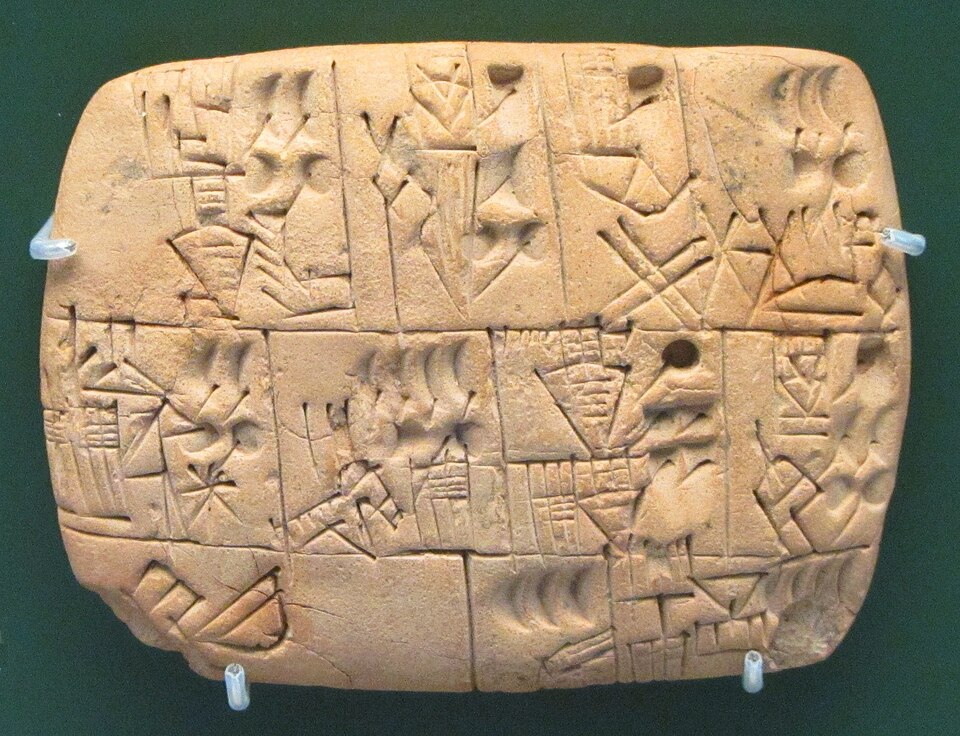

The earliest known true writing system emerged in southern Mesopotamia, in the city of Uruk (modern Warka, Iraq), during the late fourth millennium BCE. The proto-cuneiform tablets recovered from the Eanna temple precinct at Uruk, dated to approximately 3400–3100 BCE (the Uruk IV and III periods), constitute the oldest securely dated examples of writing in the world.3, 4 These earliest tablets are overwhelmingly administrative in character: they record inventories of grain, livestock, beer, and textiles; document ration distributions to temple workers; and track the movement of goods within the institutional economy of the Uruk temple complex. The tablets use a combination of numerical signs, impressed into the clay with a round stylus, and pictographic signs, incised with a pointed stylus, that represent commodities, quantities, and occasionally the names of officials or institutions.3
The proto-cuneiform corpus comprises some 5,000 tablets and fragments, written with a repertoire of roughly 900 distinct signs. The system was primarily logographic: each sign represented a word or concept rather than a sound. However, within the first few centuries of its existence, scribes began using signs not only for their original pictographic meanings but also for their phonetic values — a technique known as the rebus principle. A sign originally depicting an arrow (ti in Sumerian) could be used to write the homophonous word for "life" (ti), regardless of the absence of any pictorial connection between the two meanings. This phonetic extension was the decisive step that transformed a limited accounting notation into a system capable of recording any utterance in the Sumerian language.3, 4
Over the following centuries, the script underwent a profound visual transformation. The original pictographic signs, which had recognisably depicted the objects they represented, were progressively abstracted into combinations of wedge-shaped impressions made by pressing a reed stylus into soft clay at various angles. By the mid-third millennium BCE, the signs had lost virtually all pictorial resemblance to their referents, and the writing system had acquired the characteristic appearance that gives it its modern name: cuneiform, from the Latin cuneus ("wedge").6 The script also evolved from a primarily logographic system into a mixed logographic-syllabic system, in which signs could represent either a word (logogram) or a syllable (phonogram) depending on context. Cuneiform proved extraordinarily versatile and long-lived: originally developed to write Sumerian, it was adapted to write Akkadian, Hittite, Elamite, Hurrian, and other languages, and remained in continuous use for more than three thousand years, from the proto-cuneiform tablets of Uruk IV to the last known cuneiform texts — astronomical diaries written in Babylon in the first century CE.6, 25
Egyptian hieroglyphs
Egyptian hieroglyphic writing appeared at approximately the same time as Mesopotamian cuneiform, and the question of whether it represents an entirely independent invention or was stimulated by awareness of the Mesopotamian system remains one of the most debated issues in the study of early writing. The earliest known Egyptian inscriptions were discovered in Tomb U-j at Umm el-Qaab, the royal necropolis at Abydos in Upper Egypt, by the German archaeologist Günter Dreyer in 1988. The tomb, dated to the Naqada IIIa period (approximately 3320–3150 BCE), contained some 150 small bone and ivory labels, each measuring roughly two by one and a half centimetres and inscribed with one to four hieroglyphic signs. These labels appear to have identified the origin or contents of goods interred with the deceased ruler, suggesting that the earliest Egyptian writing, like its Mesopotamian counterpart, served administrative and economic functions.8, 9
The dating of the Abydos labels to approximately 3200 BCE — contemporary with or possibly even slightly earlier than some Uruk IV proto-cuneiform tablets — has led some scholars to argue for the fully independent invention of writing in Egypt.8, 9 Others point to contemporaneous evidence of cultural contact between Mesopotamia and Egypt, including Mesopotamian-style cylinder seals and artistic motifs found in late Predynastic Egyptian contexts, and suggest that the idea of writing may have diffused from Mesopotamia even if the specific script was an Egyptian creation. John Baines has argued that the Egyptian system, with its distinctive combination of logographic and phonetic elements and its intimate connection to Egyptian art and royal ideology, represents an original invention that drew at most on the general concept of visual notation rather than on any specific Mesopotamian model.8
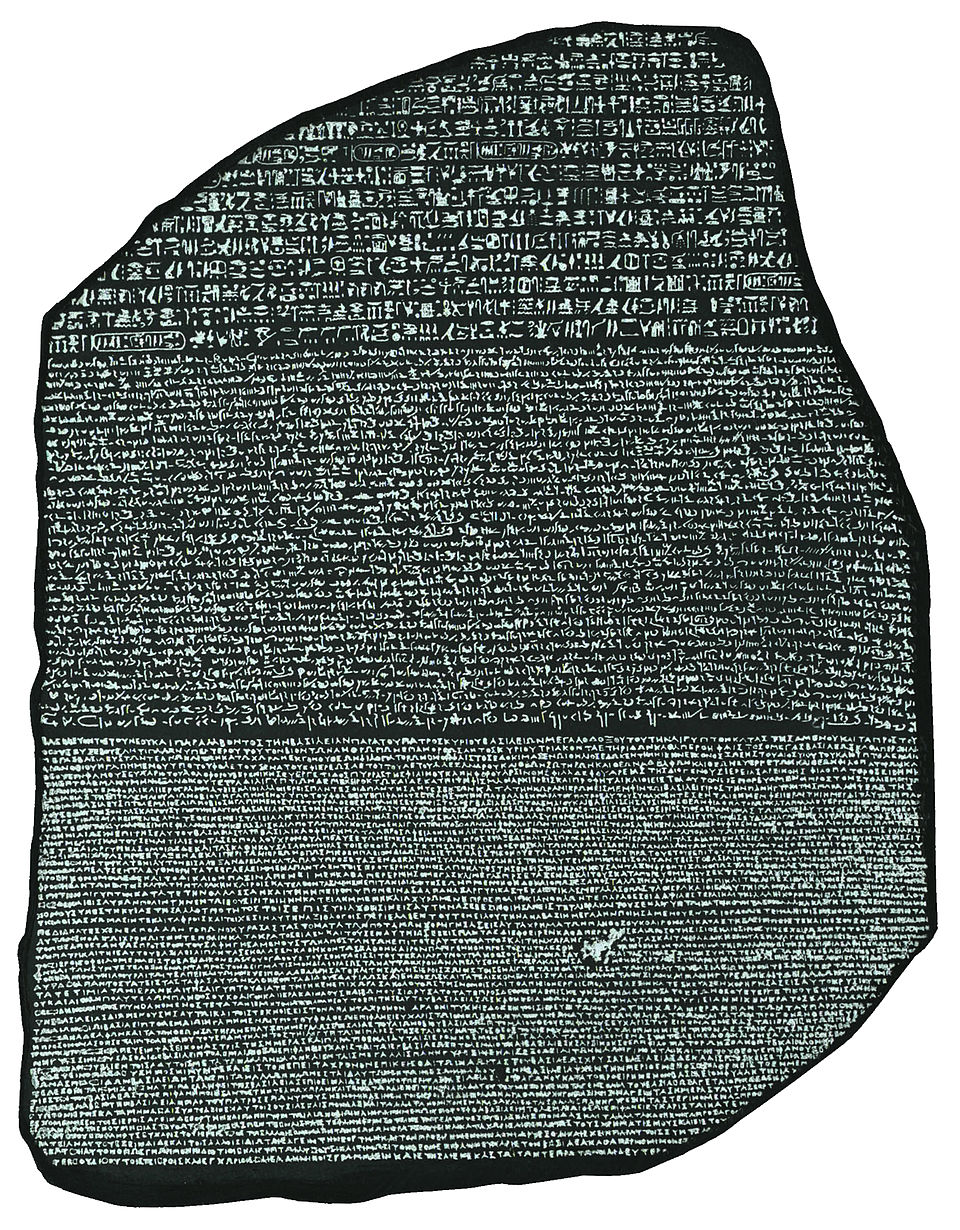

The mature Egyptian hieroglyphic system combined three types of signs: logograms (signs representing whole words), phonograms (signs representing one, two, or three consonants), and determinatives (unpronounced signs that clarified the semantic category of a word). Remarkably, the system included uniconsonantal signs that functioned much like an alphabet, yet the Egyptians never abandoned their logographic and multi-consonantal signs in favour of a purely alphabetic system — a conservatism that Trigger attributed to the deep cultural, religious, and political significance the Egyptians invested in hieroglyphic writing as a sacred medium of royal and divine communication.6, 7 Alongside the formal hieroglyphic script used for monumental inscriptions, the Egyptians developed hieratic, a cursive adaptation written with ink on papyrus, and by the seventh century BCE, Demotic, an even more abbreviated cursive form. The hieroglyphic script fell out of use after the closure of the last Egyptian temples in the late fourth century CE and remained unreadable until Jean-François Champollion announced his decipherment in 1822 using the bilingual Rosetta Stone.6
Chinese oracle bone script
The Chinese writing system is the only major script tradition to have been independently invented and to have survived in continuous, unbroken use from antiquity to the present day. The earliest securely dated Chinese writing consists of the oracle bone inscriptions (jiaguwen) of the late Shang dynasty, discovered at the royal capital near Anyang in Henan province and dating to approximately 1200 BCE. These inscriptions were carved into the shoulder blades of oxen and the plastrons (flat undersides) of turtle shells, which were then subjected to heat until they cracked; the resulting fracture patterns were interpreted as answers from ancestral spirits and deities to questions posed by the Shang king about warfare, harvests, weather, illness, and ritual propriety.10
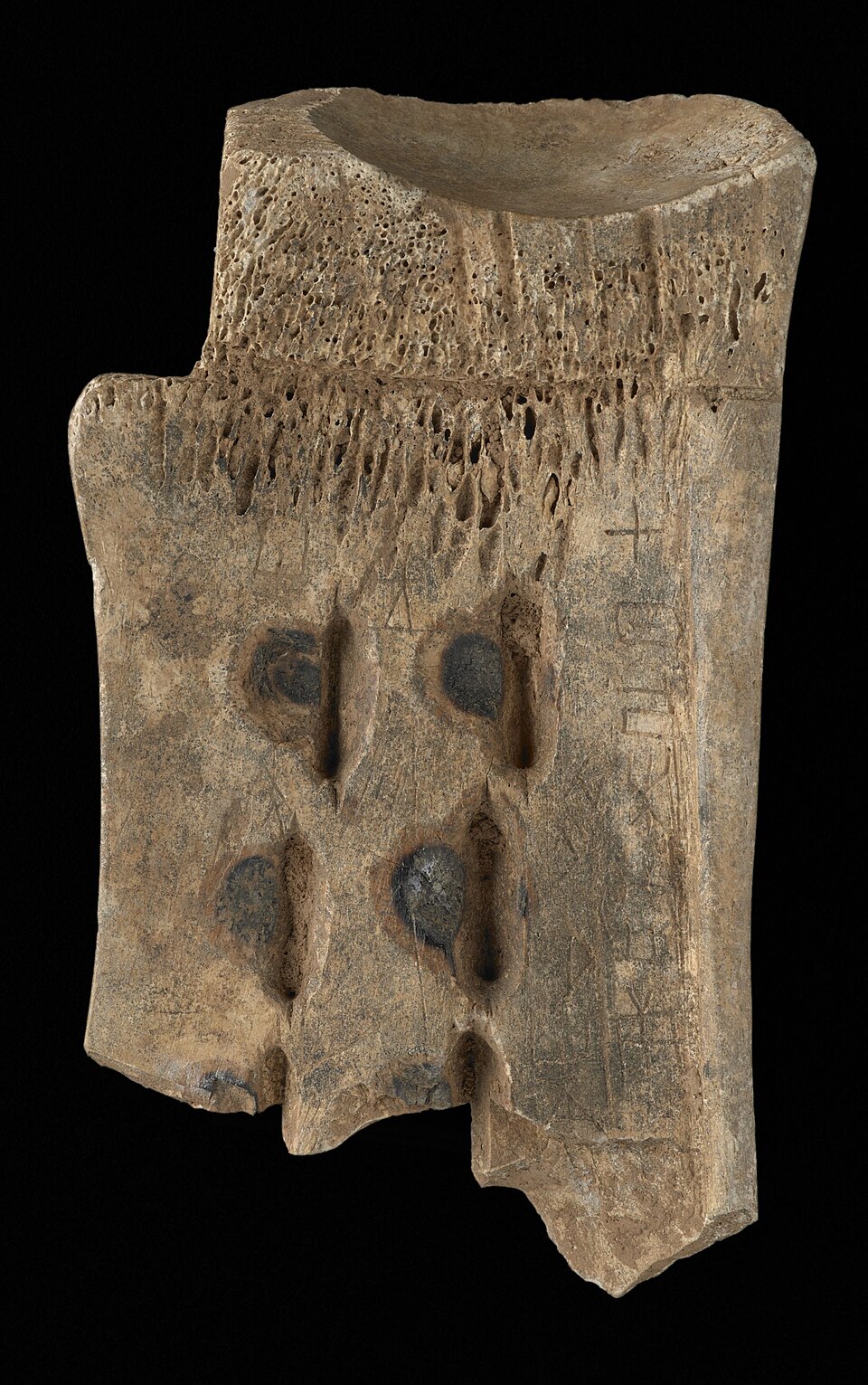

The Anyang oracle bone corpus is vast, comprising over 150,000 fragments bearing roughly 4,500 distinct characters, of which approximately 1,500 have been deciphered. Crucially, the oracle bone script was already a sophisticated and mature writing system at the time of its earliest attestation, employing logograms, phonetic loan characters, and semantic-phonetic compounds — the same structural principles that govern modern Chinese characters. This maturity strongly implies a period of prior development that has not yet been recovered archaeologically.10, 11
At the Neolithic site of Jiahu in Henan province, dated to approximately 6600 BCE, archaeologists have identified a small number of marks incised on tortoise shells and bone artefacts, some of which bear a striking visual resemblance to later Shang characters. However, the Jiahu signs are few in number (approximately sixteen confirmed examples), they do not form sequences, and a gap of roughly five thousand years separates them from the oracle bone inscriptions. Most scholars regard the Jiahu marks as isolated symbols or clan marks rather than as evidence of writing or even proto-writing, though the possibility of a very long developmental tradition cannot be entirely excluded.12
The great majority of Chinese characters are semantic-phonetic compounds, consisting of a semantic element (radical) that indicates the general category of meaning and a phonetic element that suggests the pronunciation. This structural principle, already present in the oracle bone script, allowed the system to expand its vocabulary without limit and to adapt to the evolving phonology of the Chinese language across three millennia. Unlike cuneiform and Egyptian hieroglyphs, which were eventually abandoned and had to be rediscovered through scholarly decipherment, the Chinese script underwent continuous evolution — from oracle bone script through bronze inscriptions, seal script, clerical script, and regular script — without any interruption in the literate tradition.11, 6
Mesoamerican writing systems
Writing was independently invented in Mesoamerica, making it one of the only regions in the world where the concept of encoding language in visual symbols arose without any influence from an existing literate tradition. The earliest candidate for Mesoamerican writing is the Cascajal Block, a tablet-sized serpentine slab discovered in the Olmec heartland of Veracruz, Mexico, and dated on the basis of associated ceramic remains to the San Lorenzo phase, ending around 900 BCE. The block bears 62 distinct glyphs arranged in apparent sequences, some resembling plants, insects, and other natural forms. If accepted as genuine writing, it would represent the earliest known text in the Western Hemisphere, predating previously known Mesoamerican scripts by several centuries.13 The Cascajal Block remains controversial, however: its unprovenanced discovery context, the absence of comparable texts, and the difficulty of demonstrating that its signs encode language rather than conveying meaning through pictographic convention have led some scholars to treat the identification with caution.13, 5
The earliest widely accepted Mesoamerican writing appears in the Zapotec tradition of the Oaxaca Valley. Carved stone monuments at San José Mogote and Monte Albán, dated to approximately 600–500 BCE, bear short inscriptions that include calendar day-names and possible personal names, indicating that the script recorded historical and calendrical information associated with elite individuals and political events.5, 14 The Zapotec script remains only partially deciphered, but its existence demonstrates that writing had emerged in Mesoamerica by the mid-first millennium BCE, fully independent of Old World literate traditions.
The most fully developed and best-understood Mesoamerican writing system is the Maya hieroglyphic script, which reached its Classic period florescence between approximately 250 and 900 CE but has origins extending back to at least 300 BCE. Maya writing is a mixed logographic-syllabic system: it employs logograms representing whole words and syllabic signs representing consonant-vowel pairs, which can be combined to spell words phonetically.15 The decipherment of Maya writing ranks among the great intellectual achievements of twentieth-century scholarship. In 1952, the Russian linguist Yuri Knorosov demonstrated that many Maya glyphs functioned as syllabic phonetic signs, overturning the prevailing view that the script was purely logographic or ideographic. In 1960, Tatiana Proskouriakoff showed that the inscriptions on Maya stone monuments recorded the historical lives of rulers — births, accessions, conquests, and deaths — rather than purely mythological or astronomical content.15, 14 Today, approximately eighty percent of surviving Maya texts can be read.
The Indus Valley script
The script of the Indus Valley (or Harappan) civilisation, which flourished in the northwestern regions of South Asia between approximately 2600 and 1900 BCE, constitutes one of the great unsolved problems in the study of ancient writing. Some 5,000 inscriptions have been discovered, primarily on small steatite seals but also on pottery, copper tablets, and other artefacts. The inscriptions are characteristically brief, averaging only about five signs in length, with the longest known example containing only 26 symbols. This brevity, combined with the absence of any bilingual text and the uncertainty about the underlying language, has prevented decipherment despite over a century of attempts.16
The question of whether the Indus signs represent a true writing system encoding language or merely a system of non-linguistic symbols — such as heraldic emblems, clan markers, or commodity labels — has been the subject of intense scholarly debate. Asko Parpola, the leading advocate for the linguistic hypothesis, has argued that the script is logo-syllabic and encodes a Dravidian language, identifying a number of signs with specific phonetic values based on comparisons with later South Asian scripts and symbol systems.16 In 2009, Rao and colleagues published a computational analysis in Science showing that the conditional entropy of the Indus sign sequences is closer to that of known linguistic systems than to various non-linguistic symbol systems, providing statistical support for the linguistic hypothesis.17
The opposing view, articulated most forcefully by Farmer, Sproat, and Witzel in 2004, contends that the Indus symbols are not linguistic writing at all. They argue that the brevity and apparent lack of evolutionary development of the Indus sign system over six centuries of use is inconsistent with known writing systems, and that the symbols may instead represent religious, political, or economic emblems that conveyed identity or status without encoding spoken language.18 The debate remains unresolved, and the Indus script continues to resist the decipherment efforts that have succeeded for cuneiform, Egyptian hieroglyphs, and Maya writing. Whether the Harappan civilisation possessed true literacy or employed a sophisticated but non-linguistic symbol system is one of the most consequential open questions in the archaeology of communication.
The invention of the alphabet
While the major writing systems described above were each invented independently, the alphabet — arguably the most influential writing technology in human history — was invented only once. All alphabetic scripts in use today descend from a single ancestral system: the Proto-Sinaitic (or early alphabetic) script, which emerged around 1800 BCE in the context of contact between Semitic-speaking populations and Egyptian civilisation.19, 20
The earliest Proto-Sinaitic inscriptions are known from approximately thirty to forty short texts found at Serabit el-Khadim, an Egyptian turquoise mining site in the Sinai Peninsula, and from two inscriptions discovered in 1993 by John Coleman Darnell at Wadi el-Hol in the Western Desert of Egypt. The Wadi el-Hol inscriptions, found on a military and trade road linking Thebes and Abydos, have been dated to roughly 1850–1700 BCE, making them among the oldest surviving alphabetic texts.20 The Egyptologist Orly Goldwasser has advanced an influential theory that the alphabet was invented by illiterate or semi-literate Canaanite workers who were familiar with Egyptian hieroglyphs as pictures but could not read them as Egyptian text. These workers selected a subset of hieroglyphic signs and assigned each one the sound of the first consonant of the Semitic word for the object the sign depicted — a technique known as the acrophonic principle. Thus the hieroglyph for "house" (Semitic bayt) became the letter b; the hieroglyph for "water" (Semitic mayim) became m; and the hieroglyph for "ox head" (Semitic ʾalp) became ʾ (later the Greek alpha and Latin A).19
This reduction — from the hundreds of signs required by logographic and syllabic systems to approximately twenty-two consonantal letters capable of representing the full phonology of a language — was one of the most consequential simplifications in the history of human technology. By around 1050 BCE, the descendant Phoenician alphabet had stabilised as a standardised script of twenty-two consonantal letters, carried across the Mediterranean by the mercantile city-states of the Levantine coast.6 The Greeks, who adopted the Phoenician alphabet around the ninth to eighth century BCE, made a further innovation of world-historical importance: they repurposed Phoenician consonant letters that had no equivalent in Greek phonology to represent vowels, creating the first fully explicit alphabet in which both consonants and vowels were systematically notated.6, 21 From the Greek alphabet descended the Latin, Cyrillic, Coptic, Gothic, and Armenian scripts. From the Phoenician script, through Aramaic intermediaries, descended the Hebrew, Arabic, and Syriac scripts, and through further transmission the Brahmi script of India, which gave rise to Devanagari, Thai, Tibetan, and dozens of other South and Southeast Asian writing systems. Virtually every alphabet and abugida in use in the world today traces back to the Proto-Sinaitic innovation of the early second millennium BCE.6, 19
Independent origins and key transmissions of writing systems5, 6, 7
| Writing system | Region | Earliest evidence | Script type | Status |
|---|---|---|---|---|
| Proto-cuneiform | Southern Mesopotamia (Uruk) | c. 3400–3100 BCE | Logographic → logosyllabic | Independent invention |
| Egyptian hieroglyphs | Upper Egypt (Abydos) | c. 3200 BCE | Logographic-phonetic | Independent or stimulus diffusion |
| Indus script | Indus Valley (Harappa, Mohenjo-daro) | c. 2600 BCE | Undeciphered | Debated (linguistic vs. non-linguistic) |
| Chinese oracle bone script | North China (Anyang) | c. 1200 BCE | Logographic | Independent invention |
| Proto-Sinaitic alphabet | Sinai & Western Egypt | c. 1800 BCE | Consonantal alphabet | Derived from Egyptian signs |
| Zapotec script | Oaxaca, Mexico | c. 600–500 BCE | Logographic (partially deciphered) | Independent invention |
| Maya hieroglyphs | Southern Mexico & Guatemala | c. 300 BCE | Logosyllabic | Independent Mesoamerican tradition |
Writing and complex society
A striking pattern emerges from the comparative study of the world's independent writing traditions: in every documented case, writing appeared in the context of complex, hierarchically organised societies that had already developed agriculture, urbanisation, and centralised political authority. In Mesopotamia, the earliest tablets come from the temple precincts of Uruk, the largest city in the world at the time. In Egypt, the Abydos labels were found in a royal tomb. In China, the oracle bone inscriptions were produced at the behest of the Shang king. In Mesoamerica, the earliest texts are associated with elite ritual and political display at regional centres such as Monte Albán.5, 23 This consistent association has led many scholars to conclude that writing arose primarily as an instrument of institutional power — a technology developed by and for administrative elites to manage the economic, political, and ritual affairs of early states.22, 25
In Mesopotamia, the connection between writing and administration is particularly well documented. The proto-cuneiform tablets from Uruk overwhelmingly record economic transactions: the receipt and disbursement of barley, beer, sheep, cattle, and textiles by temple institutions. The system was developed not to record speech, literature, or history but to solve a practical problem of institutional management — tracking the flow of resources through organisations too large and complex for any individual's memory to encompass.3, 4 Literary and historical texts did not appear in Mesopotamia until several centuries after the invention of writing, suggesting that the expressive potential of the technology was recognised only gradually.25
The debate over whether writing was primarily utilitarian or ceremonial in its origins has been systematically examined across multiple traditions. Postgate, Wang, and Wilkinson compared the earliest evidence from Mesopotamia, China, and Egypt and found that while the Mesopotamian case strongly supports an economic-administrative origin, the Egyptian and Chinese cases are more ambiguous: the earliest Egyptian texts appear in a royal funerary context with clear ceremonial significance, and the Chinese oracle bones served a divinatory and ritual function.23 These differences suggest that while administrative need may have been a common catalyst, the specific social context in which writing emerged shaped its initial applications. Writing was never a neutral recording tool; from its very inception it was embedded in structures of power, wealth, and authority.22
The cognitive revolution of literacy
The invention of writing set in motion a cascade of intellectual transformations that reshaped virtually every dimension of human thought and social organisation. The most immediate consequence was the administrative revolution: writing enabled the management of institutions — temples, palaces, armies, trade networks — on a scale that had been impossible under purely oral systems of record-keeping. Tax collection, census-taking, land surveying, labour conscription, and the distribution of rations all depended on written records that could be stored, consulted, verified, and transmitted across time and space.3, 22
The anthropologist Jack Goody, in his influential 1977 work The Domestication of the Savage Mind, argued that writing did not merely record pre-existing thought but actively transformed the cognitive processes available to literate societies. Writing made possible the creation of lists, tables, and taxonomies — forms of knowledge organisation that have no oral equivalent and that fostered new modes of classification, comparison, and abstract reasoning. Goody contended that many of the intellectual differences previously attributed to innate cognitive variation between "primitive" and "civilised" societies were in fact consequences of the presence or absence of writing as a technology of thought.22 While this literacy thesis has been criticised for overstating the cognitive divide between literate and non-literate societies and for underestimating the sophistication of oral traditions, Goody's core insight — that writing is not merely a passive recording device but an active technology that shapes the kinds of thinking a society can do — remains widely accepted.7
Writing also enabled the codification of law, transforming the relationship between rulers and the ruled. The Code of Hammurabi, inscribed on a basalt stele in Akkadian cuneiform around 1750 BCE, illustrates how writing allowed rulers to promulgate standardised legal norms across their territories, aspiring to consistency and predictability in the administration of justice.22, 24 The emergence of literature as a written tradition represents another profound consequence. The Epic of Gilgamesh, composed in Sumerian verse around 2100 BCE and later adapted into Akkadian, is the earliest known work of narrative literature, exploring themes of friendship, mortality, and the search for meaning that remain recognisable more than four thousand years later.6, 24
The recording of scientific and mathematical knowledge — from the astronomical observations of Babylonian scribes to the geometric proofs of Greek mathematicians — depended fundamentally on the capacity to write down observations, calculations, and arguments in permanent form. Writing also made possible the production of sacred texts that could be transmitted verbatim across vast stretches of time and space, lending religious traditions a fixity and authority that oral transmission alone could not guarantee.22, 24 In all of these domains, writing served as what Goody called a "technology of the intellect" — a tool that did not merely preserve existing knowledge but made possible entirely new kinds of knowing.22
References
Archaic Bookkeeping: Early Writing and Techniques of Economic Administration in the Ancient Near East
The Earliest Writing? Sign Use in the Seventh Millennium BC at Jiahu, Henan Province, China
Mesoamerican Writing Systems: Propaganda, Myth, and History in Four Ancient Civilizations
The Collapse of the Indus-Script Thesis: The Myth of a Literate Harappan Civilization
Canaanites Reading Hieroglyphs. Part I – Horus is Hathor? Part II – The Invention of the Alphabet in Sinai
Two Early Alphabetic Inscriptions from the Wadi el-Hôl: New Evidence for the Origin of the Alphabet from the Western Desert of Egypt