Overview
- True writing — a system that systematically encodes spoken language in permanent visual form — was independently invented at least three and possibly four times in human history: in Mesopotamia (c. 3400–3100 BCE), Egypt (c. 3200 BCE), China (by c. 1200 BCE), and Mesoamerica (c. 900–600 BCE), with scholarly debate continuing over whether Egyptian script was influenced by Mesopotamian precedent or arose wholly independently.
- Each independent invention followed a broadly similar trajectory — from pictographic or token-based accounting systems to phonographic scripts capable of representing any utterance — but the specific mechanisms differed: Mesopotamian cuneiform evolved from clay accounting tokens, Chinese script emerged in the context of royal divination, and Mesoamerican glyphs developed within elite political and ritual contexts.
- The convergent emergence of writing in geographically and culturally isolated societies suggests that writing is not a singular accident but a predictable outcome of social complexity: when societies reach sufficient scale, economic complexity, and political stratification, the demand for durable record-keeping and communication generates the selective pressure for a system of visible language.
Writing — the systematic representation of spoken language in permanent visual form — is among the most consequential inventions in human history. It enabled the accumulation of knowledge across generations, the administration of complex societies, the codification of law, and the creation of literature. Yet this transformative technology was not invented once and disseminated outward from a single source. The archaeological evidence demonstrates that true writing was independently invented at least three and possibly four times by societies that had no contact with one another: in Mesopotamia, in Egypt, in China, and in Mesoamerica.1, 4, 5 The convergent emergence of writing in geographically separated civilisations reveals that it is not a unique accident but a predictable product of social complexity.
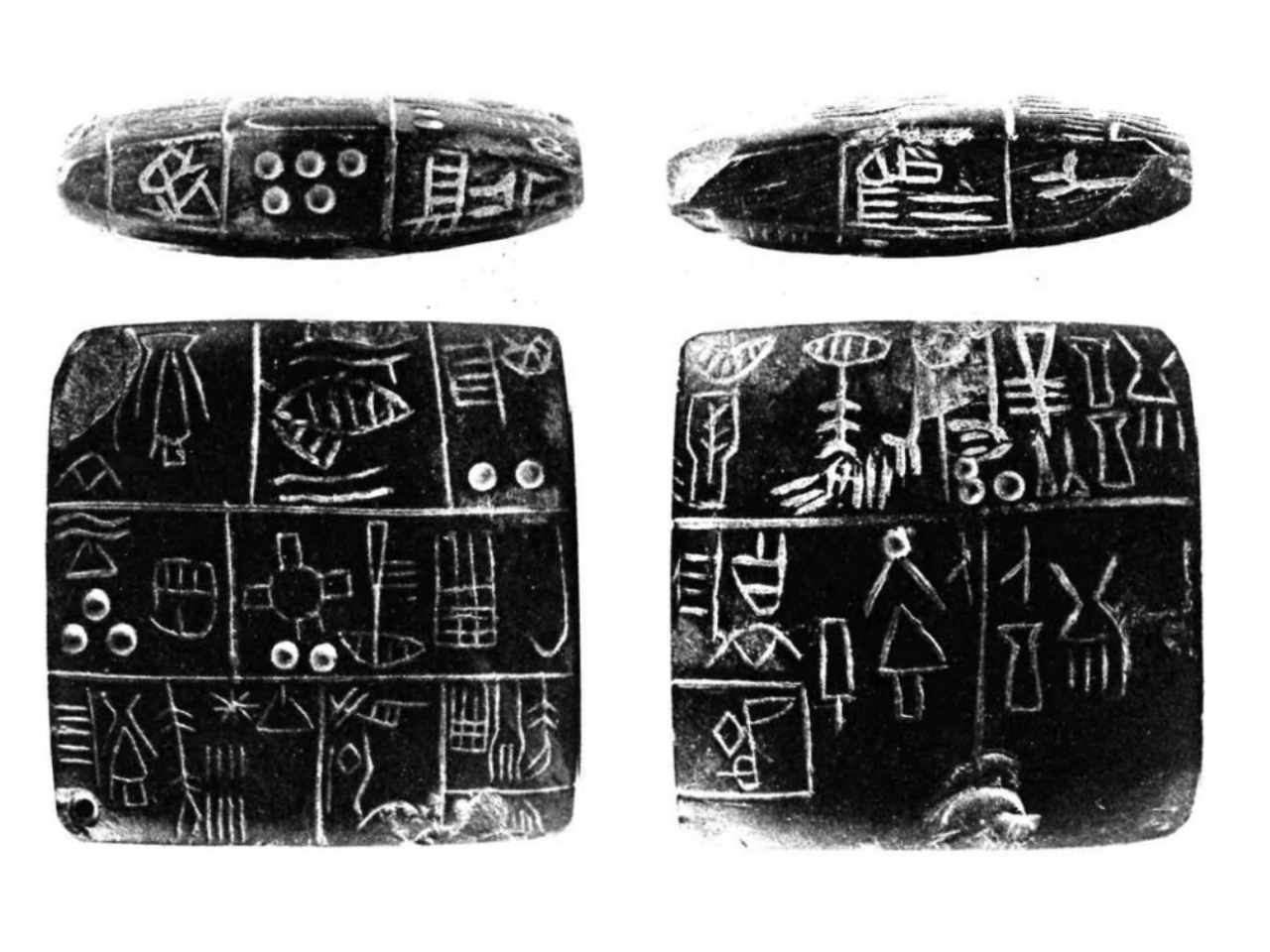

Mesopotamian cuneiform
The earliest known writing system emerged in southern Mesopotamia, in the cities of the Late Uruk period (c. 3400–3100 BCE). The system that would develop into cuneiform began as a set of pictographic and ideographic signs impressed into clay tablets, used primarily for economic record-keeping: accounting for quantities of grain, livestock, and other commodities administered by temple institutions.3, 14
Denise Schmandt-Besserat traced the origins of Mesopotamian writing to an even older technology: small clay tokens of various shapes — spheres, cones, discs, cylinders — that had been used across the Near East since approximately 8000 BCE to represent specific commodities and quantities. By the fourth millennium BCE, these tokens were being enclosed in hollow clay envelopes (bullae), with impressions of the enclosed tokens pressed into the exterior surface so that the contents could be verified without breaking the seal. Schmandt-Besserat argued that the critical innovation was the realisation that the impressions on the surface made the tokens inside redundant: the marks alone could serve as a record, and the envelope became a flat tablet.2, 16
The transition from proto-writing to true writing occurred when the system began to represent the sounds of language rather than merely things and quantities. The key mechanism was the rebus principle: a sign originally depicting a concrete object was used to represent a word or syllable with the same sound, regardless of meaning. In Sumerian, for example, the sign for "arrow" (ti) could also represent the word for "life" (ti), because the two words sounded the same. This phonographic extension enabled the system to encode abstract concepts, grammatical elements, and personal names — anything that could be said in spoken Sumerian — transforming a bookkeeping device into a general-purpose writing system.3, 4, 14
Egyptian hieroglyphs
Egyptian hieroglyphic writing appears in the archaeological record from approximately 3200 BCE, with the earliest known examples coming from the royal cemetery at Abydos (Umm el-Qaab) in Upper Egypt. Gunter Dreyer's excavation of Tomb U-j, attributed to a predynastic ruler, yielded more than 150 small bone and ivory labels inscribed with signs that have been interpreted as early hieroglyphs, used to label the origin and contents of grave goods.6, 7
The question of whether Egyptian writing was independently invented or inspired by contact with Mesopotamia has been debated since the nineteenth century. The two systems are roughly contemporaneous (with current evidence placing the earliest Egyptian signs within a few centuries of the earliest Uruk tablets), and trade contacts between Mesopotamia and Egypt existed in the fourth millennium BCE. However, the two writing systems are structurally and visually distinct: Egyptian hieroglyphs are predominantly consonantal (representing consonant sequences without indicating vowels), while early Mesopotamian writing was logographic and syllabic. The sign inventories share no obvious similarities, and the physical media differ (clay tablets versus stone, bone, and papyrus). John Baines has argued that while the general concept of writing — the idea that speech can be made visible — may have been transmitted through contact, the specific system was an Egyptian creation, developed independently to serve the distinctive needs of Egyptian royal ideology and administration.1, 6 Bruce Trigger characterised Egyptian writing as either fully independent or, at most, stimulated by awareness of the Mesopotamian precedent without direct borrowing of specific techniques or signs — a process he termed "stimulus diffusion" as distinct from true transmission.5, 15
Chinese script
The Chinese writing system constitutes an unambiguous case of independent invention. The earliest substantial corpus of Chinese writing consists of the oracle bone inscriptions (jiaguwen) of the Shang dynasty, dating to approximately 1200 BCE, discovered at the royal capital of Yinxu near modern Anyang. These inscriptions record divination questions posed to royal ancestors: a question was inscribed on the prepared shoulder blade of an ox or the plastron of a turtle, heat was applied to produce cracks, and the cracks were interpreted as answers from the spirit world.8, 9
The oracle bone script already contained hundreds of distinct characters, many of which are recognisable as ancestors of modern Chinese characters, suggesting a substantial period of prior development. The exact date at which Chinese writing originated remains uncertain; claims for earlier writing based on symbols found on Neolithic pottery from sites such as Banpo and Dawenkou (dating to the fifth and fourth millennia BCE) remain contentious, as most scholars consider these to be isolated symbols or proto-writing rather than true linguistic notation.9, 10
The independence of Chinese writing from Mesopotamian or Egyptian influence is not in serious dispute. The earliest Chinese characters are structurally and conceptually distinct from Near Eastern scripts, no plausible route of transmission existed across the vast geographic and temporal gap, and the functional context of origin — royal divination rather than economic administration — differs fundamentally from the Mesopotamian case. The Chinese system is also typologically unique: it is a logographic script in which each character represents a morpheme (a unit of meaning), and while phonetic elements are embedded in compound characters, the system never developed into a syllabary or alphabet as Mesopotamian cuneiform partly did.4, 8, 9
Mesoamerican glyphs
Writing in Mesoamerica developed entirely independently of Old World traditions, separated by the Atlantic Ocean and by thousands of years from any possible contact with literate societies. The earliest evidence of Mesoamerican writing comes from the Zapotec civilisation of Oaxaca, Mexico, with inscribed monuments at San Jose Mogote and Monte Alban dating to approximately 600–500 BCE, though some scholars place the origins of Zapotec writing as early as 900 BCE. These early texts appear to record the names and dates associated with captive warriors, functioning within a system of political propaganda and elite display.11, 17
The Maya writing system, the most fully deciphered of the Mesoamerican scripts, reached its mature form by approximately 250 CE, though its roots extend several centuries earlier. Maya glyphs constitute a mixed logographic-syllabic system: some signs represent entire words (logograms), while others represent consonant-vowel syllables that can be combined to spell words phonetically. The decipherment of Maya script, achieved through decades of work by scholars including Yuri Knorosov, Tatiana Proskouriakoff, and others, revealed a rich literary tradition encompassing royal histories, astronomical observations, mythological narratives, and ritual texts.12, 13
Other Mesoamerican writing traditions, including the Isthmian (or Epi-Olmec) and Mixtec systems, demonstrate that the region produced multiple writing traditions, though the precise relationships among them remain debated. What is clear is that Mesoamerican writing as a whole represents a fully independent invention, arising from social and political dynamics specific to the region without any input from the literate civilisations of the Old World.1, 11
Convergent patterns across independent inventions
Despite their independent origins, the four writing traditions share several structural and developmental features that suggest convergent evolutionary pressures. All emerged in the context of complex, stratified societies with centralised political authority and economic specialisation. All began with systems that were primarily logographic or pictographic and gradually incorporated phonographic elements to represent the sounds of speech. All served institutional rather than private purposes in their early stages: economic administration in Mesopotamia, royal ideology in Egypt, royal divination in China, and elite political display in Mesoamerica.1, 5, 15
Bruce Trigger argued that these convergences reflect the functional demands of complex societies. As societies grow in scale and stratification, the volume and complexity of information that must be recorded, transmitted, and stored exceeds the capacity of human memory and oral tradition. Writing emerges as a cultural technology that meets this demand, just as agriculture emerged independently in multiple regions when the ecological and demographic conditions were right. The independent invention of writing is thus not a coincidence but an instance of convergent cultural evolution, driven by similar selective pressures in widely separated societies.5, 15
The rarity of independent invention — only three to four times in more than five thousand years of complex civilisation — suggests that while the social conditions for writing may be necessary, they are not sufficient. Some complex societies, including the Inca Empire with its quipu recording system, developed sophisticated information technologies that stopped short of full writing. The transition from proto-writing to true writing evidently required a specific cognitive breakthrough — the recognition that visual marks can encode the sounds of speech, not merely the referents of words — that was far from inevitable even in conditions of high social complexity.1, 4, 18
References
Archaic Bookkeeping: Early Writing and Techniques of Economic Administration in the Ancient Near East