Overview
- The Maya civilization occupied southeastern Mexico, Guatemala, Belize, Honduras, and El Salvador for over three thousand years, developing the only fully literate culture in the pre-Columbian Americas with a logo-syllabic writing system of approximately 800 glyphs deciphered only in the late twentieth century.
- At its Classic period peak (250–900 CE), the Maya lowlands supported an estimated 7 to 11 million people across dozens of competing city-states, with major centers like Tikal and Calakmul sustaining populations exceeding 50,000 and connected by extensive raised causeways and trade networks.
- Maya mathematicians independently invented the concept of zero, developed a vigesimal number system, and created the Long Count calendar capable of tracking millions of years, while their astronomers calculated the synodic period of Venus to within two hours of the modern value.
The Maya civilization was one of the most intellectually and artistically accomplished cultures of the ancient world, flourishing across the tropical lowlands and highlands of southeastern Mexico, Guatemala, Belize, Honduras, and El Salvador over a span of more than three millennia.1 Unlike the empires of the Old World, Maya political organization was never unified under a single ruler but consisted of a network of competing city-states, each governed by a divine king whose legitimacy rested on claims of descent from mythological ancestors and mastery of ritual knowledge.6 The Maya developed the only fully literate culture in the pre-Columbian Americas, producing a sophisticated writing system, a mathematical tradition that independently invented the concept of zero, astronomical observations of extraordinary precision, and an architectural legacy of stepped pyramids and palace complexes that still dominates the landscape of Central America.1, 13
Origins and the Preclassic period
The origins of Maya civilization lie in the gradual transition from mobile foraging to settled village agriculture that occurred across Mesoamerica between approximately 2000 and 1000 BCE.22 The earliest Maya communities cultivated maize, beans, squash, and chili peppers—the foundational crop complex of Mesoamerican agriculture—in villages scattered across the Pacific coastal plain of Guatemala and the Petén lowlands.1, 22 By the Middle Preclassic period (c. 1000–400 BCE), some of these communities had grown substantially in size and social complexity, producing monumental architecture, carved stone monuments, and early forms of the hieroglyphic script that would later become one of the Maya's defining achievements.13
The site of Nakbe in the Petén region of Guatemala contains some of the earliest known monumental Maya architecture, with massive limestone platforms and temple pyramids dating to approximately 750 BCE.22 By the Late Preclassic period (c. 400 BCE–250 CE), the neighboring city of El Mirador had grown into one of the largest urban centers in the ancient Americas, with the La Danta pyramid complex rising approximately 72 meters above the surrounding jungle floor and encompassing an estimated 2.8 million cubic meters of fill—one of the most massive constructions in the pre-Columbian world.1, 23 The scale of construction at El Mirador demonstrates that complex political organization, mobilized labor, and long-distance trade networks were already well established centuries before the conventional beginning of the Classic period.23
The Preclassic Maya were heavily influenced by the Olmec civilization of the Gulf Coast lowlands, which had developed monumental art, hieroglyphic writing, and the Long Count calendar by at least 900 BCE.22 The relationship between Olmec and early Maya cultures remains debated, but material evidence indicates that ideas about divine kingship, ritual bloodletting, the ballgame, and calendrical systems flowed from the Olmec heartland into the Maya region during the Middle Preclassic, where they were adapted and elaborated over subsequent centuries.1, 22
The Classic period and the age of divine kings
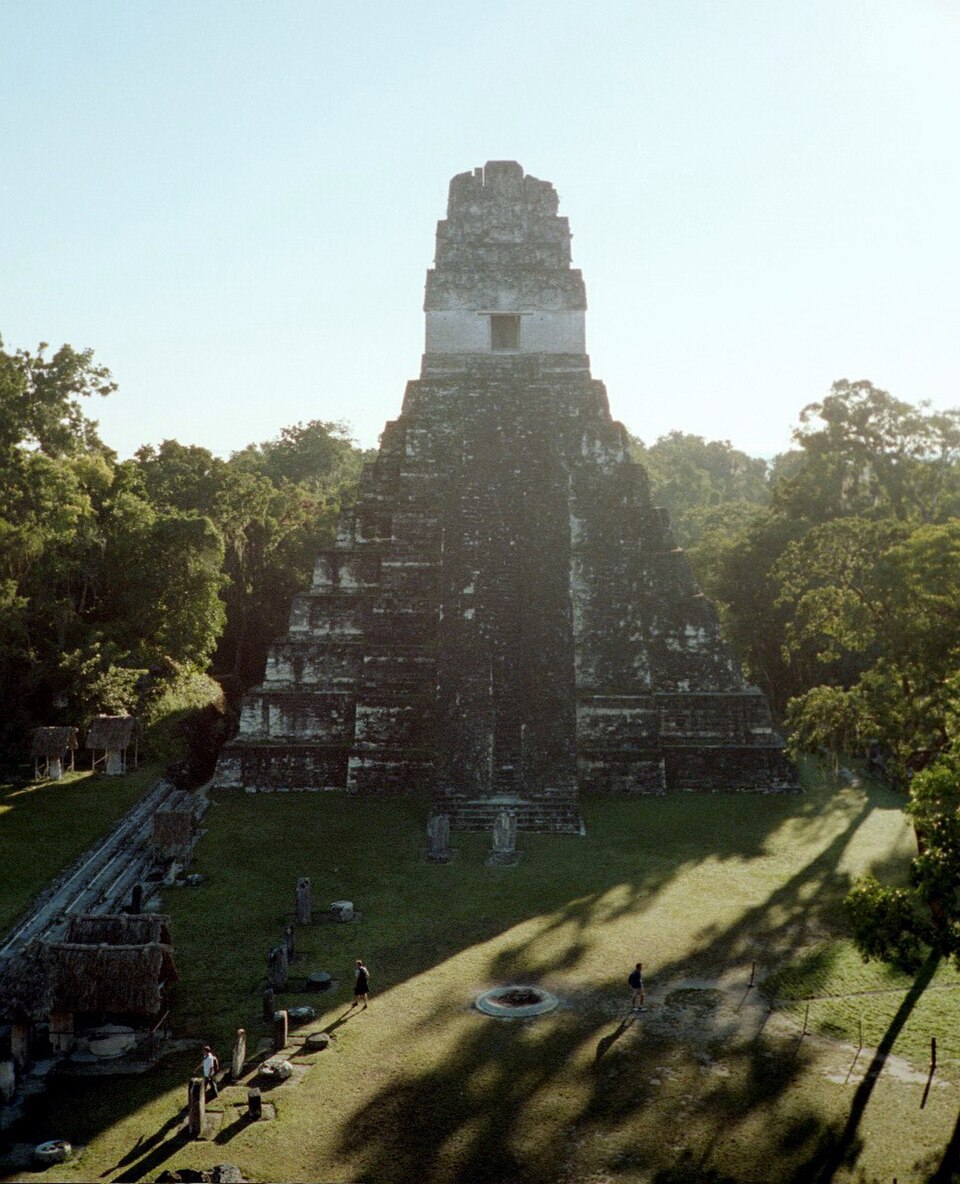

The Classic period (c. 250–900 CE) represents the apogee of Maya civilization, a six-century era during which dozens of city-states across the lowlands of present-day Guatemala, Mexico, Belize, and Honduras erected carved stone monuments (stelae) recording the deeds of their rulers, constructed monumental temple-pyramids and palace complexes, and produced some of the finest artworks of the ancient Americas.1, 6 The political landscape was organized around the institution of the k'uhul ajaw (divine lord), a ruler who claimed descent from mythological ancestors and served as the primary intermediary between the human world and the supernatural realm.3, 6
Two great powers dominated the Classic period political landscape. Tikal, located in the Petén lowlands of Guatemala, and Calakmul, situated across the border in the Mexican state of Campeche, served as the capitals of rival hegemonic networks that historians have compared to Cold War superpower blocs.6 Each city cultivated a system of subordinate allies, and the rivalry between them shaped the political fortunes of the entire lowland region for centuries. Tikal reached a peak population exceeding 60,000 inhabitants within its core zone, with Temple IV rising approximately 70 meters above the plaza floor—one of the tallest structures built in the pre-Columbian Americas.16 Calakmul's kingdom encompassed an estimated 50,000 people within the city proper and extended influence over a network whose total population may have reached 1.75 million.6
In 2018, an airborne LiDAR survey of more than 2,100 square kilometers of northern Guatemala revealed the true scale of Classic Maya settlement for the first time. The survey, led by Marcello Canuto and Francisco Estrada-Belli, identified over 61,000 previously unknown structures including houses, fortifications, raised causeways, and agricultural terraces beneath the jungle canopy, leading to revised population estimates of 7 to 11 million people for the Maya lowlands during the Late Classic period—several times higher than previous estimates.2 The density and interconnectedness of these settlements overturned the long-held view that the Maya lowlands were sparsely populated and demonstrated that the Maya had extensively modified their landscape through terracing, drainage, and irrigation systems capable of supporting intensive agriculture.2
Other major Classic period centers included Palenque, whose ruler K'inich Janaab Pakal I (r. 615–683 CE) was entombed beneath the Temple of the Inscriptions in an elaborately carved sarcophagus; Copán in western Honduras, renowned for its sculptural tradition and hieroglyphic stairway containing over 2,000 glyphs; and Caracol in Belize, which defeated Tikal in 562 CE and briefly became one of the most powerful cities in the region.1, 6
Writing and intellectual achievements
The Maya hieroglyphic script is the most complex and fully developed writing system ever created in the pre-Columbian Americas.4 A logo-syllabic system containing approximately 800 distinct signs, it combined logographic elements (signs representing whole words) with a syllabary of approximately 200 signs representing consonant-vowel pairs, allowing scribes to spell any word in the Mayan languages phonetically.4, 13 Texts were inscribed on stone monuments, painted on ceramic vessels, carved into jade and bone, and written in screenfold bark-paper books called codices, of which only four survive, the rest having been systematically destroyed by Spanish missionaries in the sixteenth century.1, 4
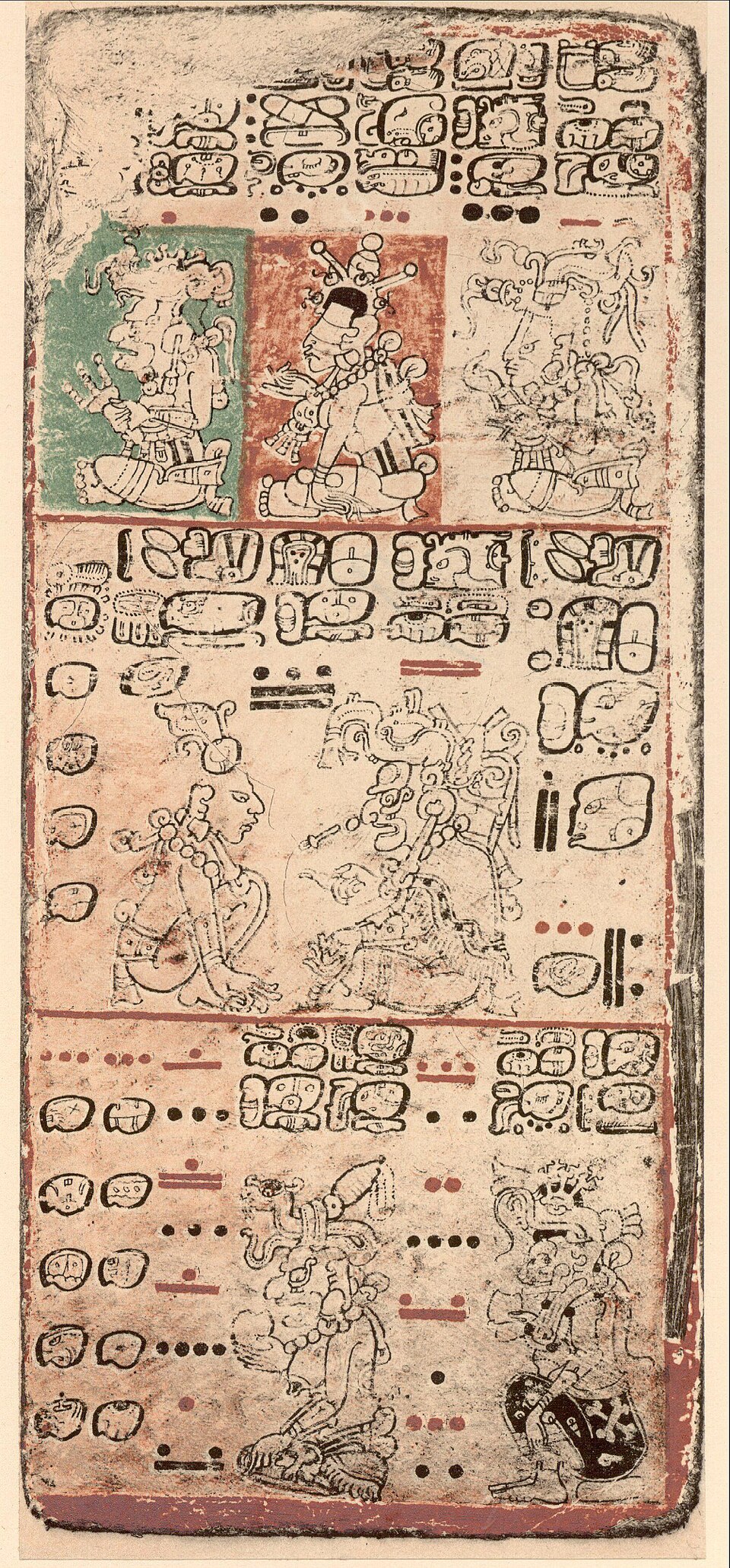

The decipherment of Maya hieroglyphs was one of the great intellectual achievements of twentieth-century scholarship. Although the calendrical and numerical components of the script had been decoded by the late nineteenth century through the work of Ernst Förstemann and Sylvanus Morley's systematic cataloguing of glyphic forms,4, 20 the linguistic content of the texts remained impenetrable until the Soviet linguist Yuri Knorosov demonstrated in 1952 that the script was partially phonetic, not purely ideographic as most Western scholars had assumed.4 Knorosov's insight, initially dismissed by the dominant school of Maya epigraphy led by J. Eric S. Thompson, was vindicated over the following decades as scholars including Tatiana Proskouriakoff, David Stuart, and Linda Schele progressively unlocked the historical content of Maya inscriptions, revealing them to be detailed records of royal accessions, wars, alliances, and ritual performances.3, 4
Maya mathematics employed a vigesimal (base-20) positional number system using only three symbols: a dot for one, a bar for five, and a shell glyph for zero.8 The Maya invention of zero as a positional placeholder is one of only three independent inventions of this concept in human history, alongside those of Babylonian and Indian mathematicians.8, 13 This mathematical system underpinned the Long Count calendar, a linear count of days beginning from a mythological creation date corresponding to August 11, 3114 BCE in the Gregorian calendar, which enabled the Maya to record dates spanning millions of years with precision.7, 8
Maya astronomers achieved observational precision that rivaled or exceeded that of their Old World contemporaries. Using only the naked eye and simple alignment devices built into their architecture, they calculated the synodic period of Venus at 584 days—within approximately two hours of the modern value of 583.92 days—and tracked the planet's appearances and disappearances over cycles spanning centuries.7 The Dresden Codex, one of the four surviving Maya manuscripts, contains Venus tables that accurately predict the planet's synodic stations over a 104-year cycle, as well as eclipse prediction tables covering over three decades of lunar and solar eclipses.7, 13
Religion and cosmology
Maya religion was an elaborate system of belief centered on the interaction between the human world, the celestial realm, and the underworld (Xibalba), with the divine king serving as the primary mediator among these cosmic layers.5, 9 The Maya conceived of the cosmos as structured around a great world tree (the wakah-chan) rooted in the underworld and reaching into the heavens, with the surface of the earth floating on a primordial sea.3, 9 Time itself was understood as cyclical, with creation and destruction recurring through multiple world ages, a cosmological vision preserved most fully in the Popol Vuh, the creation narrative of the K'iche' Maya of highland Guatemala.9
The Popol Vuh recounts the creation of humanity through multiple attempts by the gods Tepeu and Gucumatz (the K'iche' name for the feathered serpent deity known elsewhere as Kukulkan or Quetzalcoatl), culminating in the successful fashioning of human beings from maize dough.9, 21 The narrative includes the journey of the Hero Twins, Hunahpu and Xbalanque, into Xibalba, where they outwit the lords of death through a series of trials—a mythological cycle that scholars have connected to astronomical observations of Venus's disappearances below the horizon and to the rituals of the ballgame, in which the rubber ball's movement symbolized the passage of celestial bodies.9, 21
Ritual bloodletting occupied a central place in Maya religious practice. Kings, queens, and other elite individuals drew blood from their tongues, earlobes, and genitals using stingray spines, obsidian blades, and knotted cords threaded through the flesh, offering the blood-soaked paper to be burned as sustenance for the gods.5 The carved lintels of Yaxchilán, dating to the eighth century CE, depict Lady Xoc, wife of the king Shield Jaguar II, pulling a thorn-studded rope through her tongue in a bloodletting rite that induces a vision of an ancestor emerging from the jaws of a serpent—one of the most vivid depictions of Maya ritual practice in the archaeological record.3, 5 Human sacrifice also featured in Maya religious life, though its scale and frequency remain debated; captive warriors taken in battle were the most common victims, and their sacrifice was typically connected to the dedication of buildings, the accession of rulers, or the ending of calendrical cycles.1, 5
Architecture and urbanism
Maya cities were organized around ceremonial centers consisting of plazas flanked by stepped temple-pyramids, palatial residences, and ballcourts, all constructed from local limestone quarried and shaped with stone tools.1, 14
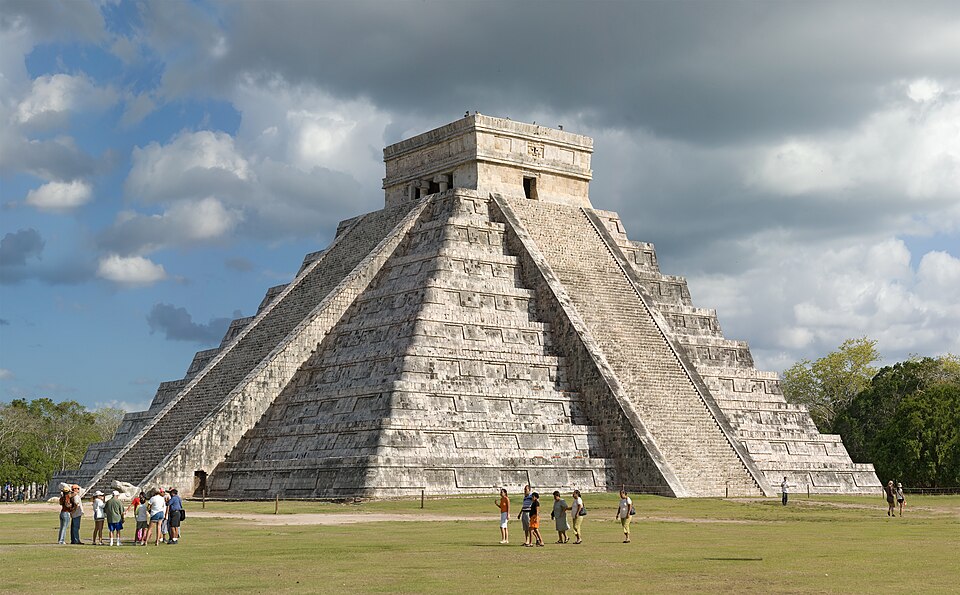

The Maya never developed the true arch; instead, they used the corbel vault, in which successive courses of stone are offset inward from each supporting wall until they meet at the apex, creating a characteristic narrow, triangular interior space.14 Despite this structural limitation, Maya architects achieved remarkable effects of scale and proportion, with temple superstructures crowned by elaborate roofcombs—perforated stone lattices that extended the visual height of buildings and served as surfaces for painted stucco decoration.1
Architectural styles varied significantly across the Maya world. The Petén style, exemplified by Tikal, featured steep-sided pyramids with narrow temple chambers and massive roofcombs. The Puuc style of the Yucatán peninsula, seen at sites like Uxmal, employed intricate geometric stone mosaic facades assembled from thousands of individually carved blocks.1, 13 Palenque developed a distinctive regional style characterized by broad interior spaces achieved through unusually thin walls, mansard-like rooflines, and extensive use of stucco sculpture.1 Chichén Itzá, which rose to prominence in the Terminal Classic and Early Postclassic periods (c. 800–1200 CE), combined Maya architectural traditions with influences from central Mexican cultures, most dramatically in the Castillo (Temple of Kukulkan), a 30-meter stepped pyramid whose nine terraces, four stairways of 91 steps each, and summit platform create a total of 365 units corresponding to the days of the solar year.13, 23
Maya cities were connected by an extensive network of raised stone causeways called sacbeob (singular: sacbe), constructed from limestone rubble surfaced with plaster. Some sacbeob linked structures within a single city, while others connected separate cities across distances of up to 100 kilometers, as in the causeway linking Cobá and Yaxuná in the Yucatán.19 The 2018 LiDAR surveys revealed that the causeway network was far more extensive than previously recognized, with hundreds of previously unknown roads connecting settlements across the lowlands into an integrated transportation infrastructure.2
Economy and trade
The economic foundation of Maya civilization was intensive agriculture centered on maize, supplemented by beans, squash, cacao, cotton, and a wide range of tree crops and garden vegetables.1, 19 Although early scholarship characterized Maya agriculture as simple slash-and-burn (milpa) farming insufficient to support large populations, archaeological and remote-sensing evidence has progressively revealed a far more complex agricultural landscape including raised fields in wetland areas, stone-walled terraces on hillsides, canal systems, and managed forest gardens.2, 19
Long-distance trade was vital to Maya political and economic life. The volcanic highlands of Guatemala supplied obsidian and jade, two of the most highly valued materials in Maya culture; the Pacific coast provided salt and marine shells; and the lowlands exported forest products including cacao, cotton textiles, and animal pelts.17 Cacao beans served as a form of currency, and cacao beverages were consumed in elite feasting and ritual contexts.19 Archaeological evidence from sites across the Maya world reveals formal marketplace areas, and ethnohistoric sources from the Postclassic period describe well-organized market systems with designated trading days and regulated weights and measures.17
Major trade goods in the Maya economy17, 19
| Commodity | Source region | Primary use |
|---|---|---|
| Obsidian | Guatemalan highlands (El Chayal, Ixtepeque) | Blades, ritual implements, mirrors |
| Jade (jadeite) | Motagua River valley, Guatemala | Royal regalia, burial offerings, jewelry |
| Cacao | Pacific piedmont, Belize, Honduras | Currency, elite beverages, ritual offerings |
| Salt | Yucatán coast, Belize coast | Food preservation, seasoning, trade medium |
| Marine shell (Spondylus) | Pacific and Caribbean coasts | Jewelry, musical instruments, offerings |
| Cotton textiles | Lowland production centers | Clothing, tribute payment, trade goods |
| Quetzal feathers | Cloud forests of Guatemala, Honduras | Royal headdresses, ceremonial regalia |
The Classic Maya collapse
Between approximately 800 and 1000 CE, the great cities of the southern Maya lowlands experienced a dramatic decline. One by one, the ruling dynasties of Tikal, Calakmul, Copán, Palenque, and dozens of other centers ceased erecting dated monuments, construction of monumental architecture halted, and populations dispersed from urban cores into the surrounding countryside or migrated northward to the Yucatán peninsula.10, 15 This process, conventionally termed the Classic Maya collapse, was not a single catastrophic event but an extended, regionally variable decline that unfolded differently across the lowlands over the course of approximately two centuries.10
The causes of the collapse have been debated for over a century, and current scholarly consensus favors a multicausal explanation involving the interaction of environmental, political, and demographic factors.10, 18 Paleoclimate records from lake sediment cores, cave speleothems, and ocean sediment reveal a series of severe, multiyear droughts that struck the Maya lowlands during the ninth and tenth centuries CE, with particularly intense dry periods around 810, 860, and 910 CE.18 These droughts would have placed extreme stress on an agricultural system already operating near its carrying capacity due to centuries of population growth.10, 12
Climate modeling has demonstrated that Maya deforestation itself likely exacerbated drought conditions. By the Late Classic period, the Maya had cleared vast tracts of forest for agriculture and construction, reducing regional evapotranspiration and moisture recycling in ways that would have decreased local rainfall by 5 to 15 percent—a reduction sufficient to push already-stressed water supplies below critical thresholds.12 The conjunction of natural drought cycles and anthropogenic deforestation created a positive feedback loop in which environmental degradation amplified climatic stress.10, 12
Political factors compounded these environmental pressures. The Late Classic period saw an intensification of interstate warfare, with an increasing number of cities engaged in destructive conflicts that disrupted trade networks and agricultural production.15 Research at the Postclassic site of Mayapan has documented a statistically significant correlation between drought intensity and the frequency of civil conflict, suggesting that resource scarcity directly fueled political violence.11 The collapse of individual polities appears to have cascaded through the interconnected political network, as the failure of major centers like Tikal and Calakmul destabilized their dependent allies and trade partners.6, 15
The Postclassic period and European contact
The collapse of the southern lowland cities did not mark the end of Maya civilization. Political and economic power shifted northward to the Yucatán peninsula, where cities such as Chichén Itzá, Uxmal, and later Mayapan emerged as major centers during the Postclassic period (c. 950–1524 CE).1, 13 Chichén Itzá dominated the northern lowlands from approximately 900 to 1100 CE, drawing on both Maya and central Mexican cultural traditions to create a cosmopolitan center whose architecture, iconography, and political organization reflected extensive contact with the Toltec and other highland Mexican societies.13, 23
After the decline of Chichén Itzá, the city of Mayapan assumed regional dominance from approximately 1200 to 1441 CE, governing a confederacy of Yucatecan polities from a walled urban center whose layout deliberately imitated that of Chichén Itzá on a smaller scale.1, 11 Maritime trade flourished along the Caribbean coast, with the island trading port of Tulum and coastal sites in Belize serving as nodes in a network that moved goods from Honduras to the Gulf of Mexico.19 When Spanish expeditions first reached the Yucatán coast in 1517, they encountered a Maya world that was politically fragmented but culturally vibrant, with functioning cities, active marketplaces, and literate scribes still producing screenfold books.1, 13
The Spanish conquest of the Maya was neither swift nor total. Unlike the Aztec Empire, which fell to Hernán Cortés in 1521, the decentralized Maya polities resisted Spanish domination for decades. The last independent Maya kingdom, the Itza state centered on the island city of Nojpetén (modern Flores, Guatemala) in Lake Petén Itzá, did not fall to Spanish forces until 1697—176 years after the fall of the Aztec capital Tenochtitlan.1, 13 Today, approximately six million people speak Mayan languages across Mexico, Guatemala, Belize, and Honduras, maintaining cultural traditions that connect directly to the ancient civilization.13
Chronology and legacy
Maya history spans more than three thousand years, from the earliest settled agricultural communities of the Preclassic period to the Spanish conquest and beyond. The following table summarizes the major periods, their approximate dates, and their defining characteristics as documented in the archaeological and epigraphic record.1, 13, 22
Major periods of Maya civilization1, 13
Key developments by period1, 13, 22
| Period | Approximate dates | Key developments |
|---|---|---|
| Early Preclassic | 2000–1000 BCE | Settled agriculture, first pottery, Olmec influence begins |
| Middle Preclassic | 1000–400 BCE | Monumental architecture at Nakbe, early hieroglyphic writing, social stratification |
| Late Preclassic | 400 BCE–250 CE | El Mirador mega-city, Long Count calendar, widespread urbanism |
| Early Classic | 250–600 CE | Tikal–Calakmul rivalry begins, Teotihuacan influence, dynastic stelae tradition |
| Late Classic | 600–900 CE | Peak population (7–11 million), greatest architectural and artistic output, collapse begins c. 800 |
| Terminal Classic | 800–950 CE | Southern lowland depopulation, drought episodes, northward migration |
| Postclassic | 950–1524 CE | Chichén Itzá, Mayapan, maritime trade, Spanish contact and conquest |
The study of Maya civilization has been transformed in the twenty-first century by technological advances that have fundamentally altered the scale and resolution of archaeological investigation. Airborne LiDAR, which can penetrate dense tropical canopy to reveal ground-level features, has exposed tens of thousands of previously unknown structures across the Maya lowlands, upending earlier models of population density and land use.2 Advances in paleoclimatology have provided increasingly precise records of past drought events, enabling more nuanced models of the relationships between climate variability and social change.18 And the near-complete decipherment of the hieroglyphic script has made the Maya one of the few ancient civilizations whose history can be reconstructed from both material remains and texts written by the people themselves.4
The Maya intellectual legacy extends far beyond Mesoamerica. Their independent invention of zero, their development of a positional number system, and their astronomical calculations represent achievements of universal scientific significance.8 The Long Count calendar's capacity for recording deep time reflects a cosmological vision in which human history occupies a tiny fraction of cosmic duration—a perspective that resonates with modern scientific understandings of geological and astronomical time.7 Today, the approximately six million speakers of Mayan languages across Central America maintain living cultural traditions—including agricultural practices, weaving techniques, ceremonial calendars, and oral narratives—that connect directly to the civilization whose monumental remains stand in the forests and fields of their homeland.13
References
Ancient lowland Maya complexity as revealed by airborne laser scanning of northern Guatemala
Popol Vuh: The Definitive Edition of the Mayan Book of the Dawn of Life and the Glories of Gods and Kings
Classic Period collapse of the Central Maya Lowlands: Insights about human–environment relationships for sustainability