Overview
- Between roughly 4000 and 2000 BCE, human societies in at least six independent regions transitioned from agricultural villages to the first cities and states, producing writing, monumental architecture, social stratification, and professional specialization in a transformation V. Gordon Childe termed the 'Urban Revolution.'
- The earliest cities emerged in southern Mesopotamia, where Uruk grew to perhaps 40,000 inhabitants by 3000 BCE, but comparable urban centers arose independently in Egypt, the Indus Valley, China, Mesoamerica, and the Andes, demonstrating that urbanism is a convergent outcome of social evolution under specific ecological and demographic conditions.
- No single theory explains why states formed; modern scholarship recognizes that agricultural surplus, population pressure, environmental circumscription, irrigation management, long-distance trade, warfare, and ideological legitimation interacted in different combinations across each region to produce the hierarchical, specialized societies that characterize early civilizations.
The emergence of cities and states ranks among the most consequential transformations in the entire history of human societies. Between roughly 4000 and 2000 BCE, communities in several regions of the world independently crossed a threshold from small-scale agricultural villages numbering a few hundred inhabitants to densely populated urban centers housing tens of thousands of people, governed by centralized political institutions, stratified by hereditary social hierarchies, and sustained by specialized economic systems that no single household could replicate on its own.1, 5 The Australian-British archaeologist V. Gordon Childe, writing in 1950, coined the term "Urban Revolution" to describe this cluster of changes, identifying ten diagnostic criteria that distinguished the earliest cities from the villages that preceded them: large population aggregations, full-time craft specialists, concentration of surplus by a ruling elite, monumental public architecture, a ruling class exempt from manual labor, systems of recording and exact sciences, writing, sophisticated artistic styles, long-distance trade, and residence-based rather than kinship-based political organization.1, 18
This transformation occurred independently in at least six regions: southern Mesopotamia, the Nile Valley of Egypt, the Indus Valley of South Asia, the Yellow River basin of China, Mesoamerica, and the Pacific coast of South America.5, 16 The fact that comparable urban societies arose without contact between most of these regions demonstrates that the rise of cities and states is not a unique accident of history but a convergent outcome of social evolution, one that emerges when specific ecological, demographic, and organizational conditions align. Understanding these preconditions, and the distinct trajectories each region followed, remains one of the central problems of anthropology and archaeology.
Preconditions for urbanism
The transition from village to city required a suite of preconditions that took millennia to develop after the initial domestication of plants and animals. The most fundamental of these was the capacity to produce an agricultural surplus beyond the immediate subsistence needs of the farming household. Without surplus, there can be no full-time specialists, no administrators, no priests, and no soldiers, because every individual must devote the bulk of their labor to food production.1, 10 The intensification of agriculture through irrigation, terracing, flood-recession farming, and selective breeding of higher-yielding crop varieties progressively increased the ratio of food produced per unit of labor, making it possible for a shrinking proportion of the population to feed a growing proportion of non-farmers.3, 9
River valleys and alluvial floodplains played a disproportionate role in the earliest urbanization because they combined exceptional soil fertility with reliable water supplies. The Tigris-Euphrates floodplain of southern Mesopotamia, the Nile Valley, the Indus floodplain, and the Yellow River loess plateau all offered environments where irrigation or flood-recession agriculture could generate the caloric surpluses needed to support dense populations and occupational specialization.3, 12 The anthropologist Robert Carneiro, in his influential 1970 circumscription theory, argued that population growth in geographically bounded environments, such as narrow river valleys flanked by desert or mountains, created competitive pressures that could not be resolved by simple emigration. Instead, defeated groups in territorial conflicts were incorporated into the polities of their conquerors, producing the political stratification and coercive authority characteristic of states.2
Beyond surplus and circumscription, the organizational capacity for collective labor was essential. Large-scale irrigation works, flood-control embankments, and monumental construction projects required coordination among hundreds or thousands of workers, which in turn demanded managerial hierarchies capable of planning, directing, and provisioning labor forces.11, 15 Storage technology also mattered: the ability to accumulate grain in centralized granaries gave emerging elites control over food distribution, which they could leverage to reward supporters, feed specialists, and provision military campaigns. The convergence of surplus production, population density, environmental constraint, organizational complexity, and elite resource control created the conditions from which the first cities emerged.10, 14
Mesopotamia and the first cities
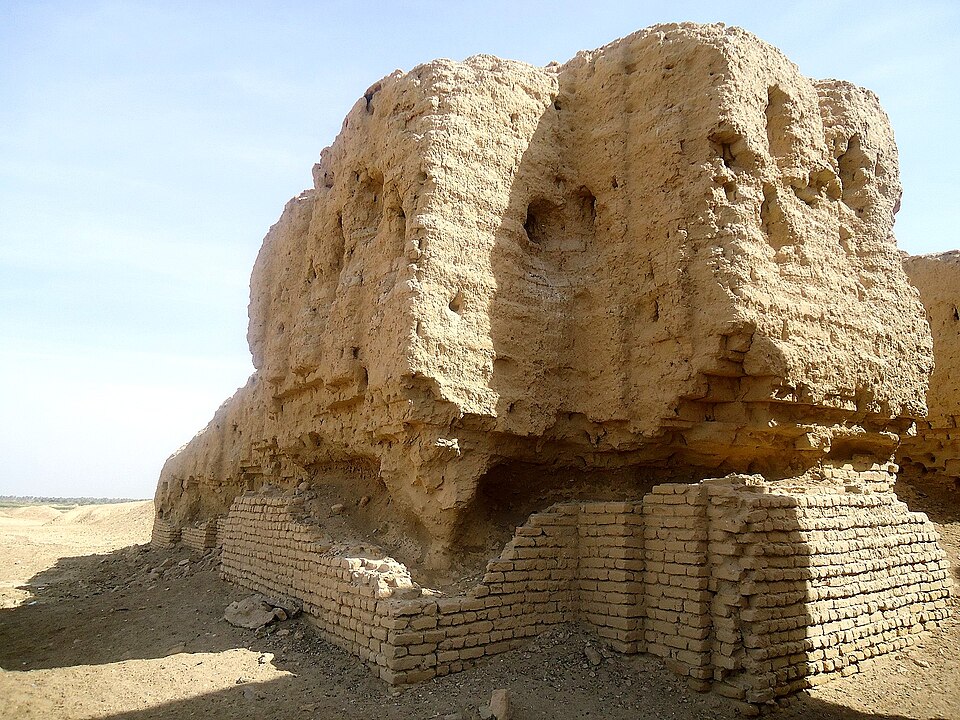

The earliest unambiguous evidence for urbanism comes from southern Mesopotamia, the alluvial plain between the lower Tigris and Euphrates rivers in what is now southern Iraq. During the Uruk period (approximately 4000 to 3100 BCE), the site of Uruk (modern Warka) grew from a modest settlement into what most archaeologists regard as the world's first true city. By approximately 3000 BCE, Uruk covered some 250 hectares and housed an estimated 40,000 to 80,000 inhabitants, a population density without precedent in the archaeological record.9, 12, 19 The city's monumental core included the Eanna precinct, a complex of temples, courtyards, and administrative buildings decorated with elaborate cone mosaics, and the Anu ziggurat, a massive stepped platform that elevated the temple of the sky god above the surrounding plain.12, 20
Southern Mesopotamia's geography was paradoxical: the alluvial plain lacked stone, timber, and metal, yet its extraordinarily fertile soils, when irrigated, produced grain surpluses far exceeding those of any rain-fed agricultural zone in the ancient Near East. This ecological asymmetry drove two defining features of early Mesopotamian civilization. First, the need for organized irrigation created institutions, most likely temple-based initially, capable of mobilizing and coordinating communal labor. Second, the absence of raw materials necessitated long-distance trade networks extending hundreds of kilometres into the stone, timber, and metal-bearing highlands of Anatolia, Iran, and the Gulf, stimulating the development of administrative record-keeping, standardized weights and measures, and ultimately writing.9, 20
The world's earliest known writing system, proto-cuneiform, appeared at Uruk around 3300 BCE in the form of impressed and incised clay tablets recording economic transactions: quantities of grain, livestock, and labor owed to or distributed by the temple administration.12 Guillermo Algaze has argued that the Uruk phenomenon represented a "world system" in which the southern Mesopotamian core, with its surplus grain and institutional complexity, established asymmetric exchange relationships with less complex societies on its periphery, extracting raw materials in return for manufactured goods and organizational models.20 By the Early Dynastic period (approximately 2900 to 2350 BCE), southern Mesopotamia was divided among competing city-states, each centered on a walled urban core with temple and palace complexes, and the institution of kingship had crystallized as the dominant form of political authority.12, 14
The Indus Valley civilization
The Indus or Harappan civilization, which flourished from approximately 2600 to 1900 BCE across a vast area of modern Pakistan and northwestern India, represents one of the most remarkable and enigmatic of the early urban societies. At its height, the civilization encompassed over 1,500 known settlements spread across roughly one million square kilometres, an area larger than contemporary Mesopotamia and Egypt combined.6, 13 Its two largest cities, Mohenjo-daro on the lower Indus and Harappa on the Ravi tributary of the upper Indus, each covered approximately 150 to 250 hectares and may have housed populations of 30,000 to 50,000 people.6
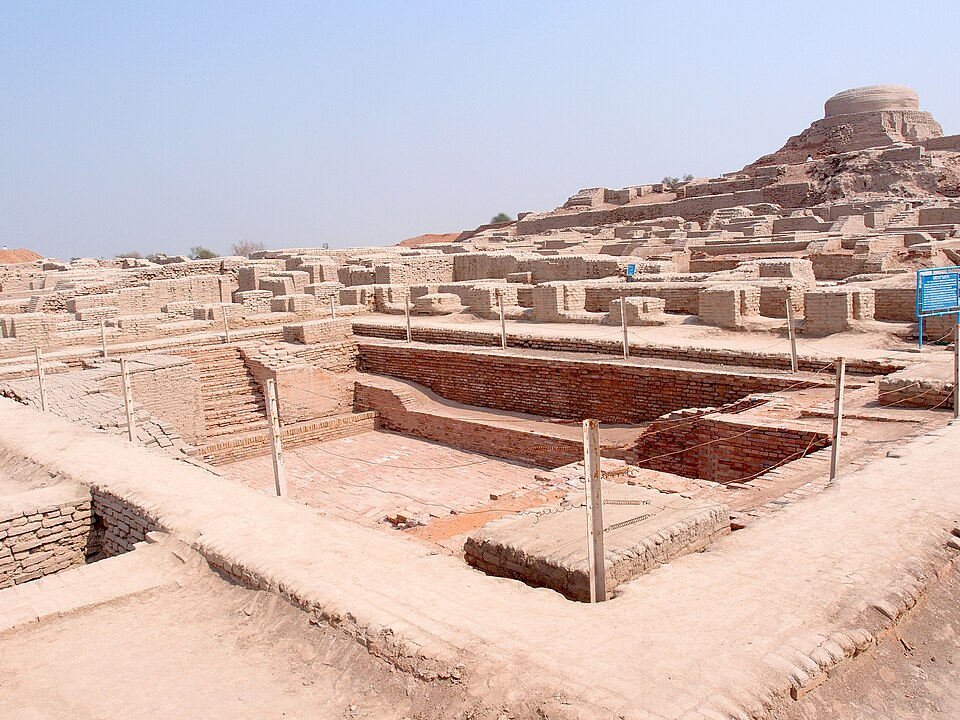

What distinguishes the Indus civilization from its Mesopotamian and Egyptian contemporaries is the extraordinary degree of urban planning and material standardization evident in its archaeological record. Mohenjo-daro and Harappa exhibit orthogonal street grids, with major thoroughfares oriented roughly north-south and east-west, dividing the city into regular blocks. Fired-brick construction followed standardized brick dimensions (with a consistent 1:2:4 ratio of thickness to width to length) across sites separated by hundreds of kilometres.13 Most remarkably, the cities possessed sophisticated covered drainage systems in which wastewater from individual houses flowed through brick-lined channels beneath the streets to soak pits or outfall points, a level of civic sanitary infrastructure not matched in the Western world for thousands of years.6, 13
Despite this material sophistication, the Indus civilization presents a striking contrast to its contemporaries in the apparent absence of monumental palaces, royal tombs, or temples of the kind that dominate Mesopotamian and Egyptian sites. The largest structures at Mohenjo-daro, including the so-called Great Bath and the Granary, appear to have served communal or civic rather than explicitly royal functions.6 The Indus script, attested on thousands of stamp seals and other objects, remains undeciphered, and with it the political organization of the civilization remains largely opaque. Some scholars have proposed that the Indus polity was organized along more heterarchical or corporate lines than the despotic kingships of Mesopotamia and Egypt, though this interpretation remains debated.3, 6 Trade connections with Mesopotamia are well documented: Indus-style seals, carnelian beads, and other artifacts have been found at sites in the Persian Gulf and in Mesopotamian cities, and Mesopotamian texts refer to trade with a land called "Meluhha," widely identified with the Indus region.6, 13 The civilization's decline after approximately 1900 BCE appears to have been gradual rather than catastrophic, possibly linked to shifts in monsoon patterns and changes in river courses that undermined the agricultural base of the major urban centers.6
China and the emergence of early states
The trajectory of urbanism and state formation in China followed a distinctive path shaped by the region's unique ecology, cosmology, and political traditions. The Erlitou culture (approximately 1900 to 1500 BCE), centered in the middle Yellow River valley in what is now Henan province, is widely regarded as the earliest state-level society in China. The Erlitou site itself covered approximately 300 hectares at its peak and contained a walled palace precinct of about 12 hectares, rammed-earth palace foundations, bronze workshops, and elite burials with jade and bronze grave goods that attest to pronounced social stratification.8 Whether Erlitou represents the semi-legendary Xia dynasty of Chinese historical tradition remains debated, but its material record unambiguously demonstrates centralized political authority, craft specialization, and monumental construction.8
The subsequent Shang dynasty (approximately 1600 to 1046 BCE) is the first Chinese state attested by both archaeological evidence and contemporary written records. The late Shang capital at Yinxu (near modern Anyang in Henan province), occupied from roughly 1250 to 1046 BCE, covered some 30 square kilometres and served as the political, ritual, and manufacturing center of a territorial state whose influence extended over much of northern China.8, 5 Shang civilization is distinguished by several features that set it apart from its western Asian contemporaries. Bronze technology reached extraordinary levels of sophistication, with ritual vessels of great size and complexity produced by a piece-mold casting technique unique to China and quite different from the lost-wax method used in the Near East.8 The oracle bone inscriptions, divination records carved on turtle plastrons and cattle scapulae, constitute the earliest substantial corpus of Chinese writing and provide direct evidence of Shang royal ideology, ritual practice, and administrative concerns.8, 5
The Shang political system was built around an ancestral kingship in which the ruler derived his legitimacy from his genealogical connection to a line of royal ancestors who were believed to intercede with the supreme deity, Di, on behalf of the living. Divination using oracle bones was not merely a religious practice but a tool of governance, employed by the king to determine the auspicious timing for military campaigns, harvests, hunts, and sacrificial rituals.8 Elaborate royal tombs at Yinxu, including large cruciform shaft graves accompanied by sacrificed humans, chariots, and vast quantities of bronze and jade objects, testify to the extraordinary concentration of wealth and coercive power in the Shang ruling lineage.5, 8
Mesoamerican and Andean civilizations
The independent emergence of urban civilizations in the Americas provides the strongest possible evidence that the rise of cities and states is a convergent evolutionary process rather than a unique historical event diffused from a single origin. In Mesoamerica and the Andes, complex societies arose with no demonstrable contact with the Old World civilizations of Eurasia and Africa, yet they developed many of the same institutional features: monumental architecture, social stratification, long-distance exchange networks, calendrical systems, and in some cases writing.5, 15
.jpg)
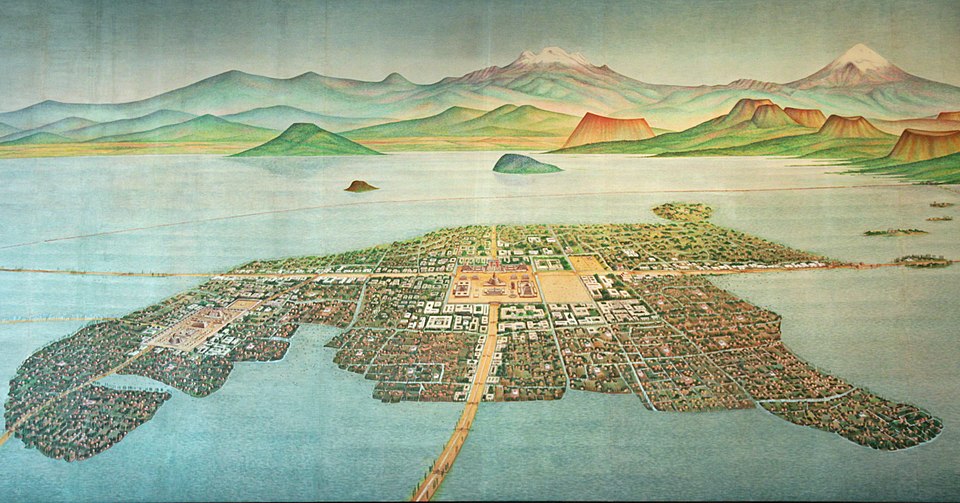
In Mesoamerica, the Olmec civilization of the Gulf Coast lowlands (approximately 1500 to 400 BCE) is often described as a "mother culture" whose artistic conventions, ritual practices, and cosmological concepts influenced all subsequent Mesoamerican societies. The Olmec centers of San Lorenzo (flourishing around 1200 to 900 BCE) and La Venta (around 900 to 400 BCE) featured massive earthen platforms, colossal basalt portrait heads weighing up to 50 tonnes, and elaborate offerings of jade and serpentine, all indicating a high degree of social complexity and the mobilization of large labor forces.16, 10 The city of Teotihuacan in the Basin of Mexico, which rose to prominence in the first centuries CE and reached a peak population estimated at 100,000 to 200,000 people by approximately 400 to 500 CE, became one of the largest cities in the world at that time. Its monumental Avenue of the Dead, the Pyramid of the Sun (the third-largest pyramid on Earth by volume), and its distinctive apartment compounds demonstrate urban planning on a scale comparable to any contemporary Old World city.16, 4
In the Andes, the site of Caral in the Supe Valley of coastal Peru has been dated by radiocarbon to approximately 3000 to 1800 BCE, making it one of the oldest urban centers in the Americas and roughly contemporary with the pyramids of Egypt. Caral's monumental platform mounds, sunken circular plazas, and residential quarters housed a population estimated in the low thousands, sustained by irrigation agriculture supplemented by maritime resources from the nearby Pacific coast.7 Remarkably, Caral and the broader Norte Chico civilization developed without ceramics, a feature unique among early complex societies. Later Andean civilizations, including the Chavín (approximately 900 to 200 BCE), the Moche (approximately 100 to 700 CE), and ultimately the Inca Empire, built upon this deep tradition of monumental construction, long-distance exchange, and centralized political authority, though each followed its own trajectory of development.17, 7
Theories of state formation
Why did states emerge? This question has occupied social theorists since at least the eighteenth century, and the diversity of proposed answers reflects both the complexity of the phenomenon and the difficulty of testing causal hypotheses against fragmentary archaeological evidence. Several major theoretical frameworks have competed for influence over the past century, and while none has achieved universal acceptance, each illuminates important dimensions of the process.14, 10
Karl Wittfogel's hydraulic hypothesis, articulated most fully in his 1957 book Oriental Despotism, proposed that the construction and maintenance of large-scale irrigation systems in arid environments required centralized bureaucratic management, which in turn gave rise to despotic political authority. In Wittfogel's formulation, control over water was the key to political power in hydraulic civilizations from Mesopotamia to China to Peru.11 Although the hydraulic hypothesis drew attention to the genuine importance of irrigation in early state economies, subsequent archaeological evidence has shown that in several regions, including Mesopotamia, China, and Mexico, state-level political organization preceded the construction of large-scale irrigation works, rather than arising from it. The hypothesis has therefore been largely abandoned as a monocausal explanation, though the relationship between water management and political complexity remains an active area of research.15, 14
Carneiro's circumscription theory, published in 1970, offered a different mechanism. Carneiro proposed that states arise when growing populations in environmentally circumscribed areas (such as river valleys bounded by desert, mountains, or ocean) come into conflict over limited agricultural land. Because the losing populations in such conflicts cannot simply migrate to unoccupied territory, they are instead subjugated and incorporated into the expanding polity of the victors, creating the hierarchical, multi-community political structures characteristic of states.2 Circumscription theory has been praised for its logical clarity and its ability to explain the geographic clustering of early states in bounded riverine environments, though critics have noted that it does not adequately account for cases of state formation in unbounded environments or for the role of ideology, trade, and elite agency in political centralization.10, 14
Other scholars have emphasized the role of long-distance trade and exchange networks in stimulating political centralization. The control of trade routes and access to prestige goods, such as obsidian, lapis lazuli, copper, jade, and marine shell, provided aspiring elites with the material resources to build political followings and legitimate their authority.20, 9 Warfare and military conquest have also been proposed as primary drivers of state formation, with states emerging as the organizational apparatus needed to wage sustained military campaigns and to administer conquered territories.2, 10 Still others have emphasized the role of ideology and religion, arguing that the ability of elites to claim privileged access to the supernatural, to control ritual knowledge, and to present the existing social order as divinely sanctioned was a necessary condition for the establishment of hereditary inequality and centralized political authority.10, 5
The modern consensus, as reflected in the work of scholars such as Norman Yoffee, Bruce Trigger, and Kent Flannery and Joyce Marcus, rejects monocausal explanations in favor of multi-factorial models that recognize the interaction of ecological, demographic, economic, military, and ideological variables.14, 5, 10 Yoffee has argued that the very concept of "the archaic state" as a uniform type is misleading, and that each early civilization must be understood as a unique historical trajectory shaped by specific local conditions rather than as a variation on a universal template.14 What the comparative evidence does suggest, however, is that certain conditions recur across independent cases: agricultural surplus capable of supporting non-food-producing specialists, population densities sufficient to create competition for resources, environmental or social constraints limiting emigration as an alternative to political subordination, and cultural mechanisms for legitimating inequality.5, 10
Comparative overview of early urban civilizations
The following table summarizes the key features of the earliest independent urban civilizations, illustrating both the commonalities and the distinctive characteristics that define each regional tradition.
Earliest independent urban civilizations: dates, sites, and features5, 16, 4
| Region | Approximate dates | Key sites | Est. peak population | Distinctive features |
|---|---|---|---|---|
| Southern Mesopotamia | ~3500–2000 BCE | Uruk, Ur, Eridu | 40,000–80,000 (Uruk) | Cuneiform writing, ziggurats, temple & palace economies |
| Nile Valley (Egypt) | ~3100–2000 BCE | Memphis, Hierakonpolis | ~30,000 (Memphis) | Divine kingship, pyramids, hieroglyphic writing |
| Indus Valley | ~2600–1900 BCE | Mohenjo-daro, Harappa | 30,000–50,000 | Grid planning, covered drains, standardized bricks, undeciphered script |
| Yellow River (China) | ~1900–1046 BCE | Erlitou, Yinxu (Anyang) | ~50,000+ (Yinxu region) | Oracle bones, piece-mold bronze casting, ancestral kingship |
| Mesoamerica | ~1500 BCE–500 CE | San Lorenzo, La Venta, Teotihuacan | 100,000–200,000 (Teotihuacan) | Colossal heads, pyramids, calendrical systems, ballgame |
| Andean South America | ~3000–1800 BCE (Caral) | Caral, Chavín de Huántar | ~3,000 (Caral) | Preceramic urbanism, sunken plazas, quipu (later), no writing system |
The table reveals several patterns. All six traditions arose in environments where intensive agriculture could generate substantial surplus, whether through irrigation in arid river valleys (Mesopotamia, Egypt, the Indus), flood-recession farming and loess cultivation (China), or a combination of irrigation and maritime resources (the Andes).3, 5 All developed monumental architecture that served both practical and symbolic functions, materializing the power of ruling institutions in forms visible across the landscape. Yet the variation is equally striking: the Indus civilization achieved urban planning without visible royal authority; the Andean tradition developed monumental architecture without pottery or writing; and China's early states placed divination at the center of political legitimacy in a manner unmatched elsewhere.5, 6, 8 These differences caution against reducing the rise of urban civilizations to any single model and underscore the importance of regional ecological, cultural, and historical contingencies in shaping each civilization's unique trajectory.
Legacy and significance
The rise of urban civilizations between the fourth and second millennia BCE established institutional frameworks, technologies, and cultural forms that continue to shape human societies. Writing, which emerged as an administrative tool for managing surplus and trade in early Mesopotamian cities, became the foundation of law, literature, historiography, and science.12 The legal codes of early states, from the Laws of Ur-Nammu (approximately 2100 BCE) to the Code of Hammurabi (approximately 1754 BCE), established the principle that social relations could be governed by codified rules rather than by custom or personal authority alone.5 Craft specialization in early cities produced innovations in metallurgy, ceramics, textile production, and construction engineering that accumulated across generations and diffused across regions through trade and conquest.1, 9
At the same time, the rise of urban civilizations created social forms that remain deeply contested. Hereditary inequality, coercive taxation, slavery, organized warfare, and the concentration of wealth in the hands of ruling elites all have their roots in the institutional structures of the earliest states.10, 15 Flannery and Marcus have documented in detail how the transition from egalitarian to hierarchical social organization proceeded through a series of identifiable steps: the manipulation of kinship systems, the creation of hereditary rank, the accumulation of ritual and economic privileges by emerging elites, and ultimately the establishment of coercive institutions capable of enforcing compliance through force.10 The comparative study of early civilizations thus illuminates not only the origins of the complex societies in which most humans now live but also the deep historical roots of the inequalities, institutions, and conflicts that continue to define the human condition.5, 14
References
Early Civilizations of the Old World: The Formative Histories of Egypt, The Levant, Mesopotamia, India and China
The Creation of Inequality: How Our Prehistoric Ancestors Set the Stage for Monarchy, Slavery, and Empire
Myths of the Archaic State: Evolution of the Earliest Cities, States, and Civilizations
V. Gordon Childe and the Urban Revolution: a historical perspective on a revolution in urban studies
Urbanism and Cultural Landscapes in Northeastern Syria: The Tell Hamoukar Survey, 1999–2001