Overview
- Ancient Rome evolved from a small settlement on the Tiber River in the eighth century BCE into a vast empire that, at its territorial peak under Trajan in 117 CE, encompassed roughly 5 million square kilometres and governed an estimated 60–70 million people across three continents.
- The Roman Republic (509–27 BCE) developed a complex constitutional system of elected magistrates, a deliberative Senate, and popular assemblies that balanced aristocratic and popular power, while the subsequent Imperial period concentrated authority in the emperor and enabled two centuries of relative stability known as the Pax Romana.
- Rome's enduring contributions — codified law originating with the Twelve Tables of 451–450 BCE, monumental engineering including 400,000 kilometres of roads and eleven major aqueducts, and the Latin language that gave rise to the Romance language family — fundamentally shaped Western civilisation long after the empire's political collapse in 476 CE.
Ancient Rome encompasses the civilisation that grew from a cluster of hilltop settlements beside the Tiber River in central Italy into one of the largest and most influential empires in human history, spanning roughly twelve centuries from the traditional founding date of 753 BCE to the deposition of the last western emperor in 476 CE.1, 5 At its territorial zenith under Emperor Trajan in 117 CE, the Roman Empire controlled approximately 5 million square kilometres stretching from Britain and the Rhine frontier in the north to the Sahara in the south, and from the Iberian Peninsula in the west to Mesopotamia in the east, governing an estimated 60 to 70 million people — perhaps one-quarter of the world's population at the time.9, 11 Rome's political institutions evolved through three distinct phases — monarchy, republic, and empire — each generating constitutional innovations that profoundly influenced subsequent Western political thought.3, 4 The Roman legacy in law, engineering, urban planning, language, and administrative organisation endured long after the empire's political dissolution, forming a foundational stratum of European and, by extension, global civilisation.5, 7
Origins and the regal period
Archaeological evidence reveals continuous occupation of the site of Rome from at least the tenth century BCE, when small communities of Latin-speaking pastoralists and farmers established villages on the Palatine and neighbouring hills above the marshy lowlands of the Tiber floodplain.1, 16 By the eighth century BCE, these settlements had coalesced into a proto-urban centre that benefited from its strategic position at the lowest practical crossing point of the Tiber, a location that controlled both north–south overland traffic and river commerce between the interior and the coast.1 The Roman literary tradition, codified centuries later by authors such as Livy and Virgil, attributed the city's founding to Romulus in 753 BCE, a date that corresponds roughly with the archaeological evidence for the initial draining and paving of the Forum valley, which transformed scattered hilltop villages into a recognisable urban community.1, 5
Roman tradition held that seven kings ruled the city from its founding until the expulsion of the last monarch, Tarquinius Superbus, in 509 BCE.1, 16 While the historicity of individual kings remains debated, the archaeological record confirms that Rome underwent dramatic urbanisation during the seventh and sixth centuries BCE under strong Etruscan cultural influence.1 Monumental temple construction, including the great Temple of Jupiter Optimus Maximus on the Capitoline Hill (traditionally dedicated in 509 BCE), the introduction of Etruscan engineering techniques for drainage and road-building, and the establishment of formal religious and political institutions all point to a period of centralised authority consistent with monarchical rule.1, 19 The Etruscans, whose sophisticated urban civilisation dominated much of central Italy in the seventh and sixth centuries BCE, provided Rome with key cultural elements including the alphabet (itself adapted from Greek via Etruscan intermediaries), religious practices such as augury and haruspicy, and architectural forms including the atrium house and the arched gateway.1, 5
The Roman Republic
The overthrow of the monarchy and the establishment of the Republic around 509 BCE inaugurated nearly five centuries of collective aristocratic governance that would prove one of antiquity's most consequential political experiments.3, 4 The new constitutional order replaced the king with two annually elected consuls who held supreme executive authority (imperium) but checked each other through mutual veto and the constraint of a single year in office.4, 16 The Senate, a body of former magistrates numbering around 300 in the middle Republic, served as the Republic's primary deliberative institution, controlling foreign policy, state finances, and provincial assignments through its collective authority (auctoritas), though it technically lacked formal legislative power.3, 4
Below the consulship, an elaborate hierarchy of magistracies — praetors, aediles, quaestors, and censors — distributed governmental functions among a competitive aristocratic elite, while the office of tribune of the plebs, established during the protracted social conflict known as the Struggle of the Orders (494–287 BCE), gave the common people (plebeians) institutional representation and the power to veto magisterial actions.3, 4 Popular assemblies (comitia) elected magistrates and voted on legislation, though their structure weighted voting in favour of wealthier citizens.4 The Greek historian Polybius, writing in the second century BCE, famously praised the Roman constitution as an ideal "mixed" system that combined monarchical (consuls), aristocratic (Senate), and democratic (assemblies) elements in a self-correcting balance of power.4, 5
A landmark achievement of the early Republic was the codification of law in the Twelve Tables (451–450 BCE), produced by a commission of ten men (decemviri) in response to plebeian demands for written, publicly accessible legal norms.12, 3 Although the original bronze or wooden tablets were destroyed during the Gallic sack of Rome in 390 BCE and survive only in fragments quoted by later authors, the Twelve Tables established fundamental legal principles — including the right to trial, the prohibition of laws targeting individuals, and formal procedures for debt and property disputes — that formed the foundation of Roman jurisprudence for centuries.12, 5
Mediterranean expansion
Rome's transformation from a regional Italian power to the master of the Mediterranean world occurred with remarkable speed between the fourth and second centuries BCE.2, 16 The conquest of the Italian peninsula was largely complete by 264 BCE, achieved through a combination of military victory, strategic road-building, and the extension of varying degrees of Roman citizenship and alliance to defeated communities — a policy of incorporation that proved far more effective at consolidating control than the exclusive practices of Greek city-states.1, 2 The three Punic Wars against Carthage (264–146 BCE) marked the decisive turning point: the First Punic War (264–241 BCE) gave Rome its first overseas provinces in Sicily, Sardinia, and Corsica; the Second Punic War (218–201 BCE), during which the Carthaginian general Hannibal famously crossed the Alps and devastated Italy for fifteen years before his defeat at the Battle of Zama, established Roman supremacy in the western Mediterranean; and the Third Punic War (149–146 BCE) ended with the complete destruction of Carthage itself.2, 5
Simultaneous campaigns in the eastern Mediterranean brought the Hellenistic kingdoms under Roman domination. The defeat of Macedon at the Battle of Cynoscephalae (197 BCE) and Pydna (168 BCE), the destruction of Corinth in 146 BCE, and the eventual annexation of Ptolemaic Egypt in 30 BCE completed Rome's encirclement of the Mediterranean, which Romans came to call mare nostrum ("our sea").2, 17 This rapid expansion profoundly transformed Roman society: the influx of war captives created a slave-based agricultural economy of large estates (latifundia) that displaced small farmers, widening the gap between rich and poor; Greek cultural influence reshaped Roman art, literature, philosophy, and education; and the demands of governing distant provinces strained Republican institutions designed for a city-state.2, 15
The crisis of the Republic and the rise of the emperors
The final century of the Republic (133–27 BCE) was marked by escalating political violence, civil war, and the progressive collapse of constitutional norms.17, 3 The reform efforts of the tribunes Tiberius and Gaius Gracchus (133 and 123–121 BCE), who attempted to address land inequality and extend citizenship, ended in their murders and established a precedent for lethal factional politics.17 The rivalry between Marius and Sulla in the 80s BCE produced Rome's first civil wars and Sulla's unprecedented dictatorship, during which he executed thousands of political opponents through the innovation of proscription lists.17, 5 Julius Caesar's conquest of Gaul (58–50 BCE), his crossing of the Rubicon in 49 BCE, his appointment as dictator perpetuo, and his assassination on the Ides of March 44 BCE demonstrated both the fragility of Republican institutions and the immense power that successful military commanders could now wield.17, 16
The final round of civil wars (44–30 BCE) pitted Caesar's heir Octavian against Mark Antony and Cleopatra, ending with Octavian's victory at the Battle of Actium (31 BCE) and the annexation of Egypt.10, 20 In 27 BCE, the Senate conferred upon Octavian the honorific title Augustus, marking the conventional beginning of the Roman Empire.10 Augustus's political genius lay in constructing an autocracy veiled in Republican forms: he held no permanent office beyond his time-limited grants of imperium and tribunician power, deferred publicly to the Senate, and styled himself not as king but as princeps ("first citizen").10, 20 This constitutional fiction proved remarkably durable, establishing a template for imperial governance that persisted, with modifications, for centuries.20, 5
The imperial apogee
.jpg)
The first two centuries of the imperial period, from Augustus through the death of Marcus Aurelius in 180 CE, are conventionally described as the era of the Pax Romana, a period of relative internal peace and stability that enabled sustained economic growth, urbanisation, and cultural florescence across the empire.11, 8 The historian Edward Gibbon famously judged this the period "in the history of the world, during which the condition of the human race was most happy and prosperous," a romantic assessment that modern scholarship has qualified but not entirely overturned.5 The empire's population at its demographic peak around 165 CE has been estimated at between 59 and 76 million, with the city of Rome itself housing approximately one million inhabitants — a scale of urbanisation not matched in Europe until nineteenth-century London.9, 8

.jpg)
The Roman economy during this period was the largest integrated economic system the pre-industrial world had known.15, 14 Long-distance trade networks moved grain from Egypt and North Africa to feed Rome, olive oil from Spain, wine from Gaul, silk from China via overland and maritime routes, and manufactured goods across vast distances.15 The standardised silver denarius facilitated commerce across the entire Mediterranean basin and beyond, and archaeological evidence from shipwrecks, Greenland ice cores (recording lead pollution from Roman mining), and the distribution of mass-produced pottery such as African Red Slip ware all indicate economic activity at levels not regained in western Europe for over a millennium after Rome's fall.14, 7
Estimated population of the Roman Empire over time9, 8
Engineering and infrastructure
Roman engineering achievements rank among the most impressive of the ancient world and had lasting practical consequences for the territories Rome governed.21, 13 The Roman road network, totalling an estimated 400,000 kilometres by the height of the empire (of which approximately 80,000 kilometres were paved trunk roads), connected every province to Rome and to each other, facilitating the rapid movement of armies, official communications, and commercial traffic.16, 5 Roads were engineered with multiple layers of compacted aggregate, drainage ditches, and cambered surfaces designed to shed water, and many Roman road alignments remain in use as modern highways.16

The water supply system of the city of Rome was among antiquity's greatest engineering accomplishments. By the third century CE, eleven major aqueducts delivered an estimated one million cubic metres of fresh water to the city daily, supplying public baths, fountains, latrines, and private residences through a sophisticated distribution network of lead and terracotta pipes, settling tanks, and elevated distribution castles (castella).13, 21 The aqueducts relied entirely on gravity flow, requiring precise surveying to maintain a consistent gradient over distances of up to 90 kilometres, and employed arcaded bridges to cross valleys — the Pont du Gard in southern France, standing 49 metres high and carrying the Nîmes aqueduct across the Gardon River, remains one of the best-preserved examples.13
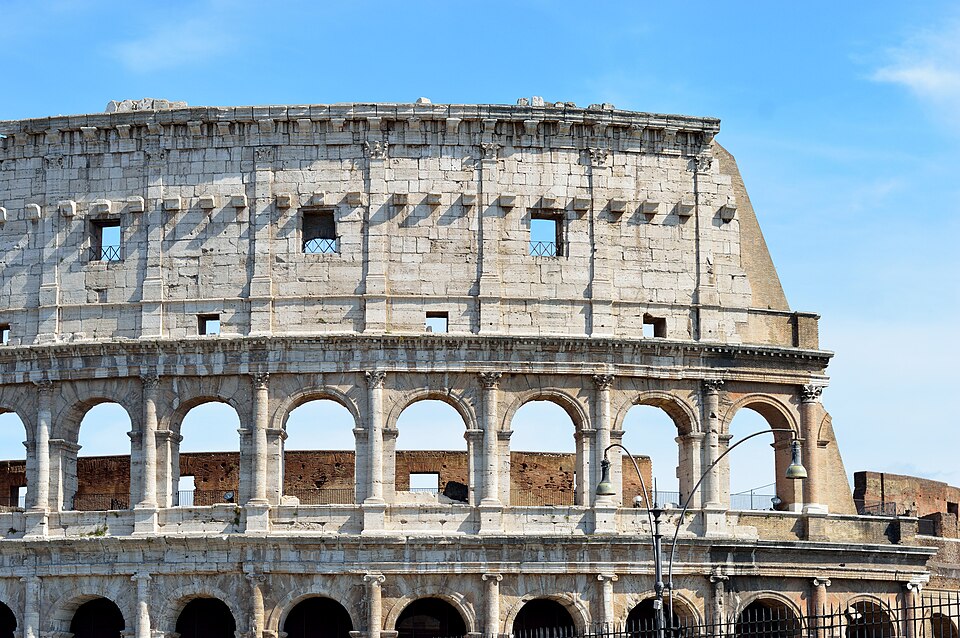
Roman concrete (opus caementicium), a mixture of volcanic ash (pozzolana), lime, and aggregate, enabled architectural achievements of unprecedented scale.21 The Pantheon in Rome, completed under Hadrian around 125 CE, features an unreinforced concrete dome spanning 43.3 metres — a record for any dome that stood for over thirteen centuries until Brunelleschi's dome in Florence.21, 5 The Colosseum (completed 80 CE), capable of seating approximately 50,000 spectators and equipped with a sophisticated system of underground passages, elevators, and a retractable awning (velarium), demonstrated Roman mastery of complex engineering logistics.21, 16
Society, law, and cultural life
Roman society was hierarchically structured around distinctions of legal status, wealth, and birth.5, 16 The fundamental division was between free persons and enslaved persons (servi), with slaves constituting an estimated 10 to 20 per cent of the empire's total population and a substantially higher proportion in Italy itself, where they worked in agriculture, mining, domestic service, education, and skilled crafts.15, 14 Manumission was common and legally regulated, creating a distinctive class of freedmen (liberti) who, though barred from holding magistracies, could accumulate considerable wealth and whose freeborn children became full citizens — a mechanism of social mobility with no parallel in the Greek world.5, 16
Roman law evolved from the pragmatic provisions of the Twelve Tables into the most sophisticated legal system of the ancient world.12, 4 The development of the ius gentium ("law of nations"), a body of legal principles applicable to all peoples regardless of citizenship, and the work of professional jurists such as Gaius, Papinian, Ulpian, and Paul during the second and third centuries CE produced a comprehensive body of civil law that the Emperor Justinian codified in the sixth century as the Corpus Iuris Civilis.5, 18 This compilation became the foundation of most European legal systems and continues to influence civil law traditions worldwide, making Roman law arguably Rome's single most enduring intellectual contribution.5
Roman cultural life was deeply shaped by the absorption of Greek models, which educated Romans admired, translated, and adapted to their own purposes.5, 20 Latin literature achieved its canonical form during the late Republic and Augustan period, with the speeches and philosophical works of Cicero, the epic poetry of Virgil (whose Aeneid became Rome's national epic), the lyric odes of Horace, the love elegies of Ovid, and the historical narratives of Livy and Tacitus establishing genres and standards of prose and verse composition that dominated Western literary education for over a millennium.5, 20 The Latin language itself, carried by Roman administration and settlement across western Europe, evolved into the Romance languages — Italian, French, Spanish, Portuguese, and Romanian — while remaining the lingua franca of European scholarship, law, and the Catholic Church well into the modern period.5
Crisis, division, and the fall of the western empire
The long decline of the western Roman Empire was a multi-century process driven by interacting military, political, economic, environmental, and epidemiological pressures rather than any single catastrophe.6, 7, 8 The Antonine Plague (165–180 CE), likely smallpox, killed an estimated 7 to 10 per cent of the empire's population and disrupted military recruitment and agricultural production.8 The third-century crisis (235–284 CE) brought five decades of near-continuous civil war, barbarian invasions, hyperinflation caused by currency debasement, and the temporary secession of large provinces — a systemic breakdown that reduced the empire to apparent anarchy before the soldier-emperor Diocletian (r. 284–305 CE) restored order through sweeping administrative, military, and fiscal reforms, including the division of the empire into eastern and western halves governed by a Tetrarchy of four co-emperors.18, 5
Constantine I (r. 306–337 CE) reunified the empire, founded Constantinople as a new eastern capital in 330 CE, and issued the Edict of Milan (313 CE) granting toleration to Christianity, which by the end of the fourth century had become the empire's official state religion.18, 5 The environmental historian Kyle Harper has demonstrated that the period from the mid-third century onward was marked by deteriorating climatic conditions — the end of the Roman Climatic Optimum — and by successive pandemic diseases, culminating in the catastrophic Plague of Justinian (541 CE), which may have killed 25 to 50 per cent of the eastern Mediterranean population and permanently altered the demographic and economic foundations of the Roman world.8
In the western provinces, the decisive factor was the loss of territory and tax revenue to barbarian groups whom the overstretched Roman military could no longer contain.6, 7 The crossing of the frozen Rhine by Vandals, Alans, and Suevi on the last night of 406 CE, the sack of Rome by the Visigoths under Alaric in 410 CE, and the progressive establishment of independent barbarian kingdoms in Gaul, Spain, and North Africa stripped the western empire of the provinces that funded its army.6 Peter Heather has argued that the Hunnic Empire, by driving Gothic and other Germanic peoples across the Roman frontier, was the proximate catalyst of the western collapse, while Bryan Ward-Perkins has emphasised that the end of Roman administration brought a genuine collapse of material complexity — a precipitous decline in pottery production, building standards, coin circulation, and literacy that constituted a real "end of civilisation" rather than a gentle transformation.6, 7 The deposition of the last western emperor, Romulus Augustulus, by the Germanic chieftain Odoacer in 476 CE marks the conventional end of the western Roman Empire, though the eastern half — the Byzantine Empire — continued for nearly another millennium until the fall of Constantinople to the Ottoman Turks in 1453 CE.6, 5
Legacy and anthropological significance
Rome's legacy pervades virtually every dimension of Western civilisation and, through European colonial expansion, much of the global order.5, 19 Roman law, transmitted through Justinian's Corpus Iuris Civilis and the medieval European legal tradition, provides the structural foundation of civil law systems used today by the majority of the world's nations.5 The Latin language gave rise to the Romance language family spoken by approximately 900 million native speakers worldwide and supplied the technical vocabulary of law, medicine, science, and theology across all European languages.5, 19 Roman engineering innovations — the arch, the dome, concrete construction, road engineering, and hydraulic systems — established templates that influenced builders for centuries and in some cases remain in active use.21, 13
For anthropology, ancient Rome provides an unparalleled case study in the dynamics of state formation, imperial expansion, cultural assimilation, social stratification, and civilisational collapse.19, 15 The Roman practice of extending citizenship to conquered populations — culminating in the Constitutio Antoniniana of 212 CE, which granted citizenship to virtually all free inhabitants of the empire — represents a distinctive model of political integration that contrasts sharply with the exclusionary practices of Greek city-states and most other ancient empires.18, 16 The study of Rome's interaction with its environment, its management of ethnic and religious diversity, and its ultimate inability to sustain complex administrative systems in the face of compounding ecological and military stresses remains directly relevant to contemporary debates about the resilience and fragility of complex societies.8, 7
References
Hydraulic engineering analysis of Roman water infrastructure: a review of practice and possibilities
The Cambridge Ancient History, Vol. IX: The Last Age of the Roman Republic, 146–43 B.C.