Overview
- The Songhai Empire (c. 1430–1591) was the largest state in African history by territorial extent, stretching across much of West Africa from the Atlantic coast to the borders of modern-day Nigeria. Centred on the city of Gao on the Niger River, it dominated the trans-Saharan trade in gold, salt, and enslaved persons and succeeded the earlier Mali Empire as the region's preeminent power.
- Under Sunni Ali (r. 1464–1492) and Askia Muhammad I (r. 1493–1528), the empire developed a sophisticated administrative system with provincial governors, a professional army, a standardised system of weights and measures, and a bureaucratic apparatus that managed taxation, trade, and justice across a vast multi-ethnic territory.
- The empire's intellectual centre was Timbuktu, home to the Sankore Mosque and a university culture that attracted scholars from across the Islamic world, producing notable works of history, jurisprudence, and theology — including the Tarikh al-Sudan and the Tarikh al-Fattash, two of the most important chronicles of West African history.
The Songhai Empire (also rendered Songhay) was the largest state in the recorded history of West Africa, dominating the middle Niger River valley and the western Sahel from the mid-fifteenth century until its destruction by a Moroccan expeditionary force in 1591. Centred on the city of Gao, approximately 1,200 kilometres downstream from Timbuktu on the Niger, the empire at its peak controlled a territory stretching from the Atlantic coast in the west to the Hausa states in the east, and from the Saharan salt mines of Taghaza in the north to the savanna and forest fringes in the south.1, 14 The Songhai succeeded and absorbed the earlier Mali Empire, establishing themselves as the dominant power in trans-Saharan trade and building an administrative apparatus of remarkable sophistication for governing a vast, ethnically diverse territory.2

Origins and the rise of Gao
The Songhai people were originally centred on the middle Niger River, with Gao serving as their principal settlement from at least the seventh century CE. Archaeological evidence and the oral traditions recorded in the seventeenth-century chronicle Tarikh al-Sudan (composed by Abd al-Rahman al-Sa'di) indicate that Gao was already an important trading centre by the ninth century, connected to the trans-Saharan caravan routes that exchanged West African gold and other goods for Saharan salt and Mediterranean imports.1, 13 The geographer al-Ya'qubi, writing around 872 CE, described the kingdom of Kawkaw (Gao) as one of the major states of the western Sudan, and ninth- and tenth-century Arab geographers consistently listed it alongside Ghana and Mali among the region's powerful polities.2
Islam reached Gao through the trans-Saharan trade networks, and the ruling Dia (Za) dynasty adopted Islam as early as the eleventh century, though the depth of conversion among the broader population is uncertain. Gao subsequently fell under the suzerainty of the expanding Mali Empire in the late thirteenth or early fourteenth century, a period during which the Songhai operated as a tributary state. The weakening of Mali in the early fifteenth century, owing to succession disputes, provincial revolts, and the disruption of trade routes, created the conditions for Songhai independence and expansion.14, 3
Sunni Ali and imperial expansion
The transformation of Songhai from a regional kingdom into a vast empire was accomplished by Sunni Ali Ber (r. 1464–1492), the warrior king whose military campaigns established the territorial foundations of the empire. Sunni Ali captured the strategically critical city of Timbuktu from the Tuareg in 1468 and the equally important city of Djenné after a prolonged siege traditionally recorded as lasting seven months, seven days, and seven hours (the actual duration is uncertain but the campaign was protracted). These conquests gave Songhai control over the two wealthiest trading cities in the western Sudan and, with them, command of the gold-salt exchange that was the economic engine of the entire region.1, 14
Sunni Ali was a formidable military commander who maintained a professional army including a cavalry force and a fleet of war canoes that patrolled the Niger River. His relationship with the Muslim scholarly establishment of Timbuktu was contentious; the Tarikh al-Sudan and the Tarikh al-Fattash (a chronicle attributed to Mahmud Kati and his descendants) portray him as a tyrant who persecuted the ulama (Muslim scholars) and maintained pre-Islamic Songhai religious practices alongside a nominal adherence to Islam. This portrayal, recorded by scholars hostile to Sunni Ali's dynasty, likely reflects genuine tensions between the centralising monarch and the autonomous scholarly class of Timbuktu, though the extent of the bias in these sources is debated.1, 5
Askia Muhammad and administrative reform
Following Sunni Ali's death in 1492, his son and successor Sunni Baru was overthrown in 1493 by Muhammad Ture, a military commander who took the title Askia and founded the Askia dynasty. Askia Muhammad I (r. 1493–1528) consolidated the empire's territorial gains and transformed it from a conquest state held together by military force into an administratively structured polity. He divided the empire into provinces, each governed by an appointed governor (fari or koi), and established specialised ministerial offices for managing the treasury, the army, the fleet, forests, and other domains. This bureaucratic apparatus, staffed in part by literate Muslim administrators, enabled a degree of centralised governance unprecedented in the western Sudan.7, 1
Askia Muhammad undertook a celebrated pilgrimage to Mecca in 1496–1498, travelling with a large entourage and distributing substantial quantities of gold along the route. The pilgrimage served multiple purposes: it legitimised Askia Muhammad's rule in the eyes of the wider Islamic world, established diplomatic contacts with Mamluk Egypt and the Hejaz, and resulted in his appointment as caliph (khalifa) of the western Sudan by the Abbasid caliph in Cairo, a title that enhanced his religious authority at home. The pilgrimage also reflected the empire's enormous wealth, derived from its control of the gold-producing regions of Bambuk and Bure and its taxation of the trans-Saharan trade.7, 12
Under Askia Muhammad, the empire established standardised weights and measures for the marketplace, created an inspector of markets to regulate commerce, and maintained a system of courts that applied Islamic law (shari'a) alongside customary Songhai legal practices. The military was reorganised with a permanent professional core supplemented by levies from provincial governors. The empire's territory was extended further under Askia Muhammad and his successors, reaching its maximum extent by the mid-sixteenth century, when it encompassed an area comparable in size to western Europe.14, 15
Timbuktu and intellectual life
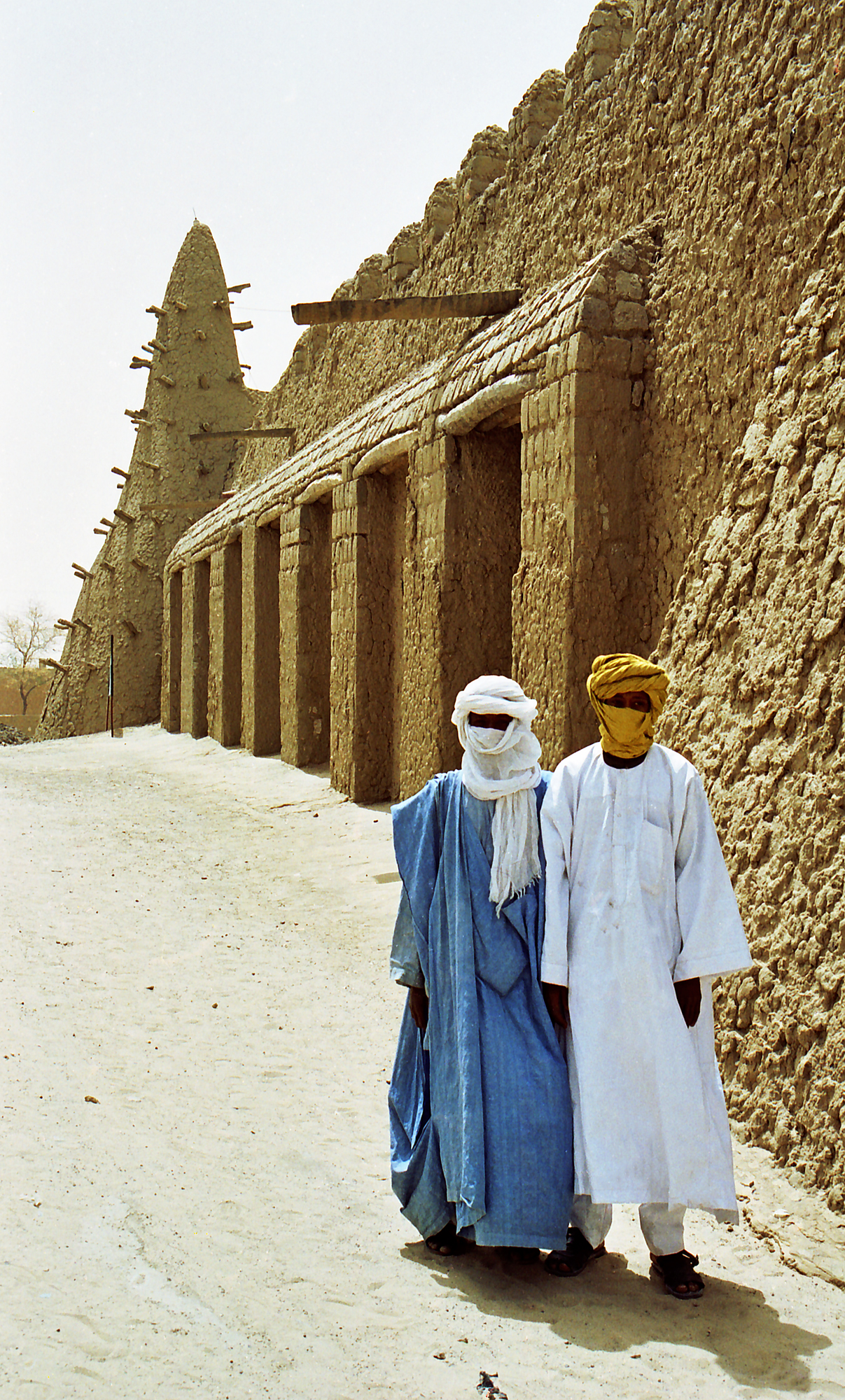
Timbuktu, incorporated into the Songhai Empire with Sunni Ali's conquest in 1468, was the intellectual jewel of the western Sudan. The city's three great mosques — Djinguereber, Sankore, and Sidi Yahia — served as centres of Islamic scholarship, and the Sankore complex functioned as what scholars have described as a university, with a decentralised system of instruction in which students moved between individual teachers who held classes in mosques, private homes, and outdoor spaces. The curriculum encompassed Quranic exegesis, Islamic jurisprudence (fiqh), Arabic grammar and rhetoric, logic, astronomy, mathematics, and history.5, 9
The scholarly culture of Timbuktu produced a rich manuscript tradition that has attracted intense scholarly attention. The Tarikh al-Sudan, composed by Abd al-Rahman al-Sa'di in the seventeenth century, and the Tarikh al-Fattash, attributed to Mahmud Kati and continued by his descendants, are the two most important narrative histories of the western Sudan, providing detailed accounts of the Songhai Empire, its rulers, wars, and institutions. The jurist Ahmad Baba al-Timbukti (1556–1627), one of the most celebrated scholars in the city's history, produced over forty works on Islamic law, theology, and biography before being deported to Morocco after the Moroccan conquest.1, 16
Estimates of the number of manuscripts produced and circulated in Timbuktu range widely, with some scholars suggesting that hundreds of thousands of manuscripts were produced over several centuries. Modern manuscript recovery projects have catalogued tens of thousands of surviving documents in private family libraries in Timbuktu and surrounding areas, covering subjects from theology and jurisprudence to astronomy, medicine, and mathematics. These manuscripts demonstrate that Timbuktu was integrated into the broader intellectual networks of the Islamic world, with scholars corresponding and exchanging texts with counterparts in Cairo, Fez, and the Hejaz.16, 10
Trans-Saharan trade and economy
The Songhai Empire's economic power rested on its control of the trans-Saharan trade, the centuries-old exchange of West African gold, enslaved persons, kola nuts, and other goods for Saharan salt and North African manufactures. The gold fields of Bambuk (between the Senegal and Faleme rivers) and Bure (on the upper Niger) produced the gold that was the most valuable commodity in the trans-Saharan exchange, and Songhai control of these regions and the trade routes connecting them to the Saharan crossings was the foundation of imperial revenue.13, 12
Salt, mined in massive slabs from the deposits at Taghaza and later Taoudeni in the central Sahara, was the other indispensable commodity. The salt trade was taxed by the Songhai state and was so lucrative that contemporary observers described salt as being worth its weight in gold in the markets of the Sahel, though the actual exchange ratios varied by location and period. The Songhai government maintained control of the salt mines and regulated the caravan traffic, extracting customs duties at key waypoints along the routes.8, 12
The trade in enslaved persons was a significant component of the trans-Saharan economy throughout the Songhai period. Captives taken in the empire's frequent military campaigns were exported northward across the Sahara to North African markets, where they entered the broader Mediterranean slave trade. The scale of this traffic is difficult to quantify, but it constituted a major element of the economic relationship between sub-Saharan West Africa and the Maghreb and contributed to the wealth of both Songhai elites and North African merchant communities.8, 6
The Moroccan invasion and collapse
The Songhai Empire's destruction came swiftly and from an unexpected direction. In 1591, Sultan Ahmad al-Mansur of Morocco dispatched an expeditionary force of approximately 4,000 men across the Sahara under the command of the Spanish-born general Judar Pasha. The Moroccan army was equipped with firearms — arquebuses and cannon — weapons that the Songhai military lacked. The two forces met at the Battle of Tondibi on 13 March 1591, where the Moroccan firearms proved devastating against the Songhai cavalry and infantry. Despite vastly outnumbering the Moroccans, the Songhai army was routed, and the empire's political structure collapsed with remarkable speed.11, 1
The Moroccan motivation for the invasion was primarily economic: control of the gold-producing regions of the western Sudan. Ahmad al-Mansur hoped to secure a direct supply of West African gold for his treasury, bypassing the intermediaries who had traditionally controlled the trans-Saharan trade. The immediate military objectives were achieved — the Moroccans occupied Timbuktu, Gao, and Djenné — but the broader economic goals were not. The gold fields proved too distant and too difficult to control from the occupied cities, and the Moroccan garrison (arma) in Timbuktu gradually lost effective contact with Morocco, becoming an autonomous ruling class that intermarried with local populations.11, 3
The fall of the Songhai Empire had far-reaching consequences for West Africa. The centralised political authority that had maintained security along the trade routes and regulated commerce was replaced by political fragmentation, as successor states, Tuareg confederations, and local polities competed for control of territory and trade. The trans-Saharan gold trade declined in relative importance as Atlantic maritime trade, increasingly dominated by European powers, redirected the flow of West African commerce toward the coast. The Kingdom of Benin and other coastal and forest states grew in significance as the Saharan interior declined. The intellectual culture of Timbuktu survived the conquest but never recovered its former vitality, though the manuscript traditions and scholarly lineages established during the Songhai period continued to shape Islamic learning in West Africa for centuries.14, 6
References
Timbuktu and the Songhay Empire: Al-Saʿdi’s Tarikh al-Sudan down to 1613 and Other Contemporary Documents