Overview
- Ancient Greece, spanning from the Bronze Age Mycenaean palaces (c. 1600 BCE) through the Hellenistic kingdoms conquered by Rome in 146 BCE, produced the Western world's foundational experiments in democratic governance, rational philosophy, empirical science, and literary culture within the distinctive political framework of the polis, or city-state.
- Athens pioneered direct democracy in the late sixth century BCE under the reforms of Cleisthenes, enabling perhaps 30,000–50,000 adult male citizens to participate in legislative assemblies and jury courts, while Sparta developed an alternative militaristic oligarchy — together illustrating the remarkable political diversity that coexisted within a shared Hellenic cultural identity.
- Greek intellectual achievements — including Aristotle's systematic natural philosophy, Hippocratic empirical medicine, Euclidean geometry, Herodotus's historiography, and the dramatic works of Sophocles and Euripides — were transmitted through Hellenistic Alexandria and Roman adoption to become the bedrock of Western scientific and humanistic traditions.
Ancient Greece encompasses the civilizations that arose in the Aegean basin and the wider eastern Mediterranean from the Bronze Age palatial societies of the second millennium BCE through the Hellenistic kingdoms that fell under Roman dominion in the mid-second century BCE.3 Within this span of roughly fifteen hundred years, Greek-speaking peoples developed the city-state (polis) as their characteristic political unit, pioneered democratic self-governance, laid the foundations of Western philosophy and natural science, and produced literary, artistic, and architectural traditions that have shaped European culture ever since.2, 3 Greece's mountainous terrain and extensive coastline fostered hundreds of independent communities rather than a single territorial empire, generating a competitive diversity of political systems, intellectual movements, and artistic styles that proved extraordinarily productive.1, 9 From the decipherment of Mycenaean Linear B tablets to the monumental library of Hellenistic Alexandria, the Greek world's cultural output forms an indispensable chapter in the anthropological study of how complex societies produce, transmit, and institutionalize knowledge.
Bronze Age origins and the Mycenaean world
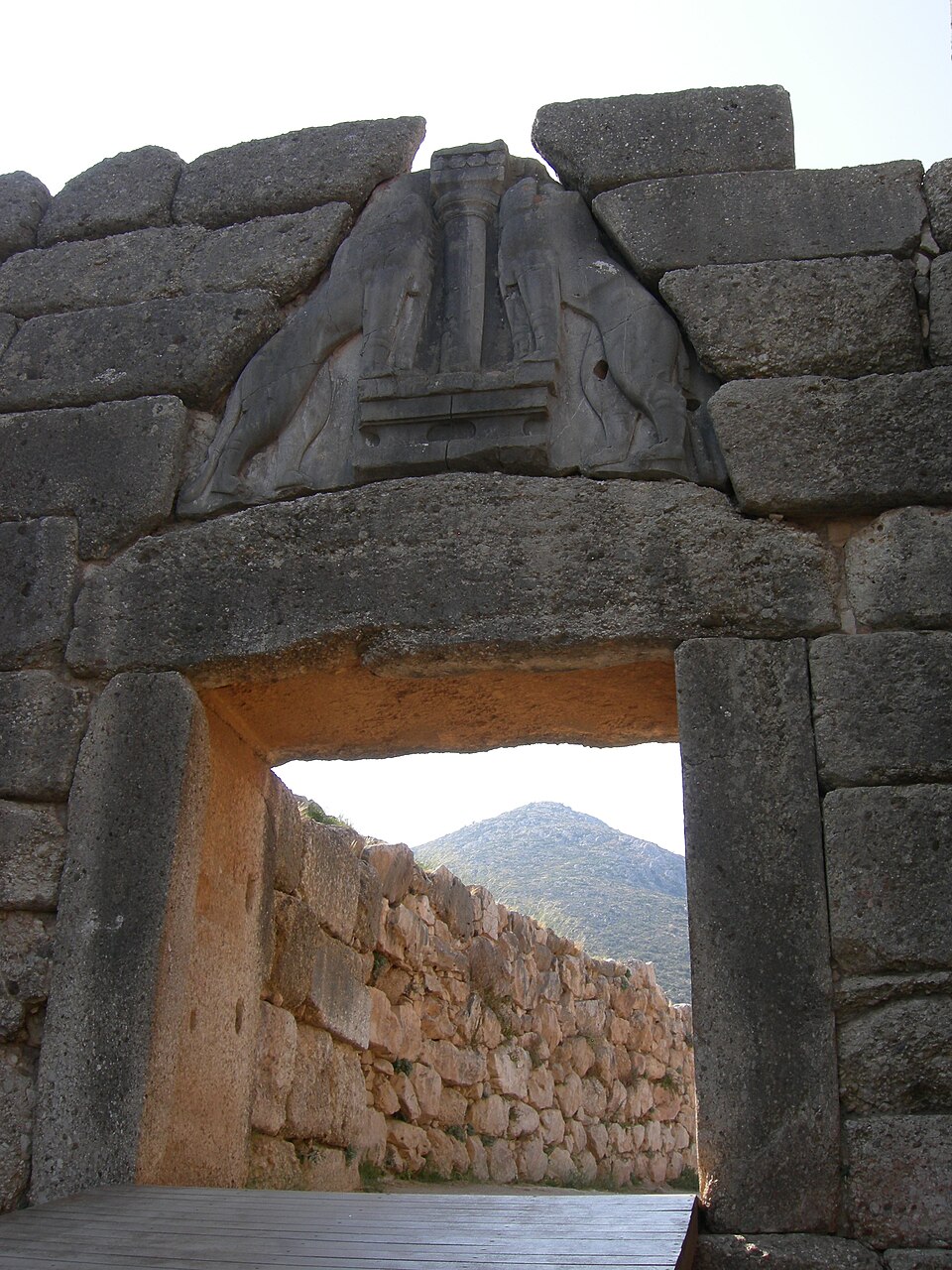

The earliest complex societies on the Greek mainland emerged during the Middle and Late Bronze Age (c. 2000–1100 BCE), building on a long Neolithic tradition of settled agriculture in Thessaly, the Peloponnese, and the Aegean islands.2 By around 1600 BCE, warrior elites at sites such as Mycenae, Tiryns, and Pylos had accumulated remarkable wealth, as demonstrated by the spectacular gold funerary masks, inlaid bronze weapons, and precious jewellery recovered from the Shaft Graves at Mycenae by Heinrich Schliemann in the 1870s.4, 16 These early palatial centres drew on Minoan Crete for artistic and administrative models, adopting the Linear A script and transforming it into Linear B — the earliest known form of written Greek, deciphered by Michael Ventris in 1952.4
At their height between roughly 1400 and 1200 BCE, Mycenaean palace-states controlled territories across the Peloponnese, central Greece, and parts of the Aegean, with administrative reach documented in the Linear B archives recovered from Pylos and Knossos.4, 2 These tablets reveal a heavily centralised redistributive economy in which palace bureaucracies tracked agricultural produce, livestock, textile production, metalwork, and labour obligations with meticulous detail.4 Mycenaean rulers constructed massive fortifications of enormous, roughly hewn limestone blocks — termed "Cyclopean" by later Greeks who believed only giants could have moved such stones — and elaborate tholos (beehive) tombs, the largest of which, the so-called Treasury of Atreus at Mycenae, features a corbelled dome spanning nearly 15 metres and rising to a height of 13.5 metres.16, 2
The Mycenaean world collapsed in a wave of destructions between approximately 1250 and 1100 BCE, part of a wider eastern Mediterranean crisis that also toppled the Hittite empire and disrupted Egyptian power.2, 14 The causes remain debated: drought, earthquake, internal social revolt, disruption of long-distance trade networks, and incursions by the enigmatic "Sea Peoples" have all been proposed, and most scholars now favour a multicausal explanation in which these stresses interacted to overwhelm palatial systems that depended on complex inter-regional exchange.2, 4 The subsequent period, conventionally called the Dark Age (c. 1100–800 BCE), saw a dramatic contraction of population, the loss of literacy, and the disappearance of monumental architecture, though recent archaeology has shown that continuity of settlement and cult practice was greater than earlier scholars assumed.1, 2
The rise of the polis
The most distinctive political innovation of ancient Greece was the polis, an autonomous community of citizens governing a defined territory that typically included an urban centre and its surrounding agricultural land (chora).1, 9 The polis emerged gradually during the eighth and seventh centuries BCE, a period of demographic recovery, renewed contact with the Near East and Egypt, the re-adoption of writing (now using an alphabet adapted from the Phoenician script), and the establishment of Greek colonies across the Mediterranean and Black Sea coasts.5, 1 By the Classical period, there were an estimated 1,000 to 1,500 poleis across the Greek world, ranging from tiny communities of a few hundred citizens to major powers such as Athens and Sparta.9
What distinguished the polis from earlier Near Eastern city-states was the principle that political authority resided in the citizen body rather than in a divine king or temple institution.7, 14 Citizenship entailed both rights — participation in governance, access to law courts, eligibility for public office — and obligations, above all military service in the hoplite phalanx, the densely packed infantry formation that became the standard mode of Greek warfare from the seventh century BCE onward.1, 7 The connection between military service and political participation was fundamental: the men who fought together to defend the community demanded a voice in its governance, and this nexus drove constitutional experimentation across the Greek world.9
The colonisation movement of the eighth through sixth centuries BCE dramatically expanded the geographic scope of Greek civilisation. Driven by population pressure, land hunger, commercial ambition, and factional strife, Greek cities founded daughter communities (apoikiai) from the western Mediterranean coast of modern Spain and France to the shores of the Black Sea.5 Major colonial foundations included Syracuse in Sicily (traditionally dated to 733 BCE), Massalia (modern Marseille, c. 600 BCE), and Byzantion (later Constantinople, c. 657 BCE).5, 3 These settlements served as vectors of cultural exchange, transmitting Greek language, religion, and artistic traditions to indigenous populations while channelling grain, metals, and enslaved persons back to the Aegean heartland.5, 15
Athens and the invention of democracy
The Athenian experiment in democratic governance stands as one of antiquity's most consequential political innovations. The roots of Athenian democracy lay in the crisis-driven reforms of the early sixth century BCE. In 594 BCE, the statesman Solon was appointed to resolve acute social conflict between indebted peasants and the landed aristocracy; he cancelled existing debts, abolished debt slavery, and reorganised the citizen body into four property classes with graduated political rights, thereby breaking the aristocratic monopoly on office-holding while stopping short of full popular sovereignty.3, 7
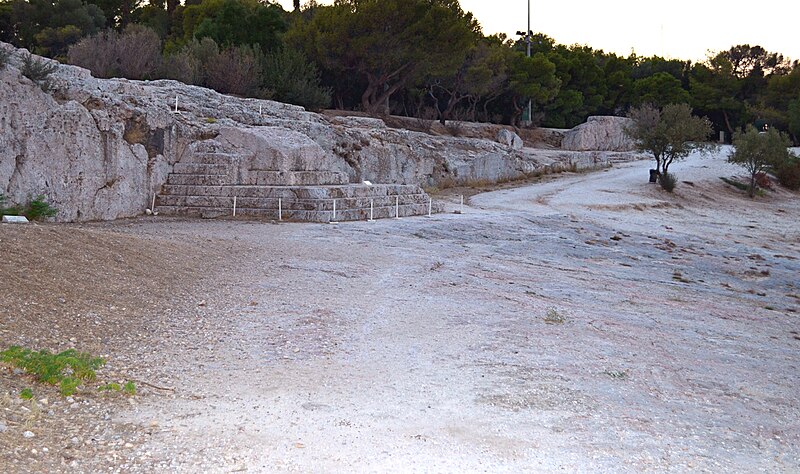

The decisive transformation came in 508/507 BCE, when Cleisthenes restructured the Athenian citizen body into ten new tribes, each composed of geographically diverse units (demes) drawn from the city, the coast, and the inland regions of Attica.6, 7 This reorganisation deliberately broke the power of regional aristocratic factions by mixing citizens of different localities into the same political units. Cleisthenes established the boule (council of 500), with fifty members from each tribe selected by lot, to prepare business for the sovereign citizen assembly (ekklesia), in which every adult male citizen could speak and vote.6, 3
At its fullest development in the fifth and fourth centuries BCE, Athenian democracy gave final decision-making power on legislation, war and peace, finance, and foreign policy to the ekklesia, which met approximately forty times per year and required a quorum of 6,000 for certain votes.6, 9 Most public offices were filled by sortition (random lottery) rather than election, on the principle that any citizen was competent to govern; only military commanders (strategoi) and certain financial officials were elected on the basis of expertise.6 The popular law courts (dikasteria), staffed by large juries of 201 to 2,501 citizens selected by lot and paid a daily stipend, exercised judicial review over officials and could invalidate legislation deemed contrary to established law.6, 3
The limitations of Athenian democracy were severe by modern standards. Women, enslaved persons, and foreign residents (metics) were entirely excluded from political participation, meaning that the citizen body of perhaps 30,000 to 50,000 adult males represented a minority of the total population of Attica, which may have reached 250,000 to 300,000 in the mid-fifth century BCE.6, 9 Slavery was integral to the Athenian economy, with enslaved people working in agriculture, mining, domestic service, and skilled crafts; the silver mines at Laurion, whose revenues financed the Athenian navy, were worked by thousands of enslaved labourers under notoriously harsh conditions.15, 3
Sparta and political diversity
If Athens exemplified democratic innovation, Sparta represented the opposite pole of Greek political organisation. Spartan society was structured around a rigidly stratified system in which a small elite of full citizens (Spartiates) dominated a much larger subject population.18, 3 At the base of this hierarchy were the helots, the enslaved agricultural population of Laconia and Messenia, who vastly outnumbered the Spartiate class and whose subjugation shaped every aspect of Spartan institutions.18 The constant threat of helot revolt drove the Spartans to maintain what was, in effect, a permanently mobilised military society.
The Spartan constitution, traditionally attributed to the semi-legendary lawgiver Lycurgus, combined monarchical, oligarchic, and democratic elements in a mixed system that ancient political theorists found fascinating.18, 3 Two hereditary kings drawn from separate royal houses served as military commanders and religious leaders; a council of elders (gerousia) comprising the two kings and 28 men over the age of 60 proposed legislation; and a citizen assembly (apella) of all Spartiates approved or rejected proposals, though its powers of initiative were limited.18 Five annually elected ephors exercised broad executive and judicial authority, including the power to discipline kings.
Spartiate males underwent the agoge, a rigorous state-directed education and training programme that began at age seven and continued until thirty, emphasising physical endurance, martial discipline, communal dining (syssitia), and obedience to the collective over individual desire.18, 17 This system produced the most formidable infantry in Greece: at the Battle of Thermopylae (480 BCE), a small Greek force led by 300 Spartans under King Leonidas famously held the narrow pass against the vastly larger Persian army for three days before being overwhelmed.3, 10 Yet the system contained the seeds of its own decline, as the number of full Spartiates shrank steadily from an estimated 8,000 in the early fifth century to fewer than 1,000 by the mid-fourth century, undermined by rigid inheritance laws that concentrated land in fewer hands and expelled impoverished citizens from the Spartiate class.18, 9
Estimated decline of the Spartiate citizen body18, 9
Philosophy and the birth of rational inquiry
The Greek intellectual revolution of the sixth through fourth centuries BCE marked a decisive turning point in human thought: the attempt to explain natural phenomena and human affairs through reason and observation rather than mythological narrative.13, 3 This movement began in Ionia, on the western coast of Asia Minor, where Thales of Miletus (c. 624–546 BCE) proposed that water was the fundamental substance underlying all matter — a claim whose specific content mattered less than its revolutionary method of seeking naturalistic explanations for the structure of the cosmos.13 Thales' successors in the Milesian school, Anaximander and Anaximenes, offered alternative cosmological theories, inaugurating a tradition of competitive rational argument that would define Greek intellectual life.13
The Presocratic tradition culminated in the atomic theory of Democritus (c. 460–370 BCE), who proposed that all matter consists of indivisible particles (atomoi) moving through void space — a remarkably prescient hypothesis that anticipated modern atomic theory in its fundamental intuition, though it lacked the empirical methodology to test or refine its claims.13, 8 Pythagoras and his followers developed the idea that mathematical relationships underlie natural phenomena, establishing connections between mathematics and music that influenced scientific thinking for millennia.13
In fifth-century Athens, Socrates (c. 470–399 BCE) redirected philosophical inquiry from cosmology to ethics, developing the dialectical method of systematic questioning to expose contradictions in conventional beliefs about virtue, justice, and the good life.3, 17 His pupil Plato (c. 428–348 BCE) founded the Academy, one of the first institutions of higher learning in the Western world, and developed a comprehensive philosophical system encompassing metaphysics (the Theory of Forms), epistemology, ethics, and political theory, articulated in dialogues that remain among the most influential philosophical texts ever written.3, 8
Aristotle (384–322 BCE), who studied at the Academy for twenty years before founding his own school, the Lyceum, pursued a programme of systematic empirical investigation across an extraordinary range of fields: logic, physics, biology, meteorology, psychology, ethics, politics, rhetoric, and poetics.8 His biological works alone described over 500 animal species based on direct observation and dissection, and his classification of logical argument forms in the Prior Analytics remained the standard framework for Western logic until the nineteenth century.8, 3 Aristotle's emphasis on systematic observation and classification of the natural world established a model of empirical inquiry that, transmitted through Islamic and medieval European scholars, became foundational for the development of modern science.8
War, rivalry, and the Classical period
The defining military conflict of the early fifth century BCE was the Persian Wars (490–479 BCE), in which a coalition of Greek poleis repelled two successive invasions by the Achaemenid Persian Empire, then the largest state in the world.3, 10 The Athenian victory at the Battle of Marathon (490 BCE) demonstrated that Greek hoplite infantry could defeat Persian forces in open battle; a decade later, the Greek naval triumph at Salamis (480 BCE) and the decisive land victory at Plataea (479 BCE) ended the Persian threat to the Greek mainland.3 These victories had profound cultural consequences, reinforcing Greek identity in opposition to "barbarian" Persia and fuelling the confidence that produced the artistic and intellectual achievements of the Classical period.3, 10
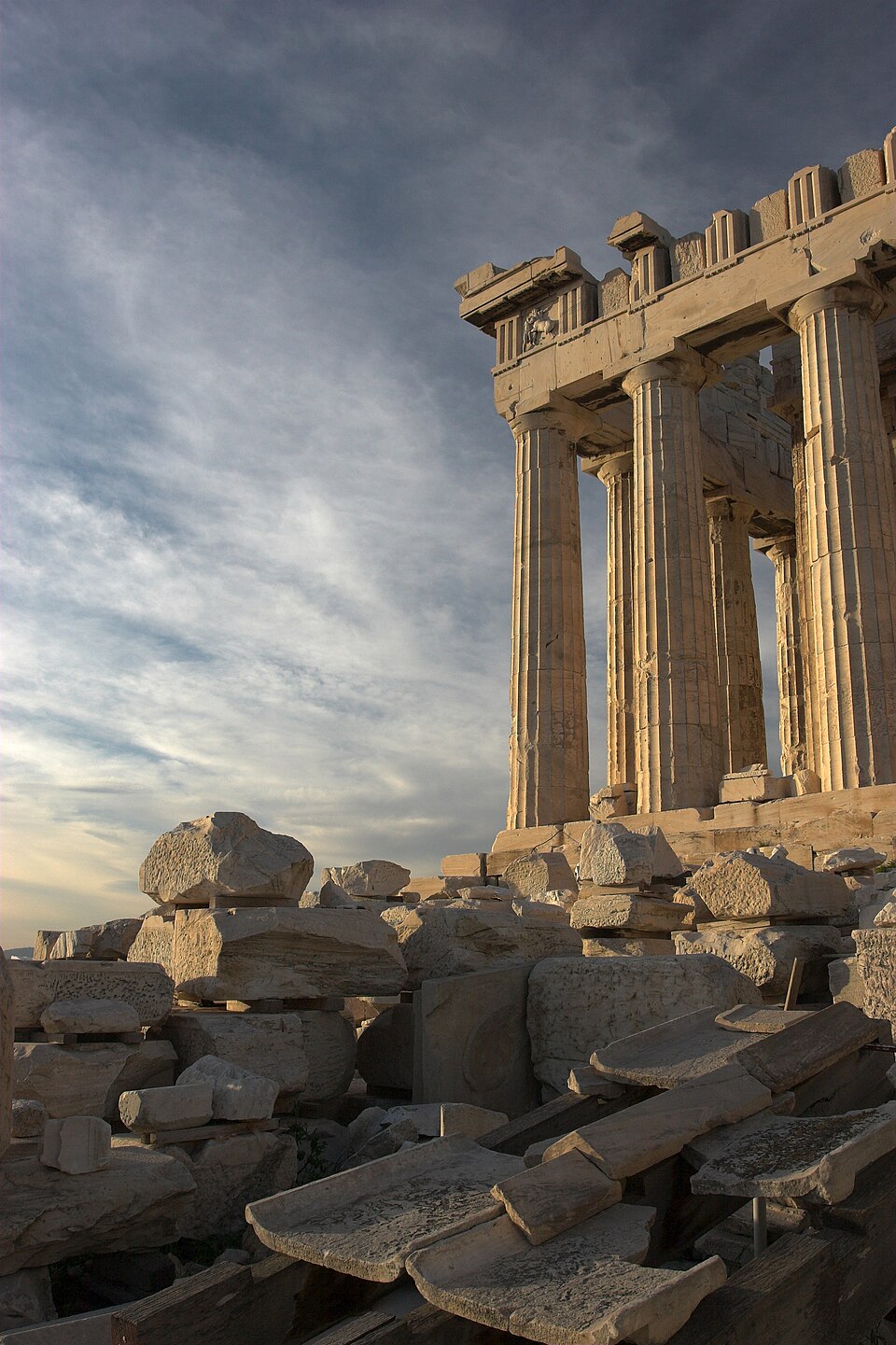

Athens leveraged its naval leadership during the Persian Wars to build the Delian League, an alliance of Aegean poleis that gradually transformed into an Athenian maritime empire.10, 9 The tribute revenues extracted from allied states financed the monumental building programme on the Athenian Acropolis, including the Parthenon (447–432 BCE), a Doric temple dedicated to Athena whose sculptural programme, designed under the direction of the sculptor Pheidias, represents one of the supreme achievements of Classical art.16, 3 Yet Athenian imperial ambition provoked growing resistance from Sparta and its Peloponnesian allies, culminating in the catastrophic Peloponnesian War (431–404 BCE).
The conflict, documented in meticulous detail by the Athenian historian Thucydides, devastated the Greek world over nearly three decades.10 Athens suffered a catastrophic plague in 430–426 BCE that killed perhaps one-quarter to one-third of the population, including the statesman Pericles; the disastrous Sicilian Expedition of 415–413 BCE destroyed the bulk of the Athenian fleet and army; and the final Spartan victory in 404 BCE, aided by Persian gold, brought democratic Athens to its knees.10, 3 Though Athens recovered its democracy within a year, the war permanently weakened the leading Greek poleis, created a power vacuum exploited successively by Sparta, Thebes, and ultimately Macedon, and shattered the ideal of pan-Hellenic solidarity that the Persian Wars had briefly fostered.10, 9
Art, religion, and cultural life
Greek religion was polytheistic, centred on a pantheon of anthropomorphic deities believed to inhabit Mount Olympus and to intervene in human affairs.21, 3 The twelve Olympian gods — Zeus, Hera, Poseidon, Demeter, Athena, Apollo, Artemis, Ares, Aphrodite, Hephaestus, Hermes, and either Hestia or Dionysus — received cult worship at temples and sanctuaries throughout the Greek world, but each polis also venerated local heroes, nymphs, and minor divinities tied to specific landscapes and communities.21 Religious practice revolved around animal sacrifice, votive offerings, prayer, and ritual processions rather than theology or doctrinal belief; orthopraxy (correct ritual performance) mattered more than orthodoxy (correct belief).21, 17
The great Panhellenic sanctuaries — Olympia, Delphi, Isthmia, and Nemea — served as centres of shared Hellenic identity, hosting athletic and artistic competitions that drew participants from across the Greek world.20, 3 The Olympic Games, traditionally dated to 776 BCE and held every four years at the sanctuary of Zeus at Olympia, were the most prestigious of these festivals, featuring foot races, wrestling, boxing, chariot racing, and the pentathlon.20 A sacred truce (ekecheiria) was declared for the duration of the games, allowing safe passage for athletes and spectators even during wartime, and Olympic victors received extraordinary honour in their home cities.20, 17
Greek art underwent a dramatic evolution from the abstract geometric patterns of the eighth century BCE through the idealised naturalism of the Classical period to the emotional intensity of the Hellenistic era.16 In sculpture, the progression from rigid, Egyptian-influenced kouroi (standing male figures) of the Archaic period to the balanced naturalism of Polykleitos's Doryphoros (c. 440 BCE) and the dynamic tension of Hellenistic works like the Laocoön group reflects a sustained engagement with the representation of the human body in motion and emotion.16, 3 Greek pottery, particularly the black-figure and red-figure wares produced in Athens from the sixth century BCE onward, provides an unparalleled visual record of Greek mythology, daily life, and social practices.16
The Athenian dramatic festivals, especially the City Dionysia, produced the tragedies of Aeschylus, Sophocles, and Euripides and the comedies of Aristophanes, works that explored fundamental questions of justice, fate, divine will, and human responsibility before audiences of 15,000 or more citizens assembled in the Theatre of Dionysus.3, 17 Herodotus (c. 484–425 BCE), the "father of history," composed the first systematic prose narrative of past events, investigating the causes of the Persian Wars through travel, interviews, and critical comparison of conflicting accounts, while his successor Thucydides developed a more rigorously analytical method that sought to identify the underlying political and economic forces driving human conflict.3
Economy and society
The Greek economy was fundamentally agricultural, with the majority of citizens in most poleis working small family farms that produced grain (primarily barley in mainland Greece, where wheat was less reliably cultivated), olives, and grapes — the so-called "Mediterranean triad" that formed the basis of the Greek diet.15, 3 The rocky, mountainous terrain of mainland Greece limited arable land, creating chronic food insecurity in many poleis and driving both colonisation and maritime trade.15 Athens, the most urbanised polis, was heavily dependent on imported grain, particularly from the Black Sea region and Egypt, and much of Athenian foreign policy was directed at securing these vital supply routes.15, 9
Maritime commerce expanded dramatically from the Archaic period onward, facilitated by the adoption of coined money (first introduced in Lydia in the seventh century BCE and quickly adopted by Greek cities), the development of commercial law and banking, and the growth of specialised trading communities in major ports such as Piraeus, Corinth, and Syracuse.15, 5 Josiah Ober has argued that the aggregate economic performance of the Greek world during the Classical and early Hellenistic periods was remarkably strong by premodern standards, with per capita consumption levels that would not be consistently exceeded in Europe until the early modern period, sustained by the competitive dynamics of the multi-polis system that rewarded institutional innovation.9
Greek medicine represented another domain in which empirical observation challenged traditional explanations. The Hippocratic corpus, a collection of roughly sixty medical texts composed between the fifth and fourth centuries BCE and attributed (mostly falsely) to Hippocrates of Cos, established the principle that disease had natural rather than supernatural causes and should be treated through observation, prognosis, and rational therapy.12 The Hippocratic text On the Sacred Disease explicitly rejected the idea that epilepsy was caused by divine possession, arguing instead for a physiological explanation rooted in the brain — a revolutionary stance that exemplified the broader Greek commitment to naturalistic explanation.12, 3
Alexander and the Hellenistic world
The rise of Macedon under Philip II (r. 359–336 BCE) fundamentally altered the political landscape of the Greek world. Through a combination of military innovation, diplomatic cunning, and the exploitation of inter-polis rivalries, Philip unified Macedon, subjugated Thrace and Illyria, and defeated the combined forces of Athens and Thebes at the Battle of Chaeronea (338 BCE), effectively ending the independence of the Greek poleis and establishing Macedonian hegemony over the Greek peninsula.11, 3
Philip's son Alexander the Great (r. 336–323 BCE), tutored in his youth by Aristotle, launched one of history's most extraordinary military campaigns, conquering the entire Achaemenid Persian Empire in a decade of relentless campaigning that carried Greek-Macedonian armies from Egypt to the borders of India.11 By the time of his death in Babylon at age 32, Alexander's empire stretched across roughly 5.2 million square kilometres, making it the largest state the world had yet seen.11, 19 His conquests spread Greek language, urban planning, and cultural institutions across western Asia and northeast Africa, creating a vast zone of cultural interaction that scholars term the Hellenistic world.
After Alexander's death, his empire fragmented into rival successor kingdoms (diadochoi): the Ptolemaic kingdom in Egypt, the Seleucid empire spanning Mesopotamia, Persia, and parts of Central Asia, and the Antigonid dynasty in Macedon and Greece, along with smaller states such as Pergamon and the Greco-Bactrian kingdom.19 The Hellenistic period (323–31 BCE) was characterised by the emergence of large, cosmopolitan cities, above all Alexandria in Egypt, founded by Alexander in 331 BCE, which grew to become the largest city in the Mediterranean world with a population that may have reached 500,000.19, 11 Alexandria's famous Library and Mouseion (Museum), patronised by the Ptolemaic kings, assembled the largest collection of texts in the ancient world and attracted scholars whose work in mathematics, astronomy, geography, medicine, and literary criticism built directly on Classical Greek foundations.19
Hellenistic science achieved remarkable advances. Euclid (fl. c. 300 BCE) systematised geometry in his Elements, which remained the standard textbook for over two thousand years; Archimedes of Syracuse (c. 287–212 BCE) made fundamental contributions to mathematics, physics, and engineering; Eratosthenes (c. 276–194 BCE) calculated the Earth's circumference with striking accuracy; and Aristarchus of Samos (c. 310–230 BCE) proposed a heliocentric model of the solar system some eighteen centuries before Copernicus.19, 3 The Hellenistic kingdoms were progressively absorbed by the expanding Roman Republic during the second and first centuries BCE, with the Roman destruction of Corinth in 146 BCE and the annexation of Ptolemaic Egypt in 30 BCE marking the conventional endpoints, but Greek language, philosophy, literature, and art profoundly shaped Roman culture, ensuring the transmission of the Greek intellectual heritage to the medieval and modern worlds.19, 3
References
The Cambridge Ancient History, Vol. III Part 3: The Expansion of the Greek World, Eighth to Sixth Centuries B.C.