Overview
- The Persian wars (499–449 BCE) were a series of conflicts between the Achaemenid Empire and an alliance of Greek city-states that produced some of antiquity's most celebrated battles — Marathon, Thermopylae, Salamis, and Plataea — and decisively shaped the political trajectory of the classical Mediterranean world.
- The Greek victories, achieved despite overwhelming Persian numerical superiority, were driven by the tactical advantages of heavy infantry (hoplite phalanx), the strategic exploitation of narrow terrain, Themistocles' decisive commitment to naval power at Salamis, and the unprecedented cooperation of normally fractious Greek poleis under Spartan and Athenian leadership.
- The wars' aftermath transformed Athens from a minor polis into an imperial naval power, catalysed the radical development of Athenian democracy under Pericles, and established the Delian League — ostensibly an anti-Persian alliance that rapidly evolved into an Athenian empire, setting the stage for the Peloponnesian War.
The Persian wars, the half-century of intermittent conflict between the Achaemenid Empire and the Greek city-states from approximately 499 to 449 BCE, constitute one of the defining episodes in the history of the ancient Mediterranean. A vast imperial power commanding resources from Egypt to Central Asia launched two major invasions of the Greek mainland, and on both occasions was defeated by a loose and quarrelsome coalition of small city-states whose combined population was a fraction of the empire's. The battles of Marathon, Thermopylae, Salamis, and Plataea became foundational narratives of Western civilization, and the wars' political consequences — the rise of Athenian democracy, the creation of the Delian League, and the emergence of Athens as an imperial power — shaped the trajectory of the classical Greek world for the next century.1, 2 The principal literary source for the wars, Herodotus' Histories, is itself one of the foundational texts of Western historical writing, composed within living memory of the events it describes and representing the first sustained attempt to explain a great historical conflict through systematic inquiry rather than myth or divine causation.1, 8

The Ionian Revolt (499–494 BCE)
The immediate cause of the Persian wars was the revolt of the Greek cities of Ionia, the central section of the western Anatolian coast, against Achaemenid rule. The Ionian Greeks had been incorporated into the Persian Empire following Cyrus the Great's conquest of Lydia in 546 BCE and were governed through local tyrants installed and maintained by Persian authority.1, 12 In 499 BCE, Aristagoras, the tyrant of Miletus, instigated a general revolt of the Ionian cities after a failed joint Ionian-Persian expedition against the island of Naxos. Aristagoras renounced his own tyranny, encouraging other Ionian cities to depose their Persian-backed tyrants, and travelled to mainland Greece seeking military assistance.1, 16
Sparta, the most powerful military state in Greece, refused to participate, but Athens and Eretria sent a small expeditionary force: twenty Athenian ships and five Eretrian. In 498 BCE, the combined Greek force marched inland and burned Sardis, the capital of the Persian satrapy of Lydia, an act of astonishing audacity that drew Persian attention to the Greek mainland for the first time.1, 2 The Athenians withdrew after the burning of Sardis, but the revolt continued for several years, spreading to Cyprus, the Hellespont, and Caria before being systematically suppressed by Persian forces. The decisive engagement was the naval Battle of Lade in 494 BCE, where a Persian fleet defeated the combined Ionian navy, and the revolt ended with the sack of Miletus, whose population was killed or enslaved.1, 10
The Ionian Revolt was militarily unsuccessful, but its strategic consequences were immense. Herodotus describes Athenian involvement as the "beginning of evils" for both Greeks and Persians, and from the Persian perspective, Athens and Eretria had committed an unforgivable act of aggression against the Great King's territory.1 Darius I, who had already been extending Persian influence into Europe through the conquest of Thrace and the subjugation of Macedonia, now had both strategic motivation and personal grounds for vengeance to direct a military expedition against the Greek mainland.12, 2 According to Herodotus, Darius appointed a servant to remind him three times at every dinner: "Master, remember the Athenians" — an anecdote that, whether literally true or not, captures the sense in which Athenian involvement in the revolt had made the Greek mainland a personal matter for the Great King.1
The Battle of Marathon (490 BCE)
Darius' first expedition against mainland Greece, launched in 490 BCE, was a seaborne campaign aimed primarily at punishing Athens and Eretria for their role in the Ionian Revolt. A Persian fleet carrying an army of perhaps 20,000 to 25,000 infantry and cavalry, commanded by the generals Datis and Artaphernes, crossed the Aegean, sacked Eretria, and landed at the bay of Marathon on the northeastern coast of Attica, approximately 40 kilometres from Athens.1, 4
The Athenians marched out to meet the Persians with a force of approximately 9,000 hoplites, supplemented by perhaps 1,000 Plataeans, the only Greek city to send aid. Sparta had promised assistance but claimed that religious obligations prevented them from marching until after the full moon, and their forces arrived only after the battle was over.1, 4 The Athenian commander Miltiades, who had personal knowledge of Persian military tactics from his earlier career as a vassal ruler in the Thracian Chersonese, devised the strategy that won the battle. He reinforced the wings of the Athenian line at the expense of the centre, then ordered an advance at the run across the final distance separating the two armies — a tactic designed to minimise the time Athenian hoplites would be exposed to Persian archery.1, 4, 3
The result was a decisive Greek victory. The strengthened Athenian wings routed the Persian flanks and then wheeled inward to envelop the Persian centre, which had pushed back the weakened Greek middle. Herodotus reports that 6,400 Persians fell against only 192 Athenians, figures that, while perhaps exaggerated, reflect the devastating advantage of heavily armoured hoplites in close combat against more lightly equipped Persian infantry.1, 4 The Athenian dead were cremated and buried in the soros, the great tumulus that still stands on the Marathon plain and has been confirmed by archaeological excavation to contain the cremated remains and grave goods of the fallen.13
Marathon's significance transcended the immediate military outcome. It was the first major Greek victory over a Persian army and proved that the hoplite phalanx could defeat Persian forces in open battle, shattering the aura of Persian invincibility. For Athens specifically, Marathon became the foundational myth of the democratic polis: it was the citizen-soldiers of Athens, fighting in their own defence rather than as subjects of a king, who had defeated the greatest empire in the world, and this narrative of democratic martial virtue would shape Athenian political identity for generations.2, 8
Xerxes' invasion (480–479 BCE)
The defeat at Marathon was an affront to Persian royal prestige that demanded retribution. Darius began preparations for a much larger expedition but died in 486 BCE before it could be launched. His son and successor Xerxes I spent several years assembling what Herodotus describes as the largest military force ever marshalled in the ancient world, though the Greek historian's figure of 1.7 million infantry is universally regarded by modern scholars as a massive exaggeration; estimates of the actual Persian land force typically range from 70,000 to 300,000, with the fleet numbering perhaps 600 to 1,200 warships.1, 2, 11
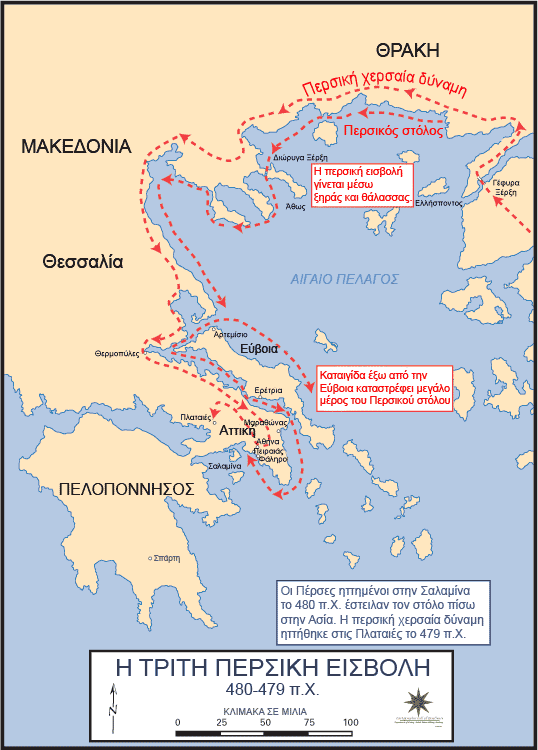
Xerxes' logistical preparations were impressive by any standard. He ordered the construction of a canal across the Athos peninsula to avoid the cape where a Persian fleet had been wrecked by storms in 492 BCE, and he had two pontoon bridges thrown across the Hellespont at Abydos, each over a kilometre long, to allow his army to cross from Asia into Europe without the delays and vulnerabilities of a naval transport.1, 12 Supply depots were established along the army's intended route through Thrace and Macedonia, reflecting an appreciation of the logistical challenges of maintaining a large force in hostile territory far from its base.12, 2
The Greek response to the invasion was an unprecedented, if imperfect, cooperation among normally antagonistic city-states. A congress of Greek poleis met at the Isthmus of Corinth in 481 BCE and formed a defensive alliance, the Hellenic League, under Spartan military leadership. Many Greek states, particularly those in the north most immediately threatened by the Persian advance, either submitted to Persia (a process the Greeks called "medising") or attempted to remain neutral; Herodotus notes that the number of Greeks who fought on the Persian side may have exceeded those who resisted.1, 2
Major battles of the Persian wars1, 3
| Battle | Date | Type | Result | Significance |
|---|---|---|---|---|
| Marathon | 490 BCE | Land | Greek victory | First major defeat of a Persian army; Athenian foundational myth |
| Thermopylae | 480 BCE | Land | Persian victory | Delayed Persian advance; Spartan heroic legend |
| Artemisium | 480 BCE | Naval | Inconclusive | Greek fleet withdrew after Thermopylae fell |
| Salamis | 480 BCE | Naval | Greek victory | Destroyed Persian naval superiority; Xerxes withdrew |
| Plataea | 479 BCE | Land | Greek victory | Destroyed Persian land army; ended invasion threat |
| Mycale | 479 BCE | Land/Naval | Greek victory | Liberated Ionian Greeks; opened Aegean to Greek fleets |
Thermopylae and Salamis
The first major engagement of Xerxes' invasion was the simultaneous battle at the narrow coastal pass of Thermopylae and the naval battle off Artemisium in the late summer of 480 BCE. The Greek strategy was to hold the Persians at Thermopylae, where the coastal road between Thessaly and central Greece was constricted to a narrow passage between mountains and the sea, while the allied fleet engaged the Persian navy at the nearby strait of Artemisium.1, 5
The Greek force at Thermopylae, commanded by the Spartan king Leonidas, numbered approximately 7,000 men, including 300 Spartans, 700 Thespians, and contingents from several other Greek cities. For two days, the Greeks held the pass against repeated Persian assaults, the narrow ground negating the Persians' numerical advantage and preventing the deployment of cavalry. On the third day, however, a local Greek named Ephialtes revealed to the Persians the existence of a mountain path (the Anopaea path) that allowed a Persian force to outflank the Greek position.1, 5 When Leonidas learned that the path had been turned, he dismissed most of the Greek force but remained with his 300 Spartans, the 700 Thespians, and 400 Thebans (the latter possibly held as hostages) to cover the retreat. The rearguard fought to the death, an act of self-sacrifice that became the most celebrated military episode in Greek history and an enduring symbol of resistance against overwhelming odds.5, 1
With Thermopylae lost, central Greece lay open to the Persian advance. Athens was evacuated, and the Persian army occupied and sacked the Acropolis. The decisive moment of the war came at Salamis, the narrow strait between the island of Salamis and the Attic coast, where the Greek fleet made its stand in September 480 BCE. The Athenian leader Themistocles had been the driving force behind Athens' transformation into a naval power in the preceding decade, persuading the assembly to use the revenues from a newly discovered vein of silver at Laurion to build a fleet of 200 triremes rather than distributing the windfall as a cash payment to citizens.14, 6
At Salamis, Themistocles manoeuvred the reluctant Greek allies into fighting in the narrow strait rather than retreating to the Isthmus of Corinth, reportedly by sending a secret message to Xerxes claiming that the Greek fleet was about to disperse, thereby inducing the Persians to commit to battle in confined waters where their numerical superiority could not be brought to bear.1, 6 The result was a devastating Persian defeat: the heavier, more manoeuvrable Greek triremes rammed and sank or disabled perhaps 200 to 300 Persian vessels in the narrow strait, while their own losses were comparatively light. Xerxes, who had watched the battle from a throne on the shore, withdrew with a large portion of his army to Asia, leaving his general Mardonius with a picked force to continue the campaign the following year.1, 6, 17
Military technology and tactics
The Persian wars were shaped fundamentally by the contrasting military systems of the two sides. The core of Greek military power was the hoplite phalanx, a formation of heavily armoured citizen-soldiers fighting shoulder to shoulder in a dense line typically eight ranks deep. Each hoplite carried a large round shield (the aspis), a thrusting spear approximately 2.5 metres long, and a short sword as a secondary weapon, and wore a bronze helmet, breastplate (or composite corslet), and greaves.3, 5 The weight of this equipment — roughly 30 kilograms in total — made the hoplite slow and vulnerable to missile fire at range, but in close combat the phalanx was devastating: the overlapping shields created a nearly continuous wall of bronze, and the mass of the formation, with each rank pushing the one ahead, generated enormous forward pressure that lighter-armed opponents found nearly impossible to resist.3, 11
The Achaemenid military system was fundamentally different. The Persian army was a multinational force drawn from across the empire's vast territories, organised by ethnic contingent, each fighting in its own traditional style. The elite of the Persian infantry were the 10,000 "Immortals" (Athanatoi), so called, according to Herodotus, because their number was always maintained at exactly ten thousand through immediate replacement of casualties.1, 12 Persian infantry typically fought with a shorter spear, a large wicker shield (spara), and a powerful composite bow, relying on massed archery to disrupt enemy formations before closing to melee. Persian cavalry, including both heavy lancers and mounted archers, provided tactical flexibility that the Greeks largely lacked, and the empire could deploy specialized troops — Scythian horse archers, Egyptian marines, Phoenician sailors — from across its subject territories.3, 12
The tactical dynamics of the Persian wars were thus shaped by a fundamental asymmetry: the Greeks held a decisive advantage in close infantry combat, while the Persians held advantages in ranged firepower, cavalry, and overall numbers. Greek strategy throughout the wars centred on forcing engagements in confined spaces — narrow passes on land (Thermopylae) and confined straits at sea (Salamis) — where the Persian numerical and cavalry advantages could not be brought to bear, and where the superior weight and cohesion of the hoplite phalanx or the heavier Greek triremes could prove decisive.3, 2 At sea, the Greek trireme was somewhat heavier and less manoeuvrable in open water than its Phoenician and Ionian counterparts in the Persian fleet, but its construction was more robust and its ram more effective in the close-quarters ramming engagements that confined waters produced.17, 6 The consistent Greek preference for fighting on terrain that neutralised Persian advantages represents one of the earliest documented examples of what modern military theory calls "asymmetric strategy" — deliberately choosing the conditions of engagement to offset an opponent's overall superiority.3
Plataea and the war's aftermath
The following summer, in 479 BCE, the two final decisive engagements of the invasion took place. The Battle of Plataea, fought on the Boeotian plain near the town of Plataea, was the largest land battle of the Persian wars. The Greek army, numbering perhaps 40,000 hoplites and a roughly equal number of light-armed troops under the Spartan regent Pausanias, faced Mardonius' Persian force of perhaps 70,000 to 120,000.1, 11 After several days of manoeuvring and a botched Greek night retreat that threatened to disintegrate the allied army, a Persian cavalry attack on the Spartan contingent precipitated a general engagement in which the heavily armoured Spartan and Tegean hoplites broke through the Persian centre, killing Mardonius. The destruction of the Persian field army at Plataea ended any realistic prospect of a renewed Persian invasion of Greece.1, 11, 3
On the same day, according to tradition, the Greek fleet under the Spartan king Leotychidas landed at Mycale on the Ionian coast and defeated the remnants of the Persian fleet that had been beached there, an action that effectively liberated the Ionian Greek cities and opened the eastern Aegean to Greek offensive operations.1, 10
The political consequences of the Greek victory were transformative, particularly for Athens. The contribution of Athenian naval power at Salamis — Athens had supplied roughly half of the allied fleet — established the city as the pre-eminent maritime power in the Aegean and provided the strategic foundation for its subsequent imperial expansion.9, 18 In 478/477 BCE, Athens assumed leadership of a new maritime alliance, the Delian League, ostensibly formed to continue the war against Persia and liberate the remaining Greek cities under Persian control. Member states contributed either ships or monetary tribute, which was stored at the sacred island of Delos.9, 18 Over the following decades, however, Athens gradually transformed the Delian League from a voluntary alliance into an Athenian empire, using the league's treasury (which was moved from Delos to Athens in 454 BCE) to fund the city's own building programme, including the Parthenon, and employing military force against member states that attempted to withdraw.9, 18
The Persian perspective and modern historiography
The traditional narrative of the Persian wars has been overwhelmingly shaped by Greek sources, particularly Herodotus, and this has produced a deeply one-sided account. From the Greek perspective, the wars were a struggle of freedom against despotism, of citizen-soldiers defending their homeland against an enslaved imperial army, a framing that has profoundly influenced Western political thought from antiquity to the present.1, 8 Modern scholarship, particularly the work of Pierre Briant and Amélie Kuhrt, has sought to recover the Persian perspective and to situate the Greek wars within the broader context of Achaemenid imperial administration and strategy.12, 7
From the Achaemenid perspective, the Greek campaigns were peripheral operations on the western edge of an empire that stretched from the Indus to the Nile. The Greeks were not a major strategic concern for the Persian Empire as a whole; the resources committed to the invasions, while substantial, represented only a fraction of the empire's total military capacity, and the loss of the Greek campaigns did not threaten the empire's survival or even its control over the Ionian coast, which remained contested for decades afterward.12, 7 Persian royal inscriptions make no mention of the Greek defeats at Marathon or Salamis, an omission that may reflect either deliberate suppression of unfavourable news or, more likely, the marginal importance of these events in the broader perspective of Achaemenid imperial history.7, 12
The archaeological evidence for the Persian wars is relatively sparse compared to the literary sources, but several discoveries have confirmed or illuminated aspects of the ancient accounts. The burial tumulus at Marathon has been excavated and confirmed as a genuine war grave. The Serpent Column, a bronze monument erected at Delphi from the spoils of Plataea and later moved to Constantinople (where it still stands in the Hippodrome), preserves the names of the 31 Greek states that participated in the resistance, providing an invaluable check on the literary tradition.13, 1 Underwater archaeology at Artemisium has recovered bronze and pottery artefacts consistent with a naval engagement, and geological studies of the Thermopylae pass have confirmed that the coastal geography in antiquity was significantly narrower than today, consistent with Herodotus' description of a defensive position where a small force could hold against vastly superior numbers.11, 5
The reliability of Herodotus as a historical source has itself been a subject of continuous debate since antiquity. Thucydides, writing a generation later, implicitly criticised Herodotus' methodology, and the Roman writer Plutarch composed an entire essay, On the Malice of Herodotus, accusing him of pro-Athenian bias and outright fabrication. Modern scholars generally regard Herodotus as a broadly reliable guide to the main sequence of events, while recognising that his accounts of specific battles contain exaggerations (particularly regarding Persian numbers), simplified tactical narratives, and episodes shaped by oral tradition and patriotic mythology rather than direct eyewitness testimony.1, 2 Other ancient sources, including Aeschylus' tragedy The Persians (472 BCE) — the earliest surviving Greek drama and a work composed by a veteran of both Marathon and Salamis — provide independent perspectives on the events, though they too are shaped by the conventions and purposes of their respective genres.8, 10
The legacy of the Persian wars in Western historical memory has been immense and often distorted. The wars established the enduring trope of "East versus West" that has shaped European self-understanding from antiquity through the Crusades to the modern era, frequently in ways that oversimplify the complex cultural exchanges and mutual influences between the Greek and Persian worlds.8, 12 Herodotus himself, despite his clear sympathy for the Greek cause, was remarkably even-handed in his treatment of Persian culture, expressing admiration for Persian customs and repeatedly noting the courage and skill of Persian soldiers. The reduction of his nuanced account to a simple freedom-versus-tyranny binary is a distortion that says more about the preoccupations of later readers than about the complex realities of the fifth-century Mediterranean world.1, 7