Overview
- Nubia, the region along the middle Nile south of Egypt, produced a succession of powerful kingdoms — Kerma (c. 2500–1500 BCE), Napata (c. 900–590 BCE), and Meroe (c. 590 BCE–350 CE) — that rivalled and at times surpassed their Egyptian neighbours in military power, monumental architecture, and long-distance trade.
- The Kushite 25th Dynasty (c. 747–656 BCE) reunified Egypt under Nubian rule, with pharaohs such as Piye and Taharqa restoring temples, reviving Old Kingdom artistic traditions, and governing an empire stretching from the confluence of the Blue and White Niles to the Mediterranean.
- Meroitic civilization developed Africa's first indigenous iron-smelting industry on a major scale, created an as-yet only partially deciphered alphabetic writing system, and built more pyramids than Egypt itself, demonstrating that Nubia was not a peripheral dependency but an independent centre of cultural innovation.
Nubia, the stretch of the Nile Valley extending from the First Cataract near Aswan in southern Egypt to the confluence of the Blue and White Niles near modern Khartoum, was home to some of the most powerful and enduring kingdoms of the ancient world. Far from being a mere periphery of pharaonic Egypt, Nubia developed its own traditions of statecraft, monumental architecture, writing, metallurgy, and religious practice across more than three millennia, producing the kingdoms of Kerma, Napata, and Meroe in succession.1, 11 The Nubian 25th Dynasty even conquered and ruled all of Egypt for nearly a century, and the Meroitic kingdom that followed built more pyramids than Egypt itself, smelted iron on an industrial scale, and created an indigenous alphabetic script that remains only partially deciphered.4, 15 The history of Nubia thus challenges any framework that treats sub-Saharan Africa as peripheral to the story of ancient civilization; instead, the Nubian kingdoms stand as one of Africa's most significant independent contributions to the human cultural record.1, 2

Despite this significance, Nubia has received far less scholarly and public attention than its northern neighbour. Colonial-era Egyptology tended to treat Nubian cultures as derivative of Egyptian civilization, an assumption that archaeological research over the past century has progressively dismantled. Major excavation campaigns — from George Reisner's early twentieth-century work at Kerma and the royal cemeteries of el-Kurru and Nuri, through the UNESCO salvage campaigns prompted by the construction of the Aswan High Dam in the 1960s, to Charles Bonnet's ongoing excavations at Kerma — have revealed a civilization of remarkable originality and sophistication.5, 6, 19 This article surveys the major Nubian kingdoms from Kerma through the decline of Meroe, examining their political structures, material culture, interactions with Egypt, and lasting contributions to African and world history.
Geography and environment
The Nubian landscape differed fundamentally from the broad, fertile floodplain of Egypt. South of the First Cataract, the Nile cut through hard crystalline rock, producing a series of six cataracts — stretches of rapids and shallow water that divided the river into navigable segments and created natural boundaries between regional polities.11, 17 The cultivable floodplain in Upper Nubia was narrower than in Egypt, often restricted to a strip only a few hundred metres wide hemmed in by desert on both sides. This meant that Nubian agriculture, while productive, could never support the population densities characteristic of the Egyptian Nile Valley, and Nubian economies relied more heavily on pastoralism, trade, and the exploitation of mineral resources than their Egyptian counterparts.11, 1
The region's mineral wealth, however, was extraordinary. Nubia possessed some of the ancient world's richest gold deposits, concentrated in the Eastern Desert and the Wadi Allaqi region, and the very name "Nubia" may derive from the ancient Egyptian word nebu, meaning gold.20, 8 In addition to gold, Nubia was a source of ebony, ivory, incense, exotic animal skins, and semi-precious stones, all of which were highly prized commodities in the ancient Mediterranean world. Control of these resources and of the trade routes that carried them northward to Egypt and beyond was a primary driver of state formation in Nubia throughout its history.11, 7
The stretch of the Nile between the Third and Sixth Cataracts, known as the Dongola Reach and the Shendi Reach, offered the most favourable conditions for agriculture and settlement in Upper Nubia. The Dongola Reach, where the Kerma kingdom arose, benefited from a relatively broad floodplain and a gentler gradient, while the Shendi Reach, the heartland of the later Meroitic kingdom, lay in a zone where seasonal rainfall supplemented Nile-fed irrigation, allowing cultivation beyond the immediate floodplain.11, 17 The Island of Meroe, the triangular region bounded by the Nile, the Atbara River, and the Blue Nile, received enough summer rain to support savanna grasslands and seasonal grazing, making it a richer ecological zone than the arid expanses farther north. This environmental gradient had profound consequences for the political and economic character of the successive Nubian kingdoms: Kerma and Napata were oriented primarily toward Egypt and the Nile trade corridor, while Meroe, located farther south, could draw on both Nilotic and African hinterland resources.1, 4
The Kerma kingdom (c. 2500–1500 BCE)
The earliest major Nubian state was the kingdom of Kerma, centred on a site near the Third Cataract in what is now northern Sudan. Kerma represents the oldest known urban centre in sub-Saharan Africa and the first Nubian polity to achieve the scale and complexity of a true state.3, 19 The site was first excavated by George Reisner between 1913 and 1916, and subsequent campaigns directed by Charles Bonnet from the 1970s onward have greatly expanded understanding of the settlement's layout, chronology, and material culture.5, 19
The city of Kerma was dominated by two massive mud-brick structures known as deffufas: the Western Deffufa, a monumental temple or ceremonial building rising over 18 metres in height, and the Eastern Deffufa, associated with funerary rituals in the adjacent royal cemetery.3, 19 The construction technique of the deffufas — solid mud-brick cores with whitewashed exteriors — was distinctly Nubian rather than Egyptian in character, demonstrating that Kerma's monumental architecture represented an indigenous tradition rather than an imitation of pharaonic models. The city also contained workshops for bronze-working, pottery production, and other crafts, along with residential quarters and storage facilities that supported a population of several thousand.3, 11
The royal cemetery at Kerma provides some of the most dramatic evidence for the kingdom's wealth and the power of its rulers. Over the course of the kingdom's history, royal tumuli grew progressively larger, with the largest measuring over 90 metres in diameter.3, 5 The burials of the Classic Kerma period (c. 1750–1500 BCE) included extraordinary quantities of grave goods: gold jewellery, faience ornaments, bronze weapons, fine pottery, and imported Egyptian luxury objects. Most strikingly, the largest royal tumuli contained the remains of hundreds of sacrificial attendants — as many as 300 to 400 individuals in the greatest tombs — suggesting a system of retainer sacrifice that exceeded anything documented in Egypt and ranks among the most extensive known from any ancient civilization.3, 1
Kerma maintained a complex relationship with Egypt that oscillated between trade, diplomacy, and open warfare. During the Egyptian Middle Kingdom (c. 2055–1650 BCE), the pharaohs of the Twelfth Dynasty constructed a chain of massive fortresses at the Second Cataract, partly to regulate trade and partly as a defensive barrier against Kerma's growing power.8, 7 Inscriptions from the reign of Senusret III reveal an Egyptian attitude of fear and hostility toward the Nubians, describing them as cowardly yet dangerous adversaries. During the Second Intermediate Period (c. 1650–1550 BCE), when Egypt was divided between the Hyksos rulers in the Delta and the Theban dynasty in Upper Egypt, Kerma seized the opportunity to expand northward, occupying the Egyptian fortresses at the Second Cataract and establishing diplomatic contacts with the Hyksos against their common Theban enemy.8, 3 This alliance demonstrates that Kerma was operating as a major political player in the broader geopolitics of the Nile Valley, not merely a local chiefdom.
The kingdom of Kerma was ultimately destroyed by the expansionist pharaohs of Egypt's New Kingdom. Thutmose I (c. 1504–1492 BCE) campaigned deep into Nubia, reaching at least the Fourth Cataract, and his successor Thutmose III completed the conquest, reducing Kerma to an Egyptian colonial territory administered by a viceroy bearing the title "King's Son of Kush."8, 11 For the next five centuries, Nubia was governed as a province of the Egyptian empire, during which time Egyptian temples, administrative centres, and cultural practices were imposed across the region, profoundly shaping the cultural landscape from which later Nubian kingdoms would emerge.
Timeline of major Nubian kingdoms1, 4
| Period | Approximate dates | Capital | Key features |
|---|---|---|---|
| Kerma | c. 2500–1500 BCE | Kerma | Deffufas, royal tumuli, retainer sacrifice, gold trade |
| Egyptian colonial period | c. 1500–1070 BCE | Various provincial centres | Viceregal administration, temples at Abu Simbel, Soleb |
| Napatan kingdom | c. 900–590 BCE | Napata (Jebel Barkal) | 25th Dynasty rule over Egypt, Amun worship, el-Kurru/Nuri pyramids |
| Meroitic kingdom | c. 590 BCE–c. 350 CE | Meroe | Iron smelting, Meroitic script, pyramids, Kandake queens |
The Napatan period and the 25th Dynasty
After the collapse of Egyptian colonial administration in Nubia around 1070 BCE, coinciding with the end of the New Kingdom, the political history of the region becomes obscure for roughly two centuries. By about 900 BCE, however, a new Nubian kingdom had emerged with its political and religious centre at Napata, near the Fourth Cataract, at the foot of Jebel Barkal, a flat-topped sandstone mountain that both Egyptians and Nubians regarded as sacred to the god Amun.4, 17 The Napatan rulers adopted many elements of Egyptian royal culture, including the worship of Amun, the construction of temples in Egyptian architectural style, and the use of Egyptian hieroglyphic writing for royal inscriptions. Yet their kingdom was distinctly Nubian in character, governed from a Nubian heartland and drawing on Nubian traditions of military organisation, burial practice, and material culture.4, 1
The royal cemetery at el-Kurru, excavated by Reisner in the early twentieth century, provides the earliest evidence for the Napatan royal line. The earliest burials at el-Kurru were traditional Nubian tumulus graves, but over successive generations they evolved toward Egyptian-style pyramidal superstructures, reflecting the progressive adoption of Egyptian funerary traditions by the Nubian elite.6, 4 By the mid-eighth century BCE, the Napatan kings had amassed sufficient military power to intervene in the affairs of a politically fragmented Egypt. Around 747 BCE, King Piye (also known as Piankhy) led a military campaign northward through Egypt, defeating a coalition of Libyan dynasts and local rulers to establish Kushite control over the entire Nile Valley from Napata to the Mediterranean Delta.8, 4
Piye's conquest inaugurated the 25th Dynasty of Egypt, often called the Kushite or Nubian Dynasty, which lasted approximately a century (c. 747–656 BCE). Piye himself, after his campaign of conquest, returned to Napata, where he was eventually buried beneath a pyramid at el-Kurru — the first pyramid constructed in the Nile Valley in over 500 years.6, 4 His successors, particularly Shabaqo and Taharqa, ruled as pharaohs from Memphis and Thebes while maintaining their Nubian identity and connection to Napata. Taharqa (c. 690–664 BCE) was the most powerful of the Kushite pharaohs, undertaking an ambitious programme of temple construction and restoration across both Egypt and Nubia.8, 4 At Karnak, Taharqa built a colonnade in the First Court and restored structures throughout the temple complex; at Jebel Barkal, he constructed a rock-cut temple and expanded the Amun temple precinct to rival the great sanctuaries of Thebes.4, 10
The 25th Dynasty pharaohs consciously revived the artistic and religious traditions of Egypt's Old and Middle Kingdoms, which they regarded as the classical age of Egyptian civilization. Royal portraits adopted the idealised, broad-shouldered style of Old Kingdom sculpture, inscriptions revived archaic spellings and formulae, and funerary practices were reformed to align with what the Kushite rulers understood as authentic Egyptian tradition.10, 4 This cultural programme was not mere imitation but rather a deliberate assertion of legitimacy: by presenting themselves as restorers of ancient orthodoxy, the Kushite pharaohs positioned their rule as a correction to the disorder and cultural decline of the preceding Libyan dynasties.4, 8
The 25th Dynasty ended through Assyrian intervention. The expanding Neo-Assyrian Empire under Esarhaddon invaded Egypt in 671 BCE, capturing Memphis and forcing Taharqa to retreat southward. A second Assyrian invasion under Ashurbanipal in 663 BCE penetrated as far south as Thebes, which was sacked, definitively ending Kushite control over Egypt.8, 4 The Kushite rulers withdrew to their Nubian heartland, where they continued to rule as kings of Kush from Napata and, eventually, Meroe, for another millennium.
The Meroitic kingdom (c. 590 BCE–c. 350 CE)
Sometime around 590 BCE, the royal capital appears to have shifted southward from Napata to Meroe, a city located between the Fifth and Sixth Cataracts on the east bank of the Nile, in the heart of the so-called Island of Meroe. The reasons for this shift are debated: an Egyptian military campaign by Psamtik II in 593 BCE may have threatened Napata, or the move may have reflected a longer-term economic reorientation toward the richer agricultural and pastoral lands of the southern Nile and the trade routes connecting the Nile Valley to the Red Sea coast and the African interior.4, 13 Regardless of the immediate cause, the relocation marked the beginning of a new and remarkably long-lived phase of Nubian civilization: the Meroitic kingdom endured for nearly a thousand years, making it one of the longest-lived states in African history.4, 1
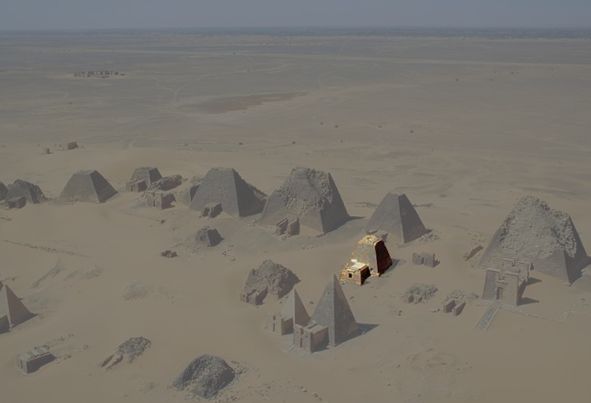
The city of Meroe itself was a substantial urban centre covering at least 1.5 square kilometres, with a walled royal quarter containing palaces, temples, and a Roman-style bath, surrounded by residential areas, workshops, and extensive industrial facilities.13, 18 The most archaeologically prominent feature of the site is the series of pyramid cemeteries to the east of the city, where over 200 pyramids — steep-sided, relatively small structures quite distinct in form from their Egyptian predecessors — served as royal and elite tombs over the course of the Meroitic period.4, 6 These Meroitic pyramids, with their characteristic steep angles of roughly 70 degrees and attached funerary chapels decorated with carved relief panels, represent a distinctively Nubian adaptation of the Egyptian pyramid tradition. The sheer number of pyramids at Meroe and the nearby cemeteries of Begrawiya North and South exceeds the total number of pyramids built in Egypt itself.2, 4
One of the most significant achievements of the Meroitic period was the development of large-scale iron production. Enormous slag heaps surrounding the city of Meroe, first noted by the archaeologist A. H. Sayce in 1911 and subsequently investigated by Peter Shinnie and others, attested to iron smelting on an industrial scale.13, 14 Recent archaeometric studies by Jane Humphris and Thilo Rehren have confirmed that iron production at Meroe was substantial, though perhaps not as continuously intensive as earlier scholars such as Arkell had suggested when he labelled Meroe "the Birmingham of Africa."14 Radiocarbon dates indicate that iron smelting at Meroe was well established by the third century BCE and continued for several centuries, using local wood and charcoal as fuel. The role of Meroe in the broader diffusion of ironworking across sub-Saharan Africa remains a subject of active debate; while some scholars have argued that Meroe served as a conduit for iron technology spreading southward and westward, others point to independent centres of iron production in West Africa and the Great Lakes region that developed along separate trajectories.14, 1
The Meroitic kingdom also witnessed a distinctive evolution in political institutions. The role of queens, known in Greek sources as Kandake (Latinised as Candace), was unusually prominent by the standards of the ancient world. Several women ruled as sole monarchs during the Meroitic period, including Amanirenas, who led Kushite forces against a Roman invasion under Petronius in 24 BCE, ultimately negotiating a favourable peace treaty with Augustus that established a stable frontier at Maharraqa near the First Cataract.4, 12 The prominence of royal women is also reflected in the art and mortuary practices of the period: queens received pyramid burials comparable to those of kings and were depicted in temple reliefs with the same iconographic attributes of divine power.10, 4
Writing systems and the Meroitic script
The Nubian kingdoms employed several writing systems across their long history, reflecting both Egyptian cultural influence and indigenous innovation. During the Napatan period, royal inscriptions were composed in Egyptian hieroglyphics and written in the Egyptian language, a practice that underscored the Kushite rulers' claim to pharaonic legitimacy.4, 15 The longest and most important of these inscriptions, the Victory Stele of Piye, is one of the most detailed narrative texts to survive from the ancient Nile Valley, recounting Piye's military campaign through Egypt in vivid and sometimes surprisingly personal detail.4
Beginning in the second century BCE, however, the Meroitic kingdom developed its own indigenous writing system, known as Meroitic script. This script existed in two forms: a hieroglyphic version used primarily for monumental inscriptions, and a cursive version employed for everyday administrative and funerary texts.15, 16 Unlike Egyptian hieroglyphics, which are logographic and syllabic, the Meroitic script was alphabetic, comprising 23 signs representing individual consonants and vowels — a conceptual innovation that made it the earliest known alphabetic writing system indigenous to Africa.16 The script was deciphered phonetically in 1911 by the British Egyptologist Francis Llewellyn Griffith, who was able to identify the sound values of most signs by comparing Meroitic and Egyptian versions of royal names. However, the underlying Meroitic language remains only partially understood, as it belongs to no well-documented language family and the corpus of surviving texts, while substantial (over 1,200 inscriptions are known), consists largely of formulaic funerary and dedicatory texts that provide limited linguistic context for the vocabulary.15, 16
Recent work by the French linguist Claude Rilly has made significant progress in understanding the grammar and vocabulary of the Meroitic language, proposing that it belongs to the Northern Eastern Sudanic branch of the Nilo-Saharan language family and identifying cognates with modern Nubian languages.15 If this classification is correct, it would establish a linguistic continuity in the middle Nile Valley spanning at least two millennia. Nevertheless, the full decipherment of Meroitic remains one of the great unsolved problems in ancient linguistics, and many texts can be read aloud but not understood in their entirety.16, 1
Religion and cultural life
The religious traditions of the Nubian kingdoms reflected a complex synthesis of Egyptian and indigenous African elements. The worship of Amun, the supreme deity of the Egyptian state religion, was central to Nubian royal ideology from the Napatan period onward. The Amun temple at Jebel Barkal was the most important sanctuary in the Kushite realm, regarded as the southern counterpart of Karnak and the site where Amun was believed to dwell within the sacred mountain itself.4, 10 Napatan and Meroitic kings derived their legitimacy from the god Amun, and royal inscriptions frequently describe the king's accession as an act of divine election by Amun, who chose the ruler from among the royal family through an oracular process.4
Alongside Amun, the Nubian kingdoms venerated distinctively Nubian deities who had no Egyptian equivalent. The lion-headed warrior god Apedemak was the most important of these, worshipped primarily in the southern part of the kingdom at temples in Naqa, Musawwarat es-Sufra, and Meroe itself.10, 4 Temple reliefs depict Apedemak as a fierce protective deity, sometimes shown with multiple arms or emerging from a lotus flower, iconographic motifs that some scholars have suggested may reflect contact with South Asian artistic traditions, perhaps transmitted via Red Sea trading networks, although this remains speculative.10, 9 Other distinctively Nubian deities included Sebiumeker and Arensnuphis, both associated with creation and fertility, whose worship demonstrates that Meroitic religion was not simply a transplanted version of Egyptian faith but a living tradition that synthesised multiple cultural influences.4, 10
Meroitic temple architecture evolved its own distinctive conventions. The Lion Temple at Naqa, built by King Natakamani and Queen Amanitore in the first century CE, combines Egyptian-style pylons and relief decoration with Nubian elements, including the prominent depiction of the royal couple smiting enemies on both faces of the pylon — a symmetry of male and female royal power that is distinctively Meroitic.10, 2 The nearby Kiosk at Naqa, a small open-sided temple, combines Egyptian columns with Roman arches, Hellenistic decorative elements, and Meroitic iconographic programmes, producing a synthesis of architectural traditions unlike anything else in the ancient world.10 These architectural hybrids demonstrate the cosmopolitan character of the Meroitic kingdom, which maintained contact with the Mediterranean, the Red Sea world, and the African interior simultaneously.
Funerary culture in Nubia maintained its own traditions throughout the period of the kingdoms. The practice of pyramid burial, adopted from Egyptian models during the Napatan period, persisted at Meroe for over 600 years but evolved distinctively Nubian characteristics, including the steep-sided form, the attached offering chapel, and the inclusion of distinctively Nubian grave goods alongside Egyptian-style funerary equipment.6, 4 Meroitic funerary stelae inscribed in the Meroitic cursive script record offering formulae and biographical details, though their precise meaning often remains elusive due to the incomplete decipherment of the language.16
Trade networks and economic life
The economic foundation of the Nubian kingdoms rested on three pillars: agriculture, pastoralism, and long-distance trade. Agriculture in the Nile floodplain produced cereals, particularly sorghum and millet (which were better adapted to the local climate than the wheat and barley dominant in Egypt), supplemented by dates, legumes, and other crops.11, 17 Pastoralism was more important in Nubia than in Egypt, with cattle holding particular economic and symbolic significance. The large cattle burials found in Kerma-period graves and the prominence of cattle imagery in Meroitic art suggest that cattle wealth was a key marker of elite status throughout Nubian history.3, 1
Long-distance trade was the great engine of Nubian political power and cultural exchange. From the earliest periods, Nubia served as a conduit for the movement of luxury goods between sub-Saharan Africa and the Mediterranean world. Gold, ivory, ebony, incense, exotic animal skins, and live animals (including baboons, giraffes, and leopards) flowed northward from Nubia to Egypt and onward to the wider Mediterranean, while Egyptian manufactured goods, including fine pottery, linen, oils, wine, and faience objects, moved southward into Nubia.20, 7 The Nubian kingdoms' strategic position along this trade corridor was arguably their greatest geopolitical asset, and control of the gold trade in particular was a persistent source of conflict between Egyptian and Nubian powers.20, 8
During the Meroitic period, trade networks expanded significantly. The kingdom maintained commercial contacts with Ptolemaic and Roman Egypt, exchanging African luxury goods for Mediterranean manufactured products. Imported Roman bronze vessels, glassware, and pottery have been found at Meroitic sites, and the Augustan-era geographer Strabo described Meroe as an important trading centre.4, 12 The Red Sea port of Adulis (in modern Eritrea) and Indian Ocean trade routes provided additional commercial connections, and Meroitic trade goods have been identified as far afield as India. A particularly important trade route connected Meroe to the Red Sea coast via the Atbara Valley, facilitating participation in the lucrative Indian Ocean commerce that intensified during the Hellenistic and Roman periods.4, 9
Archaeological discovery and modern legacy
The archaeological exploration of Nubia has been shaped by both scholarly inquiry and the destructive forces of modern development. The earliest systematic excavations were conducted by George Reisner, who between 1907 and 1932 excavated the royal cemeteries at el-Kurru, Nuri, Jebel Barkal, and Meroe for the Harvard University–Museum of Fine Arts, Boston expedition.5, 6 Reisner's work established the basic chronological framework for Nubian history that is still used today, though his interpretive framework was deeply coloured by the racial assumptions of his era: he initially attributed the Napatan-Meroitic civilization to a "Libyan" ruling class, an interpretation that has been thoroughly rejected by subsequent scholarship.6, 1
The most transformative episode in Nubian archaeology was the UNESCO International Campaign to Save the Monuments of Nubia (1960–1980), prompted by the construction of the Aswan High Dam, which threatened to submerge much of Lower Nubia beneath the waters of Lake Nasser. This campaign, which involved archaeological teams from over 50 countries, resulted in the systematic survey and excavation of hundreds of sites and the physical relocation of major monuments, including the temples of Abu Simbel and Philae.11, 2 While the campaign saved many individual monuments, it also resulted in the permanent flooding of vast archaeological landscapes whose potential for future research was irretrievably lost. Paradoxically, the campaign's very success in publicising the threat to Nubian monuments also drew unprecedented international attention to Nubian civilization and stimulated a new generation of scholarly interest.11
More recent excavations have continued to reshape understanding of Nubian civilisation. Charles Bonnet's ongoing work at Kerma has revealed the full extent of the ancient city and its deffufas, while excavations at Doukki Gel, just south of Kerma, have uncovered a series of monumental buildings combining Egyptian, Nubian, and possibly Punt-derived architectural traditions, suggesting a degree of cultural complexity far exceeding earlier expectations.19, 3 The Meroitic site of Musawwarat es-Sufra, with its enigmatic Great Enclosure — a vast complex of corridors, ramps, and enclosures whose function remains debated — continues to challenge interpretation.18, 4 In 2011, UNESCO inscribed the "Archaeological Sites of the Island of Meroe" on the World Heritage List, recognising the site's outstanding universal value and the importance of Meroitic civilization to global cultural heritage.18
The modern legacy of the Nubian kingdoms extends beyond academic scholarship. For contemporary Sudan, Nubia represents a source of national identity and historical pride, and the pyramids of Meroe have become an increasingly prominent tourist destination and national symbol. The ongoing effort to decipher the Meroitic script carries not only linguistic but also political and cultural significance, as the full recovery of the Meroitic literary record would provide the first indigenous written narrative of an ancient African civilization south of Egypt.15, 1 The study of the Nubian kingdoms also carries broader historiographic importance: it demonstrates that ancient Africa produced complex, literate, monumental civilizations that interacted with Egypt, Greece, Rome, and the wider Indian Ocean world as partners and equals, not merely as passive recipients of external cultural influence. As archaeological techniques improve and new sites are investigated, the full richness and significance of Nubia's three-thousand-year civilizational tradition continues to come into sharper focus.1, 2
References
Kerma and the Kingdom of Kush, 2500–1500 BC: The Archaeological Discovery of an Ancient Nubian Empire
Between Egypt and Africa: Proceedings of the International Conference on Meroitic Studies, Vienna 2008