Overview
- The Kingdom of Kush was a powerful Nubian civilization centred along the Upper Nile in modern-day Sudan that endured for over two thousand years, from the Kerma period (c. 2500 BCE) through the Meroitic era until its collapse in the fourth century CE, serving as a major conduit between sub-Saharan Africa and the Mediterranean world.
- At its height in the eighth and seventh centuries BCE, Kush conquered and ruled all of Egypt as the Twenty-fifth Dynasty, with Kushite pharaohs such as Piye and Taharqa restoring temples, reviving traditional religious practices, and unifying the Nile Valley from Napata to the Mediterranean Delta.
- The Meroitic period produced a distinctive civilisation characterised by an indigenous script that remains only partially deciphered, large-scale iron smelting, over 250 steep-sided pyramids, and a syncretic religious tradition blending Egyptian worship of Amun with indigenous deities such as the lion god Apedemak.
The Kingdom of Kush was a powerful Nubian civilisation that flourished along the Upper Nile in what is now northern Sudan and southernmost Egypt, enduring in various forms for more than two thousand years, from approximately 2500 BCE to the fourth century CE.1, 2 Centred successively at the cities of Kerma, Napata, and Meroë, Kush was the most significant indigenous state in sub-Saharan Africa during the ancient period, controlling vital trade routes that connected the African interior with the Mediterranean and Near Eastern worlds.3 At the apex of its power in the eighth century BCE, Kush conquered Egypt and established the Twenty-fifth Dynasty, whose pharaohs ruled the entire Nile Valley from the Fourth Cataract to the Mediterranean Delta. Even after the loss of Egypt, the kingdom reinvented itself at Meroë, developing an indigenous script, a distinctive pyramidal architecture, large-scale iron production, and a syncretic religious tradition that blended Egyptian and local African elements.1, 2 The civilisation's long history, documented through archaeological excavation at sites such as Kerma, Jebel Barkal, and the pyramids of Meroë, attests to the creative vitality of a culture that was far more than an appendage of its Egyptian neighbour.
The Kerma period
The earliest phase of Kushite civilisation is known as the Kerma period, named after the city of Kerma located near the Third Cataract of the Nile, which served as the capital of the first Nubian state from approximately 2500 to 1500 BCE.4, 3 Archaeological excavations directed by George Reisner in the early twentieth century and, far more extensively, by Charles Bonnet of the University of Geneva from the 1970s onward have revealed Kerma to be a large, sophisticated urban centre with monumental architecture, craft specialisation, and evidence of a highly stratified society.4 The city's defining structure was the Western Deffufa, a massive mud-brick temple measuring approximately 50 metres in length and standing over 18 metres tall, one of the largest mud-brick buildings in the ancient world. A second monumental building, the Eastern Deffufa, served as a funerary chapel associated with the royal cemetery.4, 7
Scholars conventionally divide the Kerma period into three phases: Ancient Kerma (c. 2500–2050 BCE), Middle Kerma (c. 2050–1750 BCE), and Classic Kerma (c. 1750–1500 BCE).3, 4 During the Classic Kerma phase, the kingdom reached its greatest territorial extent, controlling the Nile Valley from at least the First to the Fourth Cataract — an area comparable in size to Egypt itself.4 The royal tumulus burials at Kerma grew progressively grander over time, culminating in enormous circular mounds over 80 metres in diameter that contained the remains of rulers accompanied by hundreds of sacrificed retainers, cattle, and rich grave goods including Egyptian imports, locally produced pottery, and objects of gold, ivory, and faience.4, 3 The presence of several hundred sacrificial burials in the largest royal tombs attests to a form of divine kingship in which the ruler's household accompanied him into the afterlife.
Bonnet's excavations at the neighbouring site of Dukki Gel, located just a few hundred metres from Kerma, uncovered a remarkable complex of round and oval structures built in a distinctly African architectural tradition, quite unlike the rectilinear forms of Egypt.4 Seven monumental granite statues of Kushite pharaohs of the Twenty-fifth Dynasty, discovered buried in a pit at Dukki Gel in 2003, demonstrated that the site remained culturally important more than a millennium after the fall of the Kerma kingdom.4, 7 Kerma's material culture — particularly its distinctive thin-walled, polished red-and-black pottery, among the finest ceramics produced in the ancient world — was entirely indigenous in character, demonstrating that the Kerma civilisation developed independently of Egyptian influence even as it maintained extensive trade contacts with its northern neighbour.3, 8
Egyptian conquest and New Kingdom occupation
The relationship between Egypt and Nubia oscillated between trade partnership and military confrontation throughout the third and second millennia BCE. During Egypt's Middle Kingdom (c. 2055–1650 BCE), the pharaohs of the Twelfth Dynasty constructed a chain of massive mud-brick fortresses at the Second Cataract of the Nile to control commerce with Kerma and to project Egyptian military power into Upper Nubia.10, 3 Despite these fortifications, the Kerma kingdom grew in strength during Egypt's Second Intermediate Period (c. 1650–1550 BCE), when Egypt itself was politically fragmented. Evidence suggests that the rulers of Kerma allied with the Hyksos kings of the eastern Delta against the Theban dynasty, and that Kerma forces may have occupied the Egyptian fortresses at the Second Cataract during this period of Egyptian weakness.3, 10
The reunification of Egypt under the New Kingdom (c. 1550–1069 BCE) brought a dramatic reversal of fortunes. The pharaohs of the Eighteenth Dynasty, beginning with Ahmose I and continuing with particular vigour under Thutmose I and Thutmose III, launched military campaigns deep into Nubia that ultimately destroyed the Kerma kingdom and brought the entire region as far south as the Fourth Cataract under direct Egyptian colonial administration.10, 3 Nubia was governed by a viceroy bearing the title King's Son of Kush, who oversaw the extraction of gold, cattle, and other resources for the Egyptian state. Egyptian temples were constructed at numerous sites in Nubia, most notably the great temple of Amun at Jebel Barkal near the Fourth Cataract, which the Egyptians identified as the southernmost dwelling place of their supreme god.10, 12
The Egyptian occupation, lasting approximately five centuries, profoundly transformed Nubian society. Egyptian language, religion, funerary customs, and artistic conventions were adopted by the Nubian elite, creating a cultural legacy that would shape the later Kushite kingdom. Nubian princes were educated at the Egyptian court, Nubian soldiers served in the Egyptian army, and the worship of Amun became deeply embedded in Nubian religious life.3, 1 Yet the degree of Egyptian cultural penetration should not be overstated: indigenous Nubian traditions in pottery, architecture, and social organisation persisted throughout the occupation, and the rapid emergence of an independent Kushite state after the collapse of Egyptian authority suggests that Nubian political identity was never fully suppressed.3, 7
The Napatan period and rise to power
The collapse of the Egyptian New Kingdom around 1069 BCE and the subsequent withdrawal of Egyptian administrators from Nubia created a power vacuum that a local dynasty eventually filled. By approximately the ninth century BCE, a Kushite kingdom had emerged with its political and religious centre at Napata, a city situated at the foot of Jebel Barkal, a flat-topped sandstone mountain near the Fourth Cataract that the Egyptians had regarded as a sacred residence of Amun.1, 12 The new Kushite rulers adopted Egyptian royal titulary, wrote in Egyptian hieroglyphs, worshipped Amun as their supreme deity, and built temples in the Egyptian style, yet they governed a distinctly Nubian state with its own traditions of royal succession and political organisation.2, 5
The earliest royal burials of the Napatan dynasty are found at El-Kurru, located approximately 13 kilometres downstream from Jebel Barkal, where a sequence of tumulus graves transitioning into small pyramids documents the dynasty's rise.1, 5 The tumuli at El-Kurru evolved over several generations from traditional Nubian circular mounds to Egyptian-style pyramids with funerary chapels, a trajectory that mirrors the dynasty's progressive adoption of pharaonic ideology and practice.1 The temple of Amun at Jebel Barkal, originally built by the Egyptians and now enlarged and embellished by the Kushite kings, became the spiritual heart of the kingdom. Kushite rulers regarded themselves as the true guardians of the Amun cult and legitimate successors to the pharaonic tradition, a claim that would provide the ideological justification for their conquest of Egypt.2, 12
The Twenty-fifth Dynasty: Kushite pharaohs of Egypt
The culmination of Kushite power came with the conquest of Egypt and the establishment of the Twenty-fifth Dynasty (c. 747–656 BCE), during which Kushite kings ruled the entire Nile Valley from Napata to the Mediterranean.5, 10 The conquest was initiated by Piye (also known as Piankhy), who around 747 BCE marched northward with his army, defeated a coalition of Libyan rulers and local Egyptian princes, and brought all of Egypt under Kushite authority. Piye's great triumphal stela, erected at Jebel Barkal and inscribed in Egyptian hieroglyphs, provides a vivid account of the campaign, describing the king as a devout worshipper of Amun who was motivated by a desire to restore proper order and religious observance to a politically fragmented Egypt.5, 2
Piye's successors consolidated Kushite control over Egypt. Shabaka (c. 721–707 BCE) established himself at Memphis and exercised effective authority over both Upper and Lower Egypt. Taharqa (c. 690–664 BCE), the most celebrated of the Kushite pharaohs, presided over a period of considerable prosperity and architectural achievement. He undertook an ambitious building programme across Egypt and Nubia, constructing or restoring temples at Karnak, Thebes, Kawa, and Jebel Barkal. At Karnak, Taharqa erected a monumental columned kiosk in the first court of the temple of Amun, and his reign is generally regarded as a high point of the Twenty-fifth Dynasty.5, 10 Taharqa is also identified by many scholars with the Kushite king Tirhakah mentioned in the Hebrew Bible in connection with Assyrian military campaigns against Jerusalem.5
The Kushite pharaohs are notable for their deliberate archaism — a conscious revival of Old Kingdom and Middle Kingdom artistic and religious traditions that they regarded as representing the authentic foundations of pharaonic civilisation. They restored neglected temples, revived archaic artistic styles, and promoted traditional religious practices, presenting themselves as the restorers of Egyptian cultural purity in contrast to the Libyan-descended dynasties that had preceded them.5, 2
The Kushite hold on Egypt was ended by the Assyrian Empire, the dominant military power of the Near East. In a series of invasions beginning in 674 BCE and culminating in 663 BCE, the Assyrian kings Esarhaddon and Ashurbanipal drove the Kushites from Egypt, sacking Thebes in 663 BCE. The last Kushite pharaoh to claim rule over Egypt, Tantamani, retreated southward, and Egypt passed to the Assyrian-backed Saite Twenty-sixth Dynasty.10, 5 Although the loss of Egypt was a severe blow, the Kushite kingdom itself survived intact, with its political centre at Napata and later at Meroë, and continued to flourish for nearly another thousand years.
The move to Meroë and the Meroitic period
Following the loss of Egypt, the Kushite kingdom shifted its centre of gravity progressively southward. The royal cemetery moved from El-Kurru to Nuri, across the river from Jebel Barkal, where Taharqa and his successors were buried in pyramids that grew larger and more elaborate over the following centuries.1, 2 By approximately the late sixth century BCE, the political capital had relocated to Meroë, a city located between the Fifth and Sixth Cataracts on the east bank of the Nile, in a region more southerly and climatically wetter than the arid Napatan heartland. The traditional explanation for the move — that it was prompted by a destructive Egyptian raid on Napata by Pharaoh Psamtik II in 593 BCE — is now considered overly simplistic by most scholars, who point to the long-term economic and environmental advantages of the Meroë region as more fundamental factors.1, 3
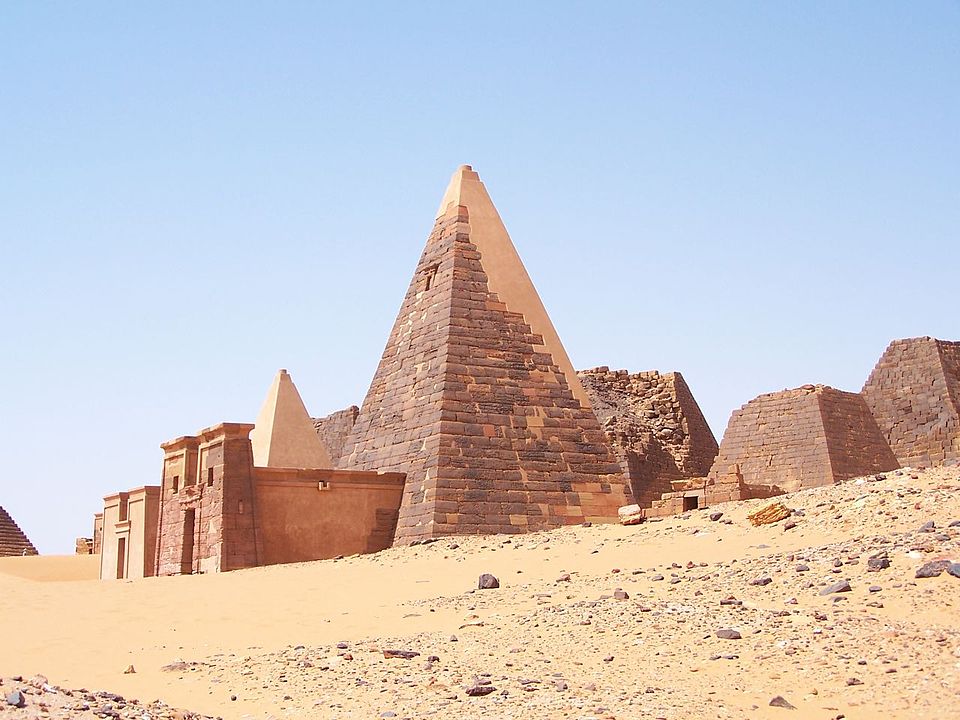

The Meroitic period (c. 300 BCE – c. 350 CE) saw the kingdom develop its most distinctive cultural characteristics. Meroë was strategically situated at the intersection of the Nile Valley and overland trade routes leading eastward to the Red Sea coast and southward into the African interior, a position that gave it access to a wide range of resources and commercial opportunities.1, 11 The royal city of Meroë, excavated by John Garstang in 1909–1914 and by Peter Shinnie in eleven seasons between 1965 and 1984, contained a royal palace, temples, baths influenced by Hellenistic architectural traditions, and extensive residential quarters, demonstrating a cosmopolitan culture that absorbed influences from Egypt, the Hellenistic world, and sub-Saharan Africa while maintaining its own distinctive identity.8, 16
The UNESCO World Heritage listing of the Archaeological Sites of the Island of Meroë in 2011, encompassing the royal city, the pyramid fields, and the temple complexes at Musawwarat es-Sufra and Naqa, recognised the site's outstanding universal value as the heartland of a major African civilisation.11
The Meroitic script
One of the most significant cultural developments of the Kushite kingdom was the creation of the Meroitic script, the earliest known indigenous writing system in sub-Saharan Africa. Developed during the late Napatan or early Meroitic period, probably around the third or second century BCE, the Meroitic script replaced Egyptian hieroglyphs as the medium for royal inscriptions, religious texts, and funerary formulae.6, 1 Two forms of the script were used: a hieroglyphic form, derived from Egyptian hieroglyphs but representing entirely different sound values, used primarily for monumental inscriptions; and a cursive form, used for everyday writing on papyrus, pottery, and wooden tablets.6
The phonetic values of the Meroitic signs were deciphered in 1911 by the British Egyptologist Francis Llewellyn Griffith, who identified royal names in Meroitic inscriptions by comparing them with parallel Egyptian cartouches containing known Kushite rulers.6, 8 Griffith demonstrated that the script was an alphasyllabary (or abugida), consisting of twenty-three signs in which consonants carry an inherent vowel that can be modified by additional markers — a writing system structurally distinct from the logographic-phonetic complexity of Egyptian hieroglyphs.6 Although the script can be read phonetically, the Meroitic language itself remains only partially understood, because no extensive bilingual text comparable to the Rosetta Stone has been discovered.
Significant progress in understanding the Meroitic language has been made by the French linguist Claude Rilly, who in his doctoral thesis (2003) and subsequent publications, including The Meroitic Language and Writing System (2012, co-authored with Alex de Voogt), demonstrated that Meroitic belongs to the Northern Eastern Sudanic branch of the Nilo-Saharan language family, placing it in the same broad linguistic grouping as the modern Nubian languages.6 This classification has opened new avenues for understanding Meroitic vocabulary and grammar through comparison with related living languages, though full translation of longer Meroitic texts remains elusive. Approximately one thousand Meroitic inscriptions are currently known, the majority consisting of short funerary formulae, but longer royal and religious texts promise important historical information if their meaning can be fully recovered.6, 7
Iron production at Meroë
The large slag heaps visible at the site of Meroë attracted early scholarly attention and led to the city being described as the "Birmingham of Africa," a characterisation coined by the archaeologist A. H. Sayce in the early twentieth century.8, 1 Iron production was indeed a major industry at Meroë and its surrounding region, and its scale and duration have been significantly clarified by recent archaeological and archaeometallurgical research.
A comprehensive radiocarbon dating programme conducted by Jane Humphris and Thomas Scheibner, published in the African Archaeological Review in 2017, presented ninety-seven radiocarbon dates that established a new chronology for ancient iron production in the Meroë region.9 Their study demonstrated that iron smelting was practised in the area for more than a thousand years, potentially beginning as early as the seventh century BCE during the late Napatan period and continuing into the sixth century CE, well after the political collapse of the Meroitic state.9 However, the chronological evidence revealed a more complex picture than earlier scholars had assumed: the slag heaps at Meroë date predominantly to either the early (Napatan) or late (post-Meroitic) periods, with surprisingly little evidence for large-scale iron production during the height of the Meroitic period itself (c. 300 BCE – 300 CE), when Meroë served as the political capital of the kingdom.9
Chronology of iron production phases at Meroë9
This unexpected chronological pattern has prompted scholars to reconsider earlier assumptions about Meroë as a continuously operating industrial centre. The reasons for the apparent gap in production during the Meroitic period proper remain debated, with possible explanations including a shift to iron production at other sites in the kingdom, changes in fuel availability due to deforestation, or sampling biases in the archaeological record.9, 15 Regardless of the precise timing, iron technology clearly played an important role in the Kushite economy, providing tools for agriculture, weapons for the military, and trade goods for export. Experimental archaeology at Meroë, involving the construction and operation of replica Meroitic furnaces, has provided valuable insights into the technical parameters of Kushite iron smelting, including the types of ore used, furnace construction methods, and the organisation of workshop space.9
Religion and religious syncretism
Kushite religion represents one of the most striking examples of religious syncretism in the ancient world, blending Egyptian theological traditions absorbed during centuries of contact and colonial occupation with indigenous African deities and ritual practices.1, 2 The supreme deity of the Kushite pantheon was Amun, the Egyptian god of creation and kingship, whose worship had been established in Nubia during the Egyptian New Kingdom and who became the dynastic god of the Kushite royal house. The great temple of Amun at Jebel Barkal, which the Kushites expanded and maintained over many centuries, served as the spiritual centre of the kingdom and the site of royal coronation and legitimation.12, 2 A distinctive Kushite theological innovation was the concept of the "pure mountain" (Jebel Barkal) as the primordial dwelling place of Amun, a claim that granted the Kushite priesthood of Amun a spiritual authority rivalling or surpassing that of the Theban clergy at Karnak.2, 5
Other Egyptian deities worshipped in Kush included Isis, Osiris, Horus, and Thoth, all of whom received temples and cult attention throughout the Napatan and Meroitic periods.1, 2 The Isis temple at Philae, on the Egyptian-Nubian border, was a shared sacred site that attracted pilgrims from both Egypt and Kush well into the Roman period, and the worship of Isis was particularly prominent in Meroitic religious life.1
The Meroitic period witnessed the emergence of distinctly indigenous deities alongside the Egyptian gods. The most important of these was Apedemak, a lion-headed war god who had no Egyptian equivalent and whose worship appears to have originated in the southern reaches of the kingdom.1, 2 Apedemak is depicted in temple reliefs as a male figure with a lion's head, sometimes with multiple heads or emerging from a lotus flower, and is associated with military victory, royal power, and fertility. The finest surviving Apedemak temple is the Lion Temple at Musawwarat es-Sufra, built under King Arnekhamani (c. 235–218 BCE), whose exterior walls bear magnificent relief carvings of the god receiving offerings from the king and queen.11, 2 Another well-preserved Apedemak temple stands at Naqa, where reliefs show the god with a serpent's body emerging from a lotus — an iconography with no Egyptian parallel that demonstrates the creative independence of Meroitic religious art.11
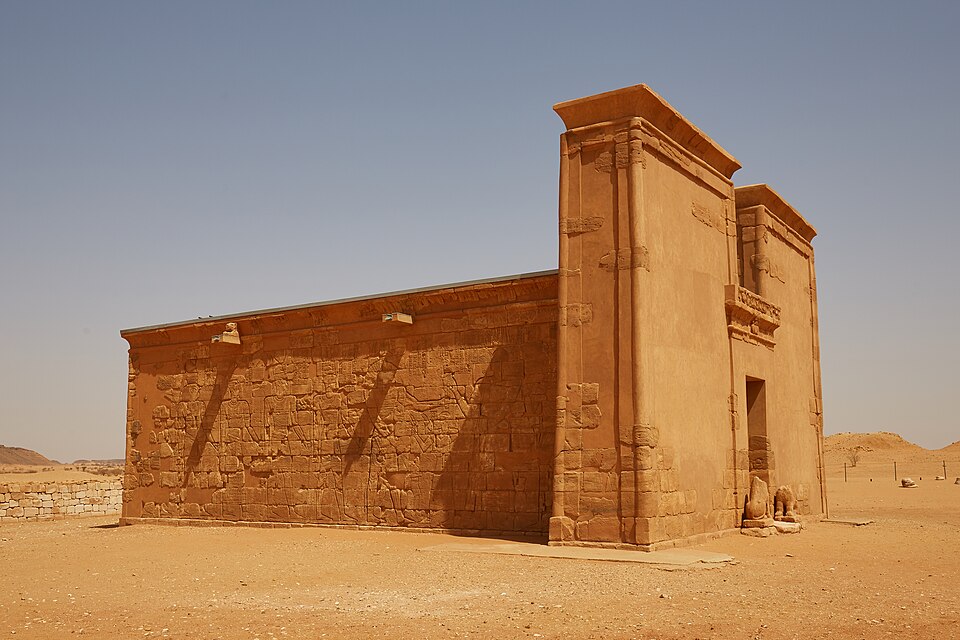

Other indigenous Meroitic deities include Sebiumeker, a creator god, and Arensnuphis, a deity of uncertain function who appears alongside Apedemak in temple reliefs at Musawwarat es-Sufra. The appearance of these non-Egyptian gods in monumental temple contexts from the third century BCE onward marks a significant shift in Kushite religious identity: while the Napatan period had been characterised by an exclusively Egyptian-derived pantheon, the Meroitic period saw the assertion of indigenous religious traditions alongside the older Egyptian elements, producing a distinctive syncretic system.2, 7
Trade networks
The Kingdom of Kush owed much of its wealth and strategic importance to its position as an intermediary between sub-Saharan Africa and the Mediterranean world. Situated along the Upper Nile and controlling the overland routes that connected the African interior with Egypt, the Red Sea coast, and ultimately the broader Mediterranean commercial system, Kush served as the primary conduit through which tropical African products reached the ancient Near East and the Greco-Roman world.1, 3
The most valuable Kushite export was gold, extracted from alluvial deposits and mines in the deserts east of the Nile. The Egyptian word for gold, nub, is widely believed to be the etymological source of the name "Nubia" itself, reflecting the region's ancient association with the precious metal.3, 10 In addition to gold, Kush exported ivory from African elephants, ebony and other tropical hardwoods, incense, exotic animal skins, ostrich feathers, and enslaved persons.1, 8 In return, Kushite elites imported Mediterranean luxury goods including wine, olive oil, fine pottery, glassware, bronze vessels, and textiles, as demonstrated by the abundance of imported objects found in Kushite royal and elite burials.1, 3
During the Meroitic period, trade connections expanded further. The Periplus Maris Erythraei, a first-century CE Greek merchant's guide to Red Sea and Indian Ocean trade, describes the port of Adulis on the Eritrean coast as an outlet for ivory and other goods originating in the Kushite interior, suggesting that Meroitic trade networks extended eastward to the Red Sea coast as well as northward along the Nile.13 Meroë's position also gave it access to trade routes leading southward and westward into the African savannah and forest zones, from which it obtained products unavailable in the Nile Valley. The kingdom thus functioned as a crucial node in a trans-continental exchange system linking tropical Africa, the Nile corridor, the Red Sea, and the Mediterranean basin.1, 15
Major Kushite trade commodities and routes1, 3, 8
| Commodity | Source | Destination |
|---|---|---|
| Gold | Eastern desert mines, alluvial deposits | Egypt, Mediterranean |
| Ivory | African interior (elephant hunting) | Egypt, Greco-Roman world |
| Ebony and tropical hardwoods | Southern Nile region, savannah | Egypt, Near East |
| Incense and aromatics | Eastern Africa, Arabia (via Red Sea) | Egypt, Mediterranean temples |
| Iron goods | Meroë region smelting centres | Regional trade |
| Wine, olive oil, ceramics | Mediterranean (imports) | Kushite elite consumption |
Kushite pyramids and monumental architecture
The Kingdom of Kush produced more pyramids than Egypt itself. Archaeologists have documented over 255 pyramids across four principal royal cemetery sites: El-Kurru, Nuri, Jebel Barkal, and the three necropolis fields at Meroë.1, 7 Kushite pyramids differ markedly from their Egyptian predecessors in form and construction. They are built of stepped courses of horizontally laid stone blocks, rise from relatively small foundations to heights of approximately 6 to 30 metres, and are characterised by a steep angle of inclination of approximately 70 degrees — far steeper than the 51-degree angle of the Great Pyramid at Giza.1, 2 Unlike Egyptian pyramids, which contained the burial chamber within or beneath the pyramid structure itself, Kushite burial chambers are located in rock-cut rooms beneath the pyramid, accessed by a descending stairway cut into the bedrock.1
The earliest Kushite pyramids appear at El-Kurru, where the transition from traditional Nubian tumulus burials to pyramid construction can be traced through the burials of the Napatan dynasty's founders in the eighth century BCE.1, 5 The royal cemetery then shifted to Nuri, where Taharqa built the largest Nubian pyramid, with a base measuring approximately 52 metres square. Nuri contains the burials of approximately twenty Napatan kings and over fifty queens, spanning from the seventh to the third centuries BCE.1, 2
The most extensive pyramid fields are at Meroë, where three separate cemeteries contain the remains of more than forty kings and queens of the Meroitic period, accompanied by numerous smaller pyramids for non-royal elites.11, 1 Each pyramid was fronted by a small funerary chapel decorated with relief carvings depicting the deceased ruler receiving offerings, being presented to the gods, or proceeding through the afterlife — scenes that draw heavily on Egyptian funerary iconography while incorporating distinctly Meroitic elements.2 The pyramid fields at Meroë, together with the royal city and the temple complexes at Musawwarat es-Sufra and Naqa, were inscribed as a UNESCO World Heritage Site in 2011, and the Jebel Barkal and Nuri sites were listed separately in 2003.11, 12
Decline and fall
The decline of the Kingdom of Kush was a gradual process driven by a convergence of internal and external pressures over the third and fourth centuries CE. The last securely dated Meroitic royal inscription belongs to the reign of a king named Teqerideamani, probably in the mid-third century CE, after which the historical record falls largely silent.1, 2 Archaeological evidence suggests progressive political fragmentation, with provincial centres asserting greater independence from the royal capital and the maintenance of monumental architecture and elite burial traditions declining in quality and scale.3
Environmental factors may have contributed to the decline. The Meroë region is semi-arid and dependent on seasonal rainfall and Nile flooding for agriculture. Evidence of deforestation associated with centuries of iron smelting, which required enormous quantities of charcoal as fuel, has led some scholars to suggest that environmental degradation may have undermined the agricultural and industrial base of the Meroitic economy, although this hypothesis remains debated.15, 3 The incursion of nomadic peoples, particularly the Noba, into the Meroitic heartland appears to have been a significant factor in the kingdom's disintegration, as pastoral groups occupied territories previously under Meroitic control.1, 2
The final blow to what remained of the Kushite state came from the rising power of the Kingdom of Aksum in the Ethiopian highlands. Around 350 CE, the Aksumite king Ezana led a military expedition into the former Meroitic territories, an event recorded in his trilingual inscription at Aksum (written in Ge'ez, Greek, and South Arabian).13, 14 Ezana's inscription describes campaigns against the Noba and Kasu (Kush) peoples along the Atbara and Nile rivers, recording the destruction of settlements and the seizure of livestock and captives.13 Significantly, the inscription does not mention Meroë itself, suggesting that the city had already been abandoned or had lost its political significance before the Aksumite incursion. The Aksumite campaign thus appears to have been directed against successor populations rather than against a functioning Meroitic state.13, 1
The post-Meroitic period (c. 350–550 CE) saw the emergence of successor kingdoms in the former Kushite territories, most notably the Nubian kingdoms of Nobatia, Makuria, and Alodia, which adopted Christianity during the sixth century CE and preserved elements of Meroitic cultural heritage within a new religious and political framework.3, 1 The Noba peoples, whose incursions had contributed to the fall of Meroë, gave their name to the region — Nubia — and their languages, belonging to the Eastern Sudanic branch of the Nilo-Saharan family, replaced Meroitic as the dominant spoken languages of the Middle Nile Valley.6, 3
The Kingdom of Kush, though long overshadowed in popular consciousness by its Egyptian neighbour, is increasingly recognised by scholars as one of the most significant civilisations of the ancient world. Its two-thousand-year history demonstrates the creative capacity of an African society that selectively adopted, adapted, and ultimately transformed the cultural traditions of Egypt while developing its own distinctive contributions in writing, architecture, religion, and technology. The ongoing archaeological exploration of sites across northern Sudan continues to expand and refine understanding of this remarkable civilisation.7, 15
References
Foundations of an African Civilisation: Aksum and the Northern Horn, 1000 BC – AD 1300