Overview
- China's Neolithic cultures along the Yellow and Yangtze rivers independently developed millet and rice agriculture by roughly 7000 BCE, giving rise to some of the world's earliest complex societies, including the Yangshao, Longshan, and Hemudu cultures.
- The Shang dynasty (c. 1600–1046 BCE) produced the earliest confirmed Chinese writing in the form of oracle bone inscriptions and achieved extraordinary mastery of bronze casting, while the succeeding Zhou dynasty introduced the concept of the Mandate of Heaven and fostered the Hundred Schools of Thought, including Confucianism and Daoism.
- The Qin unification in 221 BCE created the first centralized imperial state in Chinese history through Legalist governance and sweeping standardization, and the subsequent Han dynasty consolidated this system while opening the Silk Road, connecting China to Central Asia, Persia, and Rome.
Ancient China encompasses one of the longest continuous trajectories of cultural development in human history, stretching from Neolithic farming communities along the Yellow River and the Yangtze River in the seventh millennium BCE to the establishment of unified imperial states in the late third century BCE. The fertile loess plateaus of the middle Yellow River basin and the wetlands of the lower Yangtze independently gave rise to two of the world's earliest agricultural traditions — millet cultivation in the north and rice cultivation in the south — and the societies that emerged from these foundations developed writing, bronze metallurgy, urban centres, and sophisticated philosophical traditions that profoundly shaped East Asian civilization.1, 2, 13
The archaeological and textual record of ancient China reveals a progression from dispersed Neolithic villages through increasingly stratified chiefdoms and early states to the dynastic succession of the Shang, Zhou, Qin, and Han, each of which introduced transformative political, technological, and intellectual innovations. The oracle bone inscriptions of the Shang dynasty represent the earliest confirmed Chinese writing, the Zhou dynasty's concept of the Mandate of Heaven provided a political theology that endured for over two millennia, and the Qin unification of 221 BCE created the template for centralized imperial governance that would define Chinese statecraft until the twentieth century.7, 11, 16
Neolithic foundations
The transition from foraging to agriculture in China occurred independently in two major river systems. In the Yellow River basin of northern China, communities began cultivating foxtail millet (Setaria italica) and broomcorn millet (Panicum miliaceum) by approximately 8000 to 7000 BCE, as demonstrated by archaeobotanical evidence from sites in the Wei River valley and the middle Yellow River region. Phytolith and starch grain analyses have confirmed that millet domestication was a gradual process, with morphological changes indicative of human selection appearing over several millennia.1 In the middle and lower Yangtze River basin, rice (Oryza sativa) was independently domesticated by roughly 7000 to 5000 BCE. Excavations at Shangshan, Kuahuqiao, and other early sites have yielded rice remains showing progressive domestication traits, including the loss of seed shattering, confirming the Yangtze region as the primary centre of origin for cultivated rice.2
The Yangshao culture (c. 5000–3000 BCE) was the dominant Neolithic tradition of the middle Yellow River region, particularly concentrated in modern Henan, Shaanxi, and Shanxi provinces. Yangshao communities lived in semi-subterranean houses arranged around central plazas in villages of several hundred people. They practised millet agriculture supplemented by pig husbandry and are best known for their distinctive painted pottery, which features geometric designs and occasional zoomorphic motifs rendered in black and red pigments on buff-coloured vessels. The site of Banpo, near modern Xi'an, excavated in the 1950s, became the type site for understanding Yangshao settlement patterns and material culture.3, 19
In the lower Yangtze region, the Hemudu culture (c. 5000–4500 BCE) represents one of the earliest well-documented rice-farming societies. Excavations at the Hemudu site in Zhejiang province, first conducted in 1973, revealed thick deposits of rice remains alongside pile-built wooden houses adapted to the marshy lacustrine environment. The Hemudu assemblage also includes carved ivory, lacquerware, and bone tools, indicating a materially complex society sustained by wetland rice cultivation and supplemented by fishing, gathering, and hunting.5, 13
The Longshan culture (c. 3000–1900 BCE) succeeded the Yangshao in the Yellow River region and marked a decisive shift toward social stratification and proto-urban settlement. Longshan communities constructed rammed-earth walls enclosing settlements of considerable size, practised divination using heated animal scapulae (a precursor to Shang oracle bone practices), and produced highly refined, thin-walled black pottery made on fast wheels. Archaeological evidence of differential burial wealth, fortified settlements, and interpersonal violence suggests that Longshan society was characterised by competitive elites, intergroup conflict, and increasing political centralisation.4, 19
Erlitou and the Xia dynasty question
Traditional Chinese historiography, beginning with the Records of the Grand Historian (Shiji) compiled by Sima Qian around 100 BCE, describes the Xia as the first dynasty of China, preceding the Shang by several centuries. According to this tradition, the Xia was founded by the legendary Yu the Great and ruled for approximately 470 years before being overthrown by the Shang.18 The historicity of the Xia has long been debated, because no contemporary textual evidence — no inscriptions or documents from the alleged Xia period itself — has been discovered. The question of whether the Xia represents a genuine historical polity or a later literary construct remains one of the most contested issues in Chinese archaeology.6, 21
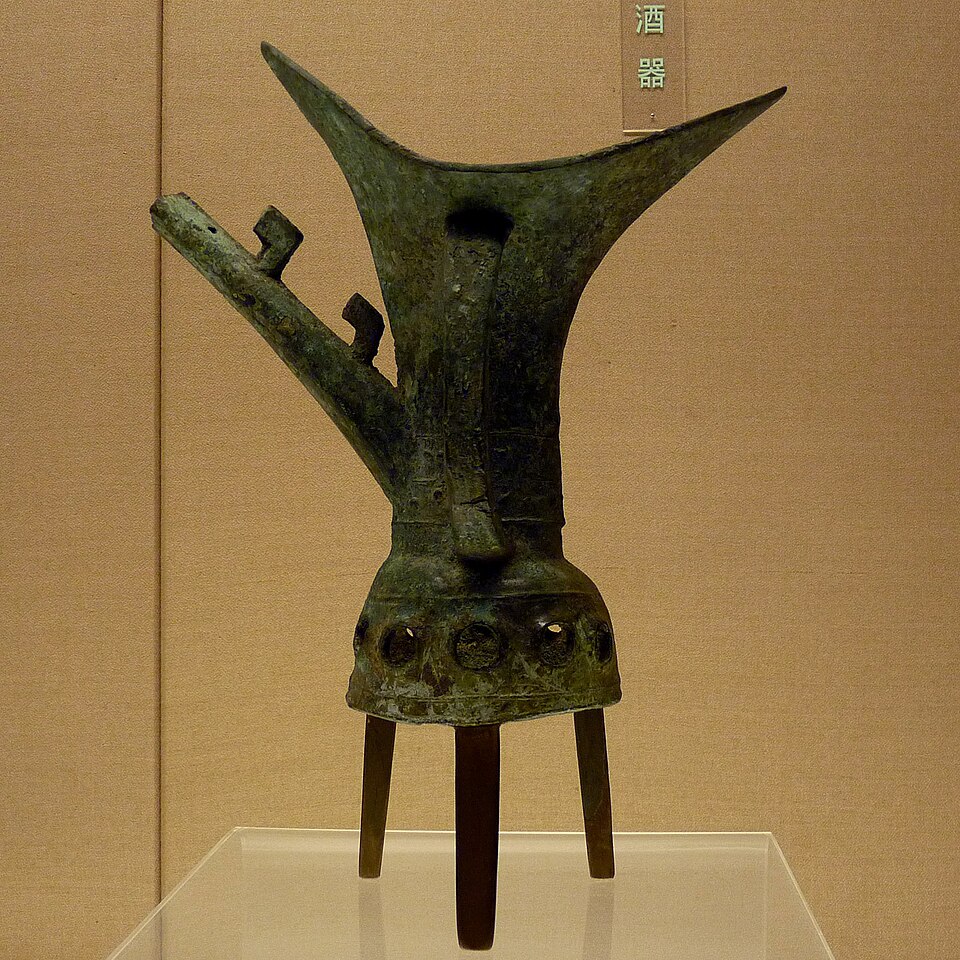

The Erlitou site, located near modern Yanshi in Henan province, is central to this debate. Erlitou flourished from approximately 1900 to 1500 BCE and represents the earliest known palace-scale architecture in China. The site features large rammed-earth platform foundations interpreted as palatial or ritual structures, workshops for bronze casting and turquoise inlay, and elite burials containing bronze vessels, jades, and other prestige goods. Erlitou's material culture shows clear continuities with earlier Longshan traditions and equally clear anticipations of Shang civilisation, positioning it as a critical transitional polity.6, 23
Chinese archaeologists associated with the government-sponsored Xia-Shang-Zhou Chronology Project have identified Erlitou as the likely capital or a major centre of the Xia dynasty, based on its chronological placement (broadly consistent with traditional dates for the Xia), its geographical location in the region traditionally associated with the Xia, and its evident political complexity.23 Many Western scholars remain cautious, noting that the identification cannot be confirmed without contemporary written records and that the correlation between Erlitou and the Xia may reflect the imposition of a later literary tradition onto an archaeological record that does not require a dynastic label. Regardless of its dynastic affiliation, Erlitou is widely recognised as representing the earliest known state-level society in China, with features including centralised bronze production, palatial architecture, and a settlement hierarchy extending over a significant territory.6
The Shang dynasty
The Shang dynasty (c. 1600–1046 BCE) is the earliest Chinese dynasty for which both archaeological and contemporary textual evidence exist. The Shang state was centred in the North China Plain, with successive capitals at Zhengzhou (Erligang phase, c. 1600–1400 BCE) and Anyang (Yinxu phase, c. 1250–1046 BCE). Zhengzhou featured massive rammed-earth walls enclosing an area of approximately 3 square kilometres, bronze foundries, and bone workshops, indicating a powerful and well-organised polity.8, 13
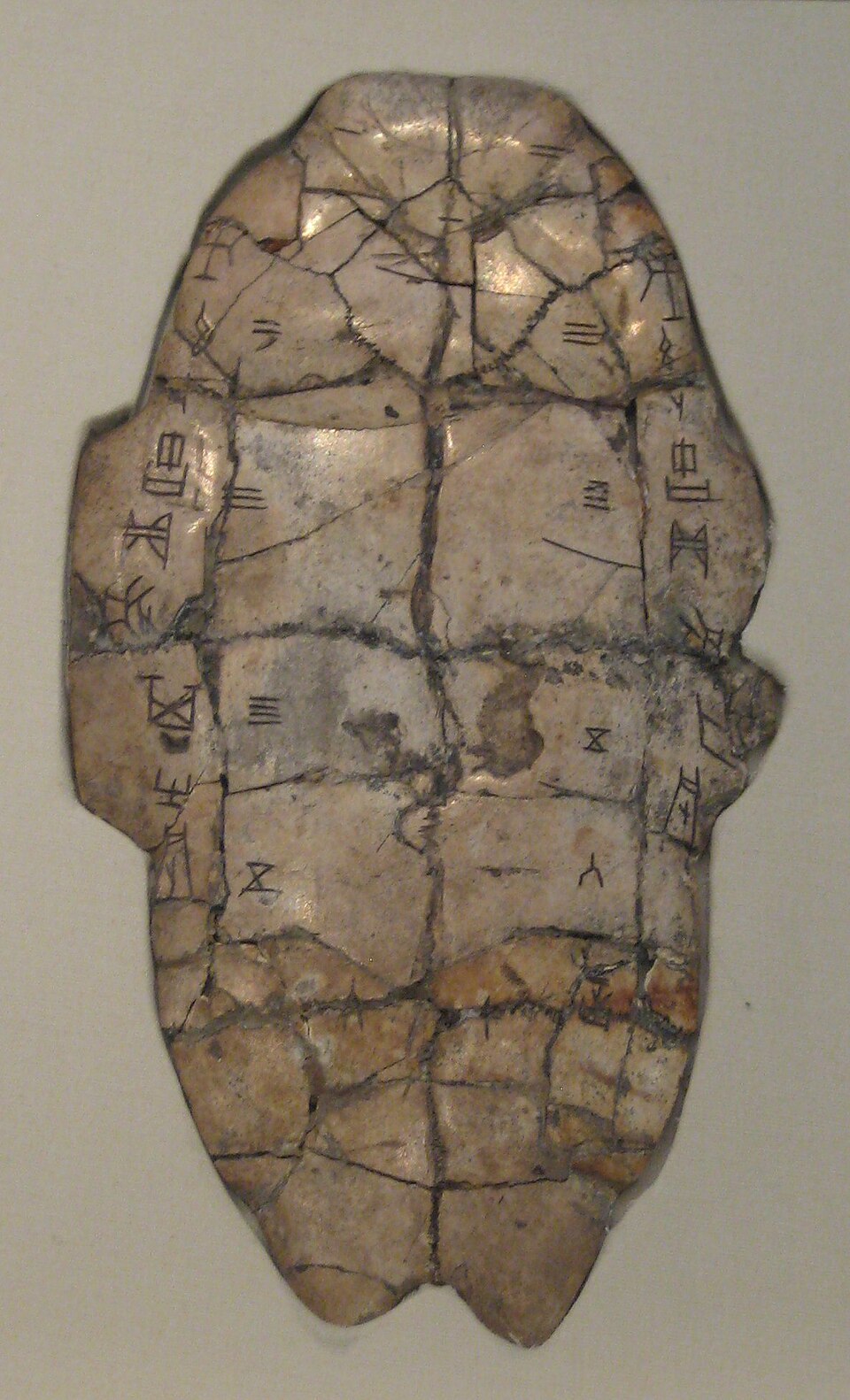

The most significant textual legacy of the Shang is the corpus of oracle bone inscriptions (jiaguwen), discovered at Yinxu near modern Anyang beginning in 1899. These inscriptions, carved on turtle plastrons and cattle scapulae, record divination rituals performed by the Shang royal house. The king or his diviners would pose questions to ancestral spirits — about weather, harvests, military campaigns, childbirth, and ritual propriety — then apply heat to the bone or shell until it cracked. The resulting cracks were interpreted as answers, and the question, date, diviner's name, and sometimes the outcome were inscribed on the surface. Over 150,000 oracle bone fragments have been recovered, containing approximately 4,500 distinct characters, many of which are recognisable ancestors of modern Chinese characters.7, 9
Shang bronze casting represents one of the supreme technological achievements of the ancient world. Unlike the lost-wax method used in Western Asia and later in Greece, Shang artisans developed a distinctive piece-mould technique in which a clay model was created, sectional moulds were formed around it, the model was shaved down to create a core, and molten bronze was poured into the space between the moulds and the core. This method permitted the production of vessels of extraordinary complexity, with intricate surface decoration cast directly into the metal rather than added afterwards. The resulting ritual vessels — ding tripod cauldrons, gui grain containers, jue wine vessels — served as symbols of political authority and were essential components of ancestral sacrifice.10, 8
The Shang political order was centred on the king, who served as the chief ritualist mediating between the living and the ancestral spirits. Shang society was sharply stratified: royal and aristocratic burials at Yinxu include massive tombs containing bronze vessels, jade objects, chariots, and the remains of sacrificed humans and animals, while commoner burials are simple pit graves with few or no goods. The practice of human sacrifice, attested both in oracle bone inscriptions and in archaeological contexts, involved war captives and appears to have been integral to royal mortuary and dedicatory rituals.7, 8
The Zhou dynasty
The Zhou dynasty (c. 1046–256 BCE) is traditionally divided into two periods: the Western Zhou (c. 1046–771 BCE), when the royal court was based near modern Xi'an, and the Eastern Zhou (770–256 BCE), when the capital was relocated to Luoyang after the sack of the western capital by nomadic invaders. The Eastern Zhou is further subdivided into the Spring and Autumn period (770–476 BCE) and the Warring States period (475–221 BCE), a progression reflecting the steady erosion of royal authority and the rise of powerful competing states.11
The Zhou conquest of the Shang, traditionally dated to approximately 1046 BCE, introduced one of the most consequential political concepts in Chinese history: the Mandate of Heaven (tianming). According to this doctrine, Heaven (tian) granted the right to rule to a virtuous dynasty, and this mandate could be withdrawn if the ruler became corrupt or incompetent, legitimising the overthrow of a failing dynasty by a more virtuous successor. The Zhou used the Mandate of Heaven to justify their conquest of the Shang, arguing that the last Shang king had forfeited Heaven's favour through tyranny and dissolution. This concept became the foundational political theology of imperial China, invoked by every subsequent dynasty to legitimise its rule.11, 18
The Western Zhou political system has often been described as feudal, though the analogy with European feudalism is imprecise. The Zhou king distributed territorial grants to members of the royal clan and allied lineages, who established subordinate polities that owed military service, tribute, and ritual obligations to the Zhou court. These grants were accompanied by elaborate bronze vessels bearing inscriptions that recorded the terms of investiture. Over time, the regional lords consolidated their local power, and by the Eastern Zhou period the nominal authority of the Zhou king had become largely ceremonial, while the real power lay with the competing states of Qi, Chu, Jin, Qin, and others.11, 13
The intellectual ferment of the Eastern Zhou, particularly the Warring States period, produced the Hundred Schools of Thought (baijia), one of the most productive periods of philosophical innovation in world history. Confucius (Kong Qiu, c. 551–479 BCE) articulated a vision of social order based on ritual propriety (li), humaneness (ren), filial piety (xiao), and the moral cultivation of rulers and officials, ideas transmitted through the Analects (Lunyu) compiled by his disciples.20 Mozi (c. 470–391 BCE) challenged Confucian particularism with doctrines of universal love and utilitarian governance. Laozi and Zhuangzi developed the Daoist tradition, emphasising spontaneity, the limitations of conventional knowledge, and alignment with the natural order (dao). Legalist thinkers such as Shang Yang, Han Feizi, and Li Si advocated impersonal rule through strict laws, rewards and punishments, and the centralisation of state power — ideas that would prove decisive in the Qin unification.12, 15
Qin unification and the first empire
The state of Qin, based in the Wei River valley of modern Shaanxi, rose from a peripheral western polity to become the dominant military power of the Warring States period through a series of Legalist reforms initiated by Shang Yang in the mid-fourth century BCE. Shang Yang's reforms abolished aristocratic privilege, reorganised the population into mutual-responsibility groups, rewarded military merit with rank and land, and imposed uniform laws enforced through severe punishments. These measures transformed Qin into a centralised, militarised state capable of mobilising its entire population for warfare and agriculture.15, 16
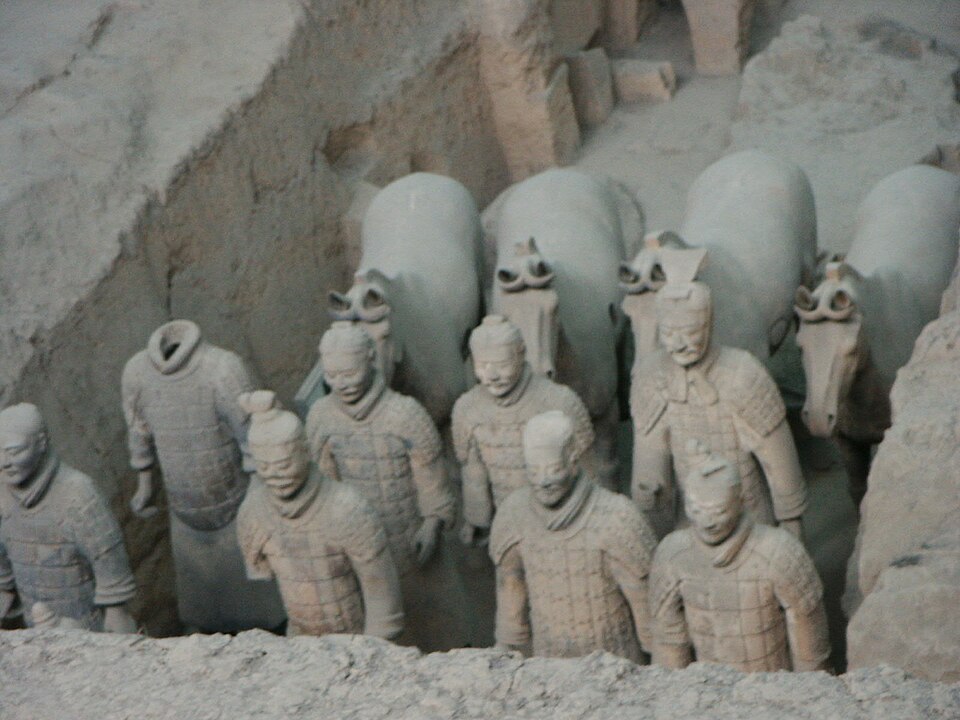

In 221 BCE, King Zheng of Qin completed the conquest of the last remaining rival states and proclaimed himself Qin Shi Huang (First Emperor of Qin), establishing the Qin dynasty and the first unified imperial state in Chinese history. The new regime implemented sweeping standardisation measures: weights, measures, axle widths, and currency were unified across the empire; the diverse scripts of the former states were replaced by a single standardised writing system (small seal script); and a network of roads and canals was constructed to connect the imperial capital at Xianyang to the provinces.16, 18
The Qin also undertook monumental construction projects. Sections of defensive walls built by the northern states during the Warring States period were connected and extended to form a continuous frontier barrier against nomadic incursions from the steppe — the precursor to the later Great Wall. The First Emperor's mausoleum complex near modern Xi'an, discovered in 1974, contains the famous terracotta army: an estimated 8,000 life-sized ceramic warriors, along with horses, chariots, and weapons, arranged in battle formation to guard the emperor in the afterlife. Each figure is individually modelled with distinct facial features, hairstyles, and armour, representing an extraordinary feat of organised production.14
Despite its transformative achievements, the Qin dynasty was short-lived. The First Emperor's death in 210 BCE was followed by palace intrigue, the succession of an ineffectual second emperor, and widespread rebellion provoked by the harshness of Qin governance, including mass conscription for construction projects, severe penal codes, and the alleged burning of books and execution of scholars. The dynasty collapsed in 206 BCE, only fifteen years after unification.16, 18
The early Han dynasty
After a brief civil war between rival rebel leaders, Liu Bang emerged victorious and founded the Han dynasty in 202 BCE, taking the throne as Emperor Gaozu. The Han retained the essential administrative framework of the Qin — centralised bureaucracy, commandery-county divisions, standardised laws — but moderated the harshness of Legalist governance by reducing taxes, softening penal codes, and incorporating Confucian ideals of benevolent rulership into the imperial ideology. This synthesis of Legalist state structure with Confucian moral philosophy became the template for Chinese imperial governance for the next two millennia.16
Under Emperor Wu (r. 141–87 BCE), the Han dynasty reached its greatest territorial extent and cultural influence. Wu Di adopted Confucianism as the official state ideology, established an imperial academy to train officials in the Confucian classics, and instituted examinations as a criterion for bureaucratic appointment, laying the foundations of the civil service examination system that would endure until 1905. He also pursued aggressive military expansion, extending Han control into Central Asia, the Korean peninsula, and northern Vietnam.16, 18
Han technological and intellectual achievements were extensive. Iron production reached industrial scale, with state monopolies on iron and salt generating substantial revenue. Paper was invented during the Han period, though it did not become widely used for writing until later centuries. The historian Sima Qian composed the Shiji (Records of the Grand Historian), a comprehensive history spanning from the mythological Yellow Emperor to his own time, establishing the model for all subsequent Chinese dynastic histories.18
Origins of the Silk Road
The term "Silk Road" was coined by the German geographer Ferdinand von Richthofen in 1877, but the network of overland trade routes connecting China to Central Asia, Persia, and the Mediterranean world had its origins in the diplomatic missions of the Han dynasty. In 139 BCE, Emperor Wu dispatched the envoy Zhang Qian westward to seek an alliance with the Yuezhi, a nomadic people displaced by the Xiongnu confederacy, against their common enemy. Zhang Qian was captured by the Xiongnu and detained for over a decade before escaping and eventually reaching the Ferghana Valley and Bactria. Although his diplomatic mission failed, his reports on the peoples, products, and geography of Central Asia opened Chinese awareness of the western regions and prompted further diplomatic and military engagement.22, 17
Following Zhang Qian's missions and subsequent Han military campaigns that secured the Gansu Corridor and the Tarim Basin, regular trade routes developed connecting the Han capital at Chang'an (modern Xi'an) to Parthian Persia and ultimately to the Roman Mediterranean. Chinese silk, lacquerware, and iron moved westward, while Central Asian horses, jade, glassware, and eventually Buddhist religious texts and ideas moved eastward. The Silk Road was not a single road but a shifting network of oasis towns, mountain passes, and caravan routes across some of the most inhospitable terrain on Earth, including the Taklamakan and Gobi deserts and the Pamir and Tian Shan mountain ranges.17, 22
The economic and cultural consequences of the Silk Road were profound. The exchange of goods was accompanied by the transmission of technologies, artistic motifs, languages, and religions. Buddhism entered China along Silk Road routes during the first century CE, beginning a process of cultural exchange that would transform Chinese religion, philosophy, art, and literature. The Silk Road also facilitated the spread of diseases, metallurgical techniques, and agricultural products, including grapes and alfalfa from the west and peaches and apricots from the east.17
Chronological overview
Major periods and developments in ancient Chinese history3, 8, 11, 16, 23
| Period | Approximate dates | Key developments |
|---|---|---|
| Early Neolithic | c. 7000–5000 BCE | Millet domestication (north), rice domestication (south) |
| Yangshao culture | c. 5000–3000 BCE | Painted pottery, semi-subterranean villages, millet agriculture |
| Hemudu culture | c. 5000–4500 BCE | Pile-built settlements, wetland rice farming, lacquerware |
| Longshan culture | c. 3000–1900 BCE | Walled towns, black pottery, scapulimancy, social stratification |
| Erlitou culture | c. 1900–1500 BCE | Palatial architecture, bronze casting, possible Xia capital |
| Shang dynasty | c. 1600–1046 BCE | Oracle bone writing, piece-mould bronze casting, Anyang capital |
| Western Zhou | c. 1046–771 BCE | Mandate of Heaven, feudal investiture, bronze inscriptions |
| Eastern Zhou | 770–256 BCE | Hundred Schools of Thought, iron technology, interstate warfare |
| Qin dynasty | 221–206 BCE | Imperial unification, standardisation, terracotta army |
| Western Han | 202 BCE–9 CE | Confucian state ideology, Silk Road, Sima Qian's Shiji |
Enduring significance
The civilisational trajectory from Neolithic village to unified empire that unfolded in ancient China produced institutions, technologies, and ideas of lasting global significance. The Chinese writing system, rooted in Shang oracle bone script, became the basis for literary traditions across East Asia, including Japan, Korea, and Vietnam.9 The Confucian emphasis on education, moral self-cultivation, and meritocratic governance shaped political culture throughout the region for over two millennia.20 The Qin-Han model of centralised bureaucratic administration, with its commandery-county structure, standardised laws, and salaried officials, provided a template for imperial governance that successive dynasties adapted but never fundamentally abandoned.16
The piece-mould bronze casting tradition of the Shang and Zhou represents a technological path entirely distinct from the lost-wax tradition of Western Eurasia, demonstrating that complex metallurgy could develop through multiple independent trajectories.10 The Silk Road, born from the strategic calculations of the Han court, created the first sustained overland connection between East Asia and the Mediterranean, initiating patterns of trans-Eurasian exchange that would persist, in various forms, for nearly two millennia.17 The archaeological and textual record of ancient China thus documents not merely a regional history but one of the foundational threads of global civilisation.13
References
Dating the Hemudu Neolithic rice cultivation site, East China, by paleomagnetic chronostratigraphy