Overview
- The Tang dynasty (618–907 CE) presided over one of the most cosmopolitan and culturally productive eras in Chinese history, with its capital Chang'an functioning as the world's largest city and a magnet for merchants, monks, and diplomats from across Eurasia.
- Tang China produced enduring achievements in poetry (Li Bai, Du Fu, Wang Wei), refined the civil service examination system that would govern Chinese bureaucracy for a millennium, and saw critical technological developments including woodblock printing and early gunpowder formulations.
- The An Lushan Rebellion (755–763 CE) shattered the dynasty's centralised power, initiating a long decline marked by regional military autonomy, eunuch court politics, and agrarian uprisings that culminated in the dynasty's fall in 907 CE.
The Tang dynasty (618–907 CE) is widely regarded as the apex of Chinese imperial civilization, a nearly three-century period during which China was the largest, wealthiest, and most culturally dynamic empire on Earth. With its capital at Chang'an — a planned metropolis of perhaps one million inhabitants that served as the eastern terminus of the Silk Road — Tang China was a cosmopolitan society open to foreign religions, artistic traditions, and commercial networks on a scale unmatched in Chinese history before the modern era.1, 2 Tang poets produced a body of lyric verse that remains the foundation of Chinese literary culture; Tang legal codes provided the template for governance across East Asia; and Tang technological innovations, including woodblock printing and the earliest chemical formulations of gunpowder, would ultimately transform the world.8, 15 Yet the dynasty also contained the seeds of its own undoing: the catastrophic An Lushan Rebellion of 755–763 shattered centralised authority and inaugurated a century and a half of gradual decline, regional fragmentation, and social upheaval that ended with the dynasty's fall in 907.1, 6

Founding and the early Tang
The Tang dynasty emerged from the collapse of the short-lived Sui dynasty (581–618 CE), which had reunified China after nearly four centuries of division but exhausted itself through the megalomaniac building projects and disastrous military campaigns of its second emperor, Sui Yangdi.17, 1 Li Yuan, the Duke of Tang and a member of the northwestern military aristocracy, rose in rebellion in 617, captured Chang'an, and proclaimed himself Emperor Gaozu of the Tang dynasty in 618. The actual military and political architect of the new dynasty, however, was his second son, Li Shimin, who led the campaigns that defeated rival claimants across China and then, in 626, seized the throne from his father in the Xuanwu Gate Incident, a palace coup in which he killed his elder brother and rival heir.1, 2
Li Shimin, who reigned as Emperor Taizong (626–649), is traditionally regarded as one of the greatest rulers in Chinese history and the model of an ideal Confucian sovereign. He surrounded himself with able advisors, notably Wei Zheng, whom he empowered to offer frank criticism of imperial policy, and he established institutions of governance that balanced central authority with systematic consultation.1, 2 Taizong's military accomplishments were equally impressive: he destroyed the Eastern Turkic Khaganate in 630, establishing Tang suzerainty over the steppe peoples of Mongolia and earning the title Tian Kehan (Heavenly Khan) from the defeated Turks. He subsequently extended Chinese power into the Tarim Basin and Central Asia, bringing the oasis city-states of the Silk Road under Tang protection and opening the trade routes that would channel foreign goods, religions, and cultural influences into China for the next century.1, 9
Taizong also refined the institutional machinery of the Chinese state. He reorganised the central government around the Three Departments and Six Ministries system, streamlined the equal-field land distribution system that was intended to prevent the concentration of agricultural land among great families, and promoted the civil service examination as a supplement to aristocratic appointment in selecting government officials.1, 14 While aristocratic lineage remained the dominant path to office under the early Tang, the examination system created a parallel channel for talent from outside the great families, a channel that would progressively widen over the dynasty's lifespan and eventually become the primary mechanism of elite recruitment in later Chinese history.14, 2
Wu Zetian and the Zhou interregnum
The most remarkable political figure of the Tang era was Wu Zetian (624–705), the only woman in Chinese history to rule as emperor in her own right. Originally a low-ranking concubine of Emperor Taizong, Wu Zetian entered the court of his son Emperor Gaozong, whom she married, and gradually accumulated political power as Gaozong suffered debilitating strokes in the 660s.13, 1 After Gaozong's death in 683, she ruled through two of her sons before deposing the second in 690 and proclaiming herself emperor of a new dynasty, the Zhou, an act without precedent in Chinese history. She reigned as Emperor Wu until 705, when, aged and ill, she was forced to abdicate in favour of her son, and the Tang dynasty was formally restored.13, 2
Wu Zetian's reign has been the subject of intensely polarised historical evaluation. Traditional Chinese historiography, written almost entirely by male Confucian scholars, depicted her as a ruthless usurper who employed secret police, encouraged denunciation, and eliminated political rivals through judicial murder. Modern reassessment, while not denying her political ruthlessness, has emphasised her considerable achievements: she expanded the civil service examinations and opened them to a broader social base, broke the power of the old northwestern aristocratic families that had dominated the early Tang court, promoted Buddhism as a legitimating ideology for her unprecedented rule, and maintained the empire's territorial integrity during a period of external pressure from Tibetans and Turks.13, 1 Her patronage of Buddhism was particularly significant: she sponsored the construction of cave temples at Longmen, commissioned the translation of Buddhist texts, and declared herself an incarnation of Maitreya, the future Buddha, merging imperial and religious authority in a way that both enhanced her legitimacy and enriched Chinese Buddhist culture.3, 13
Cosmopolitan culture and the Silk Road
The Tang dynasty presided over the most cosmopolitan era in Chinese history prior to the modern period. The capital city of Chang'an, rebuilt on a grand scale by the Sui and further developed by the Tang, was the largest planned city in the world, covering approximately 84 square kilometres within its outer walls and housing a population that may have reached one million or more at its peak in the early eighth century.18, 2 The city was laid out on a strict grid of north–south and east–west avenues, with the imperial palace complex at the northern end and the two great market districts — the East Market and the West Market — serving as centres of domestic and international commerce respectively. The West Market in particular was a hub of Silk Road trade, where Sogdian, Persian, Arab, Turkic, Indian, Korean, and Japanese merchants mingled with Chinese buyers and sellers in a vibrant multicultural commercial district.18, 5
The material culture of the Tang elite reflected this cosmopolitanism. Tang tombs have yielded ceramic figurines of Central Asian merchants, camels laden with trade goods, and foreign musicians and dancers, illustrating the degree to which exotic goods and cultural practices permeated elite life. Edward Schafer's classic study The Golden Peaches of Samarkand catalogued the extraordinary range of foreign imports that reached Tang China via the Silk Road: grapes and grape wine from Ferghana, lapis lazuli from Afghanistan, glass from the Byzantine and Sasanian empires, spices and aromatics from Southeast Asia, and horses from the Central Asian steppe.5, 10 Foreign religions flourished alongside indigenous traditions: Nestorian Christianity, Manichaeism, Zoroastrianism, Judaism, and Islam all maintained communities in Chang'an and other major cities, alongside the dominant traditions of Buddhism, Daoism, and Confucianism.2, 5
Buddhism experienced its greatest period of Chinese influence during the Tang. The pilgrim Xuanzang's epic seventeen-year journey to India (629–645) and the enormous corpus of Sanskrit texts he brought back inspired a new wave of translation activity and doctrinal development. Tang China saw the maturation of distinctively Chinese Buddhist schools, including Chan (Zen), Pure Land, and Tiantai, which adapted Indian Buddhist thought to Chinese cultural sensibilities and would subsequently spread to Korea, Japan, and Vietnam.3, 2 However, Buddhism's growing wealth and institutional power also provoked periodic hostility from the state. The most severe episode was the Huichang Suppression of 842–845, ordered by Emperor Wuzong under Daoist influence, which resulted in the destruction of thousands of monasteries, the laicisation of over 250,000 monks and nuns, and the confiscation of vast monastic estates.3, 1 Although Buddhism recovered, the suppression permanently reduced its institutional power and accelerated the tradition's evolution toward the more decentralised Chan and Pure Land forms that would dominate later Chinese Buddhism.
Estimated population of major Tang-era cities, eighth century CE18, 2
Poetry and literary culture
The Tang dynasty is universally acknowledged as the golden age of Chinese poetry, producing a body of verse that remains the foundation of the Chinese literary tradition and one of the great achievements of world literature. The Quan Tangshi (Complete Tang Poems), compiled in the early eighteenth century, contains nearly 49,000 poems by over 2,200 authors, and these represent only those that survived the centuries of loss and destruction that followed the dynasty's fall.11, 12
The two poets most revered in the Chinese tradition are Li Bai (701–762) and Du Fu (712–770), who are conventionally paired as complementary geniuses: Li Bai the spontaneous, romantic, Daoist-inflected "Immortal of Poetry" and Du Fu the conscientious, morally engaged, Confucian "Sage of Poetry."11 Li Bai's verse is characterised by imaginative exuberance, apparent effortlessness, and a visionary quality that draws on Daoist themes of transcendence, the beauty of nature, and the pleasures of wine and friendship. His most famous poems — "Drinking Alone Under the Moon," "Quiet Night Thought," and "Seeing Off Meng Haoran at Yellow Crane Tower" — achieve a luminous simplicity that has made them among the most memorised and recited verses in the Chinese language across the centuries.11, 12
Du Fu, by contrast, is celebrated for the moral seriousness and technical mastery of his verse, particularly the poems composed during and after the An Lushan Rebellion, which transformed his poetry from accomplished but conventional court verse into the anguished, precisely observed chronicles of a society in collapse. Poems such as "Spring View," "Moonlit Night," and the sequence "Ballad of the Army Carts" combine intimate personal feeling with sweeping social panorama, establishing a mode of engaged, historically conscious lyric poetry that became the dominant ideal of Chinese poetics for a thousand years.11, 12 Du Fu's regulated verse (lüshi) in particular set technical standards of tonal prosody, parallelism, and compressed allusiveness that subsequent generations of poets strove to emulate.
Beyond Li Bai and Du Fu, the Tang produced an extraordinary constellation of poetic talent. Wang Wei (699–759) perfected the landscape poem as a vehicle for Buddhist contemplation; Bai Juyi (772–846) championed accessible, socially engaged verse; Li Shangyin (c. 813–858) developed a dense, allusive style of love poetry that influenced later Chinese lyric; and Han Yu (768–824) led a "prose reform" movement that championed the classical style of pre-Han prose against the ornate parallel prose favoured by the court.11, 2 Poetry was not merely an elite literary pursuit during the Tang but a practical social skill: the civil service examination included a poetry composition component, ensuring that every aspiring official was trained in verse, and poems circulated as gifts, letters, and markers of social status among the educated class.14, 11
The civil service and Tang legal code
The Tang dynasty's most enduring institutional legacy was the refinement of the civil service examination system and the codification of Chinese law. Although examinations for selecting officials had existed in some form since the Han dynasty, it was under the Tang that the system acquired the structure and prestige that would make it the central institution of Chinese governance for the next millennium.14, 1 The Tang examination system offered multiple tracks, the most prestigious being the jinshi (presented scholar) degree, which tested candidates on their knowledge of the Confucian classics, their ability to compose policy essays, and their skill in writing poetry. The jinshi examination was notoriously difficult: pass rates in the Tang period may have been as low as one to two percent of candidates, and success conferred enormous social prestige.14, 2
In practice, the examination system coexisted with older forms of elite recruitment throughout the Tang, including the yin privilege (hereditary right of officials' sons to enter government service) and direct recommendation by high-ranking officials. Aristocratic families of the great clans, particularly those based in the northeastern heartland of Shandong and Hebei, continued to dominate high office through much of the dynasty. Nevertheless, the examination system gradually expanded the social base of the bureaucracy, creating a class of "new men" who owed their positions to literary and intellectual ability rather than birth, and this process accelerated significantly after the An Lushan Rebellion weakened the old aristocratic power structures.14, 1
The Tang Legal Code (Tang lü shuyi), promulgated in 653 and revised periodically thereafter, was the most comprehensive and influential legal code in East Asian history. It consisted of 502 articles organised into twelve sections, covering criminal law, administrative regulations, household and land management, taxation, military affairs, and judicial procedure.7, 1 The code established a hierarchy of punishments — beating with the light stick, beating with the heavy stick, penal servitude, exile, and death — calibrated to the severity of the offence and the social status of both perpetrator and victim. Confucian principles of filial piety and hierarchical social relations were embedded in the code's structure: crimes against social superiors (parents, husbands, rulers) were punished more severely than identical offences against social equals or inferiors.7 The Tang Code served as the direct model for the legal codes of Japan (the Taihō Code of 701), Korea (the Goryeo and Joseon codes), and Vietnam, establishing a common legal framework across the East Asian cultural sphere that endured for centuries.7, 2
The An Lushan Rebellion and its aftermath
The pivotal event of Tang history was the An Lushan Rebellion (755–763), a catastrophic civil war that killed millions, shattered centralised government, and transformed China's political and social landscape irreversibly. An Lushan was a frontier general of Sogdian and Turkic origin who had risen to command three of the most powerful military commands on the northeastern frontier, accumulating a personal army of nearly 200,000 troops. In 755, he marched on the capitals, capturing Luoyang and then Chang'an within months.6, 1 Emperor Xuanzong fled to Sichuan in a disorderly retreat during which his soldiers mutinied and demanded the execution of his favourite consort, Yang Guifei, and her cousin Yang Guozhong, the chief minister whom they blamed for the disaster — an episode that became one of the most famous tragic narratives in Chinese literature, immortalised in Bai Juyi's long poem "Song of Everlasting Sorrow."2, 6
The causes of the rebellion were structural as well as personal. Edwin Pulleyblank's analysis identified the underlying problem as the tension between the dynasty's centralised civil administration and the increasingly autonomous frontier military commands (jiedushi) that had been created to defend the empire's expanding borders.6 By the 740s, these frontier commands controlled the majority of the empire's effective military force, while the metropolitan armies had atrophied. The chief minister Li Linfu had compounded the danger by appointing non-Chinese generals to frontier commands on the theory that they lacked the social connections to participate in court politics — a calculation that proved spectacularly wrong in An Lushan's case.6, 1
The rebellion was eventually suppressed with the help of Uyghur cavalry and the loyalty of several key Tang generals, but the cost was enormous. The census of 754 recorded approximately 52.9 million people; the census of 764 recorded only 16.9 million, a figure that reflects not only massive mortality but also the breakdown of administrative registration in vast areas that had passed beyond central government control.1, 2 The post-rebellion Tang state was fundamentally transformed: provincial military governors (jiedushi) retained de facto autonomous control over large portions of the empire, particularly in the northeast; the equal-field land system collapsed, replaced by a simpler two-tax system; and the court became increasingly dependent on eunuch-controlled palace armies for its security, creating a new source of instability that plagued the dynasty for its remaining century and a half.1, 6
Technology and innovation
The Tang dynasty witnessed several technological developments that would ultimately have global significance. The most consequential was the development of woodblock printing, which transformed the production and dissemination of written knowledge. The earliest securely dated printed text is the Diamond Sutra of 868 CE, a Buddhist scripture printed from carved woodblocks and discovered in the Mogao Caves at Dunhuang, though evidence suggests that printing technology was in use at least several decades earlier.15, 2 Woodblock printing initially served primarily religious purposes, reproducing Buddhist texts and devotional images for mass distribution, but it rapidly expanded to secular uses, including the printing of calendars, dictionaries, and literary anthologies. The technology would eventually reach the Islamic world and Europe, where it contributed to the information revolution that preceded and enabled the development of movable type.15
The earliest recorded chemical formulations of gunpowder also date to the Tang period. A Daoist alchemical text of 850 CE, the Zhenyuan miaodao yaolue, warns against mixing saltpetre, sulphur, and charcoal — precisely the three ingredients of gunpowder — noting that the mixture tends to ignite and can cause burns and fires.8 These early formulations were produced in the context of Daoist alchemical experimentation aimed at discovering elixirs of immortality, not military applications, and it would not be until the following Song dynasty (960–1279) that gunpowder was systematically developed as a weapon of war. Nevertheless, the Tang-era discovery of gunpowder's incendiary properties represented a pivotal moment in the long chain of developments that would eventually transform global warfare.8, 2
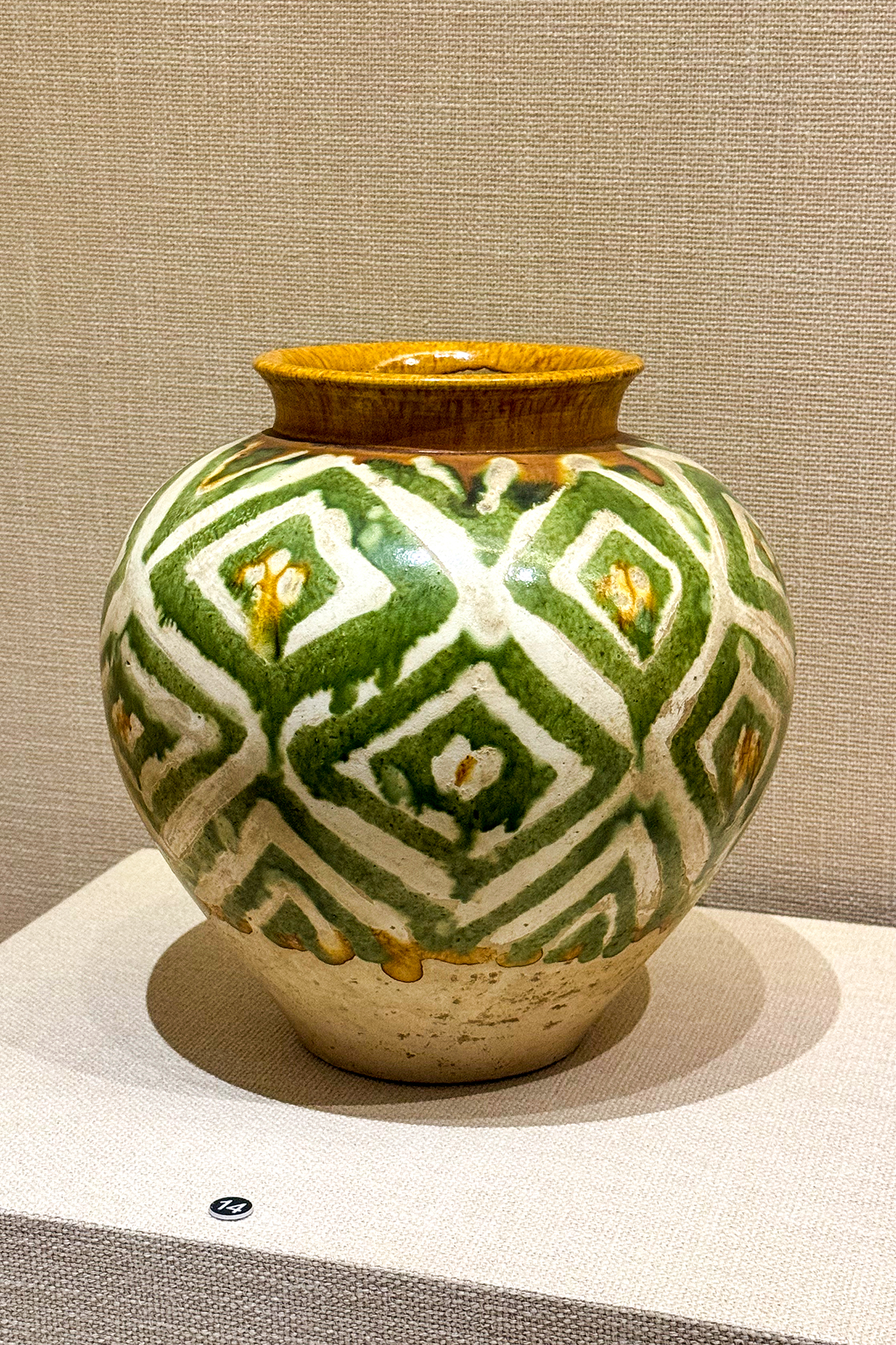
Other notable Tang-era technological achievements included advances in ceramic production, particularly the development of true porcelain at kilns in northern China; improvements in iron and steel metallurgy; the refinement of canal lock technology along the Grand Canal; and innovations in cartography and astronomical instrumentation. The Tang monk Yi Xing (683–727) conducted what may have been the first large-scale geodetic survey, measuring the length of a degree of meridian arc through observations at multiple stations along a north–south line, a project that anticipated European geodetic surveys by a millennium.2, 1
Decline and fall
The final century of the Tang dynasty was a period of progressive fragmentation punctuated by intermittent efforts at reform and recovery. After the An Lushan Rebellion, real power outside the capital increasingly lay with provincial military governors who controlled taxation, military recruitment, and civil administration in their territories, rendering the central government's authority nominal over large parts of the empire.1, 2 Within the court, eunuch factions competed with scholar-official factions for control of policy, and from the 820s onward, eunuchs effectively controlled the succession to the throne, installing and deposing emperors at will. The "Sweet Dew Incident" of 835, in which a botched attempt by Emperor Wenzong to eliminate the eunuch faction resulted in the massacre of hundreds of officials and their families, epitomised the dysfunction of late Tang court politics.1
The dynasty's death blow came not from the court or the frontier but from below. A series of devastating agrarian rebellions erupted in the 870s and 880s, fuelled by peasant grievances over taxation, official corruption, natural disasters, and the chronic insecurity of a society in which banditry and military violence had become endemic. The most destructive was the Huang Chao Rebellion (874–884), led by a failed examination candidate who overran the south, captured both Luoyang and Chang'an, and declared himself emperor of a rival Qi dynasty.1, 2 Although Huang Chao was eventually defeated by a coalition of Tang loyalist and Turkic Shatuo forces, the rebellion devastated the agricultural heartland and destroyed what remained of central government authority. The last Tang emperor, Ai Di, was deposed in 907 by the military strongman Zhu Wen, who proclaimed the Later Liang dynasty, inaugurating the chaotic Five Dynasties and Ten Kingdoms period (907–960) that preceded the reunification of China under the Song.1, 2
Despite its violent end, the Tang dynasty's cultural and institutional legacy proved extraordinarily durable. Tang poetry remained the gold standard of Chinese literary achievement. The civil service examination system, refined under the Tang, became the central institution of Chinese governance under the Song and subsequent dynasties. The Tang legal code provided the template for East Asian legal systems for centuries. And the cosmopolitan openness of Tang culture — its willingness to absorb and transform foreign influences from across Eurasia — established a model of cultural confidence that continued to shape Chinese self-understanding long after the dynasty itself had passed into history.2, 1
References
Science and Civilisation in China, Volume 5, Part 7: Military Technology; The Gunpowder Epic