Overview
- The Swahili coast civilization flourished along approximately 3,000 kilometres of the East African littoral and its offshore islands from roughly the first century CE onward, reaching its peak between the twelfth and fifteenth centuries. Cities such as Kilwa, Mombasa, Lamu, Zanzibar, and Mogadishu were nodes in an Indian Ocean trading network that connected East Africa to Arabia, Persia, India, Southeast Asia, and China.
- The civilization was defined by its maritime orientation, its cosmopolitan culture blending Bantu African and Islamic elements, and its distinctive stone-town architecture — coral-rag buildings, mosques, and palaces that reflected the wealth generated by the export of gold, ivory, iron, timber, and enslaved persons in exchange for textiles, ceramics, glass beads, and luxury goods from across the Indian Ocean world.
- The Swahili language, a Bantu language with significant Arabic loanwords, served as the lingua franca of Indian Ocean commerce and remains today one of the most widely spoken languages in Africa, used by over 100 million people across East and Central Africa.
The Swahili coast civilization encompasses the network of trading cities, towns, and settlements that developed along the eastern seaboard of Africa from southern Somalia to northern Mozambique, including the offshore islands of Zanzibar, Pemba, Mafia, Kilwa, Lamu, and the Comoros archipelago. The term "Swahili" derives from the Arabic sawahil (coasts), and the civilization is distinguished by its maritime orientation, its role as a bridge between the African interior and the Indian Ocean trading world, and its distinctive cultural synthesis of Bantu African and Islamic elements.1, 3 At its height between the twelfth and fifteenth centuries, the Swahili coast was one of the most commercially dynamic regions on earth, with cities such as Kilwa Kisiwani issuing their own coinage and importing Chinese porcelain, Indian textiles, and Persian glassware in quantities that attest to their integration into global exchange networks spanning from the South China Sea to the Mediterranean.4, 16

Origins and early settlement
The earliest evidence for coastal settlement and maritime activity on the East African coast comes from the first-century CE Greek mercantile guide known as the Periplus Maris Erythraei (Periplus of the Erythraean Sea), which describes a string of trading stations along the coast it calls "Azania," noting the export of ivory, rhinoceros horn, tortoiseshell, and palm oil, and the import of iron tools, weapons, glass, and wheat from the Mediterranean and Indian Ocean worlds.5 The Periplus indicates that the coast was already integrated into Indian Ocean commerce by the first century, though the settlements it describes were likely small-scale fishing and trading communities rather than the stone-built urban centres of the later period.5, 6
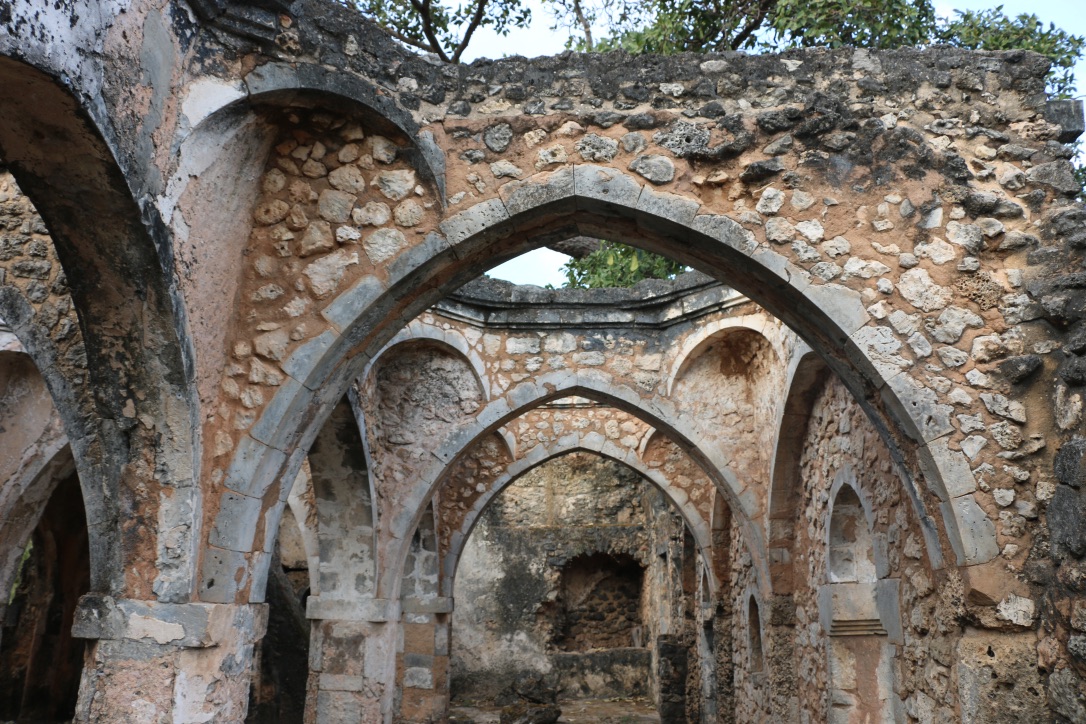
The Swahili settlements that emerged from the mid-first millennium CE onward were founded by Bantu-speaking communities who had migrated to the coast as part of the broader Bantu expansion across sub-Saharan Africa. Linguistic analysis demonstrates that Swahili is a Bantu language belonging to the Sabaki subgroup, closely related to languages spoken in the immediate hinterland, and that its basic grammatical structure and core vocabulary are African, not Arabic.7, 12 Archaeological evidence from sites such as Shanga on the Lamu archipelago (Kenya), excavated by Mark Horton, shows a continuous sequence of occupation from the eighth century onward, with the earliest phases characterised by timber-and-daub construction, local pottery, and modest quantities of imported goods, gradually giving way to coral-stone architecture, increasing imports, and the appearance of mosques in the ninth and tenth centuries.10
Indian Ocean commerce
The Indian Ocean monsoon system was the engine of Swahili commerce. The northeast monsoon (November to March) carried sailing vessels from Arabia, the Persian Gulf, and India to the East African coast, while the southwest monsoon (April to September) carried them back. This predictable annual cycle structured the trading calendar, with foreign merchants arriving during the northeast monsoon season, conducting business during a stay of several months, and departing with the shift in winds. The Silk Road and its maritime extension linked Swahili ports into a transcontinental network of exchange.6, 1
The primary exports of the Swahili coast were drawn from the African interior: ivory from elephants hunted in the hinterland, gold transported northward from the mines of the Zimbabwe Plateau (particularly through the port of Sofala), iron smelted in the interior and forged into tools and weapons, mangrove poles used as building timber in the treeless Persian Gulf region, ambergris, and enslaved persons. In return, the coast imported textiles (particularly from India), glass beads, Chinese and Islamic ceramics, glassware, and metals. The volume and variety of these imports, documented through archaeological excavation of Swahili stone towns, demonstrate a trade of considerable scale and regularity.4, 14
Kilwa Kisiwani, an island off the southern Tanzanian coast, emerged as the dominant commercial power on the Swahili coast between the twelfth and fifteenth centuries. Kilwa's ascendancy was linked to its control of the gold trade from the Zimbabwe interior channelled through the southern port of Sofala. The Kilwa sultans minted their own copper coinage, built the Husuni Kubwa palace complex (one of the largest pre-colonial structures in sub-Saharan Africa), and erected a great mosque whose coral-stone vaults and domes rank among the finest achievements of medieval African architecture. The Moroccan traveller Ibn Battuta, visiting Kilwa around 1331, described it as one of the most beautiful cities he had seen, noting its well-constructed stone buildings and its prosperity from the gold trade.4, 15
Chinese ceramics found at Swahili sites provide striking evidence of the coast's connections to the far reaches of the Indian Ocean world. Excavations at Kilwa, Manda, Shanga, and other sites have recovered thousands of sherds of Chinese stoneware and porcelain dating from the Tang dynasty (seventh to tenth centuries) through the Ming dynasty (fourteenth to seventeenth centuries). These imports, together with Islamic glazed wares and Indian beads, demonstrate that the Swahili coast was integrated into trading networks extending from southeastern China to the Mediterranean.16, 10
Stone towns and urban life
The most distinctive physical feature of Swahili civilization is the "stone town" (mji) — a densely built urban settlement of coral-rag houses, mosques, tombs, and public buildings, typically situated on an island or a narrow coastal promontory. Coral rag, quarried from fossilised reef limestone, was the primary building material, cut into blocks and bound with lime mortar. The houses of the elite featured carved coral doorframes, interior niches for the display of imported ceramics, and private ablution facilities, while mosques incorporated mihrab niches, minarets, and decorative plasterwork.3, 10
Stone-town society was stratified. A patrician class (waungwana) controlled long-distance trade, owned land, and dominated the political and religious life of the towns. Below them were free commoners, artisans, fishermen, and farmers, and below these were enslaved persons, who performed domestic and agricultural labour. The patrician identity was defined by genealogy (real or claimed descent from founding lineages), wealth, Islamic piety, and the command of Swahili language and culture. Intermarriage between African patrician families and Arab or Persian merchants occurred and contributed to the cosmopolitan character of Swahili elite culture, but the older colonial-era interpretation that the stone towns were founded by Arab or Persian colonists has been decisively refuted by archaeological and linguistic evidence demonstrating the Bantu African foundations of Swahili civilization.1, 9
Islam and cultural identity
Islam arrived on the Swahili coast through the same maritime trade networks that connected it to the wider Indian Ocean world. The earliest evidence for mosques on the coast dates to the eighth and ninth centuries at sites such as Shanga and Unguja Ukuu (Zanzibar), where small mosques were constructed alongside local shrines, suggesting a gradual process of Islamicisation rather than a single dramatic conversion event.10, 13 By the twelfth century, Islam had become the dominant religion of the stone-town elite, though the rural hinterland and non-patrician populations often maintained indigenous religious practices alongside or instead of Islamic observance.13
Islam provided the Swahili elite with a shared cultural framework that facilitated trade across the Indian Ocean. A Muslim merchant arriving in Kilwa from the Persian Gulf or Gujarat could expect to find familiar institutions — mosques, courts administering Islamic law, a shared calendar, and a common ethical vocabulary — that reduced the transaction costs of long-distance commerce. Swahili Islam was Sunni, predominantly following the Shafi'i school of jurisprudence, and it incorporated Sufi mystical practices and local African religious elements, including spirit possession cults and reverence for ancestral graves. This syncretic character was typical of Islam in maritime trading societies across the Indian Ocean world.1, 3
The Swahili language itself reflects the civilization's cultural position at the intersection of African and Indian Ocean worlds. Its grammatical structure — noun classes, verb morphology, and syntax — is thoroughly Bantu, while its vocabulary contains a significant layer of Arabic loanwords, particularly in domains related to trade, religion, navigation, and political administration. Portuguese, Persian, Hindi, and later English loanwords were added in subsequent centuries. The language served as a lingua franca of Indian Ocean commerce long before the colonial period, and its expansion into the African interior along trade routes made it the most widely spoken African language, used today by over 100 million speakers across East and Central Africa.12, 7
Portuguese disruption and transformation
The arrival of the Portuguese in the Indian Ocean at the end of the fifteenth century inaugurated a violent transformation of the Swahili coast's political and commercial order. Vasco da Gama's fleet reached the East African coast in 1498, and subsequent Portuguese expeditions sought to establish a monopoly over Indian Ocean trade by seizing control of strategic ports. Kilwa was attacked and occupied by Francisco de Almeida in 1505, and its ruling sultan was replaced by a Portuguese puppet. Mombasa was sacked in 1505 and again in 1528. The Portuguese built Fort Jesus in Mombasa in 1593, a massive stone fortification that symbolised their attempt to impose military control over the northern Swahili coast.11, 2
Portuguese intervention disrupted the existing trading networks but did not destroy the Swahili commercial system entirely. The Portuguese lacked the manpower to control the entire coast and focused their efforts on a few key ports while extracting tribute from others. Many Swahili towns continued to trade independently, and the Portuguese themselves relied on Swahili merchants and intermediaries for access to the African interior. The Omani Arabs, who drove the Portuguese from the northern Swahili coast in the late seventeenth century (culminating in the fall of Fort Jesus in 1698), subsequently established their own commercial hegemony, eventually making Zanzibar the capital of the Omani Sultanate of Zanzibar in the nineteenth century.11, 3
Legacy
The Swahili coast civilization's legacy is embedded in the linguistic, architectural, and cultural fabric of modern East Africa. The Swahili language, now the official or national language of Tanzania, Kenya, Uganda, and the Democratic Republic of the Congo, originated in the coastal trading culture and spread inland along nineteenth-century trade routes. The stone towns of Lamu, Zanzibar, and Kilwa Kisiwani are UNESCO World Heritage Sites that preserve the architectural traditions of the medieval trading cities. The Aksumite Empire to the north and Great Zimbabwe to the south were among the African polities connected to the same Indian Ocean networks that sustained the Swahili coast, and together these civilizations demonstrate the depth and sophistication of Africa's pre-colonial participation in global commerce.3, 14