Overview
- The Code of Hammurabi, inscribed on a 2.25-metre basalt stele around 1750 BCE during the reign of King Hammurabi of Babylon, is the best-preserved and most comprehensive legal compilation from the ancient Near East, containing 282 case laws governing property, family, commerce, labor, agriculture, and assault.
- The code's graduated system of justice applied the principle of lex talionis among social equals but imposed lesser penalties or monetary fines when injuries crossed class boundaries among the three recognized social strata: the awilum (free citizen), the mushkenum (dependent or commoner), and the wardum (slave).
- Although it was long regarded as the oldest law code, the Code of Hammurabi was preceded by the Sumerian Code of Ur-Nammu by roughly three centuries, and its relationship to the later biblical Covenant Code has become a major focus of comparative legal scholarship.
The Code of Hammurabi is the most complete and best-preserved legal compilation to survive from the ancient Near East. Inscribed in the Akkadian language on a monumental basalt stele during the reign of King Hammurabi of Babylon (circa 1792–1750 BCE, middle chronology), the code comprises a literary prologue, 282 case laws, and a concluding epilogue.1, 2 The stele was discovered in 1901–1902 at the site of ancient Susa in southwestern Iran, where it had been carried as spoils of war by an Elamite king in the twelfth century BCE. It now resides in the Musée du Louvre in Paris under inventory number Sb 8.9, 10 Although the code was once celebrated as the earliest known body of law, the subsequent discovery of the Sumerian Code of Ur-Nammu (circa 2100–2050 BCE) and the Laws of Eshnunna (circa 1930 BCE) demonstrated that Hammurabi inherited a long tradition of codified legal practice in Mesopotamia.1, 13 The Code of Hammurabi remains the most extensive and influential of these collections, offering an unparalleled window into the social structure, economic practices, and legal philosophy of Old Babylonian civilization.
Hammurabi and the Old Babylonian kingdom
Hammurabi was the sixth king of the First Dynasty of Babylon, an Amorite lineage that had established itself in the city during the early second millennium BCE. When he ascended to the throne around 1792 BCE, Babylon was a relatively minor city-state in a fragmented political landscape dominated by rival powers including Larsa to the south, Eshnunna to the east, and the kingdom of Upper Mesopotamia centred at Mari to the northwest.2, 3 Through a combination of diplomatic skill, strategic alliances, and military campaigns concentrated in the final decade of his forty-two-year reign, Hammurabi transformed Babylon from a regional polity into the dominant power in Mesopotamia. He defeated Rim-Sin I of Larsa around 1763 BCE, gaining control of the wealthy southern cities of Ur, Uruk, Nippur, and Isin; he subsequently conquered Eshnunna and the strategically important city of Mari, whose destruction around 1761 BCE eliminated his principal rival.2, 3

Hammurabi's administration extended well beyond military conquest. His surviving correspondence, preserved on thousands of clay tablets, reveals a ruler deeply involved in the daily management of his kingdom: adjudicating disputes, overseeing canal maintenance, managing temple revenues, and directing the allocation of agricultural land.3, 8 The law code should be understood within this broader context of centralized bureaucratic governance. By inscribing a comprehensive set of legal provisions on a publicly displayed monument, Hammurabi asserted both his authority as supreme judge and his legitimacy as a divinely appointed ruler responsible for maintaining justice and social order throughout his realm.2, 7
The stele and its discovery
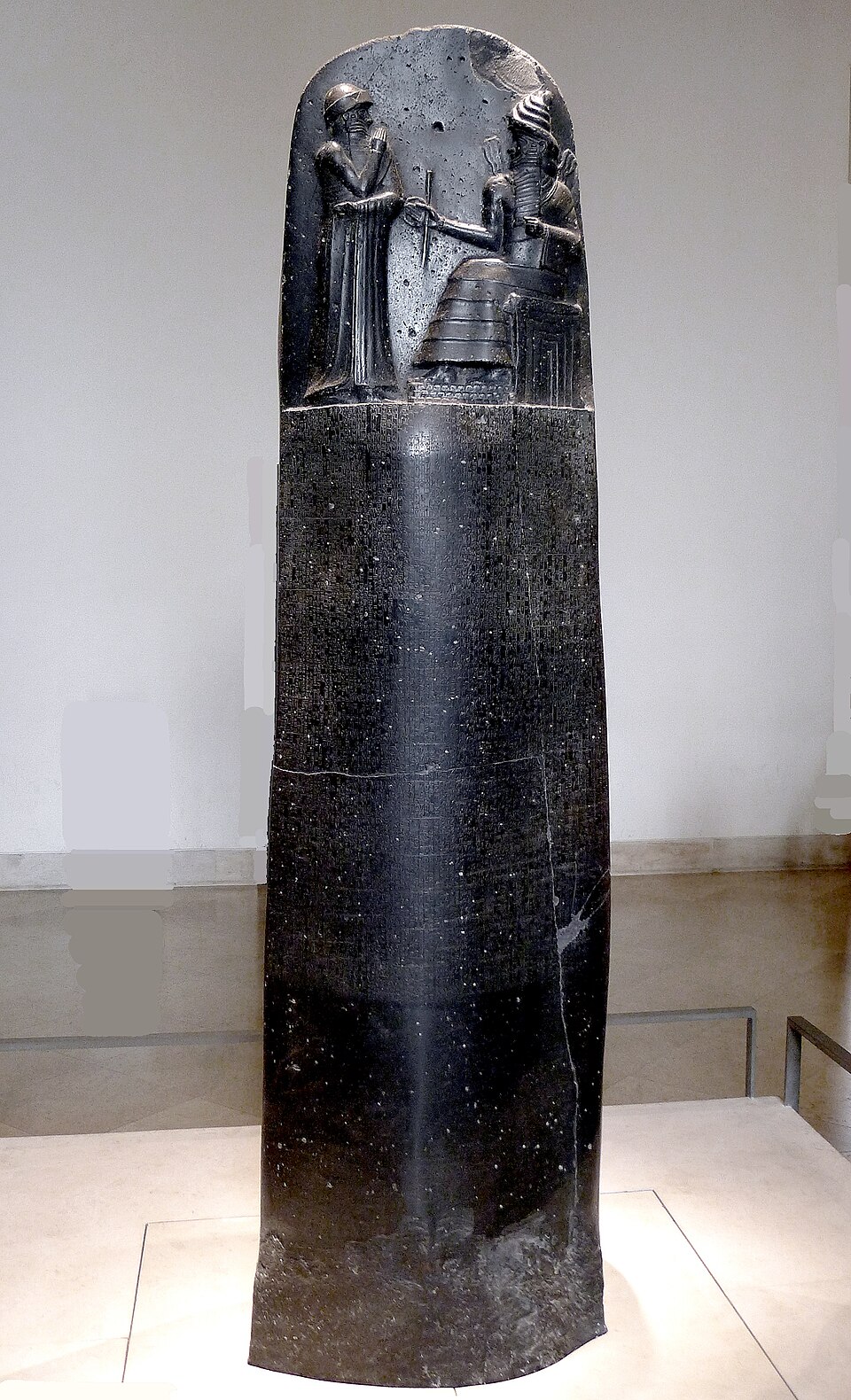
The Code of Hammurabi was inscribed on a stele of black basalt (sometimes described as diorite in older literature) standing approximately 2.25 metres tall.10 The upper portion bears a relief sculpture depicting Hammurabi standing before the seated god Shamash, the Babylonian deity of the sun and of justice. Shamash wears the horned crown of divinity, and flames — his solar attribute — rise from his shoulders. The precise meaning of the scene has been debated by scholars: interpretations include Hammurabi receiving the laws from the god, accepting the rod and ring symbols of royal sovereignty, or presenting the code for divine approval.1, 16 Regardless of the specific reading, the relief establishes an explicit connection between divine authority and the legal pronouncements carved below it.
The text occupies the remainder of the stele in approximately 4,130 lines of cuneiform script arranged in columns. The stele was not found in Babylon itself but at the site of ancient Susa (modern Shush, Iran), capital of the Elamite kingdom. It had been carried there as a trophy of war, most likely by the Elamite king Shutruk-Nahhunte during his invasion of Babylonia in the mid-twelfth century BCE.9, 10 Shutruk-Nahhunte appears to have erased seven columns of text from the front of the stele, apparently intending to inscribe his own commemorative text in their place, but the replacement inscription was never added. As a result, approximately 35 to 40 of the original provisions were lost from the stele itself, though many have since been recovered from clay tablet copies found at other Mesopotamian sites, including Babylon, Nineveh, Assur, Nippur, and Sippar.1, 5
The stele was discovered during the winter of 1901–1902 by an expedition led by the French archaeologist Jacques de Morgan. The Egyptologist Gustav Jéquier, a member of the team, unearthed the monument in three large fragments on the tell of the Susa acropolis. The fragments were joined, and the Dominican Assyriologist Jean-Vincent Scheil published the editio princeps — including a transliteration and French translation — in the fourth volume of the Mémoires de la Délégation en Perse in 1902.9 The discovery was immediately recognized as one of the most important finds in the history of Near Eastern archaeology, and the stele was transported to the Louvre, where it has remained on continuous display since 1902.10
Structure of the code
The Code of Hammurabi is organized into three distinct sections: a prologue, a body of case laws, and an epilogue. The prologue, occupying roughly 300 lines, is composed in an elevated literary style and establishes the theological and political framework for the laws that follow. In it, Hammurabi declares that the gods Anu and Enlil appointed him "to make justice prevail in the land, to abolish the wicked and the evil, to prevent the strong from oppressing the weak."1, 6 He enumerates his benefactions to the major cities and temples of his realm, presenting himself as a pious shepherd of his people and a servant of the gods.
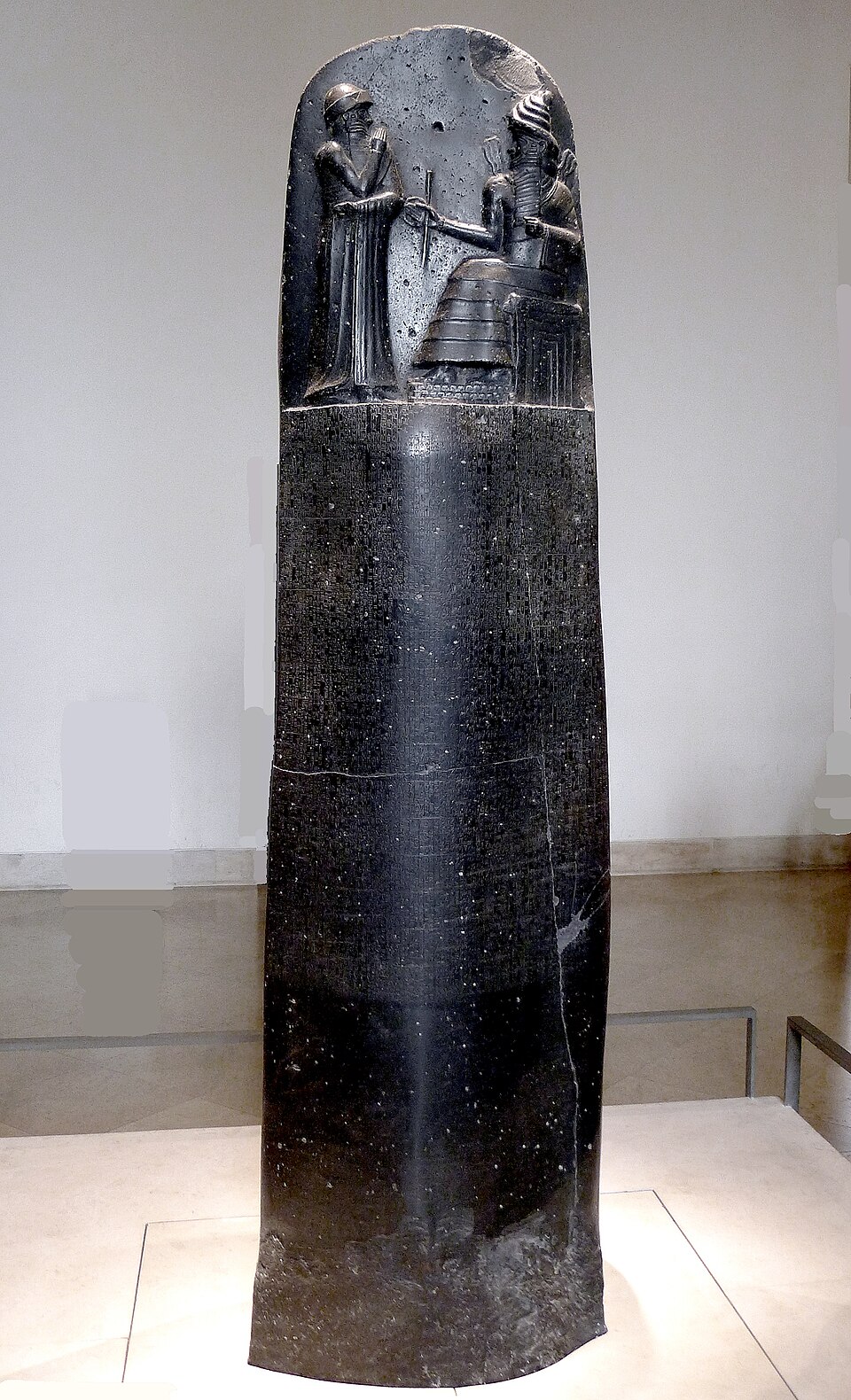

The body of the code contains 282 case laws, each formulated in the casuistic (case-law) pattern characteristic of Mesopotamian legal tradition: "If a man does X, then Y shall be the consequence." The laws are not organized under formal headings — no such divisions appear in the original text — but scholars have identified a broadly thematic arrangement that progresses through several major categories.1, 4 The code opens with provisions concerning judicial procedure and false accusations (laws 1–5), followed by offences against property (laws 6–25), regulations governing land tenure, agriculture, and irrigation (laws 26–75), commercial transactions, debt, and merchant activity (laws 76–126), family law including marriage, divorce, inheritance, and adoption (laws 127–195), personal injury and assault (laws 196–214), and professional liability, labour, and fees for physicians, builders, boatmen, and agricultural workers (laws 215–282).1, 21
The epilogue, approximately 500 lines in length, returns to the elevated literary register of the prologue. Hammurabi exhorts future rulers to uphold his laws, invokes blessings upon those who do, and calls down elaborate curses upon any successor who would alter or disregard his inscribed judgments.1, 5 The trilateral structure of prologue, laws, and epilogue is not unique to Hammurabi; it appears in earlier Mesopotamian law collections as well, though in the Code of Hammurabi it achieves its most elaborate and rhetorically sophisticated form.1
Social hierarchy and lex talionis
One of the most distinctive features of the Code of Hammurabi is its graduated system of justice, in which the severity of punishments and the value of compensation vary according to the social status of both the perpetrator and the victim. The code recognizes three primary social categories: the awilum (a free citizen of the upper class), the mushkenum (a dependent or commoner, whose precise social and legal standing remains debated among scholars), and the wardum (a slave, who was considered property but retained certain limited legal protections).1, 4, 8
The principle of lex talionis — retaliatory justice proportional to the offence, popularly summarized as "an eye for an eye" — is applied in the code only among social equals of the highest class. Law 196 states: "If an awilum should blind the eye of another awilum, they shall blind his eye." Law 197 continues: "If he should break the bone of another awilum, they shall break his bone."1, 6 However, when the same injuries are inflicted upon a person of lower status, the code prescribes monetary compensation rather than physical retaliation. Law 198 specifies that if an awilum blinds the eye of a mushkenum, he shall pay one mina of silver (approximately 500 grams); law 199 further provides that if a man blinds the eye or breaks the bone of another man's slave, he shall pay one-half the slave's value.1, 21
Graduated penalties for assault by social class of victim1, 6
| Offence | Victim: awilum | Victim: mushkenum | Victim: wardum |
|---|---|---|---|
| Blinding an eye (Laws 196, 198, 199) | Offender's eye blinded | 1 mina of silver (~500 g) | Half the slave's purchase price |
| Breaking a bone (Laws 197, 198) | Offender's bone broken | 1 mina of silver (~500 g) | Half the slave's purchase price |
| Knocking out a tooth (Laws 200, 201) | Offender's tooth knocked out | ⅓ mina of silver (~167 g) | Not specified |
| Striking the cheek of a social superior (Law 202) | 60 strikes with an ox-hide whip in public assembly | ||
This system reveals a society in which legal personhood was not uniform. The awilum enjoyed the fullest protections under law, while injuries to persons of lower status were treated essentially as property damage to be compensated financially. The mushkenum occupied an intermediate position that scholars have variously interpreted as a palace dependent, a state tenant, or simply a commoner without the full privileges of the upper class.4, 8 Slaves, though classified as property, were not entirely without recourse: the code includes provisions governing their medical treatment, their right to engage in certain commercial transactions, and the conditions under which they could obtain freedom.1
Major categories of law
The breadth of the Code of Hammurabi is remarkable. Its 282 provisions address nearly every domain of social and economic life in Old Babylonian society, providing modern historians with an exceptionally detailed, if idealized, portrait of an early urban civilization.
Property and commerce. The code devotes extensive attention to the regulation of economic transactions. Laws governing the hire of fields, orchards, and houses establish the rights and obligations of landlords and tenants. Agricultural provisions specify the penalties for negligent irrigation that damages a neighbour's crops (laws 53–56) and regulate the terms under which shepherds are held responsible for livestock entrusted to their care.1, 21 Commercial law governs the activities of merchants (tamkarum) and their agents (shamallum), prescribing the terms of partnership agreements, the obligations of parties to commercial loans, and the penalties for fraud. Laws 100–107 regulate long-distance trade and establish that agents must provide written receipts for money advanced to them by their principals.1, 8
Family and inheritance. The family-law provisions (laws 127–195) constitute nearly one-quarter of the entire code and address marriage, divorce, adultery, inheritance, and adoption in considerable detail. Marriage was formalized through a written contract; without such a contract, a woman was not legally considered a wife (law 128).1 A husband could divorce his wife, but the code imposed financial obligations upon him depending on the circumstances: if the wife had borne children, the husband was required to return her dowry and provide her with usufruct of a field, orchard, or other property sufficient to raise the children (law 137). Women possessed certain property rights, including the right to retain their dowry and any gifts received from their husbands, and a wife whose husband was taken prisoner of war could enter the household of another man without penalty if she lacked the means to support herself (laws 133–136).1, 4
Professional liability. Some of the code's most striking provisions govern the liability of professionals, particularly physicians and builders. Laws 215–223 establish a fee schedule for surgical procedures that varies by the social class of the patient: a physician who successfully performs a major operation on an awilum receives ten shekels of silver, but only five shekels for a mushkenum and two shekels for a slave.1, 17 The penalties for malpractice are severe. If a physician performs surgery on an awilum and causes the patient's death or the loss of an eye, the physician's hands are to be cut off (law 218). If the patient is a slave, the physician must replace the slave with one of equal value (law 219).1, 17 Similarly, a builder whose negligently constructed house collapses and kills the owner is subject to the death penalty (law 229); if the owner's son is killed, the builder's son is put to death (law 230), a provision that extends vicarious liability across generations.1, 6
Earlier Mesopotamian law codes
When the Code of Hammurabi was first published in 1902, it was hailed as the oldest known body of law in the world. Subsequent archaeological discoveries revealed that it was, in fact, the culmination of a legal tradition stretching back at least three centuries before Hammurabi's reign.
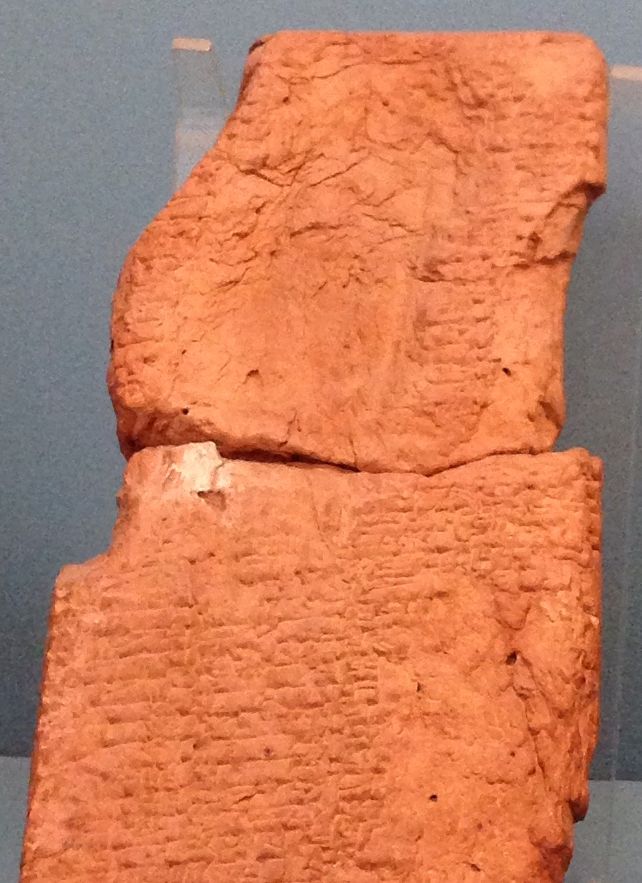

The Code of Ur-Nammu, composed during the Third Dynasty of Ur (circa 2100–2050 BCE), is the oldest extant law code. Identified and translated by Samuel Noah Kramer in 1952 from fragmentary tablets found at Nippur and Ur, the Code of Ur-Nammu contains approximately 57 provisions, of which some 30 are sufficiently preserved to be read.13, 1 Its prologue, like that of Hammurabi, presents the king as a divinely appointed guardian of justice. A critical difference between the two codes lies in their approach to punishment: where the Code of Hammurabi imposes physical retaliation for bodily harm among equals, the Code of Ur-Nammu consistently prescribes monetary fines. If a man blinds another man's eye, the penalty is the payment of half a mina of silver — not the blinding of the offender's eye.13
The Laws of Eshnunna, dated to approximately 1930 BCE, were discovered in 1945–1947 and published by Albrecht Goetze in 1956. Containing roughly 60 provisions, they regulate prices, wages, marriage, assault, and the liability of animal owners for injuries caused by their livestock.12 Several provisions in the Laws of Eshnunna bear close resemblance to laws in both the Code of Hammurabi and the later biblical Covenant Code, including regulations concerning goring oxen that are nearly identical to those found in Exodus 21:28–36.11, 12
The Code of Lipit-Ishtar, composed around 1934–1924 BCE for the king of Isin, also predates Hammurabi and shares the trilateral structure of prologue, laws, and epilogue.1 Together, these earlier collections demonstrate that Hammurabi did not invent the concept of codified law but rather drew upon and systematized a deeply rooted Sumerian and Akkadian legal tradition. His achievement lay in the comprehensiveness of his compilation, the sophistication of its literary framing, and the durable medium on which it was inscribed.1, 4
Major Mesopotamian law collections in chronological order1, 4, 13
| Law collection | Approximate date | Language | Provisions | Punishment approach |
|---|---|---|---|---|
| Code of Ur-Nammu | c. 2100–2050 BCE | Sumerian | ~57 (30 legible) | Monetary fines |
| Laws of Eshnunna | c. 1930 BCE | Akkadian | ~60 | Mixed (fines and physical) |
| Code of Lipit-Ishtar | c. 1934–1924 BCE | Sumerian | ~38 | Monetary fines |
| Code of Hammurabi | c. 1750 BCE | Akkadian | 282 | Lex talionis and fines |
Relationship to later legal traditions
The discovery of the Code of Hammurabi in 1902 immediately provoked scholarly comparison with the legal provisions of the Hebrew Bible, particularly the Covenant Code (Exodus 20:22–23:33), the oldest legal collection in the Pentateuch. Parallels between the two texts are numerous and, in some cases, remarkably specific. Both collections employ the casuistic "if...then" formula. Both contain provisions governing goring oxen, bodily injury, theft, deposit of goods, and the treatment of slaves. Both apply the principle of lex talionis, stated explicitly in Exodus 21:23–25 as "eye for eye, tooth for tooth, hand for hand, foot for foot."11, 6
The nature of the relationship between these texts has been debated for more than a century. In the years following the code's discovery, some scholars proposed that the biblical authors had directly borrowed from Hammurabi's laws. Others, particularly those working within confessional traditions, emphasized the significant differences between the two — the Covenant Code's theological framing of law as a divine covenant, its relatively more egalitarian treatment of social classes, and its distinctive humanitarian provisions regarding the treatment of foreigners, widows, and orphans.11
Contemporary scholarship has moved toward a more nuanced position. In his 2009 monograph Inventing God's Law, David P. Wright argued that the Covenant Code was composed by Judahite scribes during the period of Neo-Assyrian domination (circa 740–640 BCE), when copies of the Laws of Hammurabi were widely available as part of the scribal curriculum throughout the Assyrian empire. Wright demonstrated that the Covenant Code depends directly upon the Laws of Hammurabi as a source text, but revises and transforms them in systematic ways to reflect Israelite theological and social values.11 This scholarly consensus holds that the relationship is neither one of simple borrowing nor of independent invention, but of creative literary revision within a shared ancient Near Eastern legal tradition.4, 11
What the code reveals about Babylonian society
Whether or not the Code of Hammurabi was enforced as a practical legal statute — a question that scholars have debated extensively, since very few surviving court documents explicitly cite the code as their legal basis — it remains an invaluable source of information about the structure and values of Old Babylonian society.4, 7, 14
The code portrays a complex, stratified urban society organized around agriculture, long-distance trade, and temple-centred religious practice. Its provisions presuppose a functioning bureaucratic state with written contracts, standardized weights and measures, professional specialization, and a judiciary capable of hearing disputes and enforcing judgments.8, 15 The elaborate regulations governing commercial partnerships, agency relationships, and the hire of agricultural labourers reveal an economy of considerable sophistication, in which credit, interest, and profit-sharing arrangements were routine features of commercial life.1, 8
The family-law provisions illuminate gender relations in ways that are both revealing and complex. Women in Old Babylonian society were not legal equals of men, but neither were they without rights. The code protects a wife's dowry as her personal property, provides for the maintenance of divorced women, and grants widows usufruct rights to their deceased husbands' estates for the purpose of raising children.1, 4 At the same time, the penalties for adultery fell disproportionately on women: a wife caught in adultery could be bound and thrown into the river (law 129), while a man's extramarital relations with an unmarried woman carried no comparable penalty.1 The code's provisions on marriage, divorce, and inheritance thus reflect a patriarchal social order in which women possessed limited but meaningful legal protections within the framework of male authority.
The medical provisions (laws 215–223) offer a rare glimpse into the practice of surgery in the ancient world and suggest that physicians occupied an ambiguous social position, valued for their skills but subject to harsh penalties for failure. The fee schedule indicates that medicine was a regulated profession, and the differential pricing by social class confirms that even access to medical care was stratified by rank.1, 17 Some scholars have speculated that the severity of the malpractice penalties may have discouraged physicians from attempting risky procedures on upper-class patients, though the extent to which these provisions were actually enforced remains uncertain.7, 17
Significance for early state formation
The Code of Hammurabi represents far more than a catalogue of specific legal rules. It is a monumental expression of early state ideology — a public declaration that the king, acting under divine mandate, has established a regime of justice and order that encompasses every aspect of social and economic life. The prologue's claim that Hammurabi was chosen by the gods "to make justice prevail in the land" and the epilogue's invocation of curses against any ruler who would abrogate the laws together construct a vision of kingship in which the sovereign's primary legitimacy derives from his role as guarantor of social justice.1, 2
This conception of royal authority was not unique to Hammurabi. Earlier Mesopotamian kings, including Ur-Nammu and Lipit-Ishtar, had similarly presented themselves as protectors of the weak against the strong. But the Code of Hammurabi articulates this ideology with unprecedented scope and ambition, systematizing the legal obligations of a complex, multi-ethnic empire in which the centralization of judicial authority was essential to the maintenance of political control.2, 3, 18, 19
The very act of inscribing the laws on a monumental stele and erecting it in a public space — probably the temple of Shamash at Sippar, from which it was later looted — was itself a political act. It made the king's justice visible and permanent, asserting that the norms governing social life were not arbitrary or subject to the whims of local officials, but were fixed, knowable, and sanctioned by divine authority.2, 7 The proliferation of clay tablet copies of the code found at sites across Mesopotamia and dating from centuries after Hammurabi's death suggests that the text achieved canonical status within the scribal tradition, serving as a model for legal reasoning and literary composition long after the political structures of the Old Babylonian kingdom had collapsed.1, 5
The Code of Hammurabi thus stands at a critical juncture in the history of governance. It demonstrates that by the early second millennium BCE, societies in the ancient Near East had developed the administrative infrastructure, the literary sophistication, and the political ideology necessary to articulate comprehensive legal norms, commit them to durable written form, and deploy them as instruments of state authority.4, 15, 20 In this sense, the code is not merely a legal document but one of the earliest surviving monuments of bureaucratic statecraft — evidence that the impulse to govern through codified, publicly accessible law is as old as civilization itself.
References
Inventing God's Law: How the Covenant Code of the Bible Used and Revised the Laws of Hammurabi