Overview
- The major transitions in human cultural history—language, symbolic thought, agriculture, urbanization, and global migration—were not singular events but extended processes, each unfolding independently in multiple regions of the world over thousands of years.
- Language enabled cumulative cultural transmission; art and symbolism marked the emergence of shared meaning systems; agriculture transformed the ecological relationship between humans and their environments; and urbanization created the institutional complexity that defines civilizations.
- Population genetics and ancient DNA have revealed that the global distribution of human diversity reflects a series of great migrations—out of Africa, into the Americas, across the Pacific—each leaving distinctive genetic, linguistic, and archaeological signatures.
The cultural history of Homo sapiens is defined by a series of transformative achievements—language, art, agriculture, cities, writing—that collectively distinguish the human species from every other organism on Earth. These milestones were not discrete inventions arriving in a single moment of inspiration; each was a protracted process, unfolding over thousands of years and arising independently in multiple regions of the world.7, 8 The archaeological, genetic, and linguistic evidence reveals that the trajectory of human cultural development was neither linear nor universal: different populations reached similar endpoints through different pathways, at different times, and under different ecological pressures. What the milestones share is their cumulative character—each built upon earlier achievements, and each irreversibly altered the conditions of human existence.
Language and cumulative culture
Language is the foundational technology of human culture. No other species possesses a communication system capable of generating an effectively infinite number of novel utterances from a finite set of elements, and no other species transmits complex information cumulatively across generations through purely social learning.1 The biological prerequisites for speech—a descended larynx, fine motor control of the vocal apparatus, specialized cortical areas including Broca's and Wernicke's regions, and a derived form of the FOXP2 gene—are products of natural selection acting on the hominin lineage over millions of years.1 Yet language is not merely a biological capacity; it is a cultural artifact, learned within communities and continuously changing through processes of sound shift, grammatical restructuring, and vocabulary innovation that historical linguists study through the comparative method.
The evolutionary origins of language cannot be dated directly, since spoken words leave no fossil trace. Researchers instead rely on indirect proxies: the anatomy of the vocal tract as preserved in hyoid bones and basicranial morphology, the archaeological record of symbolic behavior, and the genetics of language-related neural pathways.1 The convergence of this evidence suggests that fully modern language capacity was present in Homo sapiens by at least 100,000 years ago, and possibly substantially earlier. The roughly 7,000 languages spoken today are the products of tens of thousands of years of divergence and diversification, grouped by linguists into families—Indo-European, Sino-Tibetan, Niger-Congo, Austronesian, and many others—whose internal branching patterns record the migrations and separations of ancient populations.1
Art, symbolism, and cognitive modernity
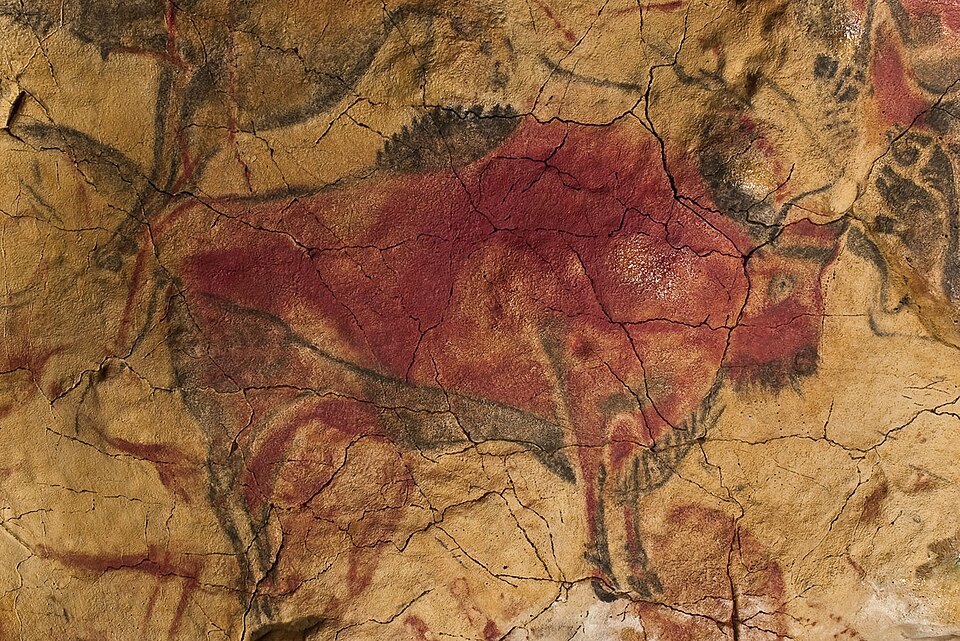

The emergence of symbolic thought—the capacity to assign arbitrary meanings to objects, marks, and sounds, and to manipulate those meanings according to shared conventions—is among the most significant transitions in human cognitive history. Archaeological evidence for this capacity appears earliest in Africa, where sites such as Blombos Cave in South Africa have yielded engraved ochre pieces bearing geometric crosshatch patterns dated to approximately 75,000 years ago, perforated shell beads interpreted as body ornamentation from 100,000 years ago, and an ochre-processing workshop from around the same period.2 These artifacts demonstrate that the cognitive operations underlying symbolic communication were in place long before the appearance of figurative art.
The earliest known figurative art—depictions of animals and human-animal composite figures—dates to at least 51,200 years ago in a limestone cave in Sulawesi, Indonesia, substantially predating the earliest European examples at sites such as Chauvet Cave in France.3 The geographic breadth of early art, spanning Southeast Asia, Europe, and Africa, indicates that the capacity for representational depiction was carried by Homo sapiens populations as they dispersed across the globe, rather than developing in any single region after dispersal.3, 8 Art and ornamentation served not merely as aesthetic expressions but as media for encoding social identity, religious belief, and group membership—functions that presuppose shared conventions of meaning and thus provide indirect evidence for fully modern language.
The Neolithic Revolution and the origins of agriculture
For more than 95% of the species' existence, all humans lived as mobile hunter-gatherers. The transition to food production—the cultivation of plants and the domestication of animals—began approximately 12,000 years ago and is conventionally called the Neolithic Revolution, though the process was gradual rather than sudden, extending over millennia at each of its multiple independent points of origin.4 In the Fertile Crescent of the Near East, the wild progenitors of emmer wheat, einkorn wheat, barley, lentils, peas, sheep, goats, cattle, and pigs were first brought under human management between roughly 11,500 and 9,000 years ago. Independent centers of domestication emerged in China (rice and millet), Mesoamerica (maize, squash, beans), the Andes (potatoes, llamas), eastern North America (sunflower, squash), sub-Saharan Africa (sorghum, pearl millet), and New Guinea (taro, yam).4, 7
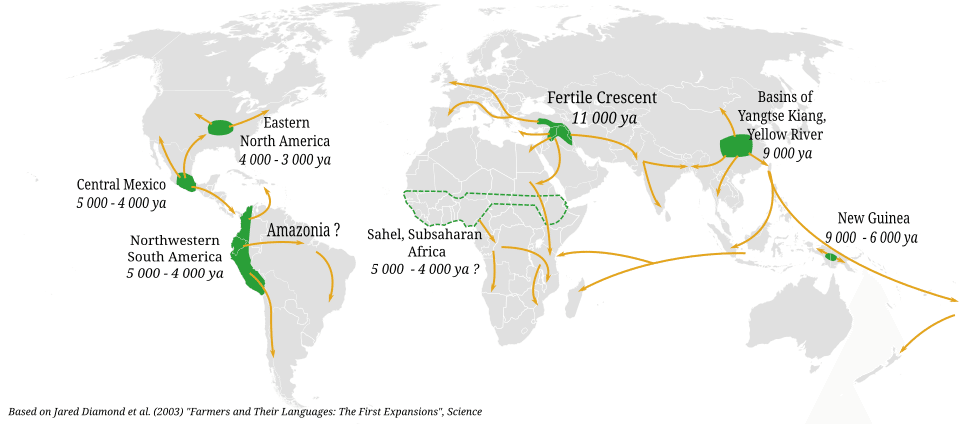

The consequences of the agricultural transition were enormous and far-reaching. Sedentary farming communities could support larger and denser populations than mobile foraging bands, creating the demographic foundation for occupational specialization, social stratification, and political centralization.7 At the same time, the transition to farming brought new vulnerabilities: increased susceptibility to epidemic disease in dense settlements, nutritional deficiencies from reliance on a narrow range of staple crops, and the emergence of inequality between those who controlled land and surplus and those who did not.4, 8 The Neolithic Revolution was not simply a story of progress; it was a fundamental restructuring of human ecology with both benefits and costs that continue to shape the modern world.
Urbanization and the rise of civilizations
The emergence of the first cities, beginning in Mesopotamia around 3500 BCE, represented a qualitative leap in social complexity. The city of Uruk in southern Iraq reached a population of approximately 40,000 by 3200 BCE, making it the largest human settlement in the world at the time.5 Urban life required and produced new forms of social organization: centralized administration, occupational specialization far beyond what village-scale societies could support, long-distance trade networks, monumental public architecture, and—most consequentially—writing. The earliest known writing, proto-cuneiform from Uruk dating to approximately 3300 BCE, originated not as a literary medium but as an accounting tool for tracking grain, livestock, and labor within the temple economy.5


Urbanization and state formation occurred independently in multiple regions: Mesopotamia, Egypt, the Indus Valley, China, Mesoamerica, and the Andes each developed complex societies with cities, monumental architecture, and systems of recording information, though not all developed full writing systems.7 The convergent emergence of urban civilizations in geographically and culturally independent settings demonstrates that the trajectory from agriculture to urbanism, while not inevitable, was a recurrent response to the demographic pressures and organizational demands created by food-producing economies.5, 7 Each civilization developed its own distinctive institutions, technologies, and symbolic systems, and the comparative study of these independent trajectories remains one of anthropology's most productive research programs.
Migration and global human diversity
The global distribution of human biological and cultural diversity is the product of a series of great migrations that began with the dispersal of Homo sapiens out of Africa approximately 70,000 years ago.6, 8 Genomic analyses of both living populations and ancient DNA have reconstructed the major routes and timings of these movements. Modern humans reached Australia by at least 65,000 years ago, requiring a sea crossing that demonstrates sophisticated maritime capability even at this early date. Europe was colonized by approximately 45,000 years ago, with populations encountering and interbreeding with Neanderthals who had inhabited the continent for hundreds of thousands of years. The Americas were reached by at least 16,000 years ago, with entry most likely via a coastal route along the Pacific rim from Beringia.6, 8
Later migrations associated with the spread of agriculture further reshaped global human diversity. The Bantu expansion carried farming populations and Niger-Congo languages across sub-Saharan Africa within the past 5,000 years. The Austronesian expansion, beginning from Taiwan approximately 5,500 years ago, spread populations and languages across island Southeast Asia, the Pacific, and ultimately to Madagascar—one of the most geographically extensive colonization events in human history.7 Population genetics has revealed that these migrations were not simple replacements of earlier populations but complex processes involving admixture, displacement, and cultural exchange.6 The patterns of genetic, linguistic, and archaeological variation observable in the modern world are the cumulative product of these overlapping waves of movement, contact, and divergence.