Overview
- Stone tool production spans over three million years of hominin history, from the earliest Lomekwian cores dated to 3.3 million years ago through the sophisticated ground stone implements of the Neolithic, representing the longest-enduring technological tradition of any species on Earth.
- The progressive refinement of knapping techniques from simple Oldowan choppers to standardized Acheulean handaxes to prepared-core Levallois methods and Upper Paleolithic blade technologies tracks increasing cognitive complexity, hierarchical planning, and the emergence of cultural transmission among hominin lineages.
- Stone tool traditions provide the most durable and widespread evidence for reconstructing hominin behavioral evolution, with changes in tool complexity, raw material sourcing, and reduction strategies closely correlated with brain expansion, language development, and the capacity for cumulative culture.
Stone tool technology is the oldest and longest-enduring tradition of material culture in the hominin lineage. The deliberate shaping of stone by percussion — a practice called knapping — extends back at least 3.3 million years to the Lomekwian industry of West Turkana, Kenya, and persisted as the primary means of producing cutting, scraping, and piercing implements until the widespread adoption of metallurgy in the Holocene.1 Because stone is virtually indestructible compared to organic materials such as wood, bone, or hide, lithic artifacts constitute the most abundant and geographically widespread evidence for hominin behavior in the archaeological record. The progressive changes in how hominins selected raw materials, prepared cores, detached flakes, and shaped finished tools provide an unparalleled window into the cognitive evolution of the human lineage over more than three million years.3, 17
Archaeologists classify stone tool traditions into a series of technological modes, each characterized by increasingly complex reduction strategies and a greater degree of standardization in the finished product. These modes do not represent a rigid evolutionary ladder — different hominin species in different regions adopted and abandoned technologies at different times — but they nevertheless document a broad trajectory from simple, opportunistic flaking to the elaborate, multi-step production sequences of the Upper Paleolithic and Neolithic.9, 11
The Lomekwian: earliest known stone tools
The oldest securely dated stone tools in the archaeological record come from the site of Lomekwi 3 on the western shore of Lake Turkana in northern Kenya. Excavated by a team led by Sonia Harmand and announced in 2015, the Lomekwian assemblage consists of approximately 150 artifacts — cores, flakes, and anvils — found in sediments dated by paleomagnetic and radiometric methods to approximately 3.3 million years ago (Ma), roughly 700,000 years older than the previously oldest known tools from Gona, Ethiopia.1 The Lomekwian artifacts are notably large and heavy compared to later Oldowan tools, with cores weighing up to 15 kilograms, and the flaking patterns suggest a technique combining passive hammer (resting the core on an anvil and striking it) and bipolar percussion.1
The identity of the Lomekwian toolmaker remains uncertain. The temporal and geographic context places the tools near the range of Kenyanthropus platyops, a contemporaneous hominin species known from the same region of West Turkana, but no direct association between tools and hominin fossils has been established at Lomekwi 3.1 The discovery pushed the origin of stone tool manufacture back to a period before the emergence of the genus Homo, demonstrating that the cognitive and motor capacities necessary for intentional stone knapping were present in earlier hominin lineages. Cut marks on animal bones from the site of Dikika, Ethiopia, dated to approximately 3.39 Ma, have been interpreted as possible evidence of stone tool use even earlier, though debate persists over whether the marks were produced by hominins or by natural processes such as trampling.15
The Oldowan (Mode 1)
The Oldowan industry, named after Olduvai Gorge in Tanzania where Louis and Mary Leakey first described it in the 1930s, is the first well-documented and widespread stone tool tradition. Oldowan assemblages appear in the archaeological record by approximately 2.6 Ma at sites in the Afar region of Ethiopia, including Gona and Hadar, and persist until roughly 1.7 to 1.5 Ma, overlapping temporally with the emergence of Acheulean technology.2, 3 The Oldowan has been identified across much of eastern and southern Africa, and possible Oldowan-like assemblages have been reported from sites in North Africa, the Levant, and East Asia, suggesting that Mode 1 technology accompanied the earliest hominin dispersals out of Africa.3
Oldowan technology is characterized by the production of sharp-edged flakes by striking a cobble (the core) with another stone (the hammerstone) using direct hard-hammer percussion. The resulting flakes, typically only a few centimetres in length, served as the primary functional tools for cutting meat, scraping hides, and processing plant materials, while the cores — often called choppers or discoids — may also have been used directly. There is little evidence of deliberate shaping of the core beyond what was necessary to produce usable flakes, and Oldowan assemblages show minimal standardization in tool form.3 Despite their apparent simplicity, experimental replication studies have demonstrated that producing effective Oldowan flakes requires a non-trivial understanding of conchoidal fracture mechanics, including the selection of appropriate raw materials, the identification of suitable striking platforms, and the precise control of strike angle and force.3, 14
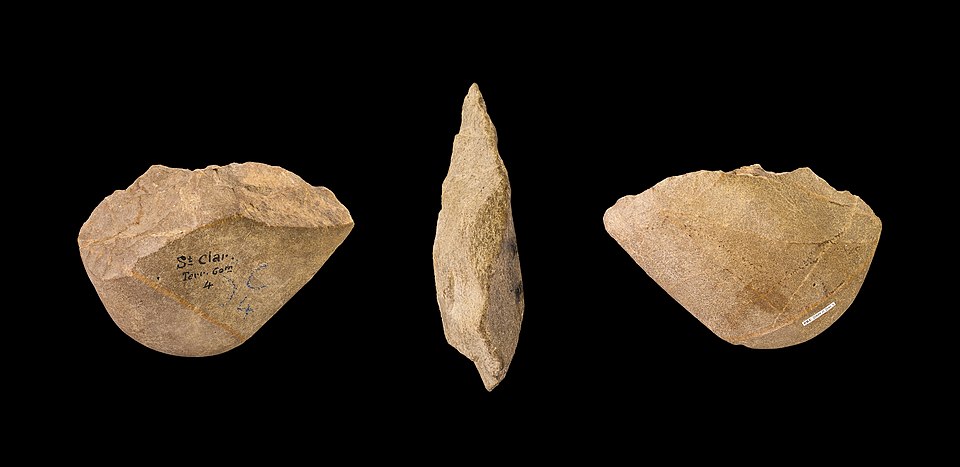

The Oldowan is most commonly associated with Homo habilis, the earliest widely recognized member of the genus Homo, though Australopithecus garhi and robust australopithecines such as Paranthropus boisei have also been found in association with Oldowan sites. Experimental studies with bonobos have shown that trained great apes can produce flakes by percussion, but the resulting products are consistently less controlled and less efficient than even the simplest Oldowan artifacts, suggesting that hominin toolmakers possessed manual dexterity and cognitive abilities beyond those of living apes.14
The Acheulean (Mode 2)
_Wellcome_M0015373.jpg)
_Wellcome_M0015373.jpg)
The Acheulean industry, first described from the site of Saint-Acheul in northern France in the nineteenth century, represents a transformative advance in stone tool technology. The earliest known Acheulean artifacts, dated to approximately 1.76 Ma, come from the site of Kokiselei 4 in the West Turkana region of Kenya.4 The hallmark of the Acheulean is the handaxe (or biface): a large, teardrop- or oval-shaped tool flaked on both faces to produce a symmetrical form with a continuous cutting edge around most of its perimeter. Acheulean toolmakers also produced cleavers — bifacially flaked tools with a straight, unretouched cutting edge at one end — and large flake blanks from which bifaces were shaped.4, 5
The production of a handaxe requires significantly more cognitive planning than Oldowan flaking. The toolmaker must maintain a mental template of the desired final form while systematically removing flakes from alternating faces of the core, adjusting the reduction strategy in response to the raw material's fracture properties, flaws, and evolving geometry. This process, which can involve dozens of carefully sequenced removals, demands hierarchical planning: the capacity to organize multiple sub-goals into a coherent sequence directed toward a predetermined outcome.16 Neuroimaging studies of modern humans replicating Acheulean handaxes have shown activation of prefrontal cortical regions associated with executive function, working memory, and action planning — regions that are not significantly engaged during simpler Oldowan flaking.16, 17
The Acheulean is strongly associated with Homo erectus (and its African variant Homo ergaster), the hominin species that achieved the first major expansion of brain size and body proportions toward modern human ranges. The Acheulean persisted for an extraordinary span of time — from 1.76 Ma to approximately 250,000 years ago — making it the longest-lasting single tool tradition in human prehistory.4, 5 The remarkable consistency of handaxe form across this vast temporal and geographic range, spanning Africa, western Europe, the Near East, and the Indian subcontinent, has prompted debate over whether the design represents a culturally transmitted template, a cognitively constrained default, or some combination of both factors.5
Prepared-core technologies (Mode 3)
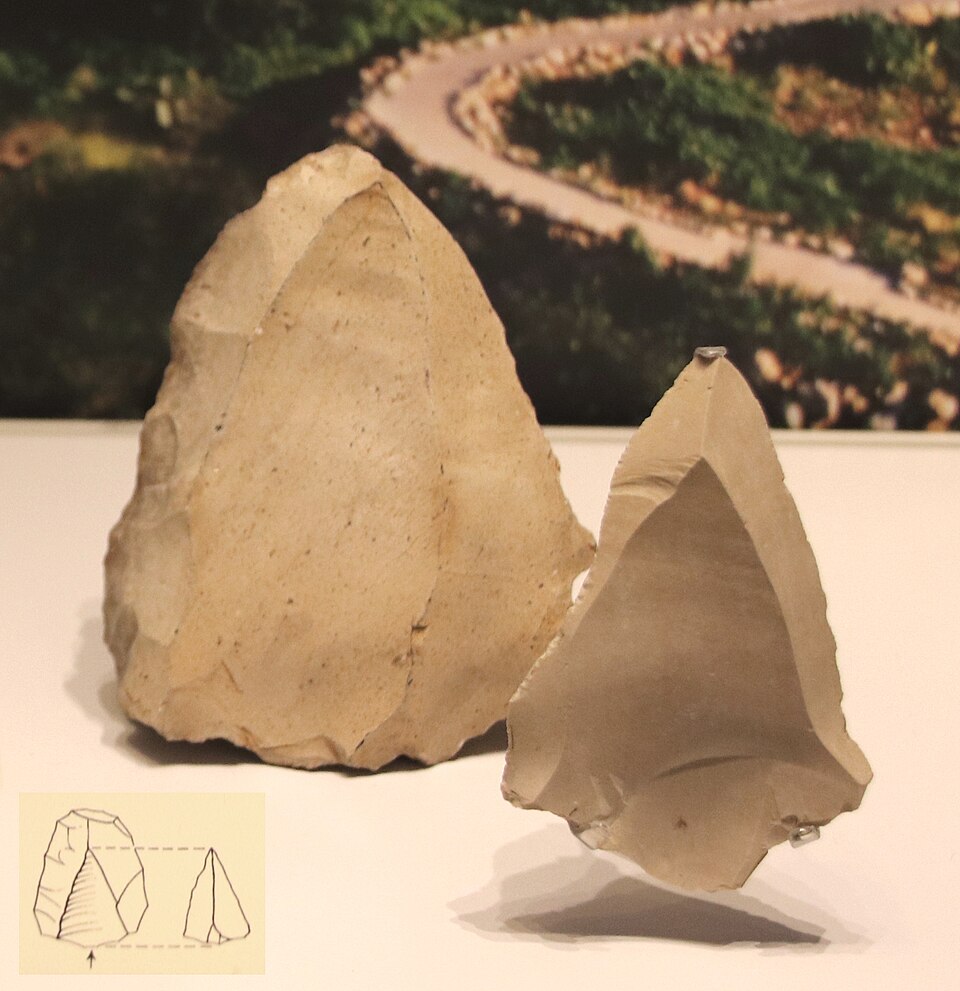
The Middle Stone Age in Africa and the Middle Paleolithic in Eurasia, spanning roughly 300,000 to 30,000 years ago, are defined by the widespread adoption of prepared-core techniques, of which the Levallois method is the most thoroughly studied. In Levallois reduction, the toolmaker first carefully shapes the upper surface of a core through a series of preparatory removals, creating a convex, domed surface (the surface de débitage) with predetermined ridges that guide the propagation of a subsequent large flake or point. The final removal, struck from a carefully prepared striking platform, detaches a flake whose size and shape are largely predetermined by the preparatory work.7, 8
.jpg)
The cognitive demands of Levallois reduction are substantial. The toolmaker must envision the final product before beginning the preparatory sequence, mentally rotate the three-dimensional core to plan platform placement, and execute a multi-stage reduction in which early steps serve no immediate functional purpose but are essential prerequisites for the final detachment. This capacity for multi-step hierarchical planning with deferred goals represents a qualitative advance over Acheulean biface production and is regarded by many researchers as evidence for a significant expansion of working memory and executive function in Middle Pleistocene hominins.8, 17
In Africa, the Middle Stone Age witnessed a striking diversification of lithic technologies beyond the Levallois method. The Still Bay industry (approximately 75,000 to 70,000 years ago) produced finely made bifacial points using pressure flaking, a technique in which small flakes are removed by pressing a pointed tool against the edge rather than striking it, allowing far greater precision and control. The Howiesons Poort industry (approximately 65,000 to 60,000 years ago) produced backed geometric segments — crescents, trapezes, and triangles — that were hafted as composite tools, combining stone inserts with wooden or bone handles using adhesives made from heated plant resins.10 These industries demonstrate that Homo sapiens in southern Africa had achieved a degree of technological sophistication comparable to, and in some respects exceeding, the innovations traditionally attributed to the Upper Paleolithic "revolution" in Europe, and they did so tens of thousands of years earlier.9, 10
Upper Paleolithic blade technologies (Mode 4)
The Upper Paleolithic, beginning approximately 50,000 to 40,000 years ago in Africa and the Near East and arriving in Europe by around 45,000 to 40,000 years ago, is characterized by the systematic production of blades: elongated flakes at least twice as long as they are wide, struck from carefully prepared prismatic cores. Blade production maximizes the total length of cutting edge obtained from a given volume of raw material, representing a significant improvement in the efficiency of stone use compared to earlier flake-based technologies.11 Although isolated blade production occurred sporadically in earlier periods in Africa, the Upper Paleolithic marks the point at which blade-based reduction became the dominant strategy across large regions of the Old World.9
Upper Paleolithic industries are far more internally diverse and regionally differentiated than earlier traditions. In Europe, a succession of named industries — the Aurignacian, Gravettian, Solutrean, and Magdalenian — each displays distinctive reduction strategies, tool forms, and associated material culture including bone and antler tools, personal ornaments, and figurative art.11 The Solutrean industry (approximately 22,000 to 17,000 years ago) produced extraordinarily thin, leaf-shaped bifacial points using refined pressure flaking, while the Magdalenian (approximately 17,000 to 12,000 years ago) emphasized backed bladelets, burins for engraving, and an elaborate bone and antler toolkit including harpoons, needles, and spear-throwers. The rapid turnover of stylistically distinct industries over intervals of a few thousand years stands in stark contrast to the technological stasis of the Acheulean and suggests a new capacity for cumulative cultural evolution — the ratchet-like accumulation of innovations across generations through high-fidelity social learning.11, 18
The diversification of Upper Paleolithic tool forms also reflects increasing functional specialization. Tools were no longer generalized cutting implements but were designed for specific tasks: burins for incising bone and antler, end-scrapers for processing hides, backed bladelets for use as projectile armatures, and perforators for punching holes in leather and shell. This specialization, combined with the proliferation of composite tools in which stone elements were hafted into handles of wood, bone, or antler, represents a fundamental shift toward modular, multi-component technology.11
Microlithic industries
Microliths — small, geometrically shaped stone tools typically less than 30 millimetres in maximum dimension — represent the logical endpoint of the trend toward standardized, efficiently produced stone inserts designed for use in composite tools. Microlithic technology emerged independently in multiple regions and time periods: in southern Africa by at least 71,000 years ago during the Howiesons Poort, in South and Southeast Asia by approximately 35,000 years ago, and in Europe and the Near East during the terminal Pleistocene and early Holocene as part of the Mesolithic (Epipaleolithic) traditions.12, 20
The production of microliths involved a multi-stage process. First, the toolmaker produced standardized small blades (bladelets) from a prepared core. These bladelets were then snapped into segments and shaped by backing — blunting one edge by steep retouch so that the opposite edge remained sharp while the backed edge could be safely mounted into a slot cut in a wooden or bone shaft. The resulting composite tools — arrows, barbed points, and cutting implements armed with rows of tiny stone teeth — combined the hardness and sharpness of stone with the structural properties of organic materials.12 Residue analyses and experimental studies have confirmed that microliths were attached to their hafts using plant-based adhesives, animal sinew bindings, or combinations of both, demonstrating a sophisticated understanding of material properties and bonding chemistry.10, 12
The widespread adoption of microlithic technology in the late Pleistocene and early Holocene is closely linked to the development of projectile weaponry, particularly the bow and arrow. The small, lightweight armatures of microlithic composite points were ideally suited for arrows, and their geometric standardization allowed damaged inserts to be quickly replaced in the field without discarding the entire weapon. In Australia, microlithic backed artifacts appeared during the mid-Holocene and have been interpreted as evidence for the adoption of composite spear-thrower darts and other hafted technologies.21
Ground stone tools and the Neolithic transition
While the flaked stone traditions described above dominated hominin technology for over three million years, a fundamentally different approach to stone working — grinding and polishing — became increasingly important during the late Pleistocene and Holocene. Ground stone tools are produced not by fracturing but by abrasion: rubbing a rough stone against another surface, often with the addition of sand and water as abrasives, until the desired form and edge geometry are achieved. The resulting tools are typically heavier and more robust than flaked implements and include axes, adzes, grinding stones (manos and metates), pestles, and mortars.13
Although isolated examples of ground stone artifacts have been reported from pre-Neolithic contexts in Australia, Japan, and New Guinea, the technology became widespread and economically central during the Neolithic revolution, the transition from mobile hunting and gathering to sedentary agriculture that began independently in several regions between approximately 12,000 and 5,000 years ago.13 Polished stone axes were essential for forest clearance and land preparation in early farming communities, while grinding stones became the primary instruments for processing cereals and other cultivated grains into flour. The shift from flaked to ground stone thus tracks one of the most consequential transformations in human history: the emergence of food production, permanent settlement, and the demographic growth that would eventually give rise to urban civilizations.13
Stone tools and cognitive evolution
The archaeological record of stone tool technology provides the most direct evidence for reconstructing the cognitive evolution of the hominin lineage. Each major technological transition — from Lomekwian to Oldowan, from Oldowan to Acheulean, from Acheulean to prepared-core methods, and from prepared-core methods to blade and microlithic traditions — entailed an increase in the number of procedural steps, the degree of hierarchical planning, and the fidelity of cultural transmission required to reproduce the technology.16, 17
Neuroimaging experiments conducted by Dietrich Stout and colleagues have demonstrated that the production of Oldowan flakes activates premotor and sensorimotor regions of the brain associated with manual coordination, while the production of Acheulean handaxes additionally recruits prefrontal regions involved in planning, cognitive control, and the integration of sub-goals into hierarchical action sequences.16, 17 Critically, several of the brain regions activated during toolmaking overlap with areas implicated in language processing, particularly Broca's area and adjacent prefrontal cortex, leading to the hypothesis that the neural substrates for complex tool production and syntactic language may have co-evolved.17
Experimental studies of tool-making transmission have reinforced this connection. Morgan and colleagues demonstrated that Oldowan knapping techniques could be transmitted with reasonable fidelity through imitation alone, but that the transmission of more complex Acheulean methods was significantly more successful when verbal instruction was added, suggesting that the emergence of Acheulean technology may have both required and promoted the development of referential communication and proto-language.18 The transition to prepared-core and blade technologies, with their longer reduction sequences and greater degree of deferred gratification, is consistent with further expansions of working memory, prospective cognition, and the capacity for teaching.17, 18
Stone tool technological modes and associated cognitive complexity16, 17
| Mode | Industry | Earliest date | Key innovation | Associated hominin(s) |
|---|---|---|---|---|
| Pre-Mode 1 | Lomekwian | ~3.3 Ma | Intentional flaking by percussion | Kenyanthropus? |
| Mode 1 | Oldowan | ~2.6 Ma | Systematic hard-hammer flaking | H. habilis, australopithecines |
| Mode 2 | Acheulean | ~1.76 Ma | Bifacial shaping, symmetry, mental templates | H. erectus / ergaster |
| Mode 3 | Levallois / MSA | ~300 ka | Prepared-core reduction, predetermined flakes | H. sapiens, Neanderthals |
| Mode 4 | Upper Paleolithic | ~50 ka | Prismatic blade cores, standardized blades | H. sapiens |
| Mode 5 | Microlithic | ~71 ka (Africa) | Geometric microliths, composite hafting | H. sapiens |
Raw material sourcing and exchange
The distances over which hominins transported stone raw materials have increased dramatically over the course of the archaeological record, providing an independent line of evidence for expanding social networks, landscape knowledge, and logistical planning. Oldowan toolmakers typically used materials available within a few kilometres of their sites, selecting cobbles from nearby river gravels.3 Acheulean hominins occasionally transported handaxes or raw materials over distances of 10 to 15 kilometres, suggesting greater mobility and landscape awareness. By the Middle Stone Age, however, the distances had increased markedly: at sites in the Olorgesailie Basin of Kenya dated to approximately 320,000 to 305,000 years ago, obsidian was transported from sources up to 50 kilometres or more away, implying either long-distance foraging ranges or exchange relationships between groups.19
The long-distance transport of obsidian and other high-quality raw materials is significant because these materials were often chosen over locally available but inferior alternatives, indicating that toolmakers possessed detailed knowledge of the fracture properties of different stone types and were willing to invest considerable effort in obtaining preferred materials. By the Upper Paleolithic, raw material transport distances of 200 to 300 kilometres are documented at numerous sites in Europe, and the directionality and selectivity of these transfers strongly suggest the operation of structured exchange networks rather than the incidental transport of stone by highly mobile foragers.11, 19
References
2.6-Million-year-old stone tools and associated bones from OGS-6 and OGS-7, Gona, Afar, Ethiopia
The revolution that wasn't: a new interpretation of the origin of modern human behavior
Still Bay and Howiesons Poort foraging strategies: recent research and models of culture change
Evidence for stone-tool-assisted consumption of animal tissues before 3.39 million years ago at Dikika, Ethiopia
Neural correlates of Early Stone Age toolmaking: technology, language and cognition in human evolution
Experimental evidence for the co-evolution of hominin tool-making teaching and language
Cultural innovations and megafauna interaction in the early settlement of arid Australia