Overview
- The Recent African Origin model, supported by converging genetic, fossil, and archaeological evidence, holds that all living non-African humans descend from a population of Homo sapiens that dispersed from Africa primarily between about 70,000 and 50,000 years ago.
- Genetic markers including mitochondrial DNA, Y-chromosome lineages, and genome-wide diversity all show a pattern of declining variation with increasing distance from Africa, consistent with serial founder effects during a rapid expansion from a single source population.
- After leaving Africa, modern humans colonized Australia by roughly 65,000 years ago, Europe by about 45,000 years ago, and the Americas by approximately 16,000 years ago, replacing archaic hominin populations while absorbing small but significant amounts of Neanderthal and Denisovan DNA through limited interbreeding.
The Out of Africa model — also called the Recent African Origin (RAO) hypothesis — holds that anatomically modern humans (Homo sapiens) evolved in Africa and subsequently dispersed to populate the rest of the world, largely replacing archaic hominin populations they encountered along the way. First proposed on the basis of mitochondrial DNA evidence in 1987, the model has since been corroborated by fossil discoveries, archaeological sequences, and whole-genome analyses that together constitute one of the most robust narratives in paleoanthropology.1, 8 The dispersal was not a single, clean migration but a complex process involving early forays that left little lasting genetic legacy, a major expansion between roughly 70,000 and 50,000 years ago that seeded all non-African populations, and limited but biologically significant interbreeding with Neanderthals, Denisovans, and possibly other archaic groups.3, 4
The Recent African Origin model
The core claim of the Recent African Origin model is that all living humans share a common ancestor population that lived in Africa within the past 200,000 to 300,000 years, and that non-African populations derive from a subset of that African population that emigrated relatively recently. This contrasts with the older multiregional model, which proposed that archaic Homo populations across Africa, Europe, and Asia evolved into modern humans in parallel, connected by gene flow. The RAO model predicts that genetic diversity should be highest in Africa and decline with distance from the continent — a prediction that has been confirmed repeatedly and decisively by population genetic studies.1, 8
The landmark 1987 study by Rebecca Cann, Mark Stoneking, and Allan Wilson analysed mitochondrial DNA (mtDNA) from 147 individuals drawn from five geographic populations. Because mtDNA is inherited exclusively through the maternal line and does not recombine, it preserves a relatively clean record of maternal lineage divergence. The resulting phylogenetic tree was rooted in Africa, with the deepest branches separating African lineages from one another and all non-African lineages nested within a single African branch. The authors estimated that the most recent common ancestor of all living human mtDNA lineages — popularly termed mitochondrial Eve — lived approximately 200,000 years ago in Africa.1 Subsequent analyses with larger datasets and refined molecular clocks have confirmed this date within a range of roughly 150,000 to 230,000 years ago.
Parallel analyses of the Y chromosome, which is inherited patrilineally and does not recombine outside the pseudoautosomal regions, have traced all living male lineages back to a common ancestor — Y-chromosomal Adam — who also lived in Africa, with most estimates placing him between 200,000 and 300,000 years ago.15 It is important to note that mitochondrial Eve and Y-chromosomal Adam were not contemporaries and were not the only humans alive at their respective times; they simply represent the most recent individuals from whom all living humans inherit their mitochondrial or Y-chromosome DNA, respectively. Other individuals alive at the same time also contributed autosomal DNA to the modern gene pool.
Early dispersals and failed expansions
The main Out of Africa dispersal was not the first time Homo sapiens ventured beyond the continent. Fossil and archaeological evidence reveals multiple earlier forays, some of which appear to have left little or no detectable genetic signature in present-day populations. A partial cranium from Apidima Cave in southern Greece, dated to approximately 210,000 years ago, has been attributed to Homo sapiens on morphological grounds, suggesting a remarkably early presence in southeastern Europe.9 A maxilla from Misliya Cave in Israel, dated to approximately 177,000–194,000 years ago, provides the earliest widely accepted evidence of modern humans outside Africa.17
Additional evidence of early Homo sapiens presence in the Levant comes from the Skhul and Qafzeh cave sites in Israel, where anatomically modern fossils have been dated to approximately 90,000–120,000 years ago. These populations appear to have coexisted with Neanderthals in the region for millennia before apparently disappearing, with Neanderthals reoccupying the Levant by around 70,000 years ago.7 The Arabian Peninsula offers further evidence of early dispersals: stone tools from the site of Al Wusta in Saudi Arabia, associated with a Homo sapiens finger bone dated to approximately 85,000 years ago, demonstrate that modern humans had reached the interior of Arabia well before the main dispersal wave.20
Teeth from Fuyan Cave in southern China, attributed to Homo sapiens and dated to at least 80,000 years ago, have been cited as evidence of an early eastern dispersal, though these dates remain debated.16 Collectively, these early dispersals suggest that Homo sapiens repeatedly expanded out of Africa during favourable climatic intervals, particularly during marine isotope stages 5 and 7, when the Sahara greened and corridors through the Levant and Arabia opened. Most of these early populations appear to have been evolutionary dead ends that left no substantial genetic contribution to living non-African populations, though some genomic studies have detected traces of an early dispersal signal in certain Australasian genomes.10, 21
The main dispersal wave
The dispersal event that gave rise to all major non-African populations occurred between approximately 70,000 and 50,000 years ago. Genomic analyses consistently indicate that non-African populations experienced a severe population bottleneck at around this time, with effective population sizes dropping to perhaps a few thousand individuals before expanding rapidly across Eurasia, Oceania, and eventually the Americas.8, 21 This bottleneck is reflected in the markedly lower genetic diversity of non-African populations compared to African populations, a pattern visible across autosomes, the X chromosome, mtDNA, and the Y chromosome.
The route of the main dispersal has been debated extensively. Two primary corridors have been proposed: a northern route through the Sinai Peninsula and the Levant into western Asia, and a southern route across the Bab el-Mandeb strait at the mouth of the Red Sea into the Arabian Peninsula and thence along the coastlines of South Asia toward Southeast Asia and Australia. The southern coastal route hypothesis gained popularity in the early 2000s because it offered a mechanism for the rapid colonisation of Australia by approximately 65,000 years ago — a date that would require fast, directed movement along the Indian Ocean littoral.6, 10
However, genomic data from modern populations suggest a more complex picture. A 2016 study of Aboriginal Australian genomes found that their ancestors diverged from Eurasian populations approximately 58,000 years ago, consistent with a single major dispersal wave that subsequently split into multiple branches rather than separate northern and southern migrations.11 A separate genomic study published the same year, analysing 483 diverse genomes, found that Papuan populations carry a small proportion of ancestry (~2%) from an earlier dispersal wave distinct from the main Out of Africa event, suggesting that at least some early dispersers did contribute to living populations in Oceania.21 The current consensus is that the main dispersal was predominantly a single event, with possible minor contributions from earlier waves detectable in some populations.
The Toba catastrophe debate
The eruption of the Toba supervolcano on Sumatra approximately 74,000 years ago — the largest volcanic event in at least the past two million years — has been invoked as a possible trigger for the population bottleneck observed in human genetic data. The Toba catastrophe theory, proposed by Stanley Ambrose in the late 1990s, argued that the eruption caused a volcanic winter lasting several years and a subsequent glacial episode that devastated human populations worldwide, reducing them to as few as 3,000 to 10,000 breeding pairs.12

The environmental impact of the Toba eruption was undoubtedly severe. It deposited a blanket of volcanic ash across South Asia, with layers up to 15 centimetres thick found in marine cores from the Indian Ocean and up to several metres thick in parts of India. Climate modelling suggests that the eruption injected enormous quantities of sulfur dioxide into the stratosphere, potentially cooling global temperatures by 3 to 5 degrees Celsius for several years.12 However, archaeological evidence from sites in India has complicated the catastrophe narrative. Stone tool assemblages from above and below the Toba ash layer at the Jwalapuram site in southern India show continuity in technology across the eruption, with no obvious signs of population collapse or cultural disruption.13, 14
More broadly, genetic analyses have not identified a population bottleneck at precisely 74,000 years ago; the bottleneck associated with the Out of Africa expansion appears to have been a gradual process spanning several thousand years rather than a sharp crash consistent with a volcanic catastrophe. The current scientific consensus is that the Toba eruption was a significant environmental perturbation but was probably not the sole or even the primary cause of the demographic bottleneck in modern human populations.13
Genetic evidence for the dispersal
The genetic evidence for a recent African origin is extensive and internally consistent across multiple independent marker systems. Sub-Saharan African populations harbour substantially more genetic diversity than all non-African populations combined, and this diversity decreases in a remarkably smooth gradient with increasing geographic distance from eastern Africa. This pattern, known as the serial founder effect, arises because each successive population that split off from the expanding wavefront carried only a subset of the genetic variation present in its parent population.8
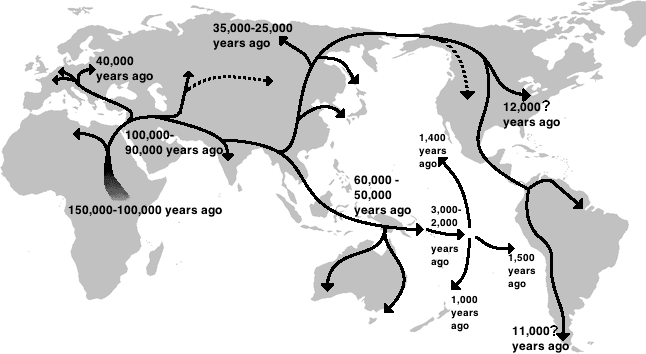

Genetic diversity decline with distance from Africa8
Genome-wide studies using hundreds of thousands of single-nucleotide polymorphisms (SNPs) have confirmed that all non-African populations are most closely related to one another and are nested within the broader African genetic tree, exactly as predicted by the RAO model. The deepest split in the human phylogeny separates the Khoisan-speaking populations of southern Africa and certain East African groups from all other humans, with the divergence between non-African populations representing a comparatively recent and shallow branching event.8, 11
Whole-genome sequencing has further refined the picture. The proportion of the genome shared through identity-by-descent is higher among non-African populations, consistent with a smaller founding population. Haplotype block lengths are longer outside Africa, reflecting fewer generations of recombination since the founding bottleneck. And the frequency spectrum of rare variants shows a clear excess of recent, population-specific mutations outside Africa, consistent with rapid demographic expansion from a small founding group.8
Archaeological markers of modern human expansion
The dispersal of Homo sapiens out of Africa is tracked archaeologically through the appearance of distinctive stone tool technologies and symbolic behaviours. In Africa, the Middle Stone Age (MSA) gave way to the Later Stone Age (LSA) beginning around 50,000 years ago, characterised by microlithic tools, composite weapons, bone implements, and intensified use of pigments and personal ornaments. The transition was neither abrupt nor simultaneous across the continent; elements of behavioural modernity, including shell beads, ochre processing, and geometric engravings, appear sporadically in the African MSA as early as 100,000 years ago.2
In Europe and western Asia, the arrival of Homo sapiens is associated with the Initial Upper Palaeolithic (IUP) and subsequently the Upper Palaeolithic, which replaced the Mousterian industries of the Neanderthals beginning around 46,000 to 43,000 years ago. The IUP is characterised by elongated blade technologies, often incorporating Levallois-like elements carried from preceding Middle Palaeolithic traditions, and appears at sites from the Levant to Bulgaria.7, 18 The site of Bacho Kiro Cave in Bulgaria has yielded Homo sapiens remains directly associated with IUP artefacts dated to approximately 46,000–44,000 years ago, representing one of the earliest securely dated modern human presences in Europe.18
The Upper Palaeolithic proper, beginning around 40,000 years ago in Europe, is distinguished by a suite of technological and cultural innovations including prismatic blade production, bone and antler tools, figurative art, personal ornaments, and structured use of living space. The Aurignacian, Gravettian, and subsequent technocomplexes represent a cultural florescence without precedent in the European archaeological record, and they are associated exclusively with Homo sapiens.7 Whether these innovations were brought fully formed from Africa or developed in situ through the process of expanding into new environments remains a subject of active research.
Replacement and interbreeding with archaic populations
The Out of Africa dispersal brought modern humans into contact with archaic hominin populations that had been established in Eurasia for hundreds of thousands of years, principally Neanderthals in Europe and western Asia and Denisovans in eastern Asia. The genetic evidence shows unequivocally that interbreeding occurred between these groups, but that its extent was limited and the overall demographic pattern was one of replacement rather than assimilation.
The sequencing of the Neanderthal genome in 2010 revealed that all non-African modern humans carry approximately 1.5 to 2.1 percent Neanderthal DNA, while sub-Saharan Africans carry essentially none — a pattern consistent with interbreeding occurring after the Out of Africa dispersal but before the differentiation of the major non-African populations.3 The interbreeding most likely took place in the Levant or western Asia between approximately 60,000 and 50,000 years ago, when expanding modern human populations first encountered resident Neanderthal groups. A Homo sapiens individual from the Pesterа cu Oase cave in Romania, dated to approximately 40,000 years ago, was found to carry 6 to 9 percent Neanderthal DNA, indicating that the individual had a Neanderthal ancestor as recently as four to six generations back.5
The Denisovan contribution to modern human genomes is geographically more restricted but locally substantial. Present-day Melanesian and Aboriginal Australian populations carry approximately 4 to 6 percent Denisovan DNA, while mainland Asian populations carry considerably less (approximately 0.2 percent).4, 11 This distribution suggests that interbreeding with Denisovans occurred in Southeast Asia or Near Oceania, consistent with the geographic range implied by the sparse Denisovan fossil record. Some of the introgressed archaic DNA has been subject to positive natural selection in modern humans, including variants affecting immune function, adaptation to high altitude, and tolerance of low oxygen environments.3, 4
Despite this interbreeding, the archaic populations themselves disappeared. Neanderthals vanished from the European record by approximately 40,000 years ago, and the latest known Denisovan remains date to roughly 50,000 years ago. The mechanism of replacement remains debated, but likely involved a combination of competitive exclusion through superior resource exploitation, demographic swamping by the larger and more rapidly growing modern human population, and possibly the effects of novel diseases.3
The global colonisation sequence
After the main dispersal from Africa, Homo sapiens colonised the remaining habitable continents in a broadly sequential pattern, constrained by geography, climate, and the technological capacity to cross water barriers and survive in extreme environments.

Australia and Sahul. The colonisation of the Australian continent (then connected to New Guinea as the landmass Sahul) required multiple sea crossings of at least 90 kilometres through the islands of Wallacea, even at times of maximum sea-level lowering. Excavations at the Madjedbebe rock shelter in northern Australia have yielded artefacts dated to approximately 65,000 years ago, making it the earliest securely dated site of human occupation on the continent.6 Genomic analyses of Aboriginal Australian populations indicate a deep divergence from other non-African groups at approximately 58,000 years ago, followed by long-term genetic isolation, consistent with a single founding population that arrived early and remained relatively separated from subsequent Eurasian population movements.11
Europe. Modern humans reached Europe by at least 46,000–45,000 years ago, as documented by the Homo sapiens fossils and IUP artefacts from Bacho Kiro Cave in Bulgaria.18 The colonisation of Europe was a protracted process, with modern humans initially occupying the Mediterranean and Danubian corridors before spreading northward and westward. For several thousand years, modern humans and Neanderthals appear to have occupied different parts of Europe, with Neanderthals persisting in refugia on the Iberian Peninsula and elsewhere until approximately 40,000 years ago. By 35,000 years ago, Homo sapiens was the sole hominin species in Europe.5, 7
The Americas. The peopling of the Americas represents the final major continental colonisation. Genetic and archaeological evidence now converges on an entry date of approximately 16,000 to 15,000 years ago, with populations moving from northeastern Asia into Beringia (the land bridge exposed during glacial periods) and thence southward along the Pacific coast or through the ice-free corridor between the Laurentide and Cordilleran ice sheets. The Monte Verde site in southern Chile, securely dated to approximately 14,500 years ago, demonstrates that humans had reached the southern tip of South America within a millennium or two of initial entry, suggesting rapid coastal dispersal.22 Ancient genomic data from early American remains confirm an ancestral population that diverged from East Asian groups approximately 23,000 years ago, with a period of isolation in Beringia before expansion into the Americas proper.19
Approximate colonisation dates for major regions6, 18, 19, 22
| Region | Earliest evidence (ka) | Key site or source |
|---|---|---|
| Levant | ~177–194 | Misliya Cave, Israel |
| Arabia | ~85 | Al Wusta, Saudi Arabia |
| Australia | ~65 | Madjedbebe, Northern Territory |
| East Asia | ~45–80 | Fuyan Cave, China (debated) |
| Europe | ~46 | Bacho Kiro Cave, Bulgaria |
| Americas | ~16 | Monte Verde, Chile |
Synthesis and ongoing questions
The Out of Africa model has moved from a contested hypothesis in the late 1980s to the dominant framework for understanding modern human origins, supported by an overwhelming convergence of genetic, fossil, and archaeological evidence. The basic narrative — a recent African origin, a major dispersal between 70,000 and 50,000 years ago, serial founder effects producing a gradient of declining diversity, and replacement of archaic populations with limited interbreeding — is now firmly established.1, 3, 8
Significant questions remain, however. The role of early dispersals before 70,000 years ago is still poorly understood: did they contribute meaningfully to the gene pools of living populations, or were they truly dead ends? The relative importance of coastal versus inland routes during the main dispersal remains unresolved, in part because Pleistocene coastlines are now submerged and their archaeological record is largely inaccessible.10 The precise mechanisms by which modern humans replaced Neanderthals and Denisovans — whether through competitive superiority, demographic advantage, disease, climate change, or some combination — are still debated. And the extent to which behavioural modernity (symbolic thought, complex language, cumulative culture) was a cause of the successful dispersal or a consequence of it remains one of the most provocative open questions in paleoanthropology.2
What is no longer in doubt is that all living humans are remarkably closely related, sharing a recent common origin on a single continent within the past few hundred thousand years. The genetic differences among the world's populations are shallow, recent, and minor compared to the variation that exists within African populations alone — a finding with profound implications for understanding human identity, diversity, and shared heritage.8
References
The revolution that wasn't: a new interpretation of the origin of modern human behavior
The initial Upper Palaeolithic of the Levant and its bearing on the question of a unique origin of Homo sapiens
The dispersal of Homo sapiens across southern Asia: how early, how often, how complex?
The Toba supervolcanic eruption: tephra-fall deposits in India and paleoanthropological implications
A revised root for the human Y chromosomal phylogenetic tree: the origin of patrilineal diversity in Africa