Overview
- The oldest fossils of Homo sapiens come from Jebel Irhoud in Morocco (~315,000 years ago) and Omo Kibish in Ethiopia (~233,000 years ago), demonstrating that our species emerged across Africa rather than at a single point of origin.
- Neanderthals and Denisovans occupied Eurasia for hundreds of thousands of years alongside expanding Homo sapiens populations, and genomic evidence confirms that all three lineages interbred, leaving measurable traces of archaic DNA in living human populations.
- The ancient DNA revolution, recognized with the 2022 Nobel Prize, has revealed that human evolutionary history was reticulate rather than strictly branching, with gene flow between divergent lineages a recurring feature rather than an exception.
The emergence of Homo sapiens and the fate of our closest relatives—the Neanderthals and Denisovans—constitute the final and best-documented chapter of human evolution. Rather than a simple story of a single superior species replacing all others, the evidence reveals a complex period in which multiple human lineages coexisted across Africa and Eurasia, interacted, interbred, and exchanged genes before all archaic lineages except our own disappeared.3, 4 The genomic revolution enabled by ancient DNA extraction has fundamentally transformed this field, revealing patterns of admixture, migration, and natural selection that the fossil record alone could never have disclosed.3, 5
The picture that has emerged is one of a reticulate evolutionary history. Neanderthals contributed roughly 1–4% of the DNA carried by all non-African people alive today. Denisovans contributed up to 5–6% of the genome of some Melanesian and Australian Aboriginal populations. And growing evidence suggests additional episodes of interbreeding with as-yet-unidentified archaic lineages in Africa itself.3, 5, 7 Human evolution, it turns out, was not a branching tree in the strict sense but a braided stream, with lineages repeatedly splitting and reconnecting over hundreds of thousands of years.4
The origin of Homo sapiens
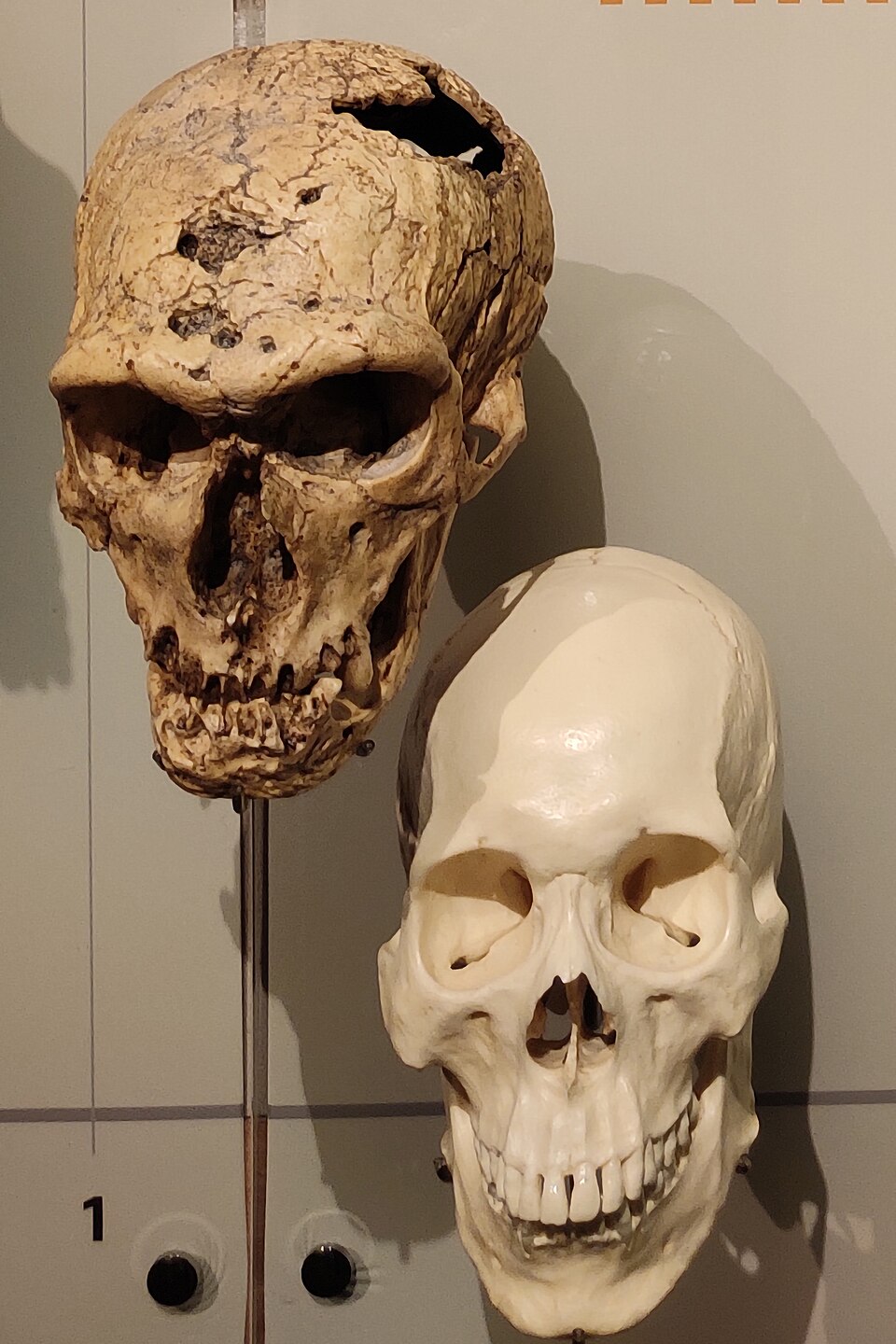
The oldest fossils attributed to Homo sapiens come from Jebel Irhoud in Morocco, dated to approximately 315,000 years ago by thermoluminescence methods.1 The Jebel Irhoud specimens display a modern-looking face—flat, retracted beneath the braincase, with a projecting chin—combined with a more elongated, archaic-shaped braincase, indicating that even the evolution of our own species was mosaic rather than sudden.1 The characteristic globular braincase of modern H. sapiens does not appear in the fossil record until roughly 100,000–130,000 years ago, at sites such as Omo Kibish and Herto in Ethiopia.2, 4
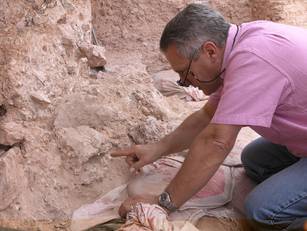

The geographic spread of early H. sapiens fossils across the African continent—from Morocco in the northwest to Ethiopia in the east to Florisbad in South Africa—has led to the "African multiregionalism" model, which proposes that our species did not arise at a single location but evolved through gene flow among subdivided populations scattered across the continent.4 This model is supported by genetic analyses showing that the deepest divergences among living human populations trace back 200,000–300,000 years and correspond to a structured, interconnected metapopulation rather than a single ancestral group.4
Neanderthals and Denisovans
The Neanderthals (Homo neanderthalensis) were a cold-adapted human species who occupied Europe and western Asia for more than 300,000 years. With average brain volumes actually larger than those of modern humans, Neanderthals were sophisticated hunters of large game, produced Mousterian stone tools, buried their dead, cared for the sick and injured, used pigments and feathers for apparent symbolic purposes, and may have produced some of the oldest known cave art in Europe.6, 3 The sequencing of the Neanderthal genome in 2010 confirmed that they interbred with Homo sapiens, contributing approximately 1–4% of the DNA found in all non-African populations today.3, 7
.jpg)
The Denisovans were identified in 2010 not from substantial fossil remains but from ancient DNA extracted from a single finger bone found in Denisova Cave in Siberia—making them the first hominin group discovered primarily through genetics rather than morphology.5 Subsequent work has shown that Denisovans were a widespread Eurasian population that interbred with both Neanderthals and modern humans. Melanesian and Australian Aboriginal populations carry up to 5–6% Denisovan DNA, while Tibetan populations carry the Denisovan-derived EPAS1 gene variant that enables survival at extreme altitude—a striking example of adaptive introgression in which an archaic allele proved beneficial in a specific modern human environment.5, 8
The out-of-Africa dispersal
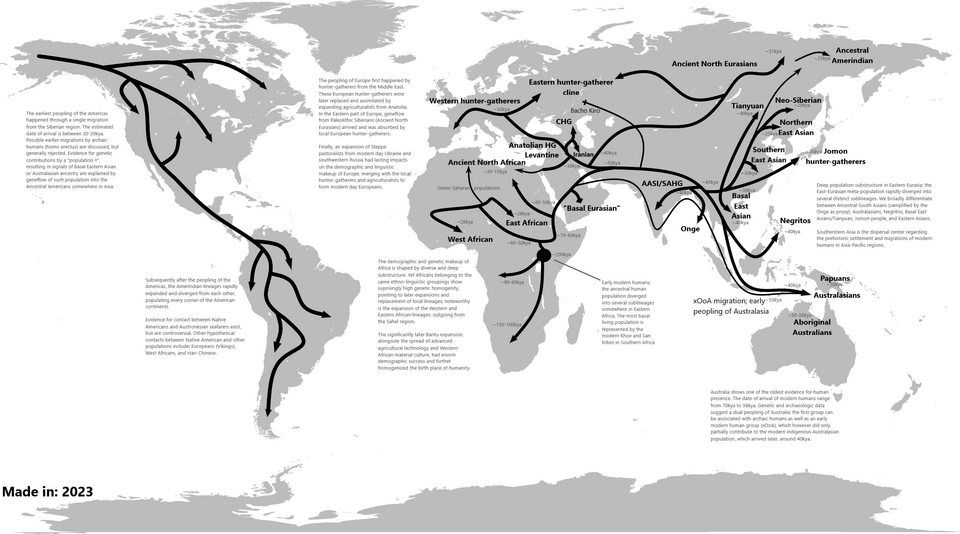
Homo sapiens began expanding beyond Africa in multiple waves. Early dispersals, including a possible presence in Greece by 210,000 years ago and in the Levant by at least 180,000 years ago, appear to have been geographically limited and may not have left substantial genetic legacy in modern populations.9, 6
.png)
During these expansions, H. sapiens encountered and interbred with Neanderthals in western Eurasia and with Denisovans in eastern Eurasia, The major successful expansion occurred after roughly 70,000 years ago, when modern humans dispersed rapidly across southern Asia, reaching Australia by 65,000 years ago, Europe by 45,000 years ago, and the Americas by at least 16,000 years ago.6, 4
During these expansions, H. sapiens encountered and interbred with Neanderthals in western Eurasia and with Denisovans in eastern Eurasia, acquiring genetic variants that in some cases proved adaptively beneficial in new environments.3, 8 The disappearance of all archaic Homo lineages within roughly 30,000 years of sustained contact with expanding modern human populations remains one of the most consequential events in human evolutionary history. Whether competition, assimilation through interbreeding, disease, climate change, or some combination of these factors drove the extinctions is still debated.6, 4
The ancient DNA revolution
The ability to extract and sequence ancient DNA from fossil specimens tens of thousands of years old has transformed paleoanthropology from a discipline reliant on bones and stones to one that can directly read the genomes of extinct populations. Techniques developed by Svante Pääbo and colleagues—work recognized with the 2022 Nobel Prize in Physiology or Medicine—have made it possible to sequence complete nuclear genomes from Neanderthals, Denisovans, and early Homo sapiens, revealing patterns of admixture, population structure, and natural selection invisible in the fossil record.3, 5
Ancient DNA has revealed that interbreeding between divergent hominin lineages was not a rare accident but a recurring feature of human evolution. It has identified previously unknown populations, traced migration routes, documented episodes of natural selection acting on introgressed archaic alleles, and provided temporal constraints on population divergences that complement and often refine those obtained from fossils alone.3, 7, 8 The emerging picture is one in which the boundaries between species were more permeable than traditional taxonomy implied, and in which the genetic legacy of extinct lineages lives on in the genomes of billions of people today.3, 4
The functional legacy of archaic DNA
The archaic DNA persisting in modern human genomes is not merely a neutral relic of past interbreeding; natural selection has acted on introgressed variants, retaining some and purging others. Neanderthal-derived alleles have been associated with immune function, keratin biology affecting skin and hair, fat metabolism, and susceptibility to certain diseases including type 2 diabetes and Crohn's disease.3, 7 The Denisovan-derived EPAS1 variant in Tibetan populations, which modulates the hypoxia response pathway and enables efficient oxygen transport at high altitude, remains the most striking example of adaptive introgression — a case in which an allele from an extinct hominin lineage conferred a major fitness advantage in a specific modern human environment.8
At the same time, substantial regions of the genome appear to be depleted of archaic ancestry, suggesting that Neanderthal and Denisovan alleles were deleterious in many genomic contexts and were removed by purifying selection over the thousands of generations since admixture. Regions near genes involved in speech, brain development, and male fertility show particularly strong depletion of archaic introgression, hinting that these may have been the domains in which Homo sapiens was most distinctively adapted and least compatible with archaic variants.3, 7 The emerging picture is one in which interbreeding provided a reservoir of genetic variation that natural selection then sculpted — retaining adaptive variants and eliminating harmful ones — leaving the complex mosaic of archaic and modern DNA that all non-African humans carry today.4