Overview
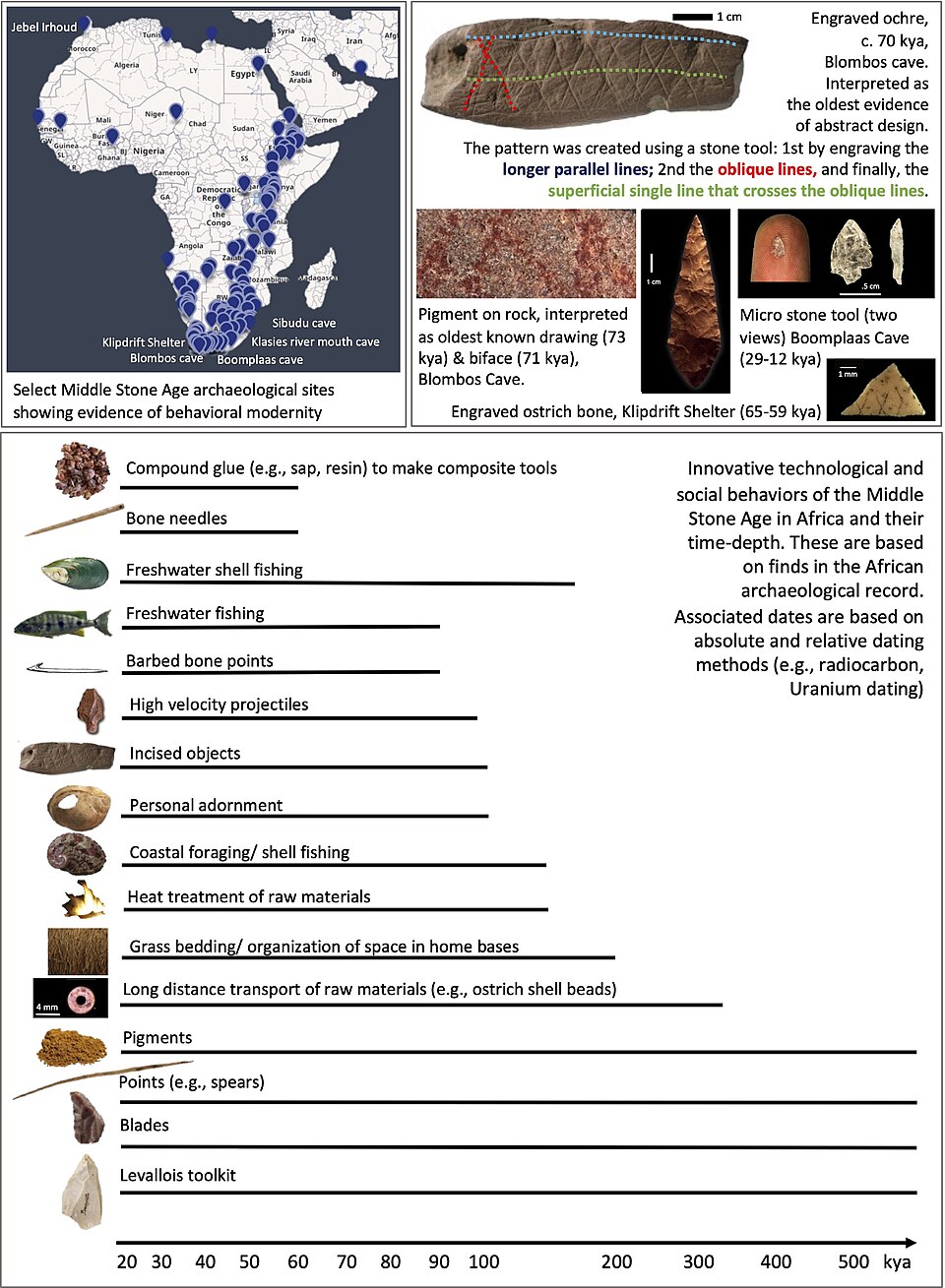
- The African Middle Stone Age (~300,000–30,000 years ago) documents the earliest known technological and cognitive revolution of Homo sapiens, including heat-treated stone tools, pressure flaking, hafted composite weapons, and bone tool industries tens of thousands of years before comparable innovations appeared in Eurasia.
- Symbolic behavior emerged in Africa by at least 100,000 years ago, as evidenced by deliberately engraved ochre at Blombos Cave, perforated shell beads at Blombos, Skhul, and Grotte des Pigeons, engraved ostrich eggshell containers at Diepkloof, and the oldest known abstract drawing at 73,000 years ago.
- The episodic appearance and disappearance of complex technologies in the African MSA is best explained by demographic models linking population size and connectivity to the maintenance of cumulative culture, rather than by a single genetic mutation or sudden cognitive leap.
The Middle Stone Age (MSA) of Africa, spanning roughly 300,000 to 30,000 years ago, represents the longest and most consequential period of technological and cognitive innovation in the history of Homo sapiens. During this interval, African populations developed heat-treated stone tools, pressure-flaked bifacial points, hafted composite weapons assembled with compound adhesives, standardised bone tools, marine resource exploitation strategies, long-distance raw material exchange networks, and an array of symbolic behaviours including ochre engraving, shell bead manufacture, and abstract drawing.1, 20 These innovations appeared not as a single revolutionary package but incrementally across the continent, tens of thousands of years before comparable behaviours are documented in Eurasia. The MSA archaeological record has fundamentally reshaped understanding of the origins of human behavioural modernity, demonstrating that the cognitive capacities underlying complex culture were assembled gradually in Africa and did not arise from a sudden genetic event associated with the dispersal out of Africa.1
The recognition that Africa was the crucible of behavioural as well as anatomical modernity has been one of the most significant developments in palaeoanthropology since the late twentieth century. In a landmark synthesis published in 2000, Sally McBrearty and Alison Brooks documented that nearly every component of the so-called "human revolution" — blade technology, bone tools, expanded geographic range, specialised hunting, aquatic resource use, long-distance trade, pigment processing, and decorative art — appeared in the African MSA tens of thousands of years before the European Upper Palaeolithic, where these behaviours had traditionally been thought to originate.1 Subsequent discoveries have only strengthened this picture, pushing the dates for key innovations further back and expanding the geographic range across which they are documented.
Chronological framework and early MSA sites
The MSA begins with the transition from the Acheulean, a handaxe-dominated technology that persisted for over a million years, to industries characterised by prepared-core (Levallois) flaking techniques, the production of points and blades, and a shift from large cutting tools to smaller, more standardised implements.1, 3 This transition occurred at different times across Africa, but thermoluminescence dating of fire-heated flint artefacts from Jebel Irhoud, Morocco, has established that MSA technology was present by approximately 315,000 years ago, directly associated with the earliest known Homo sapiens fossils.2, 3 The Jebel Irhoud lithic assemblage is dominated by Levallois prepared-core products and pointed forms, demonstrating that the cognitive demands of hierarchical reduction sequences — envisioning and executing a multi-step plan to produce a predetermined flake shape from a carefully shaped core — were met by the earliest members of our species.3
In eastern Africa, the Olorgesailie basin in the southern Kenya Rift Valley preserves evidence that the transition to MSA technology coincided with the earliest known long-distance transport of obsidian and the systematic use of pigment, dating to approximately 320,000 to 305,000 years ago.18 In southern Africa, the Florisbad site in the Free State of South Africa yielded a partial cranium with both archaic and modern features associated with MSA artefacts, dated to approximately 259,000 years ago. These early MSA sites demonstrate that the technological transition was a pan-African phenomenon, occurring across diverse ecological zones from the Saharan fringe to the southern Cape and the East African Rift.1, 18
The terminal boundary of the MSA is likewise diachronous. In southern Africa, the MSA gives way to the Later Stone Age (LSA) between approximately 40,000 and 20,000 years ago, with transitional assemblages documented at several sites. In eastern Africa, MSA technologies persisted until roughly 30,000 years ago in some regions, overlapping temporally with LSA industries elsewhere on the continent.1, 4
The Still Bay and Howiesons Poort
Two techno-complexes within the later MSA of southern Africa have attracted particular attention for their technological sophistication and associations with symbolic behaviour: the Still Bay and the Howiesons Poort. Single-grain optically stimulated luminescence dating of nine sites across southern Africa has established that the Still Bay dates to approximately 72,000 to 71,000 years ago and the Howiesons Poort to approximately 65,000 to 59,000 years ago, with each industry persisting for roughly 5,000 years or less before disappearing from the archaeological record.4

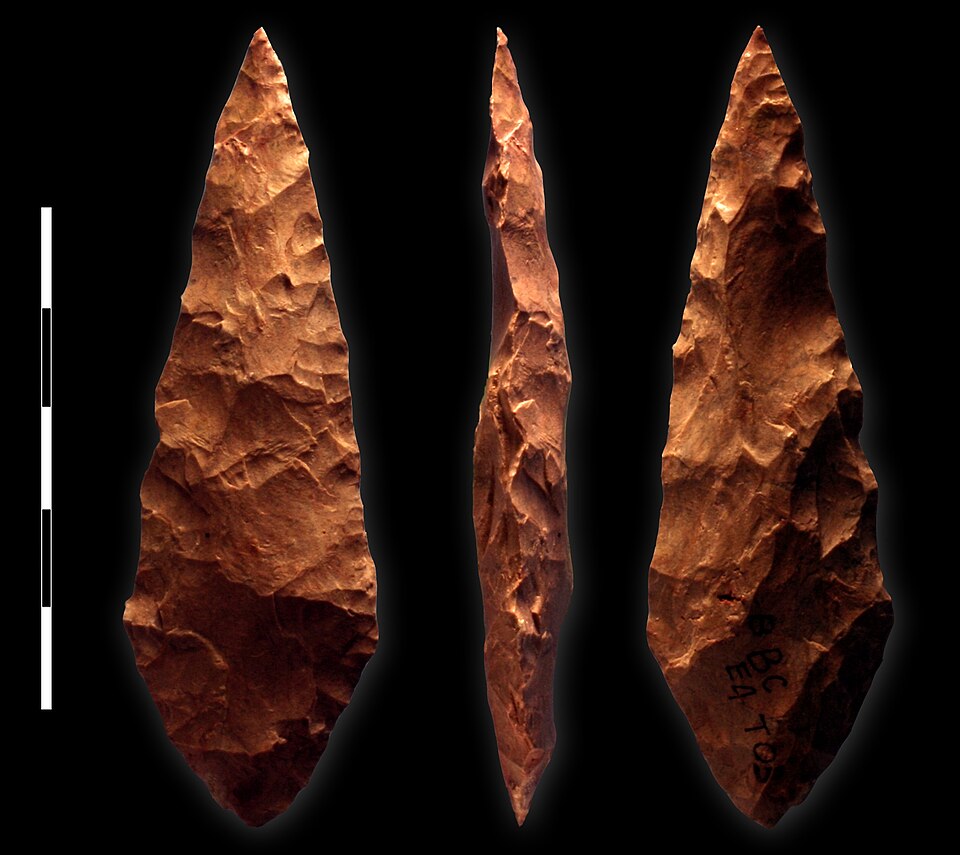
The Still Bay industry is defined by the production of finely crafted bifacial foliate points, often made on heat-treated silcrete, with final shaping accomplished through pressure flaking — a technique not documented in Eurasia until the Solutrean of western Europe, some 50,000 years later.4, 6 At Blombos Cave on the southern Cape coast, the Still Bay levels have yielded more than forty bifacial points alongside engraved ochre, shell beads, and bone tools, making it one of the most informative MSA sites in the world.9, 21 Technological analysis of the Blombos and Sibudu assemblages reveals that Still Bay point production required mastery of heat treatment, a multi-step reduction sequence, and the fine motor control and planning depth demanded by pressure flaking.6, 23
The Howiesons Poort, which followed the Still Bay after a brief interval, is characterised by a dramatically different toolkit. Rather than bifacial points, Howiesons Poort knappers produced backed geometric segments — crescents, trapezes, and triangles — by deliberately blunting one edge of a blade or flake with abrupt retouch. These small, standardised tools are widely interpreted as components of composite weapons, hafted with mastic onto wooden shafts to create arrows, throwing spears, or cutting implements.4, 22 Use-trace and residue analyses of Howiesons Poort segments from Sibudu Cave have provided evidence consistent with their use as arrowheads, suggesting that bow-and-arrow technology may have been present in southern Africa by approximately 64,000 years ago.22
The brief florescence and subsequent disappearance of both the Still Bay and Howiesons Poort raise fundamental questions about the nature of cultural change during the MSA. Both industries were replaced by less distinctive MSA assemblages, and the reasons for their abandonment remain debated. Climate change, demographic contraction, and shifts in mobility strategy have all been proposed as contributing factors.4, 19
Heat treatment and pressure flaking
Among the most cognitively demanding innovations documented in the MSA is the deliberate heat treatment of silcrete — a silica-cemented sedimentary rock — to improve its flaking properties. At Pinnacle Point on the southern Cape coast of South Africa, thermomagnetic analysis of silcrete artefacts has demonstrated that MSA toolmakers systematically heated silcrete to temperatures of 300 to 400 degrees Celsius before knapping, transforming a relatively intractable raw material into one that could be flaked with the precision and control of fine-grained flint.5 Experimental replication has shown that the process required approximately 20 to 40 kilograms of hardwood and nearly 30 hours of controlled fire management, demanding sophisticated knowledge of combustion, thermal properties of stone, and multi-day planning.5
Heat treatment of silcrete predominates among artefacts dating to approximately 72,000 years ago at multiple sites, but evidence from Pinnacle Point indicates that the technique appeared as early as 164,000 years ago, making it one of the oldest known examples of transformative technology — the deliberate alteration of a material's fundamental physical properties to suit human purposes.5 The cognitive implications are substantial: heat treatment requires analogical reasoning (understanding that fire can change stone in predictable ways), inhibitory control (waiting for slow heating and cooling cycles rather than acting impulsively), and causal reasoning about processes that are not directly observable, since the internal structural changes that improve flaking quality are invisible to the naked eye.5
Pressure flaking — the removal of small, controlled flakes by pressing a pointed tool (of bone, antler, or hard wood) against the edge of a stone artefact — was used during the final shaping of Still Bay bifacial points at Blombos Cave, dating to approximately 75,000 years ago. Experimental replication by Mourre, Villa, and Henshilwood demonstrated that the morphology of the Blombos points could not be replicated by direct percussion alone and required pressure flaking applied to previously heat-treated silcrete blanks.6 This pushed the earliest known use of pressure flaking back by more than 50,000 years relative to its first documented appearance in the European Solutrean, approximately 22,000 years ago.6
Hafted composite tools and compound adhesives
The manufacture of composite tools — artefacts assembled from multiple components, typically a stone or bone working element attached to a wooden handle or shaft — represents a critical threshold in human technological evolution. Composite tool production requires the conceptual integration of disparate materials into a single functional unit, multi-step manufacturing sequences, and in many cases the preparation of adhesives to bind components together.7

At Sibudu Cave in KwaZulu-Natal, South Africa, microscopic analysis of stone tool surfaces from MSA levels dating to approximately 70,000 years ago revealed traces of compound adhesives composed of plant gum mixed with red ochre (haematite) or, in some cases, plant gum combined with fat. These multi-ingredient adhesives were used to fix stone points and segments into wooden hafts, creating spears and other composite weapons.7 Lyn Wadley and colleagues argued that the production of compound adhesives implied cognitive capacities comparable to those required for modern complex tasks: the ability to hold multiple sub-goals in working memory simultaneously, to execute operations in a precise sequence (since the adhesive must be prepared before it can be applied, and the components must be assembled before the adhesive cools), and to engage in abstract reasoning about the causal properties of different materials.7
The evidence for hafting extends across the MSA. Residue and use-wear analyses at multiple sites in southern and eastern Africa have identified traces of adhesives, binding materials, and impact fractures consistent with the use of stone-tipped projectile weapons from at least 200,000 years ago onward.1, 7 At Sibudu Cave, the Howiesons Poort backed segments show morphometric and use-wear characteristics consistent with their employment as arrowheads, suggesting that these composite tools formed part of a bow-and-arrow weapon system by approximately 64,000 years ago.22 If confirmed, this would represent the earliest evidence for projectile technology capable of killing at distances beyond the range of a thrown spear, with profound implications for hunting efficiency, intergroup conflict, and social organisation.
Bone tool industries
The production of formal bone tools — implements shaped by grinding, scraping, polishing, or abrasion rather than simple fracture — is another hallmark of MSA innovation. The earliest well-documented bone tool industry comes from three sites at Katanda on the Upper Semliki River in the Democratic Republic of the Congo, where excavations yielded barbed and unbarbed bone points as well as a dagger-like object from MSA contexts dated to at least 90,000 years ago by multiple independent techniques including electron spin resonance, thermoluminescence, and uranium series.8 The barbed bone points are morphologically similar to harpoons used by recent fishing peoples, and their association with abundant catfish remains suggests a specialised riverine fishing economy of considerable sophistication.8
At Blombos Cave, the Still Bay levels (~75,000 to 72,000 years ago) have produced numerous bone tools including carefully shaped and polished awls or points, interpreted as potential leatherworking implements or projectile tips.21 The Blombos bone tools were manufactured using a sequence of grinding, scraping, and polishing that required sustained effort and intimate knowledge of the mechanical properties of bone. Formal bone tools are also documented from the Howiesons Poort at Sibudu and from several other MSA sites across southern and eastern Africa, indicating that bone working was a widespread rather than isolated innovation.1, 21
Evidence for symbolic behaviour
The MSA has produced the earliest unambiguous evidence for symbolic behaviour in the human lineage, including deliberately engraved designs on ochre and bone, perforated shell ornaments, engraved ostrich eggshell containers, and an abstract drawing executed in ochre crayon. These finds are critical to understanding the evolution of the capacity for symbolic thought — the ability to create, manipulate, and communicate using arbitrary symbols — which underpins language, art, religion, and all forms of culture that distinguish modern human societies.9, 20

The engraved ochres from Blombos Cave are among the most intensively studied symbolic artefacts in the MSA. Two pieces of red ochre recovered from the Still Bay levels, dated to approximately 77,000 years ago, bear deliberately incised cross-hatched geometric patterns that cannot be explained as by-products of utilitarian activities such as pigment grinding.9 Subsequent excavations have recovered additional engraved ochre fragments from multiple MSA levels at Blombos spanning approximately 100,000 to 72,000 years ago, establishing that this was not a single isolated event but a sustained tradition.10 In 2018, Henshilwood and colleagues reported the discovery of a cross-hatched pattern drawn with an ochre crayon on a ground silcrete flake from a 73,000-year-old level at Blombos, representing the oldest known drawing by a human.11
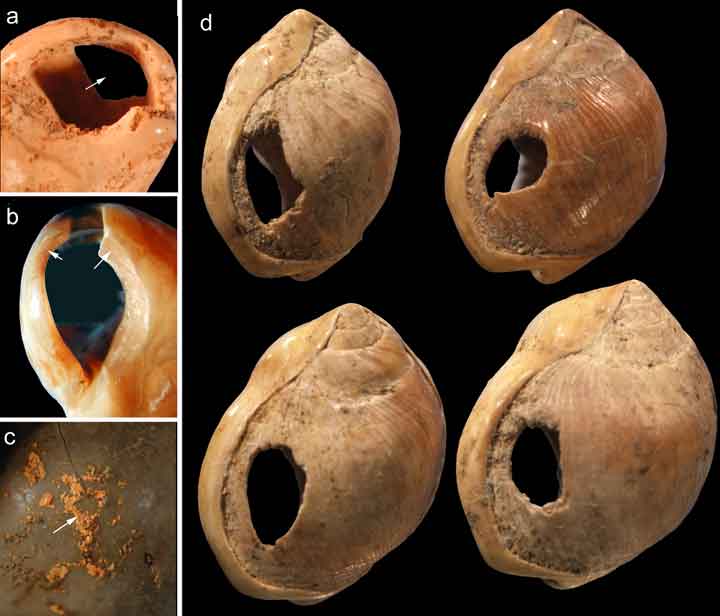
Shell beads provide compelling evidence for personal ornamentation, a behaviour widely regarded as indicating the use of material culture to communicate social identity. At Blombos Cave, forty-one deliberately perforated Nassarius kraussianus tick shells from the approximately 75,000-year-old M1 phase show wear patterns consistent with stringing and traces of red ochre, indicating that they were threaded as beads and worn on the body.12 Even earlier evidence comes from outside Africa: at Skhul cave in Israel, two perforated Nassarius gibbosulus shells from layers containing Homo sapiens burials date to 100,000 to 135,000 years ago, and at Grotte des Pigeons (Taforalt) in Morocco, thirteen perforated Nassarius gibbosulus shells with use-wear and ochre traces date to approximately 82,000 years ago.13, 14
At Diepkloof Rock Shelter in the Western Cape of South Africa, excavations of Howiesons Poort levels dated to approximately 60,000 years ago recovered 270 fragments of intentionally engraved ostrich eggshell, representing a minimum of 25 containers. The engravings display a standardised repertoire of geometric motifs — hatched bands, parallel lines, intersecting lines, and cross-hatching — that changed systematically over time, suggesting a graphic tradition maintained across generations.15 The deliberate decoration of functional containers with standardised designs implies both aesthetic sensibility and the social transmission of stylistic norms.
Key evidence for symbolic behaviour in the African MSA9, 12, 13, 14, 15
| Site | Evidence | Approximate date (ka) | Region |
|---|---|---|---|
| Skhul, Israel | Perforated Nassarius shell beads | 100–135 | Levant |
| Blombos Cave, South Africa | Engraved ochre (cross-hatched patterns) | ~100–72 | Southern Cape |
| Grotte des Pigeons, Morocco | Perforated Nassarius shell beads with ochre | ~82 | North Africa |
| Blombos Cave, South Africa | Nassarius kraussianus shell beads | ~75 | Southern Cape |
| Blombos Cave, South Africa | Abstract ochre-crayon drawing | ~73 | Southern Cape |
| Diepkloof Rock Shelter, South Africa | Engraved ostrich eggshell containers | ~60 | Western Cape |
Marine resource exploitation and long-distance exchange
The systematic exploitation of marine resources during the MSA represents a significant expansion of the hominin dietary niche. At Pinnacle Point Cave 13B on the southern Cape coast, excavations directed by Curtis Marean recovered the remains of brown mussels, limpets, and sea snails from levels dated to approximately 164,000 years ago — roughly 40,000 years earlier than the previous oldest evidence for marine shellfish consumption.16 The exploitation of intertidal shellfish requires knowledge of tidal cycles and seasonal availability, as well as the cognitive ability to plan foraging expeditions around predictable but temporally constrained resource windows. The same levels at Pinnacle Point yielded 57 pieces of red ochre, some of which had been deliberately modified, and more than 1,800 stone artefacts including small, expertly crafted bladelets, suggesting a behavioural complex that integrated subsistence innovation with symbolic expression and technological sophistication.16
The identification of early modern human ecological niche expansions across southern Africa has further demonstrated that MSA populations occupied a diversity of environments — coastal, montane, savanna, and forest — by approximately 70,000 years ago, adapting their subsistence strategies to local conditions with a flexibility that was unprecedented among earlier hominins.25
Long-distance raw material transport provides evidence for expanded social networks and possibly exchange relationships during the MSA. At the Sibilo School Road Site in the Baringo region of Kenya, dated to approximately 200,000 years ago, geochemical sourcing of obsidian artefacts revealed that raw material was obtained from three distinct volcanic sources, the most distant located 166 kilometres from the site. Remarkably, the majority of the transported obsidian came from the farthest source rather than the closest, indicating deliberate selection and sustained access to distant lithic resources.17 In the Olorgesailie basin, also in the Kenya Rift Valley, Brooks and colleagues documented obsidian transport over distances exceeding 50 kilometres by 320,000 to 305,000 years ago, coinciding with the earliest MSA technology and the use of pigment.18 Whether these long-distance transfers represent the movement of highly mobile foraging groups across large territories or the exchange of valued materials between neighbouring groups through social networks remains an open question, but either interpretation implies cognitive and social capacities well beyond those documented for earlier hominin populations.17, 18
The sapient paradox and models of innovation
The term sapient paradox, introduced by the archaeologist Colin Renfrew, originally referred to the puzzling gap between the biological emergence of anatomically modern humans and the much later appearance of the cultural hallmarks of modern behaviour, particularly the transformations associated with the Neolithic revolution approximately 10,000 years ago.24 Although the MSA evidence from Africa has substantially narrowed the temporal gap between anatomical and behavioural modernity, a version of the paradox persists: why did complex behaviours appear episodically and unevenly across the MSA, flourishing at some sites and times while being absent at others, rather than accumulating monotonically once the cognitive capacity for them existed?20, 24
The demographic hypothesis offers the most widely accepted explanation. Formal modelling by Powell, Shennan, and Thomas demonstrated that the maintenance and accumulation of complex cultural traits depends critically on effective population size and the density of social connections between subpopulations.19 When populations are large and well connected, innovations are more likely to be transmitted, refined, and retained across generations. When populations contract or become isolated — as would have occurred during glacial arid phases when African environments deteriorated — cumulative cultural traditions can be lost through a process analogous to genetic drift, even if the cognitive capacity to produce them remains intact.19
This model elegantly accounts for the episodic pattern observed in the MSA. The Still Bay and Howiesons Poort, each lasting only about 5,000 years, emerged during periods when southern African populations may have been concentrated in coastal refugia with access to marine resources, potentially achieving the population densities necessary to sustain complex cultural traditions.4, 16 Their subsequent disappearance may reflect demographic contraction rather than cognitive decline. The model also explains why behavioural modernity became sustained and cumulative after the out-of-Africa dispersal: the colonisation of Eurasia brought Homo sapiens into contact with larger and more interconnected population networks spanning diverse environments, providing the demographic conditions under which cultural complexity could ratchet upward without reversal.19
An alternative perspective, advocated by some researchers, argues that the episodic pattern may partly reflect the vagaries of archaeological preservation and excavation rather than real fluctuations in behavioural complexity. Under this view, the apparent gaps in the record may narrow as more MSA sites are discovered and dated, particularly in currently underexplored regions of central, western, and northern Africa.1, 20 The two perspectives are not mutually exclusive: both sampling bias and genuine demographic effects likely contribute to the observed pattern.
Significance for understanding human evolution
The MSA record demonstrates that the cognitive and behavioural foundations of modern humanity were assembled gradually in Africa over hundreds of thousands of years, not acquired in a single revolutionary event. McBrearty and Brooks argued persuasively that the traditional model of a "human revolution" occurring in Europe around 40,000 to 50,000 years ago was an artefact of research bias — a consequence of the far greater intensity of archaeological investigation in Europe relative to Africa — rather than a genuine reflection of the pace of human cognitive evolution.1 As Henshilwood and Marean emphasised, the concept of "behavioural modernity" itself requires careful definition: rather than a discrete threshold crossed at a single point in time, the archaeological evidence points to the incremental accumulation of a suite of cognitive capacities — symbolic reasoning, complex planning, causal understanding, and social learning — that became expressed in material culture at different times and places across the African continent.20
The innovations documented in the MSA — heat treatment, pressure flaking, compound adhesive manufacture, bone tool production, shell bead stringing, ochre engraving, and long-distance resource procurement — collectively attest to a species that possessed the full range of modern cognitive capacities well before leaving Africa. The challenge for future research lies in tracing the demographic, ecological, and social conditions under which these capacities were expressed, maintained, and transmitted across generations, and in understanding why the cultural trajectory of Homo sapiens in Africa was so different from the comparatively conservative technological traditions of contemporary Neanderthals and other archaic populations in Eurasia.1, 19, 21
References
The revolution that wasn't: a new interpretation of the origin of modern human behavior
The age of the hominin fossils from Jebel Irhoud, Morocco, and the origins of the Middle Stone Age
Ages for the Middle Stone Age of southern Africa: implications for human behavior and dispersal
Implications for complex cognition from the hafting of tools with compound adhesives in the Middle Stone Age, South Africa
82,000-year-old shell beads from North Africa and implications for the origins of modern human behavior
A Howiesons Poort tradition of engraving ostrich eggshell containers dated to 60,000 years ago at Diepkloof Rock Shelter, South Africa
Early human use of marine resources and pigment in South Africa during the Middle Pleistocene
The earliest long-distance obsidian transport: evidence from the ~200 ka Middle Stone Age Sibilo School Road Site, Baringo, Kenya
The origin of modern human behavior: critique of the models and their test implications
The Still Bay and Howiesons Poort, 77–59 ka: symbolic material culture and the evolution of the mind during the African Middle Stone Age
Indications of bow and stone-tipped arrow use 64,000 years ago in KwaZulu-Natal, South Africa
The Still Bay and Howiesons Poort at Sibudu and Blombos: understanding Middle Stone Age technologies
Neuroscience, evolution and the sapient paradox: the factuality of value and of the sacred
Identifying early modern human ecological niche expansions and associated cultural dynamics in the South African Middle Stone Age