Overview
- The oldest known figurative art dates to at least 45,500 years ago in Sulawesi, Indonesia, while non-figurative markings such as ochre engravings from Blombos Cave, South Africa, extend symbolic behaviour back to approximately 77,000 years ago, demonstrating that the capacity for artistic expression emerged deep in the African Middle Stone Age.
- Upper Paleolithic cave art in Europe, exemplified by Chauvet (approximately 36,000 years ago) and Lascaux (approximately 17,000 years ago), displays sophisticated techniques including perspective, polychrome pigments, and deliberate use of cave topography, while portable art in the form of carved figurines, engraved bones, and personal ornaments documents a rich symbolic culture across multiple continents.
- The geographic and temporal distribution of prehistoric art, now known from Africa, Europe, Southeast Asia, and Australia, has overturned earlier Eurocentric models and established that symbolic and artistic behaviour was a widespread capacity of Homo sapiens, with emerging evidence suggesting that Neanderthals also engaged in limited forms of symbolic expression.
Prehistoric art encompasses the visual and material expressions of symbolic thought created by humans and, possibly, other hominin species before the advent of writing. These works include painted and engraved images on cave walls and rock surfaces, carved figurines and ornaments, decorated tools and weapons, and musical instruments fashioned from bone and ivory. The study of prehistoric art provides some of the most direct evidence for the cognitive capacities of early humans, because the production of representational imagery, abstract symbols, and personal adornments implies abilities in planning, symbolic communication, and the capacity to imbue objects and images with meaning beyond their immediate utilitarian function.7, 16
For much of the twentieth century, the Upper Paleolithic cave art of western Europe, particularly the painted caves of France and Spain, was regarded as the earliest and most sophisticated manifestation of human artistic capacity. Discoveries over the past three decades have radically expanded this picture. The oldest known figurative cave art is now dated to at least 45,500 years ago in Sulawesi, Indonesia, while non-figurative geometric engravings from Blombos Cave in South Africa push the evidence for symbolic marking back to approximately 77,000 years ago.1, 5, 15 These findings have overturned Eurocentric models and established that the capacity for artistic expression was a widespread feature of behaviorally modern Homo sapiens, emerging in Africa well before the major dispersals into other continents.
Earliest symbolic behaviour in Africa
The earliest evidence for symbolic behaviour comes from Middle Stone Age sites in southern Africa. At Blombos Cave, located on the southern coast of the Western Cape, excavations directed by Christopher Henshilwood have recovered a series of ochre pieces engraved with abstract geometric patterns, including cross-hatched designs, dating to approximately 77,000 years ago. These engravings, made by deliberately scoring the flat surfaces of iron oxide nodules with stone tools, represent the oldest known examples of intentional abstract marking and suggest a capacity for creating and communicating through visual symbols that long predates any known figurative art.15
The same site yielded a 73,000-year-old silcrete flake bearing a drawn pattern of intersecting lines made with an ochre crayon, interpreted as an abstract drawing rather than incidental marking based on the deliberate, controlled nature of the strokes and the absence of any functional explanation for the marks.5 Blombos Cave also produced evidence of an ochre-processing workshop dating to approximately 100,000 years ago, in which ochre was ground, mixed with bone marrow fat and charcoal in abalone shells, and stored as a prepared pigment compound. While the ultimate use of this pigment, whether for body decoration, hide preservation, or symbolic marking, remains debated, the complexity of the production process implies forward planning and the transmission of learned techniques.4
Beyond Blombos, the Middle Stone Age record of southern and eastern Africa includes perforated marine shell beads from sites such as Grotte des Pigeons in Morocco (approximately 82,000 years ago) and Sibudu Cave in South Africa, engraved ostrich eggshell fragments from Diepkloof Rock Shelter (approximately 60,000 years ago), and additional ochre engravings from Klein Kliphuis and other sites. Collectively, these finds demonstrate that symbolic expression was not a sudden "revolution" but a gradually accumulating repertoire of behaviours that developed over tens of thousands of years within African populations of Homo sapiens.16
Southeast Asian cave art
The discovery and dating of cave art in the limestone karst regions of Sulawesi and Borneo in Indonesia has fundamentally altered understanding of the origins of figurative art. In 2014, uranium-series dating of calcite deposits overlying hand stencils and animal paintings in the caves of Maros-Pangkep, southern Sulawesi, demonstrated that some of these works are at least 39,900 years old, making them contemporaneous with the oldest dated cave art in Europe.14
Subsequent work pushed the dates even further back. In 2019, Aubert and colleagues reported a hunting scene from the cave of Leang Bulu' Sipong 4, also in Sulawesi, depicting human-like figures with animal features (therianthropes) hunting wild pigs and dwarf buffalo (anoa). Uranium-series dating of the overlying calcite established a minimum age of 43,900 years, making it the oldest known narrative scene in art and the earliest depiction of therianthropes, figures that combine human and animal characteristics and are widely interpreted as evidence for imaginative or mythological thinking.1 A further study in 2021 identified a figurative painting of a Sulawesi warty pig dated to at least 45,500 years ago, the oldest known figurative artwork anywhere in the world as of the time of publication.2
In Borneo, figurative paintings of wild cattle in the cave of Lubang Jeriji Saléh have been dated to at least 40,000 years ago, followed by a later phase of human figures and geometric motifs dating to approximately 20,000 years ago.12 The Southeast Asian corpus demonstrates that figurative cave art appeared in the tropical islands of the Indo-Malay archipelago at essentially the same time as, or possibly earlier than, in Ice Age Europe, suggesting that the capacity for representational art was carried by Homo sapiens populations as they dispersed from Africa and was independently expressed wherever suitable cave environments existed.
European cave art
The painted caves of western Europe remain the most extensively studied body of prehistoric art. The earliest firmly dated examples include the paintings of Grotte Chauvet in the Ardèche valley of southeastern France, which radiocarbon dating places at approximately 36,000 to 33,000 years ago, within the Aurignacian cultural period.6, 10 Chauvet's paintings display a level of technical sophistication that astonished researchers upon their discovery in 1994: the artists used techniques including shading, perspective, the suggestion of movement through multiple overlapping outlines, and the deliberate scraping of the cave wall to create lighter backgrounds against which dark pigments stand out. The subjects are predominantly large animals, including lions, rhinoceroses, horses, aurochs, and bears, depicted with naturalistic anatomical detail that demonstrates close observation of living animals.6, 7
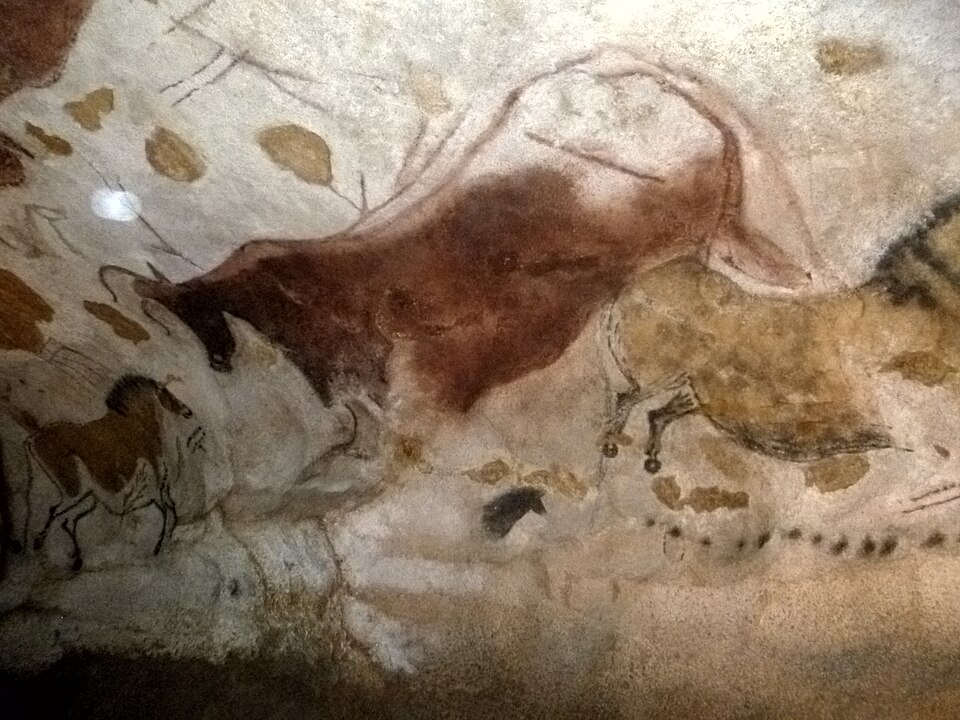

The Gravettian and Solutrean periods (approximately 33,000 to 17,000 years ago) saw a proliferation of both cave art and portable art across western Europe. The most celebrated cave art site from this era is Lascaux in the Dordogne region of France, discovered in 1940 and containing approximately 600 painted animals and 1,500 engravings dating to roughly 17,000 years ago. The "Hall of the Bulls" at Lascaux includes aurochs figures over five metres in length, rendered in polychrome pigments of red, yellow, and black derived from iron oxides and manganese dioxide. The site of Altamira in northern Spain, discovered in 1879, features a ceiling of polychrome bison paintings dating to approximately 14,000 years ago and was the first cave art site to be recognised as genuinely ancient, though its authenticity was controversially disputed for decades.7
European cave art is not evenly distributed across the continent but concentrated in specific regions, particularly the Franco-Cantabrian zone of southwestern France and northern Spain, with additional significant sites in Portugal, Italy, Romania, and the Ural Mountains of Russia. David Lewis-Williams and others have proposed that the placement of art deep within caves, often in locations that are difficult to access and far from habitation areas, suggests that the caves held ritual or spiritual significance and that the art may have been produced in the context of shamanistic practices or altered states of consciousness, though such interpretations remain debated.7
Portable art and figurines
Alongside parietal (cave wall) art, the Upper Paleolithic produced a rich tradition of portable art: small, transportable objects including carved figurines, engraved bone and antler, decorated tools, and personal ornaments such as beads and pendants. The oldest known three-dimensional figurative sculpture is the Löwenmensch (Lion Man) from Hohlenstein-Stadel cave in the Swabian Jura of southwestern Germany, a 31-centimetre-tall ivory statuette depicting a human body with a lion's head, carved from mammoth ivory approximately 40,000 years ago. The Lion Man required an estimated 400 hours of skilled carving to produce and, as a therianthrope, demonstrates the capacity for imaginative combination of concepts from different domains of experience, a cognitive ability sometimes termed "cognitive fluidity."8
The same Swabian Jura caves have yielded other Aurignacian ivory figurines, including representations of horses, mammoths, bison, and waterfowl, as well as the earliest known musical instruments: bone and ivory flutes dating to approximately 42,000 to 35,000 years ago. A five-holed flute carved from the radius of a griffon vulture, recovered from Hohle Fels cave, is the most complete example and demonstrates a sophisticated understanding of acoustic principles.9
The "Venus figurines" are a class of small female statuettes found across a broad geographic range from southwestern France to Siberia, dating primarily to the Gravettian period (approximately 30,000 to 22,000 years ago). These figurines, of which the Venus of Willendorf (Austria, approximately 25,000 years old) is the most famous, typically emphasise breasts, hips, abdomen, and thighs while minimising the head, arms, and feet. Their interpretation has been extensively debated, with proposals ranging from fertility symbols and goddess figures to self-representations by pregnant women, though no consensus has been reached.11
Timeline of major prehistoric art discoveries1, 5, 6, 8, 14
Neanderthal symbolic expression
Whether Neanderthals produced art or engaged in symbolic behaviour has been one of the most contentious questions in paleoanthropology. For decades, the dominant view held that symbolic expression was unique to Homo sapiens and that any apparent Neanderthal symbolic objects were the result of imitation or acculturation through contact with modern humans. This view has been challenged by several discoveries.
In 2018, Hoffmann and colleagues published uranium-series dates for cave art at three sites in Spain, La Pasiega, Maltravieso, and Ardales, demonstrating that red-painted geometric symbols, hand stencils, and other markings predated the arrival of modern humans in Europe by at least 20,000 years, with minimum ages of approximately 65,000 years. If accepted, these dates would establish Neanderthals as the authors of the oldest known cave art anywhere in the world.3 The same research group reported that perforated and pigment-stained marine shells from Cueva de los Aviones in southeastern Spain, dated to approximately 115,000 years ago, represent Neanderthal use of personal ornaments and symbolic pigments long before contact with Homo sapiens.13
These findings remain debated. Critics have questioned the reliability of the uranium-series dates, arguing that open-system behaviour of uranium in thin calcite crusts could produce erroneously old ages, and that some of the dated features may be natural rather than anthropogenic. Nevertheless, even sceptics generally accept that Neanderthals used pigments (particularly manganese dioxide), collected unusual objects such as raptor talons and fossil shells, and occasionally produced simple engravings, supporting a view of Neanderthal cognitive capacity as more complex than previously assumed.3, 13, 16
Australian rock art
Australia possesses one of the oldest and most extensive rock art traditions in the world, produced by Aboriginal peoples over a period spanning at least 40,000 years and continuing into the recent past. The oldest dated examples include a painting of a kangaroo from Kimberley, Western Australia, dated by radiocarbon analysis of overlying mud-wasp nests to approximately 17,300 years ago, though the antiquity of the Australian rock art tradition almost certainly extends much further back, given that human occupation of Australia dates to at least 65,000 years ago and evidence of ochre use is present from the earliest occupation levels.
The Kimberley region contains a rich sequence of art styles that archaeologists have used to construct a relative chronology: the earliest Irregular Infill style is followed by the distinctive Gwion Gwion (formerly called Bradshaw) figures, elegant depictions of human forms in elaborate headdresses and ceremonial attire, and then by the later Wanjina paintings of large, mask-like faces associated with creation beings in the cosmology of living Kimberley Aboriginal groups. In Arnhem Land, the rock art sequence includes dynamic X-ray-style paintings that depict the internal anatomy of animals alongside their external form, a convention that reflects the deep knowledge of animal anatomy possessed by hunter-gatherer communities.16
Unlike the cave art of Europe, which was produced during a relatively restricted period and ceased after the end of the last Ice Age, Australian rock art represents a living tradition that connects contemporary Aboriginal peoples to their deep past, with some sites still used for ceremonial purposes and maintained through repainting. This continuity makes Australian rock art not merely an archaeological record but a cultural heritage of ongoing significance.
Interpretation and meaning
The interpretation of prehistoric art has been shaped by changing theoretical frameworks over the past century. Early interpretations, influenced by ethnographic analogy with nineteenth-century hunter-gatherer societies, proposed that cave paintings served as "hunting magic," intended to ensure success in the hunt by depicting prey animals. This view, associated with the Abbé Henri Breuil, was dominant from the early twentieth century until the 1960s but was undermined by the observation that the animal species most frequently depicted in cave art do not correspond to the species most commonly hunted, as shown by the faunal remains at associated habitation sites.7
André Leroi-Gourhan proposed a structuralist interpretation in the 1960s, arguing that cave art was organised according to a system of binary oppositions (male/female, central/peripheral) and that the distribution of different animal species within caves followed consistent spatial patterns. While influential, this approach was criticised for imposing an overly rigid framework on a highly variable corpus of art.7
More recent approaches have drawn on neuropsychological research and ethnographic studies of shamanistic societies. Lewis-Williams argued that many features of cave art, including geometric patterns (entoptic phenomena), therianthropic figures, and the use of deep, dark cave interiors, are consistent with imagery experienced during altered states of consciousness and that the caves may have served as settings for ritual practices involving trance states. While this hypothesis has generated productive research, it remains controversial, particularly in its application to specific sites and images.7
A growing body of scholarship emphasises the diversity of prehistoric art and cautions against seeking a single explanatory framework. Different images within the same cave may have served different purposes; the same cave may have been used by different groups at different times over thousands of years; and the meaning of images may have shifted over time even within a single cultural tradition. What can be stated with confidence is that the production of art reflects cognitive capacities, including symbolic thought, planning, and the ability to represent absent entities, that are hallmarks of the modern human mind.7, 16
Cognitive and evolutionary significance
Prehistoric art provides crucial evidence for understanding the evolution of human cognition. The ability to create representational images requires several cognitive capacities that are not demonstrably present in any other species: the capacity for mental imagery (visualising an object or scene that is not present), the ability to translate a three-dimensional percept into a two-dimensional representation, the fine motor control to execute precise marks with tools, and the understanding that an image can stand for or refer to something other than itself, a capacity known as symbolic reference.16
The archaeological evidence suggests that these capacities developed gradually rather than appearing suddenly. The sequence from non-figurative geometric engravings (Blombos, approximately 77,000 years ago) through personal ornaments (shell beads, approximately 82,000 years ago in North Africa and 75,000 years ago in southern Africa) to fully figurative art (Sulawesi, at least 45,500 years ago) implies a cumulative trajectory in which different components of symbolic behaviour were assembled over a period of at least 30,000 years.5, 14, 15, 16
The relationship between art and language is a subject of intense speculation. Both require the capacity for symbolic representation, and some researchers have argued that the appearance of figurative art marks the point at which fully modern language had evolved, since the cognitive infrastructure required for one may underpin the other. Others note that language likely preceded art by a considerable margin and that art represents only one of many possible expressions of a symbolic capacity that was already in place. The debate remains unresolved, but the prehistoric art record provides the most tangible material evidence for the emergence of the symbolic mind that distinguishes Homo sapiens from all other species.7, 16
References
Early Upper Paleolithic chronology in the Levant: new ABOx-SC accelerator mass spectrometry results from the site of Ksar Akil, Lebanon
Symbolic use of marine shells and mineral pigments by Iberian Neandertals 115,000 years ago