Overview
- Archaeological dating methods fall into two broad categories: relative methods, which establish the sequence of events, and absolute (chronometric) methods, which assign calendar ages to materials.
- Radiocarbon dating, invented by Willard Libby in 1949 and calibrated against tree-ring and other records in the IntCal20 curve, remains the most widely used chronometric technique for the last 50,000 years.
- No single method covers all time ranges or materials; in practice, archaeologists combine multiple independent techniques and use Bayesian statistical modeling to build high-precision chronological frameworks.
Establishing when things happened is among the most fundamental problems in archaeology. Without dates, excavated objects are merely curiosities; with them, they become chapters in the story of human history. The methods that archaeologists use to assign ages to sites, artifacts, and events have expanded dramatically since the mid-twentieth century, producing a toolkit that ranges from simple stratigraphic observation to precision atomic physics. These methods are conventionally divided into two families: relative dating, which establishes the sequence in which things occurred without assigning specific calendar ages, and absolute or chronometric dating, which places events at specific points in time, usually expressed in years before the present or as calendar dates.3, 12
Relative dating methods
Before absolute techniques became available, archaeologists relied exclusively on methods that establish temporal order rather than calendar age. These approaches remain foundational because they are applicable to virtually any site and require no laboratory equipment. Their limitation is that they situate materials relative to one another — earlier, contemporary, or later — without specifying how many years separate those positions.
Stratigraphy is the oldest and most universally applied relative method. It rests on the geological principle of superposition: in an undisturbed sequence of deposits, lower layers were laid down before upper ones. Archaeologists read a stratigraphic section much as geologists read a cliff face, inferring that materials found together in the same depositional layer are broadly contemporary, while materials separated by distinct boundaries are of different ages. The formalization of stratigraphic principles for archaeological use, particularly through Edward Harris's development of the Harris Matrix in the 1970s, gave the discipline a rigorous analytical language for recording and interpreting complex stratigraphic sequences at urban sites where centuries of occupation had interleaved deposits in complicated ways.3
Typology uses the observation that artifacts change in style, form, and technology through time. By classifying objects into types and tracking how those types appear, peak, and disappear across a region, archaeologists can construct sequences that allow an undated assemblage to be placed within a broader chronological framework. The method was pioneered by Oscar Montelius in nineteenth-century Scandinavia and remains central to ceramic analysis, lithic studies, and the dating of metal objects where direct absolute dates are unavailable.12
Seriation is a more formal statistical extension of typological reasoning. It arranges assemblages in an order that reflects the gradual rise and fall of particular artifact types, producing a "battleship-shaped" curve of type frequency over time. Frequency seriation assumes that artifact types are introduced, become popular, and then decline in a unimodal pattern. Occurrence seriation simply sequences assemblages by which types are present or absent. Both approaches were refined in North American archaeology during the first half of the twentieth century and have been computerized to handle large datasets.12
Fluorine, uranium, and nitrogen (FUN) dating exploits systematic chemical changes in buried bone over time. Bone absorbs fluorine and uranium from groundwater, while its organic nitrogen content declines as collagen degrades. Because these processes proceed at rates dependent on local soil chemistry rather than any universal constant, the method cannot produce absolute dates; it can only determine whether bones from the same deposit share the same burial history. The technique gained historical notoriety when Kenneth Oakley used it in 1949 to expose the Piltdown hoax: "Piltdown Man" was alleged to be an early hominin but fluorine analysis revealed that the skull and jaw had very different fluorine contents, proving they were not from the same individual or time period.17
Radiocarbon dating
The most consequential advance in archaeological dating came in 1949, when American physicist Willard Libby announced a method for measuring the age of organic materials using the radioactive isotope carbon-14. The work earned Libby the Nobel Prize in Chemistry in 1960 and transformed archaeology, geology, and paleoclimatology simultaneously.1
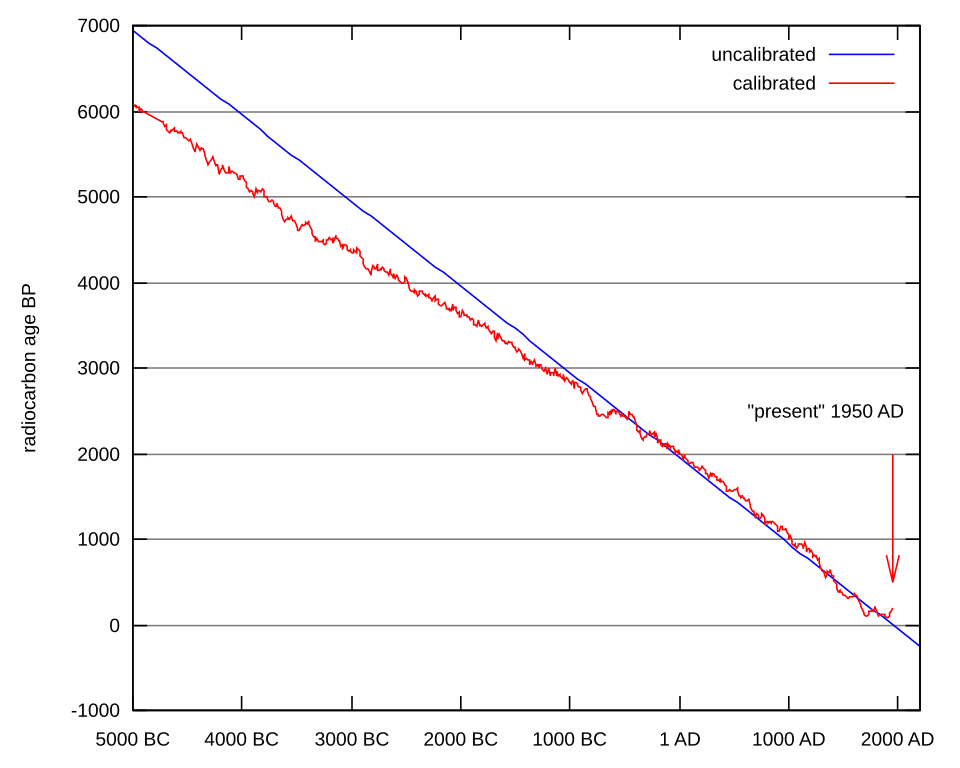

The method rests on a well-understood physical process. Cosmic rays entering Earth's upper atmosphere produce neutrons that interact with atmospheric nitrogen-14, converting it to carbon-14 (14C). This radioactive carbon combines with oxygen to form carbon dioxide and enters the global carbon cycle, so that all living organisms maintain a roughly constant ratio of 14C to stable 12C throughout their lives. When an organism dies, it stops exchanging carbon with the environment, and the 14C it contains begins to decay at a known rate — its half-life is 5,730 years. By measuring the residual 14C in a sample and comparing it to the expected initial concentration, a laboratory can calculate how long ago the organism died.1, 18
The practical upper limit of conventional radiocarbon dating is approximately 50,000 years, beyond which so little 14C remains that measurements become unreliable. The method can be applied to any organic material: charcoal, wood, seeds, bone, shell, antler, peat, and even fabric. Crucially, the dated material must be directly associated with the archaeological event of interest; dating a charcoal beam from a reused timber, for example, may produce an age centuries older than the structure it was used to build. Such "old wood" effects, along with contamination by older or younger carbon, represent the main sources of error in radiocarbon dating.10
Calibration and IntCal20. Libby originally assumed that atmospheric 14C concentrations had remained constant through time. Subsequent research showed this assumption to be incorrect: solar variability, changes in Earth's magnetic field, and past shifts in ocean circulation have all caused the atmospheric 14C/C ratio to fluctuate. As a result, a "raw" radiocarbon age expressed in "radiocarbon years before present" must be calibrated against an independent record to obtain a calendar age. The primary calibration dataset for the Northern Hemisphere is IntCal20, published in 2020, which extends back 55,000 calendar years and is constructed from tree rings, cave deposits (speleothems), lake sediment varves, and coral records.2, 18 A companion curve, SHCal20, covers the Southern Hemisphere, where the marine carbon reservoir creates a systematic offset from Northern Hemisphere values.14
Dendrochronology as a calibration anchor. The backbone of the radiocarbon calibration curve for the last 14,000 years is tree-ring chronology. Because each annual growth ring in a tree incorporates atmospheric carbon from that specific year, measuring 14C in rings of known age provides a direct link between radiocarbon time and calendar time. Long-lived trees such as bristlecone pines (Pinus longaeva) of the American Southwest and subfossil oaks preserved in Irish and German bogs and rivers have been cross-dated to produce a continuous, year-by-year record spanning more than 14,000 years, providing the most precise section of the calibration curve.4
Accelerator mass spectrometry
Conventional radiocarbon dating counts the decay events produced by 14C atoms over hours of measurement, requiring samples of one to several grams of carbon. This was a significant constraint because it demanded large, often irreplaceable, samples of organic material. The introduction of accelerator mass spectrometry (AMS) in the 1980s revolutionized the field by directly counting individual 14C atoms rather than waiting for them to decay, reducing the required sample mass by several orders of magnitude — to as little as a few milligrams of carbon.19
AMS radiocarbon dating opened up new categories of material to direct dating: single seeds, individual amino acid fractions from bone collagen, tiny charcoal fragments too small for conventional methods, manuscript fragments, and even individual pollen grains. The technique made it possible to date objects previously thought undateable and to apply rigorous pretreatment protocols — such as ultrafiltration of bone collagen — that remove contaminants and produce more reliable ages.10 AMS also made large-scale dating projects economically feasible, enabling systematic chronological surveys of entire site assemblages rather than spot-sampling.
Dendrochronology
Tree-ring dating, or dendrochronology, is in many circumstances the most precise dating method available to archaeologists, capable of assigning the felling of a timber to a specific calendar year and sometimes even to a specific season within that year. The method was pioneered by astronomer Andrew Ellicott Douglass at the University of Arizona in the early twentieth century, who noticed that the width of annual growth rings in trees varied systematically with climate, creating distinctive patterns that could be matched between trees.4
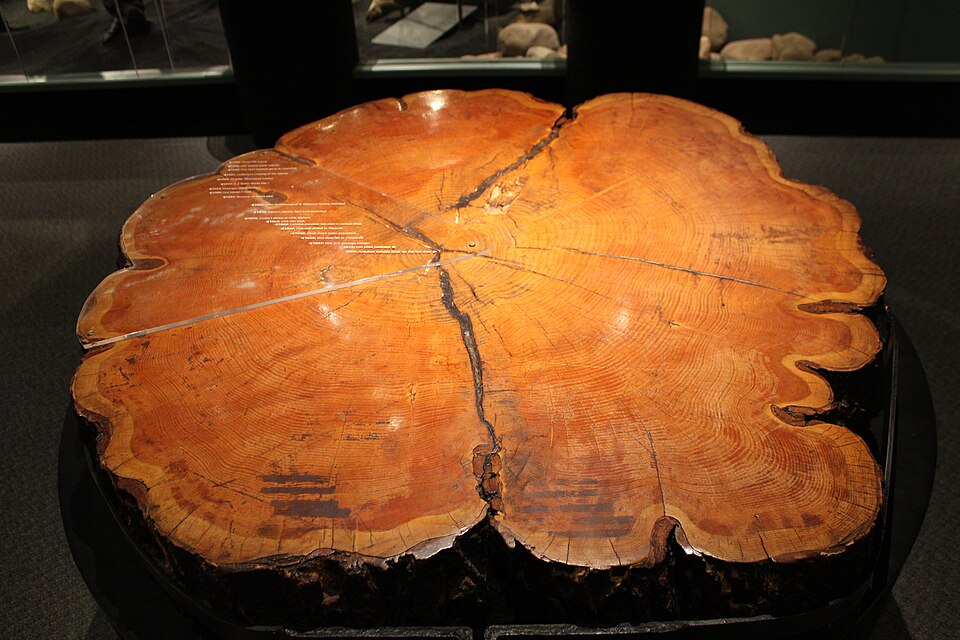

The principle is straightforward: trees in temperate and semi-arid regions produce one ring per year, with wider rings corresponding to favorable growing conditions and narrower rings to stressful ones such as drought, frost damage, or volcanic eruption. Because regional climate affects all trees simultaneously, the sequence of wide and narrow rings forms a fingerprint unique to a particular time interval. By overlapping ring sequences from living trees and progressively older dead wood, researchers have built continuous master chronologies extending back thousands of years in regions where suitable wood is preserved. These "floating" sequences can be anchored to calendar years when they overlap with the living chronology or when independent dates are available.4
Dendrochronology has its limitations. It requires the preservation of sufficient rings for pattern matching, typically at least 50–80 rings per sample. It is also geographically restricted to regions where long tree-ring chronologies have been built, covering much of Europe, western North America, and parts of the Middle East and East Asia, but leaving significant gaps elsewhere. The method can only date wood directly; associated organic materials or archaeological features must be interpreted with respect to the dated timber, and the relationship between when a tree was felled and when a structure was built or used introduces interpretive uncertainties.4
Luminescence dating
Thermoluminescence (TL) and optically stimulated luminescence (OSL) are collectively known as luminescence dating. These methods measure the time elapsed since mineral grains — primarily quartz and feldspar — were last exposed to heat or sunlight. They are applicable to sediments and fired artifacts over a range extending from a few decades to several hundred thousand years, covering time periods largely beyond the reach of radiocarbon.5, 20
The physical basis of luminescence dating lies in the behavior of electrons in crystal lattice defects. Ionizing radiation from naturally occurring radioactive elements in the surrounding sediment — uranium, thorium, potassium — displaces electrons from their normal positions, and these electrons become trapped at imperfections in the crystal structure. The trapped electron population grows continuously over time as the mineral absorbs its annual dose of radiation, functioning as a clock. When the mineral is exposed to heat (as in a kiln or hearth) or to daylight (as when sediment is transported and deposited), the trapped electrons are released and the clock is reset to zero. In the laboratory, exposing the sample to heat or stimulating light again causes the stored electrons to release their energy as luminescence, and the intensity of that signal is proportional to the dose accumulated since the last zeroing event.5, 20
TL dating was developed during the 1960s and applied primarily to fired ceramics and burnt flint, for which heating in antiquity provides a clear zeroing event. OSL, which uses light rather than heat to release the signal and is applicable to unheated sediment grains bleached by sunlight during transport, emerged in the 1980s and has become the dominant luminescence technique for dating sediments.5 OSL has proven especially important in African prehistory, where it has been used to date sediments containing Middle Stone Age and Later Stone Age assemblages far beyond the range of radiocarbon, and in the dating of loess sequences that record past glacial cycles across Eurasia.
The main source of uncertainty in luminescence dating is incomplete bleaching: grains that were not fully exposed to sunlight at deposition may retain a residual dose that inflates the apparent age. Statistical approaches and single-grain measurement — where individual grains are measured rather than bulk samples — help identify and exclude poorly bleached grains, improving accuracy in complex depositional environments.5
Potassium-argon and argon-argon dating
The potassium-argon (K-Ar) and its refined successor, the argon-argon (40Ar/39Ar) method, are the principal tools for dating volcanic materials associated with hominin fossils and archaeological sites in East and South Africa. They are applicable from roughly 100,000 years to billions of years ago, and at major hominin sites such as Olduvai Gorge, Hadar, and the Turkana Basin, they have provided the chronological framework upon which the entire narrative of human evolution depends.6, 7
Potassium-40 (40K) decays to argon-40 (40Ar) with a known half-life of approximately 1.25 billion years. When volcanic rock forms from molten magma, any previously accumulated argon escapes; the rock therefore begins life with zero radiogenic argon and accumulates 40Ar from that moment forward. Measuring the ratio of 40K to 40Ar in a sample allows the age of its last melting to be calculated.6 The 40Ar/39Ar method improves on this by irradiating the sample with neutrons to convert potassium-39 to argon-39, allowing both isotopes to be measured simultaneously in the same sample and enabling step-heating experiments that identify and correct for argon loss or excess argon. Single-crystal 40Ar/39Ar laser fusion can date individual volcanic mineral grains, making it possible to obtain ages from tuffaceous (volcanic ash) layers interbedded with sediments containing fossils and artifacts.7
Because K-Ar and 40Ar/39Ar date volcanic events rather than biological ones, their archaeological application requires that datable volcanic deposits bracket the hominin-bearing horizons above and below. At Hadar in Ethiopia, for example, 40Ar/39Ar dating of volcanic tuffs above and below the fossil-bearing strata established the age of Australopithecus afarensis, including the famous “Lucy” skeleton, at approximately 3.2 million years.6, 7
Uranium-series and ESR dating
Uranium-series dating exploits the radioactive decay chains initiated by uranium-238 and uranium-235. Uranium is soluble in water and is therefore mobile in the environment, while its daughter products — particularly thorium-230 and protactinium-231 — are insoluble and precipitate out when uranium-bearing water enters a closed system. By measuring the degree of radioactive equilibrium (or disequilibrium) between parent and daughter isotopes, the time elapsed since the system closed can be calculated. The method covers a range from a few thousand to approximately 600,000 years.8, 15
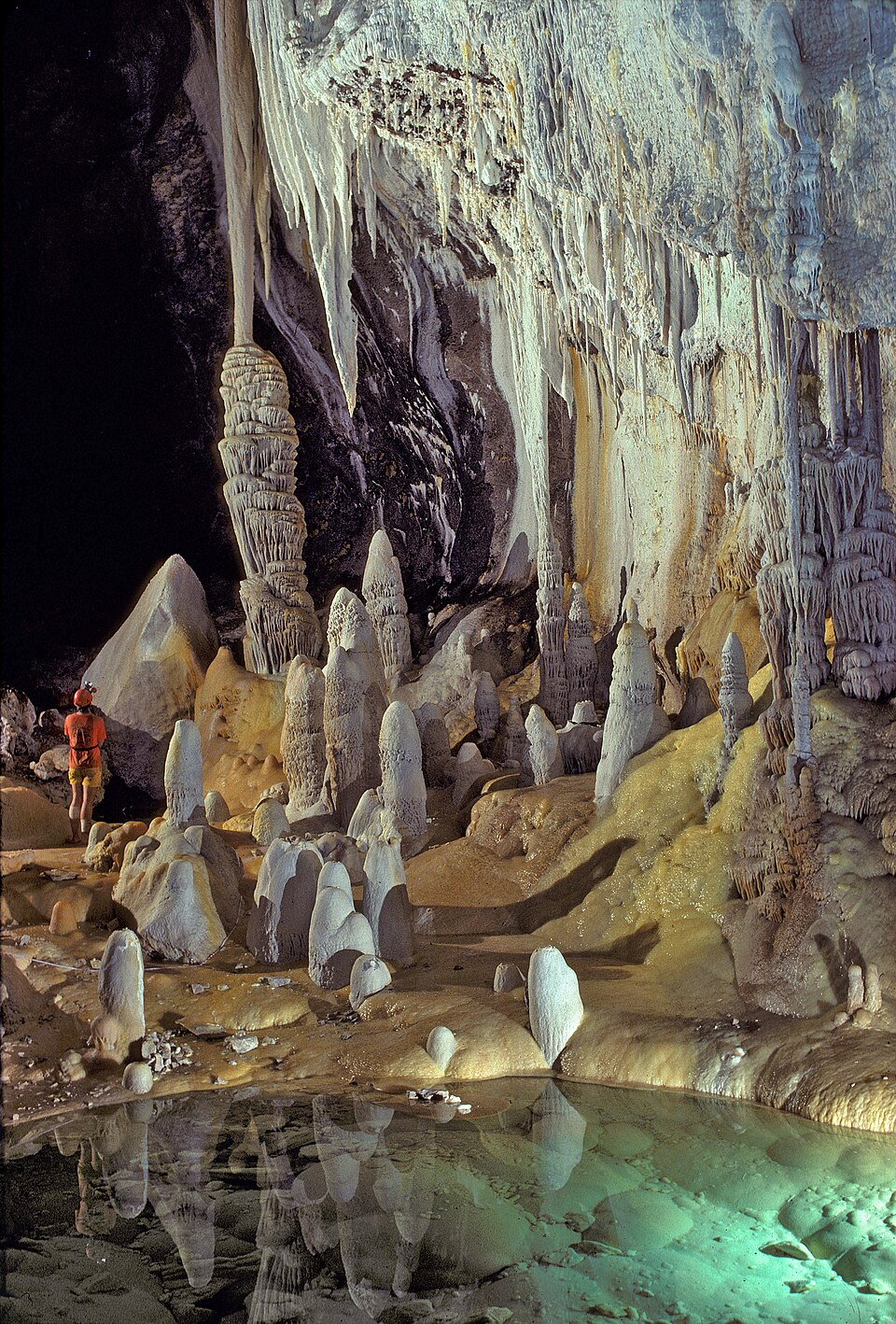

The most important archaeological applications of uranium-series dating are in cave environments. Speleothems — stalactites and stalagmites — grow incrementally from calcium carbonate precipitating from uranium-bearing groundwater. They form closed systems that are ideal for uranium-series analysis, and their growth layers can be dated with uncertainties as small as 0.1–1% of the sample age. Archaeologically, speleothems are valuable because they can overgrow artifacts, bones, or pigmented rock art, providing a minimum age for the underlying material. Studies of cave art in Spain and elsewhere using uranium-series dating have pushed the earliest known symbolic behavior back to before 65,000 years ago.15 Uranium-series dating has also been applied directly to fossil bone and tooth enamel, though open-system behavior — uranium uptake continuing after burial — complicates interpretation and requires modeling of the uptake history.8, 21
Electron spin resonance (ESR) dating is closely related in principle to luminescence dating but operates at the atomic level and is applied primarily to tooth enamel, a material that accumulates radiation dose steadily after burial but, unlike luminescence minerals, cannot be optically or thermally bleached in nature. ESR measures the concentration of free radicals (unpaired electrons) trapped in the crystal lattice of the enamel, which increases with radiation dose over time. The dose accumulated by the enamel is compared to the annual dose rate from the burial environment to calculate an age.9, 24
Because tooth enamel is robust and survives in contexts where no other datable material is present, ESR has become a critical technique for sites in the 100,000- to 2-million-year range. An important refinement involves combining ESR with uranium-series dating on the same tooth, using the uranium-series result to constrain the open-system uranium uptake history and producing more precise ESR ages. This "combined ESR/U-series" approach has been widely applied to teeth from Neanderthal and early Homo sapiens sites in Europe and the Levant.9
Other chronometric methods
Archaeomagnetism (also called paleomagnetic dating) exploits the fact that Earth's magnetic field has varied in both direction and intensity over geological time. When clay is fired to high temperatures in kilns, hearths, or burned structures, the magnetic minerals it contains align with the ambient magnetic field and lock into that orientation as the clay cools below its Curie temperature. By measuring the remanent magnetic direction of in-situ fired features and comparing it to the known record of geomagnetic secular variation for the region, archaeologists can estimate when the feature was last fired. The method requires a well-established regional reference curve and a feature that has not been disturbed since firing, limiting it to intact kilns, hearths, and similar fired features. Its precision typically ranges from a few decades to around a century.16, 22
Obsidian hydration dating is based on the absorption of water into freshly exposed obsidian surfaces. When obsidian — volcanic glass used extensively as a raw material for stone tools — is knapped or broken, a fresh surface is exposed that begins to hydrate at a rate sensitive to temperature and the specific chemical composition of the obsidian source. Measuring the thickness of the hydration rim under polarized light provides a relative or, if the local hydration rate is calibrated, an absolute age. The method was first described by Friedman and Smith in 1960 and remains useful for sites in well-studied obsidian-source regions, though the strong temperature dependence of hydration rates requires careful paleoclimate correction.13
Combining methods and Bayesian modeling
The major analytical development in archaeological chronology of the past three decades has been the formalization of multi-method integration through Bayesian statistical modeling. No single dating method is universally applicable, infallible, or free of assumptions; each covers a particular range of materials, time periods, and conditions. In practice, the strongest chronological arguments combine two or more independent methods applied to the same context, treating the resulting ages as complementary constraints on the true calendar age rather than as isolated measurements.11, 23
Bayesian chronological modeling, as implemented in software such as OxCal and BCal, provides a mathematically rigorous framework for this integration. The approach treats archaeological knowledge — the stratigraphic ordering of deposits, the sequence in which contexts were formed, the contemporaneity of objects in a closed cache — as prior information that constrains the posterior probability distributions of individual dates. A radiocarbon date from a context known stratigraphically to be earlier than another context, for example, can be constrained so that its calibrated age cannot be younger than the date of the overlying context. When many radiocarbon dates, luminescence dates, dendrochronological dates, and stratigraphic constraints are combined in a single model, the resulting age estimates are often substantially more precise than any individual measurement.11
The development and widespread adoption of Bayesian modeling has transformed research programs such as the dating of the British Neolithic, the absolute chronology of the Egyptian pharaonic sequence, the timing of the peopling of the Americas, and the precise dating of the Neanderthal to modern human transition in Europe. In each case, the combination of multiple dating methods within a coherent probabilistic framework produced chronological resolution that individual methods could not achieve alone.11, 23
Summary of major archaeological dating methods3, 5, 6, 9, 12, 20
| Method | Type | Applicable range | Primary materials | Typical precision |
|---|---|---|---|---|
| Stratigraphy | Relative | Any | Deposits, contexts | Sequence only |
| Typology / seriation | Relative | Any | Artifacts, ceramics | Sequence only |
| Fluorine/uranium/nitrogen | Relative | Any (local) | Bone | Sequence only |
| Radiocarbon (AMS) | Absolute | 200–50,000 yr BP | Organic material | ±20–100 yr |
| Dendrochronology | Absolute | ~14,000 yr BP | Wood, timber | ±1 yr (calendar) |
| TL / OSL | Absolute | 100–500,000 yr BP | Sediment, ceramics, flint | ±5–15% |
| Potassium-argon / Ar-Ar | Absolute | 100,000 yr–billions | Volcanic rock, ash | ±0.1–2% |
| Uranium-series | Absolute | 1,000–600,000 yr BP | Speleothem, bone, coral | ±0.1–5% |
| ESR | Absolute | 10,000 yr–2 Ma | Tooth enamel, shell | ±5–15% |
| Archaeomagnetism | Absolute | Regional, ~10,000 yr | Fired clay, hearths | ±10–50 yr |
| Obsidian hydration | Relative/Absolute | Decades–1 Ma | Obsidian artifacts | Variable |
References
Palaeomagnetic analysis of the Sterkfontein palaeocave deposits: implications for the age of the hominin fossils and stone tool industries