Overview
- Tenochtitlan, founded in 1325 on a small island in Lake Texcoco, grew into one of the largest cities in the world by 1519, with a population estimated between 200,000 and 300,000 inhabitants and an urban area of 8 to 13.5 square kilometres sustained by chinampa agriculture and a vast tribute economy.
- The city's hydraulic infrastructure — including the 16-kilometre Nezahualcoyotl dike, twin aqueducts from Chapultepec, three monumental causeways, and an intricate canal network — represented one of the most sophisticated water-management systems in the pre-industrial world.
- The Templo Mayor excavations, begun in 1978 under Eduardo Matos Moctezuma and continued by Leonardo López Luján, have uncovered more than 175 ritual offerings and seven construction phases, transforming scholarly understanding of Mexica religion, politics, and urban life beneath modern Mexico City.
Tenochtitlan (Nahuatl: Tēnōchtitlan, "place of the prickly-pear cactus among the rocks") was the capital of the Aztec Empire and one of the largest and most architecturally ambitious cities in the pre-Columbian world.1, 2 Founded in 1325 on a marshy island in Lake Texcoco in the Basin of Mexico, the city grew over two centuries from a modest settlement of refugee Mexica migrants into a sprawling metropolis of between 200,000 and 300,000 inhabitants, making it comparable in size to contemporary Constantinople and larger than any city in western Europe at the time of Spanish contact in 1519.1, 4 The Mexica transformed their unpromising lacustrine site into a monumental urban centre through extraordinary feats of hydraulic engineering — constructing causeways, aqueducts, dikes, and canal networks — and sustained its population through intensive chinampa (raised-field) agriculture on the shallow lake bed surrounding the island.3, 5 When Hernán Cortés and his Indigenous allies besieged and destroyed the city in 1521, they obliterated a built environment that had astonished the Spanish conquerors themselves; Bernal Díaz del Castillo famously compared Tenochtitlan to the enchanted cities described in the romance of Amadís de Gaula.12, 13 Today, the ruins of Tenochtitlan lie beneath the streets of Mexico City, and ongoing archaeological excavations continue to reveal the scale and sophistication of Mexica urban life.15
Founding and early growth
The Mexica, a Nahuatl-speaking people who had migrated southward into the Basin of Mexico during the thirteenth century, arrived as marginal newcomers in a region already dominated by established city-states such as Azcapotzalco, Culhuacan, and Texcoco.1, 6 According to the foundation narrative preserved in the Codex Mendoza and other colonial-era sources, the Mexica wandered for generations before their patron deity Huitzilopochtli guided them to an island in Lake Texcoco where they observed an eagle perched on a nopal cactus — the divine sign marking the site for their city.7, 1 The traditionally accepted founding date is 1325 CE (the Aztec calendar date 2 House), though some scholars have argued for 1345 based on alternative readings of the sources.1, 6
The island site offered both disadvantages and strategic advantages. It lacked arable land and fresh water, and was subject to periodic flooding, but its location on the lake provided natural defences against military attack and access to the aquatic resources of the Basin's interconnected lake system.1, 3 For nearly a century, the Mexica served as tributaries and mercenaries of the powerful Tepanec state centred at Azcapotzalco, gradually expanding their island through landfill and chinampa construction while building political alliances through intermarriage with the prestigious Culhua lineage.1, 5 The decisive turning point came in 1428, when the Mexica, led by the ruler Itzcoatl, joined with Texcoco and Tlacopan to overthrow Tepanec hegemony and establish the Triple Alliance, a confederacy in which Tenochtitlan rapidly became the dominant partner.1, 10 The defeat of Azcapotzalco inaugurated an era of imperial expansion that would transform Tenochtitlan from a regional city-state into the capital of the most powerful polity in Mesoamerica.10, 16
Urban layout and architecture
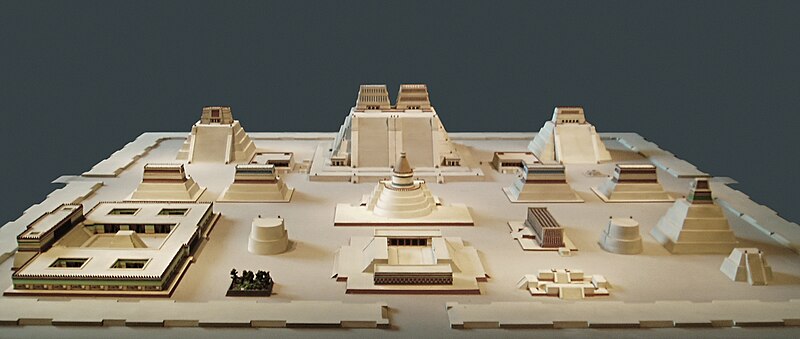
By the early sixteenth century, Tenochtitlan covered an estimated 8 to 13.5 square kilometres and was organised on a grid plan centred on the sacred precinct, a walled enclosure of approximately 500 by 300 metres that contained the Templo Mayor and more than seventy other temples, schools, and ritual structures.1, 4 The city was divided into four great quarters (campan) — Moyotlan (southwest), Teopan (southeast), Atzacualco (northeast), and Cuepopan (northwest) — corresponding to the four cardinal directions and further subdivided into approximately twenty calpulli (neighbourhood-wards), each with its own temple, school, and communal lands.1, 11 Edward Calnek's reconstruction of residential patterns, based on sixteenth-century land documents, revealed a dense urban fabric of single-storey adobe houses interspersed with multi-room stone residences of the nobility, all oriented along a network of streets and canals that served as the city's primary transport arteries.3
Three great causeways (calzadas) connected the island city to the mainland: the Iztapalapa causeway to the south, the Tlacopan (Tacuba) causeway to the west, and the Tepeyac causeway to the north.1, 12 Each causeway was constructed of compacted earth and stone, wide enough for eight horsemen to ride abreast according to Cortés, and incorporated removable bridge sections that could be dismantled to control access to the city or defend it against attack.12, 11 The causeways also functioned as dikes, helping to regulate water levels around the city, and a separate earthen dike connected the Iztapalapa causeway to the Tepeyac causeway along the eastern shore of the island, creating an additional line of flood defence.8, 1
The twin city of Tlatelolco, originally a separate and rival Mexica settlement founded on an adjacent island, was conquered by Tenochtitlan in 1473 and incorporated as its northern district.1, 10 Though politically subordinate, Tlatelolco retained its identity as the commercial heart of the empire, home to the largest marketplace in the Americas.5, 11
Hydraulic engineering and water management
Tenochtitlan's survival and growth depended on an integrated system of hydraulic infrastructure that ranks among the most complex water-management achievements of the pre-industrial world.8, 9 The Basin of Mexico contained five interconnected lakes — Zumpango, Xaltocan, Texcoco, Xochimilco, and Chalco — of which Lake Texcoco, the lowest in elevation, was brackish and subject to dangerous seasonal flooding from rainwater runoff descending from the surrounding mountains.1, 8 After a catastrophic flood devastated Tenochtitlan around 1449, the ruler Moctezuma I, acting on the advice of Nezahualcoyotl of Texcoco, ordered the construction of a massive dike (albarradón) to separate the saline waters of the open lake from the freshwater lagoon surrounding the city.8, 1
The Nezahualcoyotl dike was an engineering marvel: approximately 16 kilometres long, 8 metres high, and 3.5 metres wide, constructed of earth, stone, and timber, running roughly north to south across the lake.8 Modern reliability analysis by engineers at Delft University of Technology has demonstrated that the dike's dimensions were remarkably well calibrated to the hydraulic conditions of the lake, achieving a level of flood protection that would be considered acceptable by contemporary engineering standards despite the absence of formal probabilistic design methods.8 The dike was later extended and reinforced under the ruler Ahuitzotl after another major flood in the 1490s, and by the time of Spanish contact, the Mexica maintained a system of approximately 95 hydraulic structures across the Basin.8, 9
Fresh water reached the island city through two parallel aqueducts originating at the springs of Chapultepec, approximately four kilometres to the west.9, 1 Each aqueduct consisted of twin channels made of terracotta and mortared stone, designed so that one channel could be cleaned and repaired while the other continued to supply water — a redundancy that ensured uninterrupted flow to the city's public fountains and storage cisterns.9, 11 Waste water was managed through a network of canals that carried refuse to the lake margins, and human waste was collected in canoes for use as fertiliser on the chinampas, creating a closed-loop nutrient cycle that impressed early colonial observers.9
Major hydraulic infrastructure of Tenochtitlan8, 9
| Structure | Length / extent | Function |
|---|---|---|
| Nezahualcoyotl dike | ~16 km | Flood control, salinity barrier |
| Chapultepec aqueducts (twin) | ~4 km each | Freshwater supply |
| Iztapalapa causeway | ~8 km | Southern land access, flood barrier |
| Tlacopan causeway | ~5 km | Western land access |
| Tepeyac causeway | ~6.5 km | Northern land access |
| Basin-wide hydraulic system | ~95 structures | Water regulation across five lakes |
Chinampa agriculture and food supply
.jpg)
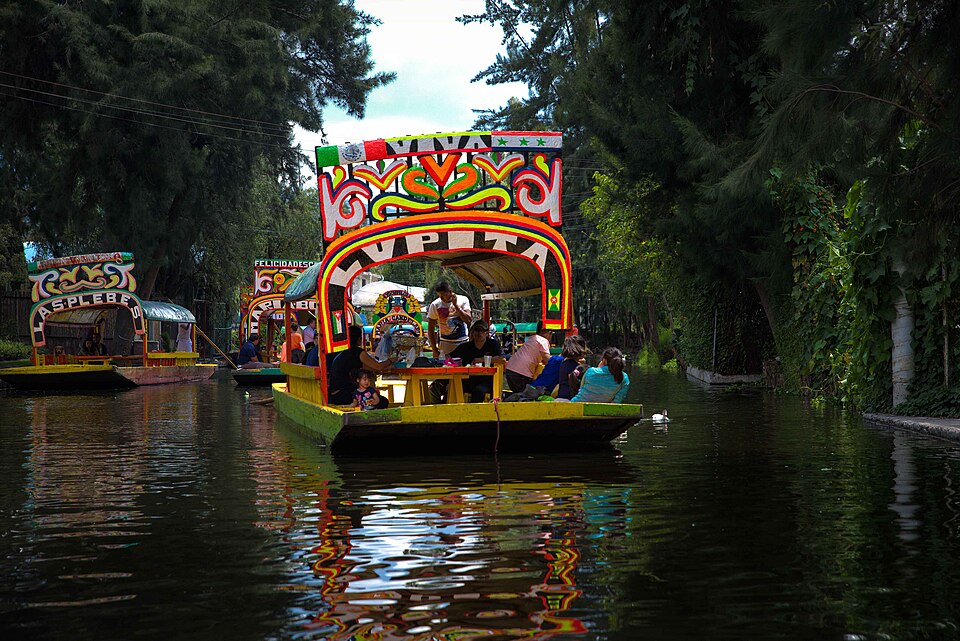
The agricultural foundation of Tenochtitlan was the chinampa, an intensive raised-field system constructed in the shallow waters of the freshwater lakes south and west of the city.3, 14 Chinampas were built by staking out rectangular plots in the lake bed, filling them with alternating layers of aquatic vegetation, mud, and soil, and anchoring them with willow trees (ahuejotes) planted along their margins.3, 1 Though often described as "floating gardens," chinampas were in fact fixed, semi-artificial islands with their bases resting on the lake floor, typically measuring approximately 30 metres long by 2.5 metres wide and separated by narrow canals that allowed canoe access for planting, weeding, and harvesting.3

Edward Calnek's pioneering 1972 study of chinampa settlement patterns demonstrated that the raised fields in the immediate vicinity of Tenochtitlan were used primarily for fresh vegetables, flowers, and seedlings rather than staple crops, and that their total output could not have fed the city's population independently.3 The bulk of Tenochtitlan's maize supply came instead from mainland tribute provinces and from the more extensive chinampa zones in the southern lakes of Xochimilco and Chalco, where thousands of hectares of raised fields produced multiple harvests per year thanks to the nutrient-rich lake water and year-round growing conditions.3, 14 Christopher Morehart and Charles Frederick's archaeological investigation of chinampa systems at Xaltocan has shown that chinampa agriculture was not exclusively an Aztec invention but predated the empire by centuries; the Mexica, however, expanded and intensified the system on an unprecedented scale to support their rapidly growing capital.14
Beyond chinampas, Tenochtitlan's food supply depended on a vast tribute network that channelled agricultural produce from conquered provinces throughout central Mexico.5, 7 The Codex Mendoza records tribute payments from over 400 subject towns, including enormous quantities of maize, beans, amaranth, chia, cacao, chilli peppers, cotton, and honey, delivered on annual or semi-annual schedules to the imperial storehouses in Tenochtitlan.7, 16 This combination of local intensive agriculture and long-distance tribute extraction enabled the city to sustain a population density that Michael Smith has estimated at roughly 15,000 to 22,000 persons per square kilometre in the most densely settled wards — figures comparable to modern-day Manhattan.1, 4
Economy and the Tlatelolco marketplace
The economy of Tenochtitlan operated on two interlocking systems: the state-administered tribute economy and the commercially driven marketplace economy.5, 16 While tribute supplied the ruling elite, the military, and the temples with staple goods and luxury materials, the daily needs of the broader urban population were met through a tiered network of regional markets, at the apex of which stood the great marketplace of Tlatelolco.5, 11
Cortés and his companions reported that the Tlatelolco market attracted an estimated 60,000 buyers and sellers daily, a figure that, even if exaggerated, reflects the enormous commercial vitality of the city.12, 11 The market was organised by commodity, with designated sections for foodstuffs, textiles, pottery, obsidian tools, precious stones, featherwork, slaves, medicinal herbs, and construction materials.11, 5 Transactions were facilitated by standardised media of exchange — primarily cacao beans for small purchases and cotton mantles (quachtli) for larger ones — and overseen by market judges who enforced fair dealing and punished fraud.5, 1 Below Tlatelolco in the market hierarchy were the large five-day rotating markets in cities such as Texcoco and Xochimilco, followed by smaller periodic markets in provincial towns and local village markets.1, 22
Long-distance trade was conducted by professional merchant guilds known as the pochteca, who operated caravans of human porters (tlameme) over hundreds of kilometres to procure luxury goods — quetzal feathers from Guatemala, jade and turquoise from distant sources, jaguar pelts, cacao from Soconusco, and gold from Oaxaca.5, 16 The pochteca occupied an ambiguous social position: nominally commoners, they accumulated enormous wealth and served as intelligence agents and advance scouts for imperial military campaigns, reporting on the political conditions and defensive capabilities of unconquered regions.16, 10
The Templo Mayor and sacred precinct
At the centre of Tenochtitlan stood the sacred precinct (huey teocalli), a walled compound containing the Templo Mayor and dozens of subsidiary temples, priestly residences, a ball court, and the skull rack (tzompantli) on which the heads of sacrificial victims were displayed.15, 1 The Templo Mayor itself was a twin-pyramid complex rising to an estimated height of 60 metres, with two parallel stairways ascending to separate shrines at the summit: the northern shrine dedicated to Tlaloc, god of rain and agricultural fertility, and the southern shrine to Huitzilopochtli, the Mexica patron deity and god of war and the sun.15, 17 This dual dedication symbolised the two foundations of Mexica power — agriculture and military conquest — and the temple's successive enlargements mapped directly onto the reigns of individual rulers and the expansion of the empire.15, 1
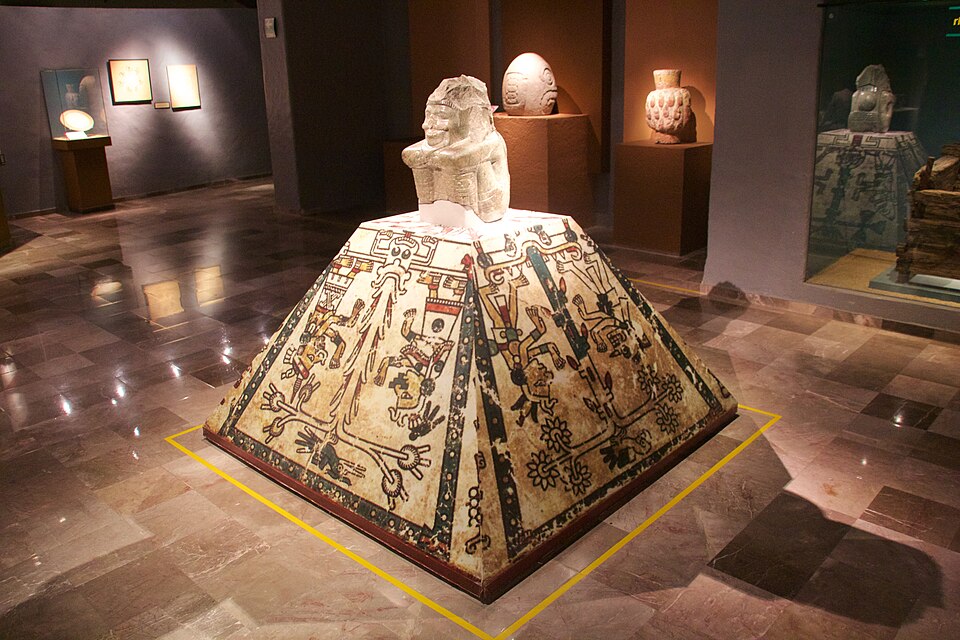

The modern archaeological investigation of the Templo Mayor began in February 1978, when electrical utility workers accidentally uncovered a massive circular monolith depicting the dismembered goddess Coyolxauhqui near the southwest corner of the cathedral.15 Under the direction of Eduardo Matos Moctezuma, the Proyecto Templo Mayor excavated an area of approximately 12,900 square metres, exposing the foundations of seven successive construction phases spanning from the early fourteenth century to the eve of the Spanish conquest.15, 2 Leonardo López Luján, who assumed direction of the project in subsequent seasons, has catalogued more than 175 ritual offerings buried within and around the temple, containing tens of thousands of objects — sacrificed animals (jaguars, eagles, wolves, fish), greenstone figurines, flint knives, ceramic vessels, copal incense, and marine shells — deliberately arranged according to cosmological principles.15
In 2006, excavations uncovered the Tlaltecuhtli monolith, the largest Aztec sculpture ever found, depicting the earth goddess in a squatting birth-death position.2, 15 More recently, the discovery and excavation of the tzompantli — a tower of mortared human skulls near the Templo Mayor — has confirmed the massive scale of human sacrifice described in colonial-era sources, with isotopic analysis of the skulls indicating that many victims were not local to Tenochtitlan but were drawn from diverse regions across Mesoamerica.18, 19
Society and daily life
Tenochtitlan's society was sharply stratified into a hereditary nobility (pipiltin) and a commoner class (macehualtin), with additional categories including serfs (mayeque) bound to noble estates and slaves (tlacotin) who occupied the lowest social rung.1, 11 The nobility monopolised high political, military, and priestly offices and enjoyed distinctive privileges: the right to wear cotton clothing and elaborate jewellery, to drink cacao, to build multi-storey stone houses, and to receive tribute labour from commoners attached to their wards.11, 5 Commoners were organised into calpulli, corporate kin-based groups that held communal land, administered local schools (telpochcalli), and provided labour and military levies to the state.1
Education was compulsory for both boys and girls, a feature that distinguished the Mexica from most contemporary civilisations.11, 17 Commoner children attended the telpochcalli (house of youth), where boys received military training and practical instruction while girls learned domestic arts and ritual duties.11 Children of the nobility attended the calmecac, elite academies attached to temples where instruction included history, astronomy, calendrics, rhetoric, poetry, law, and the interpretation of the sacred books (amoxtli).11, 1 This investment in systematic education helped produce the cadre of priests, administrators, judges, and scribes required to govern a city and empire of Tenochtitlan's complexity.17
Daily life in Tenochtitlan was shaped by the rhythms of the market, the agricultural cycle, and an elaborate ceremonial calendar of eighteen twenty-day "months" plus five unlucky days, punctuated by major festivals that involved processions, dances, feasting, and sacrificial rituals.1, 11 The canals served as the principal thoroughfares: thousands of canoes moved people, goods, and waste through the city daily, while the streets that paralleled the canals accommodated pedestrian traffic.11, 3 Sanitation standards were high by contemporary global standards; public latrines were positioned along the major canals, and human waste was systematically collected for agricultural use, keeping the streets notably cleaner than those of most European cities of the same era.9
The siege and fall of Tenochtitlan
The destruction of Tenochtitlan began with the arrival of Hernán Cortés and approximately 500 Spanish soldiers on the Gulf Coast in April 1519 and culminated in a 75-day siege that ended on 13 August 1521.12, 13 Cortés exploited existing political fractures within the Aztec tributary system, forging alliances with disaffected subject peoples — most crucially the Tlaxcalans, long-standing enemies of the Triple Alliance — who provided an estimated 200,000 Indigenous warriors over the course of the conquest campaign.12, 10 After an initial period of uneasy coexistence during which the ruler Moctezuma II received the Spaniards in his palace, escalating tensions erupted into open warfare following the massacre of Mexica nobles at the Festival of Toxcatl in May 1520, ordered by the Spanish captain Pedro de Alvarado.12, 13
The Mexica expelled the Spaniards from the city on the night of 30 June 1520 — the Noche Triste — inflicting heavy casualties as the fleeing column struggled across the gaps in the Tlacopan causeway.12, 13 Cortés regrouped at Tlaxcala, built a fleet of thirteen brigantines for lake warfare, and returned to lay siege to Tenochtitlan in late May 1521.12 The siege strategy was devastating: the Spanish cut the Chapultepec aqueduct, severing the city's freshwater supply; blockaded the causeways and lake approaches with the brigantines; and systematically demolished buildings ward by ward to deny the defenders cover.12, 13 A concurrent smallpox epidemic, introduced by a member of the Pánfilo de Narváez expedition in 1520, ravaged the besieged population and killed the ruler Cuitláhuac after only eighty days in power.12, 21
Under the last Mexica emperor Cuauhtémoc, the defenders resisted with extraordinary tenacity, fighting street by street and canal by canal, but starvation, disease, and the overwhelming numerical superiority of the combined Spanish-Indigenous force proved insurmountable.13, 12 The city fell on 13 August 1521 when Cuauhtémoc was captured attempting to flee by canoe.12 The Nahua accounts compiled by Miguel León-Portilla describe scenes of utter devastation: corpses choking the canals, buildings reduced to rubble, and survivors so weakened by hunger that they could barely walk.13 Cortés ordered the construction of a new Spanish colonial capital directly atop the ruins, using the stones of Mexica temples and palaces as building material — a deliberate act of cultural superimposition that buried Tenochtitlan beneath what would become Mexico City.20, 21
Archaeological legacy
The archaeological recovery of Tenochtitlan has been constrained by the fact that the ancient city lies beneath one of the most densely built and continuously inhabited urban centres on Earth.15, 2 Systematic excavation has been possible only when modern construction projects expose pre-Hispanic remains, as occurred with the 1978 Coyolxauhqui discovery that launched the Templo Mayor project and again in 2006 when the Tlaltecuhtli monolith was found during utility work.15 Despite these constraints, decades of salvage archaeology, combined with ethnohistorical research drawing on Nahuatl-language documents, Spanish administrative records, and pictorial codices, have produced a remarkably detailed picture of the city's layout, economy, and social organisation.2, 4
Recent advances in bioarchaeological methods have opened new avenues of inquiry. Phosphate oxygen isotope analysis of skulls from the Templo Mayor tzompantli has demonstrated that sacrificial victims came from geographically diverse origins, with isotopic signatures consistent with the Gulf Coast, western Mexico, and the Maya lowlands, confirming that the ritual economy of the Templo Mayor drew on the full extent of the empire's tributary network and beyond.19 Ongoing excavations continue to yield unexpected finds: in 2023, archaeologists uncovered a stone case containing precious offerings near the base of the Templo Mayor, adding to the growing corpus of evidence for the elaborate ritual programme that accompanied each phase of the temple's enlargement.15, 2
Tenochtitlan's significance extends beyond its archaeological remains. The city represents a powerful case study in pre-industrial urbanism, demonstrating that complex, large-scale urban societies could develop independently of Old World precedents and achieve levels of population density, hydraulic engineering, and administrative sophistication that rivalled or exceeded their contemporaries anywhere in the world.17, 4 The eagle and cactus of the Mexica foundation myth remain the central emblem of the Mexican national flag, a symbol of continuity between the Aztec past and the modern nation-state built atop its ruins.1
References
Reliability Analysis of Flood Defenses: The Case of the Nezahualcoyotl Dike in the Aztec City of Tenochtitlan
Feeding the Gods: Hundreds of Skulls Reveal Massive Scale of Human Sacrifice in Aztec Capital
Residential Patterns of Mexica Human Sacrifices at Mexico-Tenochtitlan and Mexico-Tlatelolco: Evidence from Phosphate Oxygen Isotopes
The Conquest of Mexico: The Incorporation of Indian Societies into the Western World, 16th–18th Centuries