Overview
- The Sun is a G2V main-sequence star with a mass of 1.989 x 10^30 kilograms, a radius of 695,700 kilometres, and a surface temperature of approximately 5,772 kelvins, generating its luminosity of 3.828 x 10^26 watts through the fusion of roughly 600 million tonnes of hydrogen into helium every second in its core.
- Helioseismology, the study of acoustic oscillations propagating through the solar interior, has revealed the Sun's internal structure with extraordinary precision, locating the base of the convective envelope at 0.713 solar radii and constraining the sound speed profile to better than 0.1 percent throughout most of the interior.
- At approximately 4.6 billion years old and roughly halfway through its main-sequence lifetime, the Sun will exhaust its core hydrogen fuel in about 5 billion years, expand into a red giant engulfing the inner planets, and ultimately shed its outer layers to leave behind a carbon-oxygen white dwarf.
The Sun is the star at the centre of the solar system and the source of virtually all energy that drives Earth's climate, weather, and biological systems. It is an ordinary main-sequence star of spectral type G2V — a classification indicating a surface temperature of approximately 5,772 kelvins and a luminosity powered by core hydrogen fusion — yet its proximity to Earth, just 1 astronomical unit (about 150 million kilometres), makes it by far the most studied star in astrophysics.1 Every technique developed to understand stellar interiors, from spectroscopy and nuclear physics to neutrino detection and asteroseismology, was first applied to the Sun or was profoundly shaped by solar observations. The Sun is both the prototype for stellar astrophysics and the reference standard against which all other stars are measured.1, 11
With a mass of 1.989 × 1030 kilograms (roughly 333,000 Earth masses), the Sun contains 99.86 percent of all mass in the solar system. It has been fusing hydrogen in its core for approximately 4.57 billion years and is expected to continue doing so for another five billion years before exhausting its fuel and evolving off the main sequence.1, 19 Understanding the Sun — its internal structure, energy generation, magnetic activity, and long-term evolution — is essential not only for astrophysics but for planetary science, climate science, and the practical challenges of space weather forecasting.
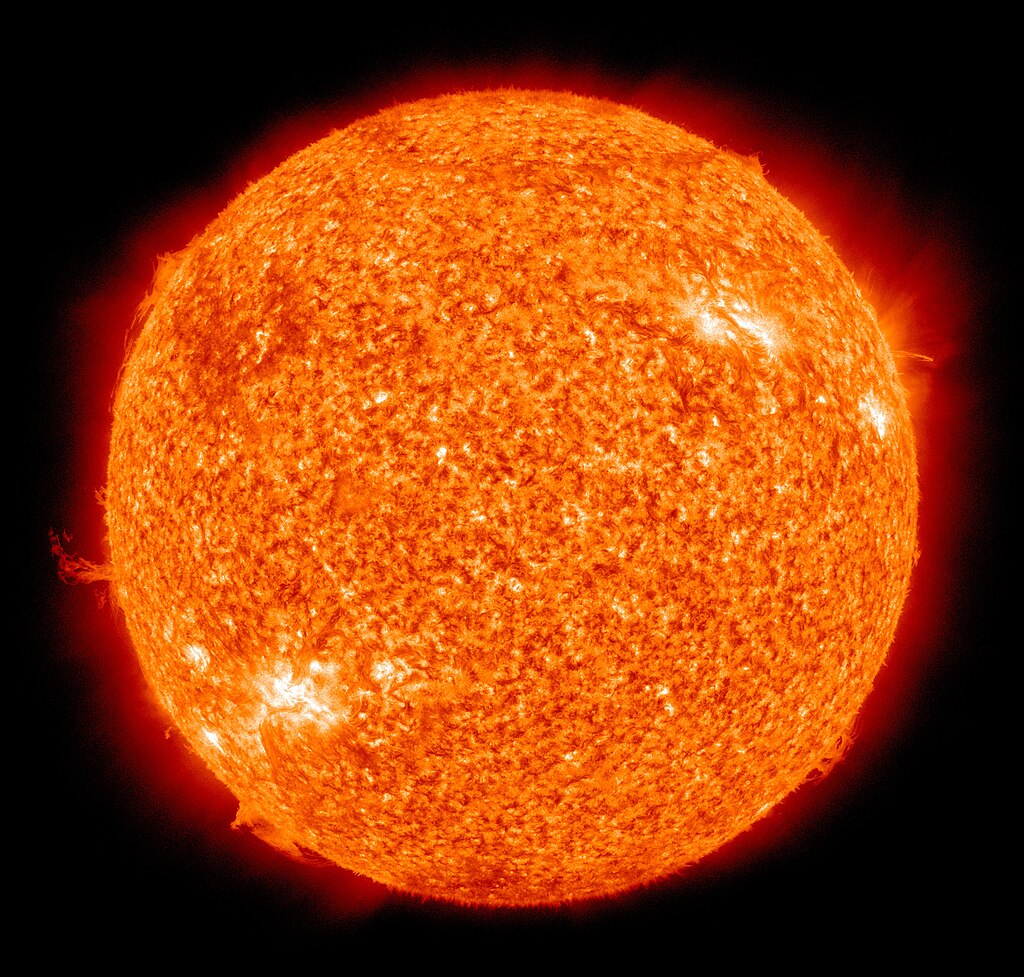

Fundamental physical properties
The Sun's basic physical parameters have been determined with extraordinary precision, largely because its proximity permits direct measurement techniques unavailable for any other star. Its equatorial radius is 695,700 kilometres, roughly 109 times Earth's radius, meaning that approximately 1.3 million Earths could fit inside the Sun's volume.1 The effective surface temperature — the temperature of a blackbody that would emit the same total luminosity — is 5,772 ± 1 kelvin, placing the Sun firmly in the middle of the G-type spectral class on the Hertzsprung-Russell diagram.1
The Sun's total luminosity is 3.828 × 1026 watts, a value known as the solar luminosity (L⊙) and used as the fundamental reference unit for expressing the luminosities of all other stars. This energy output has been measured from space with a precision better than 0.01 percent by satellite radiometers, which track the total solar irradiance (TSI) — the flux received at 1 astronomical unit, averaging approximately 1,361 watts per square metre.1 The Sun's spectral type and luminosity class (G2V) indicate that it is a dwarf star on the main sequence, powered by core hydrogen fusion. The "V" in the classification denotes luminosity class V, distinguishing main-sequence stars from the giants (III) and supergiants (I) that occupy higher regions of the HR diagram.11
Compositionally, the Sun is approximately 73.5 percent hydrogen and 24.9 percent helium by mass, with the remaining 1.6 percent consisting of heavier elements collectively termed metals in astronomical usage. Oxygen, carbon, neon, and iron dominate the metal fraction.2 These abundances were established through detailed spectroscopic analysis of absorption lines in the solar photosphere, most comprehensively by Martin Asplund and collaborators, whose 2009 revision using three-dimensional hydrodynamical atmospheric models significantly lowered the inferred abundances of carbon, nitrogen, and oxygen compared with earlier determinations — a revision that created a tension with helioseismic data known as the solar abundance problem, discussed below.2
Fundamental properties of the Sun1, 2
| Property | Value |
|---|---|
| Mass | 1.989 × 1030 kg (M⊙) |
| Equatorial radius | 695,700 km (R⊙) |
| Luminosity | 3.828 × 1026 W (L⊙) |
| Effective temperature | 5,772 K |
| Spectral type | G2V |
| Age | 4.57 ± 0.01 Gyr |
| Hydrogen mass fraction | ~73.5% |
| Helium mass fraction | ~24.9% |
| Metal mass fraction (Z) | ~0.013–0.017 |
| Mean density | 1,408 kg/m3 |
| Core temperature | ~15.7 × 10⁶ K |
| Core density | ~150,000 kg/m3 |
Internal structure
The Sun's interior is divided into three principal zones defined by the dominant mechanism of energy transport: the core, the radiative zone, and the convective zone. The boundaries between these regions are not arbitrary divisions imposed by astronomers but physical transitions revealed by helioseismology and confirmed by theoretical models of stellar structure.1, 3
The core extends from the centre of the Sun to roughly 0.25 solar radii (about 175,000 kilometres from the centre). It is here that all of the Sun's nuclear energy is generated. Temperatures in the core reach approximately 15.7 million kelvins, and the density is about 150 times that of water — approximately 150,000 kilograms per cubic metre. Despite these extreme conditions, the core constitutes less than 2 percent of the Sun's volume but contains roughly 34 percent of its mass. Hydrogen fusion via the proton-proton chain converts about 4.3 million tonnes of mass into energy every second.1, 12
Surrounding the core is the radiative zone, extending from 0.25 to approximately 0.713 solar radii. In this region, energy generated in the core is transported outward by the absorption and re-emission of photons by the dense, ionised plasma. The process is extraordinarily slow: a photon emitted in the core undergoes so many absorptions and re-emissions, each time redirected in a random direction, that the average time for the energy of a core photon to diffuse through the radiative zone and reach the surface is on the order of 170,000 years.1 The radiative zone is stably stratified — hotter, denser material lies below cooler, less dense material, suppressing convective motion. The plasma rotates nearly as a solid body throughout this region, in contrast to the differential rotation observed in the overlying convection zone.3
At the base of the convective zone, at approximately 0.713 solar radii, a narrow transition layer called the tachocline separates the solid-body rotation of the radiative interior from the latitude-dependent differential rotation of the convection zone. The tachocline is thought to play a central role in the solar dynamo — the process that generates the Sun's magnetic field — because the shear between the two rotation regimes can stretch and amplify magnetic field lines.3, 8
The convective zone occupies the outer 28.7 percent of the Sun's radius, from 0.713 R⊙ to the visible surface. Here, the temperature gradient becomes steep enough that the plasma is convectively unstable: hot parcels of gas rise buoyantly toward the surface, radiate their energy into space, cool, and sink back down. This turbulent convective churning is directly visible at the solar surface as granulation — a pattern of roughly one million bright convective cells, each about 1,000 kilometres across, separated by darker intergranular lanes where cooled material descends.1 Larger-scale convective structures called supergranules, roughly 30,000 kilometres across, organise the surface magnetic field into a network pattern visible in chromospheric emission.
Energy generation: the proton-proton chain
The Sun generates its energy through nuclear fusion, specifically the conversion of hydrogen nuclei (protons) into helium-4 nuclei. In the core conditions of the Sun, where temperatures reach approximately 15.7 million kelvins, the dominant fusion pathway is the proton-proton (pp) chain, which accounts for approximately 99 percent of the Sun's energy production. The remaining fraction comes from the carbon-nitrogen-oxygen (CNO) cycle, a catalytic fusion pathway that uses carbon, nitrogen, and oxygen nuclei as intermediaries and becomes the dominant energy source only in stars more massive than about 1.3 solar masses.12
The pp chain proceeds through three principal branches. In all branches, the net reaction is the same: four protons are converted into one helium-4 nucleus, two positrons, two electron neutrinos, and energy. The mass of the helium-4 nucleus is 0.7 percent less than that of the four protons that formed it, and this mass deficit is converted into energy according to Einstein's E = mc2.11, 12
The first and rate-limiting step of the pp chain is the fusion of two protons to produce deuterium, a positron, and an electron neutrino. This reaction requires two protons to overcome their mutual electrostatic repulsion through quantum mechanical tunnelling — a process so improbable that a given proton in the solar core must wait an average of roughly 10 billion years before successfully undergoing this reaction. It is only because the core contains an enormous number of protons (roughly 1056) that the aggregate rate is sufficient to power the Sun.12 The deuterium then rapidly fuses with another proton to form helium-3. The most probable completion pathway (pp I, accounting for about 85 percent of solar energy production) involves two helium-3 nuclei combining to form helium-4 and two protons. The pp II and pp III branches proceed through beryllium-7 and boron-8 intermediaries, respectively, and produce higher-energy neutrinos that have been critical for testing the standard solar model.6, 12
The detection of neutrinos from the CNO cycle by the Borexino experiment in 2020, with final results published in 2023, provided the first direct experimental evidence that this secondary fusion pathway operates in the Sun. The measured CNO neutrino flux, though small compared with the pp chain contribution, is consistent with predictions of the standard solar model and represents a milestone in experimental solar physics.22
Helioseismology
The interior of the Sun cannot be observed directly with electromagnetic radiation: the solar surface is opaque, and photons from the core are absorbed and re-emitted billions of times before reaching the photosphere. However, the Sun's interior is threaded by millions of acoustic oscillation modes — standing sound waves generated by the turbulent convection zone — and these waves carry information about the conditions through which they propagate. The study of these oscillations, called helioseismology, has transformed solar physics by providing a detailed three-dimensional map of the Sun's interior structure, composition, and dynamics.3
The oscillations were first detected in the early 1960s by Robert Leighton and collaborators, who noticed that patches of the solar surface oscillate vertically with a characteristic period of approximately five minutes. Subsequent theoretical work by Roger Ulrich and independently by John Leibacher and Robert Stein showed that these oscillations are acoustic pressure waves (p-modes) trapped in resonant cavities within the Sun's interior. Each mode is characterised by its angular degree (the number of nodal lines on the surface) and its radial order (the number of nodes along the radius). Lower-degree modes penetrate deeper into the solar interior, while higher-degree modes are confined to shallower layers.3
By the 1990s, networks of ground-based observatories (the Global Oscillation Network Group, or GONG) and space missions (the Solar and Heliospheric Observatory, SOHO, launched in 1995) had measured the frequencies of tens of thousands of individual oscillation modes with precisions of parts per million. Inversion of these frequencies yields a profile of the sound speed throughout the solar interior that agrees with the predictions of the standard solar model to better than 0.1 percent throughout most of the Sun.3, 14
Helioseismology has produced several landmark results. It located the base of the convective envelope at 0.713 ± 0.003 solar radii, a value so precise that it constrains the opacity of the solar material at that depth.3 It determined the helium abundance in the convective envelope to be Y = 0.2485 ± 0.0035 — lower than the primordial helium abundance from Big Bang nucleosynthesis, confirming that helium has settled gravitationally toward the solar interior over the Sun's lifetime.1, 3 It revealed the internal rotation profile of the Sun: the convection zone rotates differentially (faster at the equator, slower at the poles), while the radiative interior rotates nearly as a solid body, with a thin shear layer — the tachocline — separating the two regimes.3
Solar neutrinos and the neutrino problem
Nuclear fusion in the solar core produces not only photons but also neutrinos — electrically neutral, nearly massless particles that interact so weakly with matter that they escape the Sun within about two seconds of their creation, in stark contrast to photons that require tens of thousands of years to diffuse out through the radiative zone. Solar neutrinos therefore provide a direct, real-time probe of conditions in the Sun's core.6
The effort to detect solar neutrinos began in the late 1960s with Raymond Davis Jr.'s pioneering experiment in the Homestake gold mine in South Dakota. Using a tank of 615 tonnes of perchloroethylene cleaning fluid deep underground to shield against cosmic rays, Davis measured the rate at which electron neutrinos from the Sun converted chlorine-37 atoms into argon-37 through inverse beta decay. The result was startling: the detected neutrino flux was only about one-third of the rate predicted by John Bahcall's standard solar model. This discrepancy, confirmed by every subsequent solar neutrino experiment for three decades, became known as the solar neutrino problem.24, 6
The resolution came in 2001 from the Sudbury Neutrino Observatory (SNO) in Canada, which used 1,000 tonnes of heavy water (D2O) as its detection medium. Unlike all previous experiments, which were sensitive primarily or exclusively to electron neutrinos, SNO could detect all three neutrino flavours (electron, muon, and tau) through neutral-current interactions in which a neutrino breaks apart a deuterium nucleus regardless of its flavour. The SNO results demonstrated that the total neutrino flux from the Sun matched the standard solar model prediction precisely, but that approximately two-thirds of the electron neutrinos produced in the core had oscillated into muon and tau neutrinos during their journey from the Sun to Earth.4
This phenomenon, known as neutrino oscillation, requires neutrinos to have non-zero mass — a property not predicted by the original Standard Model of particle physics. The oscillation is enhanced by the Mikheyev-Smirnov-Wolfenstein (MSW) effect, in which the interaction of electron neutrinos with the dense electron plasma inside the Sun modifies the oscillation parameters relative to propagation through vacuum.5 Arthur McDonald (SNO) and Takaaki Kajita (Super-Kamiokande, which independently confirmed neutrino oscillation using atmospheric neutrinos) shared the 2015 Nobel Prize in Physics for this discovery. The resolution of the solar neutrino problem simultaneously vindicated the standard solar model, confirmed that the Sun's core is indeed powered by the pp chain at the rates predicted by nuclear physics, and revealed new physics beyond the Standard Model.4, 6
The solar atmosphere: photosphere, chromosphere, and corona
The visible surface of the Sun is the photosphere, a thin layer approximately 500 kilometres thick from which most of the Sun's visible light is emitted. It is not a solid surface but the depth at which the solar plasma transitions from opaque to transparent; below the photosphere, the gas is too dense and ionised for photons to travel far without being absorbed, while above it, the atmosphere becomes increasingly tenuous and transparent. The temperature of the photosphere decreases from about 6,400 kelvins at its base to roughly 4,400 kelvins at the top, with an effective temperature of 5,772 kelvins.1
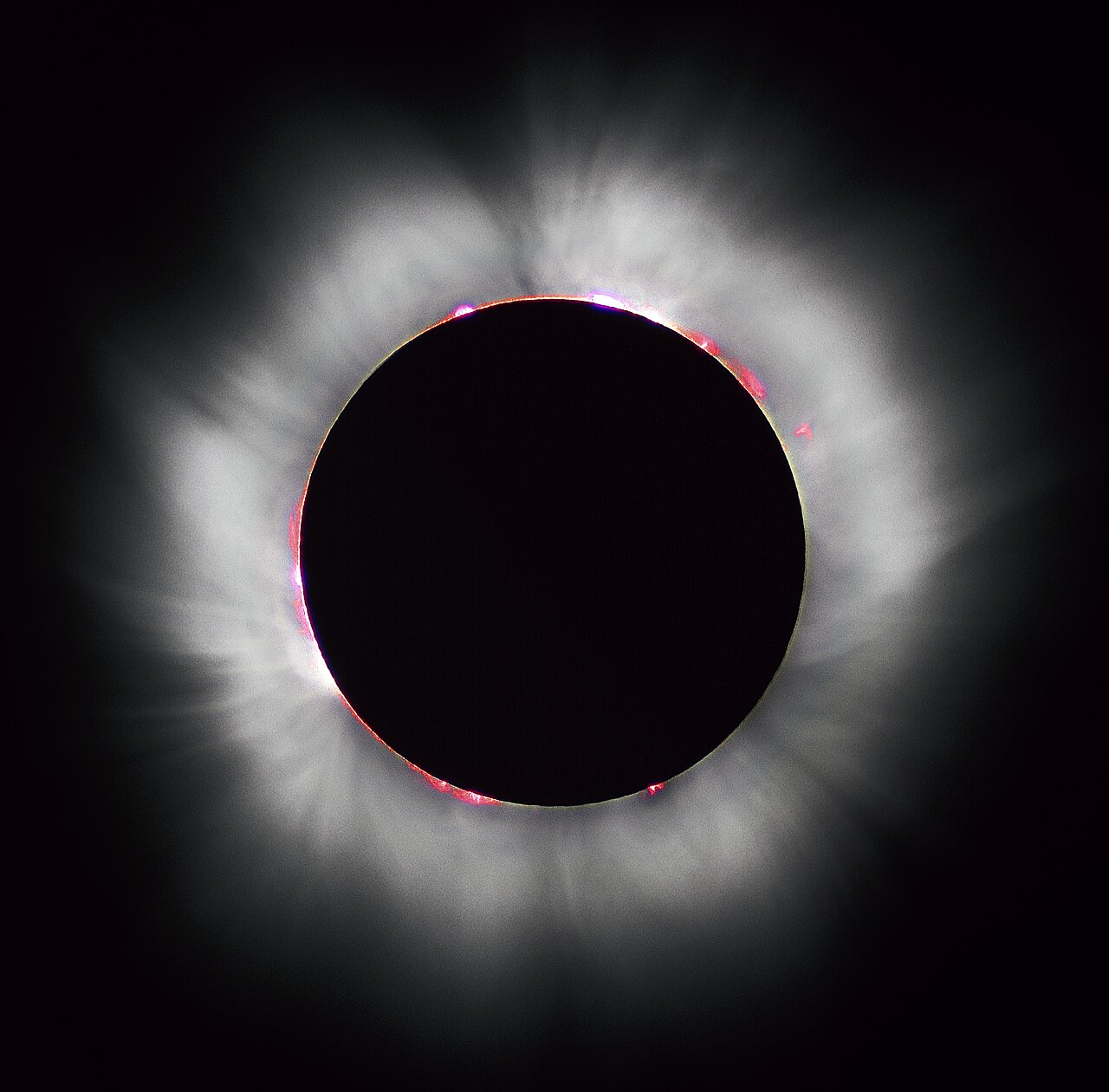

Above the photosphere lies the chromosphere, a layer extending approximately 2,000 kilometres upward, visible during total solar eclipses as a thin reddish ring of emission. The name derives from the Greek chroma (colour), referring to its distinctive red hue produced by hydrogen-alpha emission at 656.3 nanometres. The chromosphere exhibits a temperature minimum of approximately 4,100 kelvins at its base before the temperature begins to rise with altitude — a reversal that is among the most puzzling phenomena in solar physics.16
The corona, the Sun's outer atmosphere, extends millions of kilometres into space and is visible to the naked eye during total solar eclipses as a pearly white halo surrounding the dark disk of the Moon. The corona presents one of the outstanding problems in astrophysics: its temperature exceeds one million kelvins, several hundred times hotter than the photosphere below it. This is equivalent to walking away from a campfire and finding that the air becomes hotter rather than cooler — a profound violation of naive thermodynamic expectation.16 The coronal heating problem remains unsolved, though leading candidates include the dissipation of magnetohydrodynamic waves (Alfven waves) propagating upward from the turbulent convection zone and the impulsive release of magnetic energy through small-scale reconnection events called nanoflares.10, 16
The corona is not gravitationally bound to the Sun. Its million-kelvin temperature provides sufficient thermal energy for the outermost coronal particles to escape the Sun's gravitational pull, flowing outward as the solar wind — a continuous stream of charged particles, primarily protons and electrons, that fills the heliosphere. The existence of the solar wind was predicted theoretically by Eugene Parker in 1958 and confirmed observationally by the Soviet Luna and American Mariner spacecraft in the early 1960s. At Earth's orbit, the solar wind has a typical speed of 400 to 800 kilometres per second and a density of about 5 to 10 particles per cubic centimetre.10
Magnetic activity and the solar cycle
The Sun is a magnetically active star whose surface and atmospheric phenomena are dominated by its magnetic field. Sunspots — dark patches on the photosphere that are cooler than their surroundings by approximately 1,500 kelvins — are the most visible manifestation of this magnetic activity. They are regions where concentrated magnetic fields with strengths of 0.1 to 0.4 tesla (1,000 to 4,000 gauss) suppress convective energy transport, reducing the local surface temperature and luminosity relative to the surrounding photosphere.7
The number of sunspots on the solar surface varies in a regular cycle with an average period of approximately 11 years, a pattern first recognised by the German astronomer Heinrich Schwabe in 1844 from decades of daily sunspot observations. At solar minimum, the Sun may be entirely free of spots for days or weeks at a time. At solar maximum, dozens of sunspot groups may be visible simultaneously, accompanied by frequent solar flares and coronal mass ejections.7 The sunspot cycle is actually half of a roughly 22-year magnetic cycle: the magnetic polarity of the leading spots in each hemisphere reverses from one 11-year cycle to the next, so the full magnetic cycle requires two sunspot cycles to complete.7, 8
At the beginning of a cycle, sunspots appear at solar latitudes of about 30 to 35 degrees north and south of the equator. As the cycle progresses, the latitude of new spot emergence migrates toward the equator, reaching approximately 5 degrees by the end of the cycle. This migration pattern, first documented by the English astronomer Edward Maunder, produces a characteristic "butterfly diagram" when sunspot latitudes are plotted against time over multiple cycles.7
The physical mechanism responsible for the solar cycle is the solar dynamo, a magnetohydrodynamic process in which the interaction of the Sun's convective flows, differential rotation, and magnetic field amplifies and organises the magnetic field into the observed cyclic pattern. The classical picture, developed by Horace Babcock and Robert Leighton in the 1960s, describes a cycle in which an initially poloidal (north-south dipole) magnetic field is stretched into a toroidal (east-west) configuration by the differential rotation of the convection zone — a process called the Ω-effect. The toroidal field is amplified until it becomes buoyantly unstable and rises through the convection zone to emerge at the surface as bipolar sunspot pairs. The decay and dispersal of these spot pairs, combined with meridional flow toward the poles, regenerates the poloidal field with reversed polarity — a process called the α-effect — completing the dynamo loop.8 Recent numerical simulations have suggested that the dynamo may operate primarily in the near-surface layers of the convection zone rather than at the tachocline, potentially revising the classical picture.23
Periods of anomalously low or absent sunspot activity have occurred in the historical record. The Maunder Minimum (approximately 1645 to 1715) was a 70-year interval during which very few sunspots were observed, coinciding with the coldest phase of the Little Ice Age in Europe. Whether the Maunder Minimum reflects a temporary shutdown of the dynamo or merely a suppression of sunspot emergence while the magnetic cycle continues at reduced amplitude underground remains debated.7
Space weather and solar-terrestrial interactions
The Sun's magnetic activity directly affects conditions in interplanetary space and in Earth's magnetosphere, ionosphere, and upper atmosphere — a domain collectively called space weather. The two principal drivers of space weather are solar flares and coronal mass ejections (CMEs), both of which originate from magnetically active regions on the solar surface.9
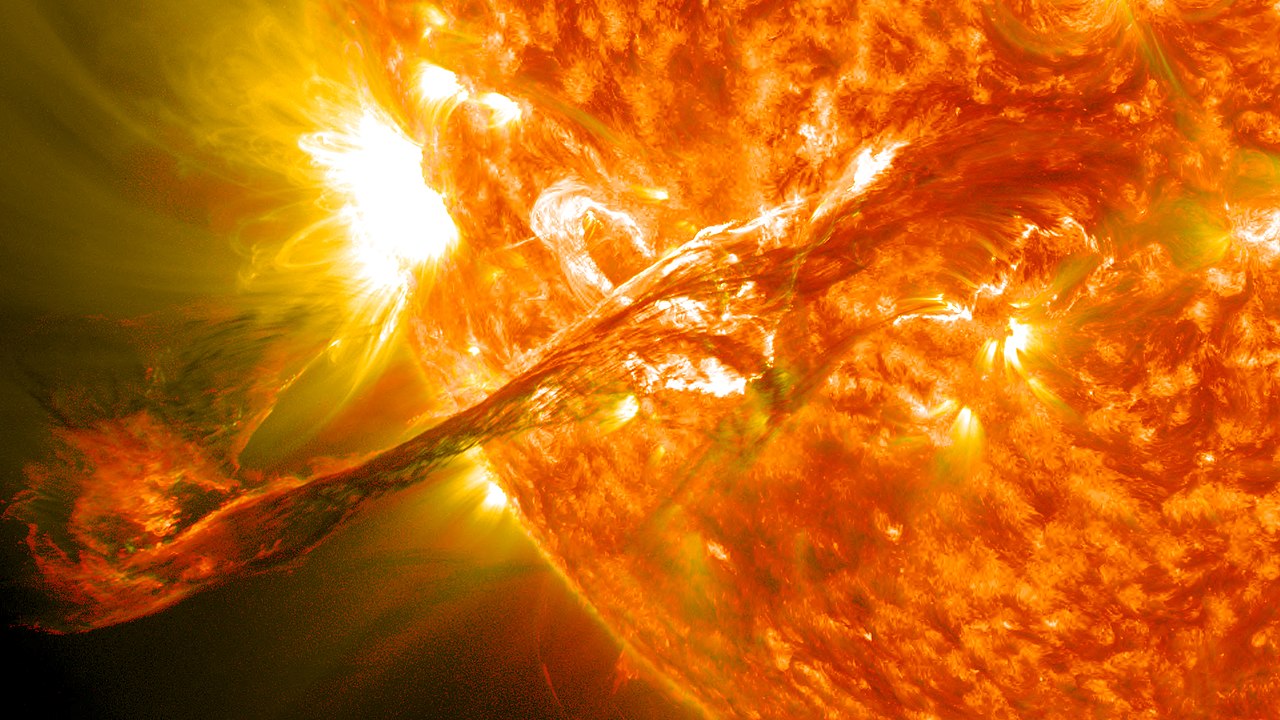

A solar flare is a sudden, intense brightening in the solar atmosphere caused by the rapid release of magnetic energy stored in stressed coronal magnetic field configurations. Flares emit radiation across the electromagnetic spectrum from radio waves to gamma rays and can accelerate electrons and protons to near-relativistic velocities. The largest flares release energies of up to 1032 ergs (1025 joules) in minutes to hours.16
A coronal mass ejection is the explosive expulsion of a large structure of plasma and magnetic field from the solar corona into interplanetary space. CMEs typically carry 1012 to 1013 kilograms of material at speeds ranging from less than 250 kilometres per second to more than 3,000 kilometres per second. When a fast, Earth-directed CME collides with Earth's magnetosphere, the compressed magnetic field and the southward component of the CME's embedded magnetic field can trigger a geomagnetic storm, during which energised particles are injected into Earth's radiation belts and accelerated along magnetic field lines toward the polar regions, producing aurorae and potentially damaging satellite electronics, disrupting radio communications, and inducing dangerous currents in long-distance power transmission lines and pipelines.9
The most powerful solar storm in recorded history is the Carrington Event of September 1859, named after the British astronomer Richard Carrington, who observed an extraordinarily intense white-light flare on the solar surface. The associated CME reached Earth in approximately 17.6 hours — roughly half the typical transit time — and triggered a geomagnetic storm of exceptional severity. Telegraph systems across North America and Europe failed, with operators reporting electric shocks and sparks from their equipment. Aurorae were visible as far south as the Caribbean. Modern estimates suggest that a Carrington-class event striking Earth today could cause trillions of dollars in damage to satellite infrastructure, power grids, and communications networks.17
The solar abundance problem
One of the most significant unresolved tensions in solar physics concerns the chemical composition of the Sun. For decades, standard solar models used the heavy-element abundances determined by Grevesse and Sauval (1998), which gave a solar metallicity of Z ≈ 0.017. These models agreed closely with helioseismic observations of the sound speed profile, the depth of the convective zone, and the helium abundance in the envelope.14
In 2005 and 2009, Asplund and collaborators published revised solar photospheric abundances based on analysis using sophisticated three-dimensional, time-dependent hydrodynamical models of the solar atmosphere, replacing the older one-dimensional empirical models. The new analysis, which also incorporated improved atomic data and non-local thermodynamic equilibrium (non-LTE) corrections, yielded significantly lower abundances for several key elements: carbon was reduced by approximately 30 percent, nitrogen by 20 percent, oxygen by 40 percent, and neon by 35 percent relative to the older values. The resulting metallicity dropped to Z ≈ 0.013.2
Standard solar models computed with these lower metallicities disagree substantially with helioseismic constraints. The predicted sound speed profile departs from the helioseismically inferred profile by up to 1 percent below the convective zone — an order of magnitude larger than the discrepancy with the older, higher abundances. The predicted depth of the convective zone shifts to 0.726 R⊙, significantly shallower than the helioseismic value of 0.713 R⊙. The predicted helium abundance in the envelope also falls below the helioseismic constraint.15
This discrepancy, known as the solar abundance problem or the solar modelling problem, has resisted resolution for two decades. Proposed solutions include the possibility that the new photospheric abundances are partially incorrect, that the interior metal abundances differ from the surface values due to some physical process not included in standard models (such as enhanced diffusion, accretion of metal-poor material in the early Sun, or missing opacity), or that the standard solar model itself requires additional physics such as convective overshooting, internal gravity waves, or modified nuclear reaction rates. Measurements of solar neutrino fluxes, particularly the CNO neutrinos detected by Borexino, have the potential to distinguish between high- and low-metallicity solar models by probing the core composition directly, though current experimental uncertainties remain too large for a definitive resolution.15, 22
Origin and age of the Sun
The Sun formed approximately 4.57 billion years ago from the gravitational collapse of a region within a molecular cloud. The precise age is determined not from the Sun itself but from the oldest solid objects in the solar system — calcium-aluminium-rich inclusions (CAIs) in primitive meteorites — which have been dated by lead-lead radiometric methods to 4.567 ± 0.01 billion years. Since these inclusions are the first solids to condense from the solar nebula, their age closely approximates the age of the Sun.19
The pre-main-sequence Sun was a T Tauri star, a young stellar object contracting under its own gravity and accreting material from a surrounding disk of gas and dust. During this phase, which lasted roughly 30 to 50 million years, the Sun was more luminous and more active than it is today, driving powerful bipolar outflows and probably emitting intense X-ray and ultraviolet radiation.18 When the core temperature reached approximately 10 million kelvins, sustained hydrogen fusion ignited via the proton-proton chain, and the Sun settled onto the main sequence.11
Standard solar models predict that the Sun's luminosity at the onset of hydrogen burning was only about 70 percent of its present value and has increased gradually over the past 4.57 billion years as the helium fraction in the core has grown, causing the core to contract slightly and heat up.1, 21 This steady brightening creates a puzzle for planetary science: with 30 percent less solar luminosity in the first two billion years of Earth's history, simple radiative equilibrium calculations suggest that Earth's surface temperature should have been below the freezing point of water — yet geological evidence, including sedimentary rocks and isotopic records, indicates that liquid water was present on Earth's surface within 200 million years of its formation. This discrepancy, known as the faint young Sun problem, was first articulated by Carl Sagan and George Mullen in 1972 and is generally attributed to a stronger greenhouse effect in Earth's early atmosphere, with higher concentrations of carbon dioxide, methane, or other greenhouse gases compensating for the lower solar luminosity.21
Future evolution
The Sun is currently about halfway through its main-sequence lifetime. Over the next approximately five billion years, it will continue converting hydrogen to helium in its core, growing gradually brighter and hotter. Standard stellar evolution models predict that the Sun's luminosity will increase by roughly 10 percent over the next billion years and will approximately double by the time it leaves the main sequence.1, 20
When the hydrogen fuel in the core is finally exhausted, fusion will cease in the centre and the inert helium core will begin to contract under gravity. Hydrogen fusion will continue in a shell surrounding the core, and the enormous energy output from this shell will cause the Sun's outer layers to expand dramatically. The Sun will leave the main sequence and ascend the red giant branch of the HR diagram, growing to roughly 200 times its current radius — large enough to engulf the orbits of Mercury and Venus. Detailed modelling by Schröder and Connon Smith (2008) indicates that the Sun's radius at the tip of the red giant branch will reach approximately 1.2 astronomical units, which is beyond the current orbit of Earth at 1.0 AU. However, mass loss from the expanding Sun will cause the remaining planets to migrate outward, and whether Earth is actually engulfed depends sensitively on the mass-loss rate, the tidal interaction between the giant Sun and the orbiting Earth, and the precise extent of the envelope expansion.20
Solar luminosity evolution over the Sun's lifetime1, 20
At the tip of the red giant branch, the temperature and density of the helium core will reach the threshold for helium fusion via the triple-alpha process. Because the core is electron-degenerate at this stage, helium ignition occurs explosively in an event called the helium flash. The flash lifts the degeneracy but is not observable from outside the star; the energy goes into expanding the core rather than into surface luminosity. The Sun will then settle into a stable phase of core helium burning on the horizontal branch, with a luminosity of roughly 50 solar luminosities and a radius of about 10 solar radii.11, 13
When core helium is exhausted, the Sun will enter the asymptotic giant branch (AGB) phase, expanding again with alternating hydrogen and helium shell burning and experiencing thermal pulses that drive significant mass loss through stellar winds. Over a period of perhaps a million years on the AGB, the Sun will shed most of its outer envelope, exposing the hot core. The ejected material will form a planetary nebula — a glowing shell of ionised gas illuminated by the ultraviolet radiation of the central remnant — which will dissipate into the interstellar medium over tens of thousands of years. The remaining core, a carbon-oxygen white dwarf with a mass of approximately 0.54 solar masses compressed into an object roughly the size of Earth, will cool and fade over trillions of years.11, 20
References
Measurement of the rate of νe + d → p + p + e− interactions produced by 8B solar neutrinos at the Sudbury Neutrino Observatory
Solar models: Current epoch and time dependences, neutrinos, and helioseismological properties
The Carrington event: Multi-wavelength observations of an extreme solar-terrestrial event