Overview
- The solar system formed approximately 4.568 billion years ago from the gravitational collapse of a dense region within a molecular cloud, producing a rotating protoplanetary disk of gas and dust around the young Sun in a process well-constrained by radiometric dating of calcium-aluminium-rich inclusions in primitive meteorites.
- Terrestrial planets grew through the hierarchical accretion of dust grains into planetesimals and then planetary embryos, while the giant planets formed farther from the Sun where volatile ices could condense, with Jupiter likely accreting a massive gas envelope within the first few million years of the disk's lifetime.
- Dynamical models such as the Nice model indicate that the giant planets underwent significant orbital migration after their formation, reshaping the architecture of the outer solar system, scattering the Kuiper belt, and potentially triggering a late episode of elevated impact flux on the inner planets and the Moon.
The solar system formed approximately 4.568 billion years ago from the collapse of a dense region within an interstellar molecular cloud.3 The resulting rotating disk of gas and dust, known as the solar nebula, gave rise to the Sun at its centre and to the planets, moons, asteroids, and comets that orbit it. The basic framework for understanding this process — the nebular hypothesis — was first proposed in the eighteenth century and has since been refined through meteoritic analysis, spacecraft observations, theoretical modelling, and the comparative study of protoplanetary disks around other young stars.4, 5 The formation of the solar system is not merely a question of local history; it provides a critical test case for planet formation theories that must also explain the remarkable diversity of exoplanetary systems now being discovered throughout the Milky Way.
The nebular hypothesis
The idea that the solar system formed from a rotating cloud of gas and dust has its roots in the eighteenth century. In 1755, the German philosopher Immanuel Kant proposed that the Sun and planets condensed from a diffuse, slowly rotating nebula under the influence of gravity. Independently, the French mathematician Pierre-Simon Laplace advanced a similar hypothesis in 1796, suggesting that the cooling and contraction of a rotating solar atmosphere shed successive rings of material that coalesced into the planets.4 Although the details of Kant's and Laplace's models were incorrect — Laplace's ring mechanism, in particular, could not explain how material would collect into discrete planets — their central insight that the solar system originated from a flattened, rotating disk of primordial material has been vindicated by two and a half centuries of subsequent investigation.
The nebular hypothesis fell in and out of favour during the nineteenth and early twentieth centuries, challenged by objections related to angular momentum distribution (the Sun contains 99.86 percent of the system's mass but only about 2 percent of its angular momentum) and by competing models that invoked tidal interactions or stellar encounters.4 The resolution came with the recognition that magnetic braking — the transfer of angular momentum from the young Sun to the surrounding disk through magnetic field coupling with ionised gas — could efficiently redistribute angular momentum outward, resolving the fundamental objection that had plagued the nebular model for over a century.4, 5
Collapse of the molecular cloud
The solar system's formation began with the gravitational collapse of a dense core within a giant molecular cloud — a cold, dark region of the interstellar medium composed primarily of molecular hydrogen (H2) with trace amounts of helium, dust grains, and heavier elements synthesised in previous generations of stars.5 Molecular clouds have typical temperatures of 10 to 20 kelvin and densities of roughly 103 to 105 particles per cubic centimetre. Collapse is initiated when a portion of the cloud exceeds the Jeans mass — the critical mass above which gravitational attraction overwhelms thermal pressure — which can be triggered by external perturbations such as a nearby supernova shock wave, cloud-cloud collisions, or density waves in the galactic spiral arms.5, 16
.jpg)
.jpg)
Evidence that a supernova may have triggered or contributed to the collapse of the presolar cloud comes from the detection of short-lived radionuclides in primitive meteorites. Aluminium-26 (26Al, half-life 0.72 million years) and iron-60 (60Fe, half-life 2.6 million years) were present in the early solar system at abundances that are most readily explained by the injection of freshly synthesised material from a nearby massive star that exploded as a supernova shortly before or during the cloud's collapse.16 The decay heat from 26Al was also a major energy source for the early thermal processing and differentiation of planetesimals.
As the cloud core collapsed, conservation of angular momentum caused it to spin faster and flatten into a disk. Within roughly 100,000 years, a hot, dense protostar formed at the centre — the proto-Sun — surrounded by a rotating protoplanetary disk (also called the solar nebula) extending to perhaps 100 astronomical units (AU) or more.5 Observations of protoplanetary disks around other young stellar objects by the Atacama Large Millimetre/submillimetre Array (ALMA) have confirmed that this disk geometry is ubiquitous among newly forming stars, with disk lifetimes typically ranging from 1 to 10 million years before the gas component is dispersed by photoevaporation and accretion onto the star.22
The condensation sequence
Within the solar nebula, the radial temperature gradient established a chemical zonation that profoundly influenced the composition of the bodies that formed at different distances from the Sun. Close to the proto-Sun, where temperatures exceeded 1,500 kelvin, only the most refractory materials — oxides and silicates of calcium, aluminium, and titanium — could exist in solid form. Farther from the Sun, progressively more volatile materials could condense: metallic iron and magnesium silicates at roughly 1,300 to 1,400 kelvin, alkali-bearing feldspars at around 1,000 kelvin, and sulfides and hydrated minerals at still lower temperatures.17
Beyond approximately 3 to 5 AU from the proto-Sun, temperatures dropped below roughly 150 to 170 kelvin, allowing water ice to condense — a boundary known as the snow line or frost line. The condensation of water ice dramatically increased the mass of solid material available for planet building beyond the snow line, because oxygen is the third most abundant element in the cosmos (after hydrogen and helium) and water ice contributed substantially to the total solid inventory. This enhancement in solid surface density beyond the snow line is widely regarded as a key factor in enabling the rapid formation of the massive cores that would become the giant planets.17, 9
The physical record of the condensation sequence is preserved in calcium-aluminium-rich inclusions (CAIs) found in carbonaceous chondrite meteorites. CAIs are millimetre- to centimetre-sized objects composed of minerals such as corundum, hibonite, melilite, and spinel — precisely the refractory phases predicted to condense first from a cooling gas of solar composition. Lead-lead radiometric dating of CAIs from the Allende and other carbonaceous chondrites yields ages of 4.5672 ± 0.0006 billion years, establishing them as the oldest known solid objects in the solar system and defining the reference age for the system's formation.1, 3
Planetesimal accretion and terrestrial planet formation
The growth of micrometer-sized dust grains into kilometre-sized planetesimals is one of the most challenging problems in planetary science. Grains readily stick together through electrostatic and van der Waals forces to form centimetre-sized aggregates, but further growth is impeded by destructive collisions at higher velocities and by the rapid inward drift of metre-sized bodies caused by aerodynamic drag from the surrounding gas — the so-called metre barrier.6 A leading mechanism for overcoming this barrier is the streaming instability, in which the mutual aerodynamic interaction between solid particles and gas concentrates particles into dense filaments that can collapse gravitationally to form planetesimals tens to hundreds of kilometres in diameter in a single step, bypassing the problematic intermediate sizes.6, 7
Once planetesimals reached sizes of roughly 1 to 10 kilometres, their mutual gravitational interactions became significant. The subsequent growth proceeded through runaway accretion, in which the largest bodies in a local region grew fastest because their enhanced gravitational cross-sections allowed them to sweep up surrounding material more efficiently than smaller competitors. Runaway accretion produced a population of lunar- to Mars-sized planetary embryos (also called protoplanets) within roughly one million years in the inner solar system.18
The final assembly of the terrestrial planets occurred over a much longer timescale of 30 to 100 million years through giant impacts between planetary embryos. Numerical N-body simulations of this late stage of accretion successfully reproduce the basic architecture of the inner solar system — four rocky planets with roughly the correct masses and orbital spacings — although reproducing the small mass of Mars remains a persistent challenge that has motivated models such as the Grand Tack hypothesis.18, 20
Chondrules — millimetre-sized spherules of silicate material found abundantly in chondrite meteorites — provide additional constraints on conditions in the early solar nebula. These objects were flash-heated to temperatures of 1,500 to 1,900 kelvin and cooled over a period of hours, but their precise formation mechanism remains debated, with proposals ranging from shock waves in the nebular gas to impacts between planetesimals. Radiometric dating indicates that chondrule formation spanned roughly 1 to 3 million years after CAI formation, overlapping with the epoch of planetesimal accretion.2, 16
Giant planet formation
The formation of the four giant planets — Jupiter, Saturn, Uranus, and Neptune — required a fundamentally different process than that which built the terrestrial planets, because these bodies contain enormous envelopes of hydrogen and helium gas that could only have been captured from the solar nebula before it dissipated. The dominant model for giant planet formation is core accretion, in which a solid core of roughly 10 Earth masses first assembles through the accretion of icy and rocky planetesimals beyond the snow line, after which the core's gravity becomes sufficient to attract and retain a massive gaseous envelope from the surrounding nebula.9
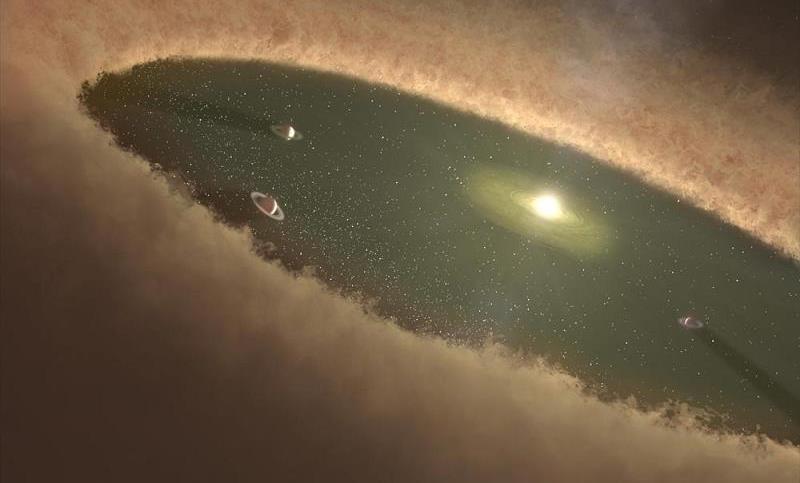

The principal challenge for core accretion is timing. Protoplanetary disk observations indicate that the gas component of the disk dissipates within roughly 3 to 10 million years, so the giant planet cores must have formed and begun accreting gas within this window.5, 22 For Jupiter, the most massive planet, the transition from slow, solid-body growth to rapid gas accretion likely occurred within the first 3 to 5 million years. Saturn, with its smaller gas-to-solid ratio, may have begun gas accretion somewhat later or less efficiently. Uranus and Neptune, which contain much smaller gas fractions relative to their solid and ice inventories, may have experienced truncated gas accretion due to the dissipation of the nebula before they could accumulate massive envelopes.9
An alternative model, disk instability, proposes that giant planets can form directly through the gravitational fragmentation of a massive, self-gravitating protoplanetary disk, bypassing the need for a solid core altogether. In this scenario, dense clumps in the disk collapse on orbital timescales of hundreds to thousands of years, producing gas giant planets very rapidly.8 While disk instability may operate in some circumstances — particularly in massive disks around young stars — the enrichment of Jupiter and Saturn in heavy elements relative to solar composition favours core accretion as the primary formation mechanism for the solar system's giant planets, since core accretion naturally predicts a core enriched in refractory and volatile solids.8, 9
The Nice model and giant planet migration
The present orbital architecture of the giant planets — with Jupiter at 5.2 AU, Saturn at 9.5 AU, Uranus at 19.2 AU, and Neptune at 30.1 AU — does not necessarily reflect their original formation locations. The Nice model, named after the French city where it was developed, proposes that the giant planets formed in a more compact configuration between roughly 5 and 17 AU and subsequently migrated to their current orbits through gravitational interactions with a massive disk of remnant planetesimals beyond their initial orbits.10
In the Nice model, the critical event is a gravitational instability triggered when Jupiter and Saturn cross their mutual 2:1 mean-motion resonance — the configuration in which Saturn's orbital period is exactly twice Jupiter's. This resonance crossing destabilises the entire outer solar system, causing Saturn, Uranus, and Neptune to migrate outward into the planetesimal disk while Jupiter migrates slightly inward. Neptune's outward migration scatters the planetesimal disk, populating the Kuiper belt and the scattered disk at their current locations and flinging a large number of small bodies into the inner solar system.10, 12 The model also naturally explains the capture of Jupiter's Trojan asteroids, the irregular satellites of the giant planets, and the orbital eccentricities and inclinations observed in the outer solar system.12
A complementary hypothesis, the Grand Tack model, addresses the earlier migration history of Jupiter. In this scenario, Jupiter formed beyond the snow line, migrated inward through the gas disk to approximately 1.5 AU (roughly Mars's current orbit), and then reversed course and migrated back outward when Saturn formed and became locked in a resonance with Jupiter. This inward-then-outward migration would have truncated the inner disk of solid material, naturally explaining the small mass of Mars and the compositional structure of the asteroid belt, which contains both dry, silicate-rich (S-type) and water-rich, carbon-bearing (C-type) bodies.20
Orbital distances of the giant planets: current positions versus estimated formation locations in the Nice model10
The Late Heavy Bombardment debate
One of the most consequential predictions of the original Nice model was that the destabilisation of the outer solar system occurred relatively late — roughly 3.9 billion years ago, some 650 million years after the solar system formed — and that the resulting surge of scattered planetesimals impacting the inner solar system produced a spike in the cratering rate known as the Late Heavy Bombardment (LHB) or lunar cataclysm.11 The LHB hypothesis was originally motivated by the clustering of radiometric ages of lunar impact melt rocks around 3.8 to 4.0 billion years, as measured in samples returned by the Apollo missions, suggesting a discrete pulse of impacts rather than a monotonically declining bombardment flux from accretion.
However, the LHB concept has become increasingly contested. Critics have argued that the apparent clustering of impact ages may reflect sampling bias — all Apollo landing sites were located on or near the Imbrium basin, and the pervasive ejecta from this single enormous impact may have reset the radiometric clocks of many samples, creating the illusion of a contemporaneous bombardment spike.19 More recent argon-argon dating of a wider range of lunar impact melt breccias has revealed a broader spread of ages, with some impacts dating to 4.2 billion years ago or older, consistent with a prolonged, gradually declining bombardment rather than a sharp late spike.19
In response to these criticisms, revised dynamical models have proposed that the giant planet instability occurred much earlier — perhaps within the first 100 million years after solar system formation — which would produce an elevated but not sharply spiked bombardment flux more consistent with the revised age data.24 The timing of the giant planet instability remains one of the most actively debated questions in planetary science, with implications for the early evolution of the terrestrial planets, the origin of water on Earth, and the conditions under which life first emerged.
Formation of the Moon
The leading hypothesis for the origin of the Moon is the giant impact hypothesis, which proposes that the Moon formed from debris ejected into Earth orbit following a collision between the proto-Earth and a Mars-sized impactor, conventionally named Theia, during the final stages of terrestrial planet accretion.14 The giant impact hypothesis was developed in the 1970s and 1980s to explain a suite of observations that no previous model — capture, co-accretion, or fission — could satisfactorily account for: the Moon's large size relative to Earth, its low bulk density and iron depletion, the high angular momentum of the Earth-Moon system, and the broad similarity in oxygen isotope ratios between the Earth and Moon.
Hydrodynamic simulations of the canonical giant impact scenario model Theia as a body roughly 10 to 15 percent of Earth's mass striking the proto-Earth at a glancing angle. The impact vaporises and melts a large fraction of both bodies, ejecting a disk of silicate-rich, iron-poor debris into orbit around the Earth, from which the Moon accretes within roughly a century.14 Hafnium-tungsten isotopic systematics in lunar samples constrain the Moon-forming impact to have occurred approximately 30 to 60 million years after CAI formation — that is, roughly 4.51 billion years ago.23
A persistent challenge for the canonical model is the near-identical oxygen, silicon, titanium, and tungsten isotope ratios of the Earth and Moon, which are difficult to achieve if the Moon is derived primarily from the impactor (as the canonical model predicts), since Theia presumably formed at a different heliocentric distance and would have had a distinct isotopic signature. Several modified versions of the giant impact have been proposed to address this problem, including higher-energy collisions between two roughly equal-mass bodies, which more thoroughly mix the impactor and target material,13 and post-impact equilibration of the silicate vapour atmosphere between the Earth and the proto-lunar disk, which could homogenise isotopic signatures even if the initial impact produced a compositionally heterogeneous disk.15
Meteoritic evidence
Meteorites are the primary physical samples of the early solar system available for laboratory study, and they provide an extraordinarily detailed record of the conditions, processes, and timescales of planet formation. The most primitive meteorites, the chondrites, are undifferentiated — they have never been melted and separated into core, mantle, and crust — and preserve material that has remained essentially unaltered since the solar system's earliest epochs.1, 16
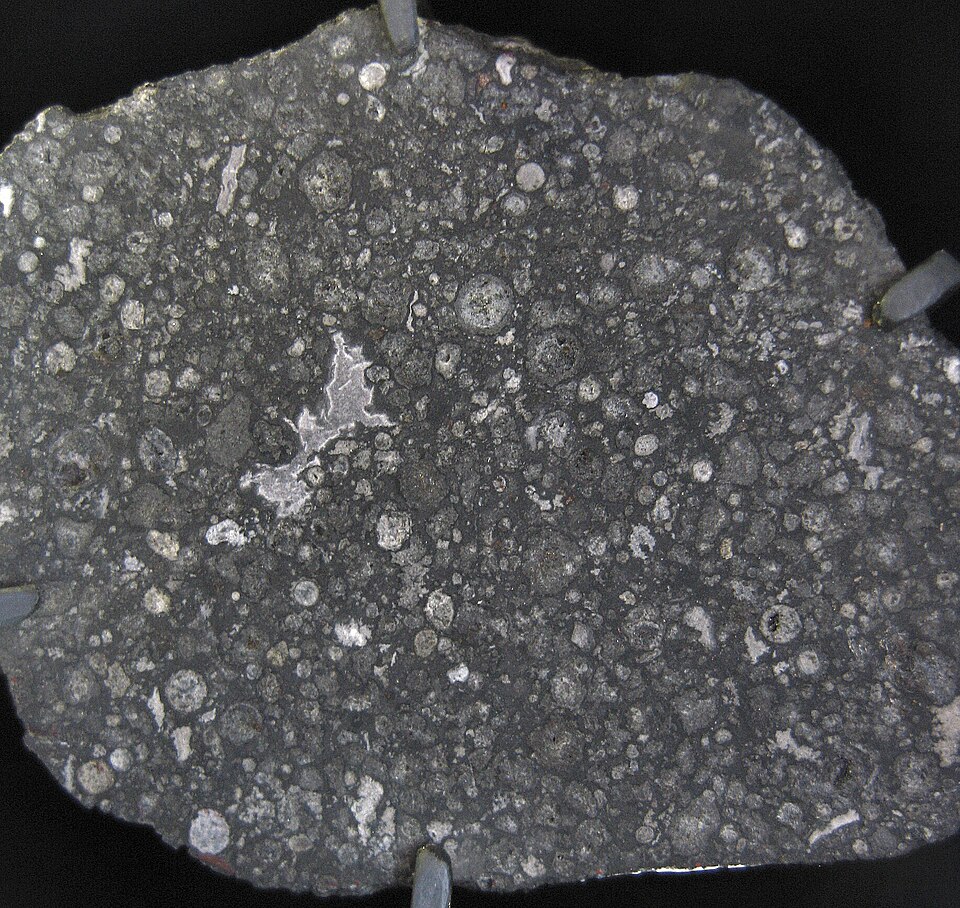

Calcium-aluminium-rich inclusions (CAIs), as noted above, are the oldest dated solids and establish the time zero of solar system chronology at 4.5672 billion years.3 Chondrules, which formed 1 to 3 million years later, record episodic, high-temperature events in the nebula that are not yet fully understood.2 Together, CAIs and chondrules demonstrate that the solar nebula remained an active, dynamic environment for at least several million years after the initial collapse.
Iron meteorites, which represent the cores of differentiated planetesimals, provide evidence that some bodies large enough to undergo melting and core-mantle separation formed within the first 1 to 2 million years of the solar system — remarkably early, and consistent with rapid planetesimal formation through mechanisms such as the streaming instability.16 The hafnium-tungsten isotopic system (182Hf decays to 182W with a half-life of 8.9 million years) has been particularly powerful for constraining the timing of core formation in planetesimals and planetary embryos, demonstrating that metal-silicate segregation occurred within the first few million years for many small bodies.23
The isotopic diversity preserved across different meteorite groups — variations in oxygen, titanium, chromium, and molybdenum isotope ratios — indicates that the solar nebula was not isotopically homogeneous and that material from different presolar sources (such as different types of stellar nucleosynthesis) was incompletely mixed. This isotopic heterogeneity serves as a fingerprint for identifying the provenance of planetary materials and has been instrumental in demonstrating, for example, that Earth and Mars sampled distinct isotopic reservoirs during their formation.16
Comparison with exoplanetary systems
The discovery of thousands of exoplanets over the past three decades has transformed the study of solar system formation from a problem with a single data point into a comparative science. As of the mid-2020s, more than 5,500 confirmed exoplanets have been detected, revealing an astonishing diversity of planetary system architectures that was entirely unanticipated when the only known planets were those orbiting the Sun.21
Hot Jupiters — gas giant planets orbiting their host stars at distances of less than 0.1 AU, with orbital periods of only a few days — were the first major surprise. No analogue exists in the solar system, and their existence demonstrated that giant planet migration, whether through interaction with the gas disk or through gravitational scattering, is a common outcome of planet formation rather than a peculiarity of our system.21 Super-Earths and sub-Neptunes, planets with radii between those of Earth and Neptune and no solar system counterpart, have turned out to be among the most common types of planet in the galaxy, raising questions about why the solar system lacks bodies in this mass range.21
Observations of protoplanetary disks by ALMA have revealed ring-and-gap structures in many disks around young stars, suggestive of ongoing planet formation or the gravitational sculpting of disk material by embedded planets. These observations provide direct empirical counterparts to the theoretical disk processes invoked in solar system formation models and have confirmed that planet formation is a robust, common process throughout the galaxy.22 The solar system, with its clear division between small, rocky inner planets and large, gas-rich outer planets separated by a belt of remnant planetesimals, appears to be one outcome among many possible configurations — a realisation that has deepened rather than diminished the scientific interest in understanding exactly how and why our particular planetary system came to be.
References
Pb-Pb dating of individual chondrules from the CBa chondrite Gujba: Assessment of the impact plume formation model
The age of the Solar System redefined by the oldest Pb-Pb age of a meteoritic inclusion
Terminal cataclysm or prolonged bombardment? New Ar-Ar ages from lunar impact melt breccias
The early instability scenario: terrestrial planet formation during the giant planet instability, and the effect of collisional fragmentation