Overview
- Planetary migration — the process by which planets change their orbital distances from their host star after formation — occurs through gravitational interactions between planets and the gas disk in which they form, and is now understood to be a common, perhaps ubiquitous, feature of planetary system evolution rather than an exotic exception.
- Two principal modes of disk-driven migration are recognized: Type I migration, which affects low-mass planets embedded in the gas disk and can move them inward on timescales of only 100,000 years, and Type II migration, which occurs when a massive planet opens a gap in the disk and drifts inward along with the viscous evolution of the gas, producing the hot Jupiters observed at extreme proximity to their host stars.
- In the solar system, the Nice model and Grand Tack hypothesis propose that Jupiter and Saturn underwent significant orbital rearrangement early in solar system history, scattering the outer planets, reshaping the Kuiper belt, and triggering the Late Heavy Bombardment — demonstrating that even our own planetary system did not form in its present configuration.
Planetary migration is the process by which a planet's orbital distance from its host star changes substantially after the planet has formed. Once considered an exotic theoretical possibility, migration is now recognized as a common — perhaps inevitable — feature of planetary system evolution, required to explain a wide range of observed phenomena from the existence of hot Jupiters orbiting their stars in just a few days to the resonant chains of compact multi-planet systems and the orbital architecture of our own solar system. The theoretical foundations were laid by Peter Goldreich and Scott Tremaine in 1980, who showed that gravitational interactions between a planet and the gaseous protoplanetary disk in which it forms can torque the planet's orbit, driving it inward or outward over astronomically short timescales.1, 3

Theoretical basis
Planetary migration arises from the exchange of angular momentum between a planet and its surrounding environment. In the most common scenario, the environment is the gas-rich protoplanetary disk that persists for the first few million years after star formation. A planet embedded in such a disk exerts gravitational torques on the gas, launching spiral density waves at Lindblad resonances interior and exterior to its orbit. The outer disk material, orbiting more slowly than the planet, is pushed outward by the planet's gravity, gaining angular momentum; the inner disk material, orbiting faster, is pushed inward, losing angular momentum. The planet itself gains or loses angular momentum in response — and the net effect determines whether the planet migrates inward or outward.1, 3
The direction and rate of migration depend on the planet's mass, the disk's density and temperature structure, the viscosity of the gas, and the presence of other planets. In most disk models, the torque from the outer Lindblad resonance slightly exceeds that from the inner resonance, producing a net inward migration. This asymmetry arises from the pressure support in the disk, which shifts the resonance locations asymmetrically relative to the planet. However, additional effects — corotation torques from gas flowing along horseshoe orbits near the planet, heating and cooling of the gas, and gradients in entropy and surface density — can modify or even reverse the direction of migration under certain conditions.3, 14
Type I migration
Type I migration applies to low-mass planets — those too small to significantly perturb the disk's surface density profile — typically planets with masses up to a few tens of Earth masses. In this regime, the planet excites spiral density waves in the disk but does not open a gap; the gas flows smoothly past the planet's orbit. The resulting torques can drive the planet inward on timescales as short as 100,000 years, far shorter than the several-million-year lifetime of a typical protoplanetary disk. This rapid timescale poses a theoretical challenge: if Type I migration operated at the rates predicted by the simplest disk models, most planets would spiral into their host stars before the disk dispersed, leaving no planets at all.3, 15
The resolution to this problem has come from increasingly detailed numerical simulations that incorporate effects neglected in early analytical models. Corotation torques — arising from gas trapped in the horseshoe region around the planet's orbit — can partially or fully counterbalance the Lindblad torques, particularly in disks with steep entropy or surface density gradients. In certain disk regions, the corotation torque can even exceed the Lindblad torque, creating migration traps or convergence zones where planets stall rather than continuing their inward drift. These traps may explain why many observed planetary systems contain planets at specific orbital distances and why resonant chains form as multiple planets migrate inward and capture each other into mean-motion resonances.14, 15
Type II migration
When a planet becomes massive enough — roughly one Jupiter mass around a solar-type star — its gravitational influence is sufficient to clear the gas from an annular gap centred on its orbit. This transition marks the onset of Type II migration. In this regime, the planet is locked within the gap it has opened and migrates along with the viscous evolution of the disk: as the disk gas flows inward under the action of its own viscosity (accreting onto the star), the planet is carried inward with it. The migration rate is therefore set by the disk's viscous timescale rather than by the planet-disk torques directly, and is typically much slower than Type I migration — on the order of the disk's viscous timescale of approximately 105 to 106 years.1, 2, 3
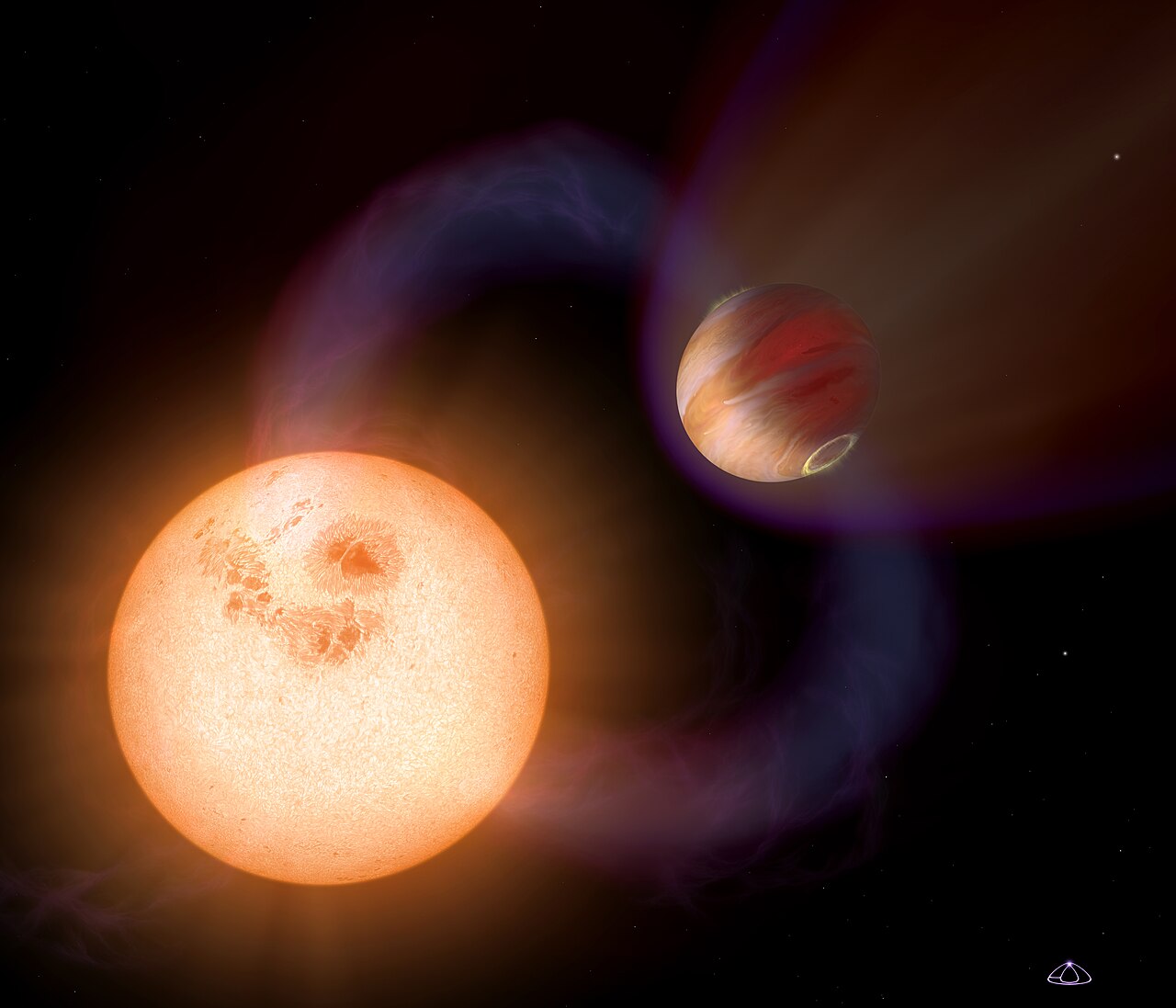
Type II migration was first invoked to explain the existence of hot Jupiters — giant planets discovered at orbital periods of only a few days, far inside the ice line where giant planet formation is thought to be possible. The discovery of 51 Pegasi b by Michel Mayor and Didier Queloz in 1995 — a Jupiter-mass planet orbiting its star at just 0.052 AU — demanded a mechanism to transport a giant planet from its presumed formation location beyond several AU to a position nearly in contact with the stellar surface.7 Lin, Bodenheimer, and Richardson proposed in 1996 that Type II migration through the protoplanetary disk could accomplish this inward transport, with the planet's migration halting when the inner disk is cleared by the star's magnetosphere or when the disk itself dissipates.2
The gap-opening criterion depends on the ratio of the planet's mass to the disk's thermal mass (related to the disk's temperature and viscosity). In typical disk models, the threshold for gap opening is approximately one Saturn mass (0.3 Jupiter masses), though this value varies with disk properties. Planets near the gap-opening threshold may undergo a transitional regime sometimes called Type III migration, in which partial gap formation and coorbital flows produce rapid, runaway migration that can move a planet across a significant fraction of the disk in only a few thousand orbits.3, 14
The Nice model
The Nice model, proposed by Konstantin Tsiganis, Rodney Gomes, Alessandro Morbidelli, and Harold Levison in a trio of papers published in Nature in 2005, describes a dramatic episode of orbital rearrangement among the giant planets of the solar system that occurred several hundred million years after the planets formed. In the model's initial configuration, the four giant planets (Jupiter, Saturn, Uranus, and Neptune) formed in a more compact arrangement than their present orbits, with Neptune originally closer to the Sun than its current 30 AU distance and a massive disk of icy planetesimals extending beyond the outermost planet.4
As the giant planets interacted gravitationally with the planetesimal disk — scattering planetesimals inward, gaining angular momentum, and slowly migrating outward — Jupiter and Saturn crossed their mutual 2:1 mean-motion resonance, a configuration in which Saturn's orbital period is exactly twice Jupiter's. This resonance crossing destabilized the entire system: the orbits of Uranus and Neptune were dramatically excited, with one or both planets being scattered outward into the planetesimal disk. The resulting gravitational chaos dispersed the planetesimal disk, scattered objects into the Kuiper belt and the Oort cloud, and sent a shower of debris into the inner solar system.4, 5
Gomes and colleagues proposed that this shower of impactors was responsible for the Late Heavy Bombardment (LHB), a pulse of large impacts recorded on the lunar surface approximately 3.9 billion years ago and evidenced by the clustering of impact-melt ages in lunar samples returned by the Apollo missions. The Nice model also explains several other features of solar system architecture: the orbital eccentricities and inclinations of the giant planets, the existence and orbital distribution of Jupiter's Trojan asteroids (captured chaotically during the resonance crossing), and the structure of the Kuiper belt, including its resonant populations and its sharp outer edge.5, 13, 16
The Grand Tack hypothesis
The Grand Tack hypothesis, proposed by Kevin Walsh and colleagues in 2011, addresses an earlier phase of Jupiter's orbital evolution — the period during which the gas disk was still present, before the events described by the Nice model. In this scenario, Jupiter formed at approximately 3.5 AU from the Sun and migrated inward through Type II migration to roughly 1.5 AU (approximately Mars's current orbit) before its migration was reversed by a gravitational interaction with Saturn.6
The reversal mechanism relies on Saturn's own inward Type II migration catching up to Jupiter. When Saturn became trapped in a 2:3 mean-motion resonance with Jupiter, the combined torques from the two planets on the gas disk changed sign: instead of driving inward migration, the resonant planet pair migrated outward together, with Jupiter retreating from 1.5 AU to approximately its present position near 5.2 AU. This inward-then-outward trajectory — the "tack" — swept through the inner solar system twice, first depleting the asteroid belt and scattering material inward, then repopulating it with a mixture of objects from different heliocentric distances.6
The Grand Tack addresses a longstanding puzzle about Mars: why Mars is so much less massive than Earth. In standard formation models, the amount of solid material available for planet building at Mars's distance should have produced a planet comparable in size to Earth, yet Mars is only about one-tenth Earth's mass. The Grand Tack explains this by having Jupiter's inward migration truncate the disk of solid material at approximately 1 AU, starving the Mars-forming region of the building blocks needed to grow a larger planet. Numerical simulations of the Grand Tack scenario reproduce the observed mass distribution of the terrestrial planets — including the small mass of Mars — more successfully than models without migration.6
Hot Jupiters as evidence of migration
Hot Jupiters — gas giant planets with orbital periods shorter than about 10 days and semimajor axes of less than 0.1 AU — are the most dramatic observational evidence for planetary migration. Giant planets cannot form at such close proximity to their stars: temperatures within 0.1 AU of a solar-type star exceed 1,500 K, far too hot for the solid condensation of ices and metals needed to build a giant planet core. The rock and metal available so close to the star amounts to only a few Earth masses at most, insufficient to trigger the runaway gas accretion that produces a Jupiter-mass planet. Hot Jupiters must therefore have formed farther out, beyond the ice line at several AU, and subsequently migrated inward.2, 7
Three migration mechanisms have been proposed to produce hot Jupiters. Disk migration (Type II) is the simplest: the planet opens a gap and drifts inward with the viscous disk flow, halting when it reaches the inner edge of the disk or when the disk dissipates.2 Planet-planet scattering produces hot Jupiters through a more violent process: gravitational encounters between two or more giant planets in the same system eject one planet to a wide orbit (or out of the system entirely) while throwing another into a highly eccentric orbit that passes close to the star. Tidal dissipation then circularizes and shrinks the orbit over millions of years, producing a hot Jupiter on a short-period, low-eccentricity orbit.10 The Kozai-Lidov mechanism involves a distant stellar or planetary companion whose gravitational perturbation cyclically exchanges the planet's orbital inclination for eccentricity, periodically driving the planet's periapsis very close to the star, where tidal friction again circularizes the orbit.11
Observational diagnostics can distinguish between these pathways. Disk migration preserves orbital alignment between the planet's orbit and the star's spin axis, while scattering and Kozai processes can produce significant spin-orbit misalignment (obliquity). Measurements of the Rossiter-McLaughlin effect — a spectroscopic signature produced during planetary transits — have revealed that some hot Jupiters orbit in the same plane as their star's equator while others are severely misaligned or even retrograde, suggesting that multiple migration pathways operate in nature.12
Resonant chains
Mean-motion resonances — orbital configurations in which the periods of two planets are related by a ratio of small integers (2:1, 3:2, 4:3) — are a natural outcome of convergent disk migration. As two planets migrate inward through the disk, the inner planet migrates more slowly (or stalls) while the outer planet continues its approach. When the outer planet reaches a position where its orbital period is an integer multiple of the inner planet's, the resulting periodic gravitational kicks can lock the two planets into a stable resonant configuration, after which they migrate inward together as a resonant pair.3, 14
This process can repeat sequentially, capturing additional planets into a resonant chain — a system in which each adjacent pair of planets is locked in a mean-motion resonance. The TRAPPIST-1 system, with seven roughly Earth-sized planets orbiting an ultracool M dwarf, is the most spectacular example: the planets form a near-continuous chain of resonances (8:5, 5:3, 3:2, 3:2, 4:3, 3:2), a configuration that almost certainly resulted from convergent migration in the protoplanetary disk followed by resonant capture.8 The long-term stability of the TRAPPIST-1 chain over billions of years constrains the planets' masses, eccentricities, and tidal dissipation properties.
However, resonant chains are fragile: gravitational perturbations during or after the dispersal of the gas disk can break the resonances, allowing the planets' orbits to become dynamically unstable. Numerical simulations by Izidoro and colleagues suggest that the majority of compact multi-planet systems discovered by Kepler originally formed in resonant chains through disk migration but subsequently experienced instabilities that disrupted the resonances, leaving the observed systems in near-resonant but non-resonant configurations. The small fraction of systems that retained their chains — like TRAPPIST-1 — represent the survivors of this disruption process.17
Scattering and the Kozai mechanism
Disk migration is not the only pathway to orbital change. Planet-planet scattering occurs when the gravitational interactions between two or more planets in the same system drive their orbits to crossing or near-crossing configurations, leading to close encounters that violently rearrange the system's architecture. The outcome typically involves one planet being ejected from the system entirely while others are left on highly eccentric or inclined orbits. Scattering is the leading explanation for the broad distribution of orbital eccentricities observed among giant exoplanets — in contrast to the nearly circular orbits produced by disk migration.10
The Kozai-Lidov mechanism operates in hierarchical triple systems — a planet orbiting a star that itself has a distant stellar companion, or a planet perturbed by a distant massive planet in the same system. The gravitational influence of the distant companion induces large-amplitude oscillations in the inner planet's eccentricity and inclination on timescales of thousands to millions of orbits. During periods of high eccentricity, the planet's periapsis may bring it close enough to the star for tidal forces to extract orbital energy, progressively shrinking and circularizing the orbit. This mechanism can transform a Jupiter-mass planet on a wide, circular orbit into a hot Jupiter over millions to billions of years, and it naturally produces the spin-orbit misalignments observed in a subset of hot Jupiter systems.11
Implications for solar system architecture and habitability
The recognition that planetary migration is widespread has fundamentally changed the interpretation of planetary system architectures. The orbital configuration of a planetary system is not simply a frozen record of where planets formed; it is the endpoint of a complex dynamical history involving migration, resonance capture, scattering, and tidal evolution. The diversity of observed architectures — from hot Jupiters to compact resonant chains to systems with widely spaced eccentric giants — reflects the diversity of initial conditions, disk properties, and dynamical histories that different systems have experienced.12
For the solar system specifically, the Nice model and Grand Tack hypothesis together suggest that the present orbits of the planets bear only an approximate relationship to their formation locations. Jupiter formed beyond the ice line but may have migrated inward to 1.5 AU before retreating. Saturn, Uranus, and Neptune migrated outward during the Nice model instability, with Neptune possibly originating interior to Uranus. The asteroid belt was sculpted by Jupiter's migration, and the Kuiper belt was populated by the outward scattering of icy planetesimals during the giant planet instability. The solar system's architecture is thus a product of migration, not merely of in-situ formation.4, 6, 9
Migration has direct implications for planetary habitability. The Grand Tack may have been essential for producing a habitable Earth by delivering water-rich material from beyond the ice line to the inner solar system during Jupiter's outward migration, while simultaneously truncating the solid disk to prevent Mars from growing too large. In other systems, the migration of a giant planet through the habitable zone could have destroyed or ejected any terrestrial planets that were forming there. The question of whether a planetary system ends up habitable may depend as much on the migration history of its giant planets as on the properties of any individual world within the habitable zone.6, 12
References
Breaking the chains: hot super-Earth systems from migration and disruption of compact resonant chains