Overview
- More than 5,700 exoplanets have been confirmed as of early 2025, discovered primarily through radial velocity spectroscopy and transit photometry, revealing that planets are ubiquitous in the Milky Way and that planetary system architectures are far more diverse than the Solar System alone would suggest.
- Exoplanets span an extraordinary range of types unknown in our own system, including hot Jupiters orbiting their stars in days, super-Earths and mini-Neptunes that represent the galaxy's most common planet class, and potentially rocky worlds within the habitable zones of their host stars.
- The James Webb Space Telescope has opened a new era of atmospheric characterization, detecting molecules such as carbon dioxide, water vapour, and dimethyl sulfide in exoplanet atmospheres through transmission spectroscopy, advancing the search for biosignature gases on temperate terrestrial worlds.
An exoplanet is a planet that orbits a star other than the Sun. Once purely hypothetical, exoplanets became observational reality in the 1990s, first with the detection of planets around a pulsar in 1992 and then with the landmark discovery of 51 Pegasi b, a gas giant orbiting a Sun-like star, by Michel Mayor and Didier Queloz in 1995 — work that earned them the 2019 Nobel Prize in Physics.1, 2, 23 As of early 2025, more than 5,700 exoplanets have been confirmed across more than 4,300 planetary systems, a number that continues to grow as space-based missions such as the Transiting Exoplanet Survey Satellite (TESS) survey the sky.6, 24 The study of exoplanets has revealed that planets are ubiquitous in the Milky Way, that planetary architectures are extraordinarily diverse, and that the Solar System, far from being a template, represents just one outcome of the planet formation process.
Detection methods
Exoplanets are extraordinarily difficult to observe directly because they are small, faint, and lost in the glare of their host stars. The vast majority of known exoplanets have therefore been discovered through indirect techniques that infer the planet's presence from its gravitational or photometric effects on the star. The two most productive methods are radial velocity spectroscopy and transit photometry, which together account for more than 95 percent of all confirmed detections.17
The radial velocity (or Doppler) method detects the tiny reflex motion of a star induced by the gravitational pull of an orbiting planet. As the star wobbles toward and away from the observer, its spectral lines are periodically blue-shifted and red-shifted, revealing the planet's orbital period and a minimum mass. This technique produced the first detection of an exoplanet around a Sun-like star when Mayor and Queloz measured velocity variations of approximately 56 metres per second in the spectrum of 51 Pegasi, corresponding to a Jupiter-mass companion on a 4.23-day orbit.1 Radial velocity surveys dominated exoplanet discovery throughout the late 1990s and 2000s and remain essential for measuring planet masses.
Transit photometry measures the slight dimming of a star's light when a planet passes across its disk as viewed from Earth. The depth of the transit is proportional to the square of the ratio of the planet's radius to the star's radius, allowing a direct measurement of planet size. The first transiting exoplanet, HD 209458 b, was observed in 1999, confirming that the radial-velocity companion was indeed a planet and providing its radius, density, and atmospheric properties.3 Transit photometry became the dominant discovery method with the launch of NASA's Kepler space telescope in 2009, which monitored approximately 150,000 stars simultaneously and discovered more than 2,600 confirmed planets.4, 5
Two additional methods have made significant contributions. Gravitational microlensing exploits the bending of light predicted by general relativity: when a foreground star with a planet passes in front of a more distant background star, the gravitational field of the lens star magnifies the background star's light, and the planet produces a brief secondary perturbation in the resulting light curve.7 Microlensing is uniquely sensitive to planets at large orbital separations and around faint, distant host stars, providing statistical constraints on the population of wide-orbit planets. Direct imaging captures photons from the planet itself, separating the planet's light from the star's glare using coronagraphs and adaptive optics. The first directly imaged multi-planet system was HR 8799, where four giant planets were resolved at projected separations of 15 to 70 astronomical units from their host star.8 Direct imaging is currently limited to young, massive planets on wide orbits, but upcoming instruments aim to extend its reach to smaller and cooler worlds.
The Kepler and TESS missions
The Kepler space telescope, launched in March 2009, fundamentally transformed the field of exoplanet science. By staring continuously at a single patch of sky in the constellation Cygnus for four years, Kepler achieved the photometric precision needed to detect Earth-sized planets transiting Sun-like stars. Its primary mission yielded more than 4,700 planet candidates, of which over 2,600 have been confirmed, and its extended K2 mission surveyed additional fields along the ecliptic until the spacecraft exhausted its fuel in 2018.4, 5
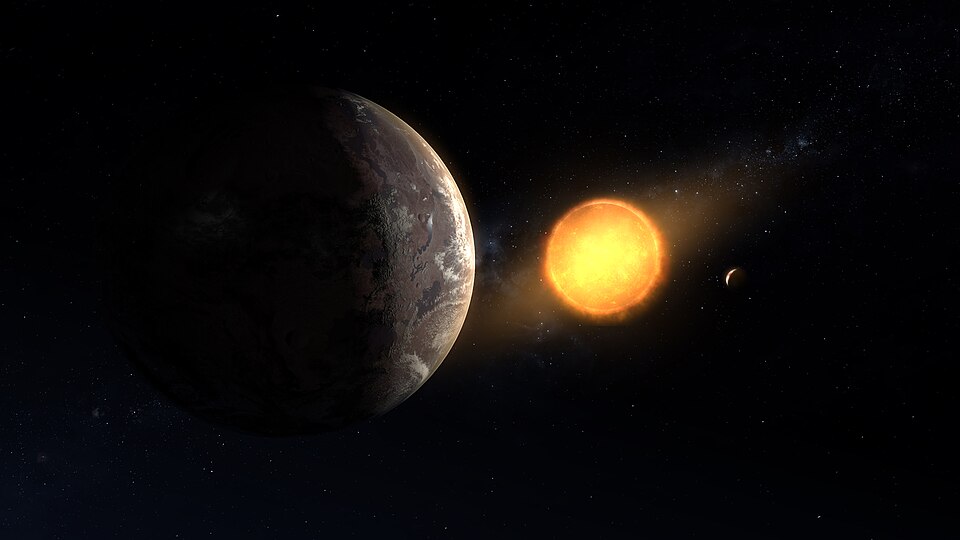

Kepler's statistical legacy is even more important than its individual discoveries. Analysis of Kepler's planet catalog revealed that small planets are far more common than large ones, that approximately one in five Sun-like stars harbours an Earth-sized planet in the habitable zone, and that the galaxy contains a population of planets between Earth and Neptune in size — super-Earths and mini-Neptunes — that have no analogue in the Solar System.5, 9 These findings established that planetary systems are the norm rather than the exception in the Milky Way.
The Transiting Exoplanet Survey Satellite (TESS), launched by NASA in April 2018, was designed to complement Kepler by surveying the entire sky rather than a single field. TESS monitors bright, nearby stars for transiting planets, prioritizing targets amenable to follow-up observations including radial velocity mass measurements and atmospheric characterization with the James Webb Space Telescope. By dividing the sky into overlapping sectors observed for 27 days each, TESS has identified thousands of planet candidates orbiting stars within a few hundred light-years of the Sun, including numerous small planets around M-dwarf stars.6
The diversity of exoplanet types
One of the most striking revelations of the exoplanet era is the sheer diversity of planets, many of which have no counterpart in the Solar System. The classification of exoplanets is based primarily on their mass, radius, density, and orbital characteristics, though the boundaries between categories remain subjects of active investigation.17
Hot Jupiters were the first exoplanet type discovered because their large masses and short orbital periods produce the strongest radial velocity and transit signals. These gas giants, with masses comparable to or exceeding Jupiter's, orbit their host stars at distances of less than 0.1 astronomical units, completing an orbit in just a few days. Their existence at such close separations was a profound surprise, as giant planets in the Solar System orbit far from the Sun. The leading explanation is orbital migration: hot Jupiters are thought to form beyond the ice line, where solid material is abundant, and then migrate inward through gravitational interactions with the protoplanetary disk or through dynamical scattering followed by tidal circularization.16 Despite their prominence in discovery statistics, hot Jupiters are actually rare, occurring around roughly 1 percent of Sun-like stars.17
Super-Earths and mini-Neptunes dominate the exoplanet census. Super-Earths are planets with masses between approximately 1 and 10 Earth masses and radii up to about 1.6 Earth radii, generally thought to be rocky or to possess thin atmospheres. Mini-Neptunes are slightly larger, with radii of roughly 1.6 to 4 Earth radii, and are believed to retain substantial hydrogen-helium envelopes or water-rich compositions.13, 22 Kepler data revealed a striking gap in the radius distribution of small planets at approximately 1.5 to 2.0 Earth radii — the so-called radius valley — separating a population of smaller, denser rocky worlds from a population of larger, lower-density volatile-rich worlds. This bimodality is attributed to atmospheric mass loss: planets that begin with thin hydrogen envelopes can be stripped by stellar radiation (photoevaporation) or heat from their cooling rocky cores (core-powered mass loss), producing bare rocky cores below the gap, while those with thicker envelopes retain their gas and remain above it.13
Exoplanet radius distribution showing the radius valley13
The habitable zone
The habitable zone is the region around a star where the surface temperature of a rocky planet could permit the existence of liquid water, widely considered a prerequisite for life as we know it. The concept was formalized by James Kasting, Daniel Whitmire, and Ray Reynolds in 1993, who calculated the inner and outer boundaries of the habitable zone based on climate models incorporating the carbonate-silicate cycle, water-vapour feedback, and CO2 condensation.15 For a star with the Sun's luminosity, the habitable zone extends from approximately 0.95 to 1.67 astronomical units, though the precise boundaries depend on assumptions about atmospheric composition, cloud cover, and planetary geophysics.
The habitable zone is not a guarantee of habitability. A planet within the habitable zone may be inhospitable if it lacks an atmosphere, possesses a runaway greenhouse climate, or is tidally locked with extreme temperature contrasts between its dayside and nightside. Conversely, worlds outside the traditional habitable zone might sustain liquid water through tidal heating, as may be the case for the subsurface oceans of Jupiter's moon Europa and Saturn's moon Enceladus. Nevertheless, the habitable zone remains the primary organizing concept for prioritizing targets in the search for potentially life-bearing exoplanets.15, 14
The habitable zones of M-dwarf stars — red dwarfs, the most numerous stars in the galaxy — are much closer to the star than the Sun's habitable zone, because M dwarfs are cooler and less luminous. Planets in these zones are easier to detect via the transit and radial velocity methods because of the shorter orbital periods and larger signal-to-star ratios involved. However, M-dwarf habitable zone planets face challenges including intense stellar flares, strong tidal forces leading to synchronous rotation, and high levels of ultraviolet and X-ray radiation that may strip planetary atmospheres.18
Atmospheric characterization with JWST
The James Webb Space Telescope (JWST), launched in December 2021, has inaugurated a new era in exoplanet science by enabling detailed spectroscopic analysis of exoplanet atmospheres. When a transiting planet passes in front of its host star, a fraction of the starlight filters through the planet's atmosphere, and different atmospheric molecules absorb light at characteristic wavelengths.
By comparing the transit depth at many wavelengths — a technique called transmission spectroscopy — astronomers can identify the chemical composition of the planet's atmosphere.12
Among JWST's earliest exoplanet results was the unambiguous detection of carbon dioxide in the atmosphere of WASP-39 b, a hot Saturn-mass planet. This marked the first definitive identification of CO2 in an exoplanet atmosphere and demonstrated JWST's ability to detect molecular features with high signal-to-noise ratios across its near- and mid-infrared instruments.12 Subsequent observations have detected water vapour, sulfur dioxide, and other molecules in the atmospheres of a growing sample of giant and sub-Neptune exoplanets.
Perhaps the most tantalizing JWST result to date concerns K2-18 b, a sub-Neptune planet orbiting in the habitable zone of an M-dwarf star. Earlier observations with the Hubble Space Telescope had detected water vapour in its atmosphere.19 JWST transmission spectroscopy subsequently revealed carbon dioxide and methane in K2-18 b's atmosphere, along with a tentative detection of dimethyl sulfide (DMS), a molecule produced predominantly by biological processes on Earth.20 The DMS detection remains unconfirmed and requires additional observations, but it illustrates how JWST is beginning to probe the atmospheric compositions of smaller, temperate worlds where biosignature gases might plausibly be present.
Planetary system architectures
The discovery of thousands of multi-planet systems has revealed that planetary architectures are remarkably diverse and that the Solar System's orderly arrangement — small rocky planets close in, gas and ice giants far out, low eccentricities, and low mutual inclinations — is just one possible configuration. Many exoplanetary systems violate one or more of these patterns.17
Some systems contain giant planets on highly eccentric orbits that would destabilize the circular, coplanar arrangement found in the Solar System. Others harbour multiple closely spaced planets in chains of mean-motion resonances, suggesting smooth inward migration through the protoplanetary disk. The Kepler multi-planet systems are typically compact, with several planets orbiting within the equivalent of Mercury's distance from the Sun, and they tend to exhibit a pattern of size uniformity — planets within a given system are more similar in size to each other than to randomly drawn planets from the overall population, a phenomenon described as the "peas in a pod" pattern.17, 22
The comparison between exoplanetary systems and the Solar System has clarified that planetary migration is a common and perhaps ubiquitous process. The Solar System may have undergone its own period of giant-planet migration, as proposed by the Nice model, but the extent and timing of that migration appear modest compared to the dramatic orbital rearrangements evident in systems with hot Jupiters or resonant chains. Understanding why the Solar System arrived at its particular architecture — and whether that architecture is necessary for long-term habitability — remains an open question in planetary science.16, 21
The frequency of Earth-like planets
One of the central goals of exoplanet science is to determine eta-Earth (η⊕): the fraction of Sun-like stars that harbour a roughly Earth-sized planet in the habitable zone. This quantity sets the scale for the number of potentially habitable worlds in the galaxy and informs the design of future missions aimed at characterizing their atmospheres.
Estimates of eta-Earth have converged over the past decade but remain subject to significant uncertainties depending on the definitions of "Earth-sized" and "habitable zone" adopted. An influential analysis of Kepler data by Petigura, Howard, and Marcy in 2013 estimated that 22 percent of Sun-like stars host an Earth-sized planet (1 to 2 Earth radii) receiving between one-quarter and four times Earth's incident stellar flux, yielding an eta-Earth of approximately 0.22 with a range from 0.11 to 0.36 at the 95 percent confidence level.9 For M-dwarf stars, which are far more numerous than Sun-like stars, Dressing and Charbonneau estimated an occurrence rate of 0.16 to 0.24 Earth-sized planets per star in the conservative habitable zone, and 0.24 to 0.44 in the optimistic habitable zone.18
If even the conservative estimates are correct, the implications are extraordinary. The Milky Way contains on the order of 100 to 400 billion stars, of which roughly 70 percent are M dwarfs and approximately 10 percent are roughly Sun-like (F, G, and K spectral types). An eta-Earth of 0.1 to 0.2 for Sun-like stars alone would imply billions of potentially habitable rocky planets in the galaxy.9, 18 Whether any of these worlds actually support life depends on factors far beyond orbital placement, including atmospheric composition, magnetic field strength, geological activity, and the stochastic history of impacts and stellar evolution.
Biosignature gases
A biosignature gas is an atmospheric constituent whose presence, abundance, or combination with other gases would be difficult to explain without the involvement of biological processes. The search for biosignatures in exoplanet atmospheres represents one of the most ambitious goals of modern astronomy and requires both the ability to detect trace gases spectroscopically and the theoretical framework to interpret their significance.14
Molecular oxygen (O2) and its photochemical product ozone (O3) are the most widely discussed biosignature gases, because on Earth, virtually all atmospheric O2 is produced by oxygenic photosynthesis, and no known abiotic process can sustain Earth-level O2 concentrations in a planet's atmosphere over geological timescales. However, theoretical work has identified scenarios in which abiotic O2 accumulation is possible — for example, through photolysis of water vapour followed by hydrogen escape on planets orbiting active M-dwarf stars — meaning that O2 alone would not constitute definitive evidence for life.14
For this reason, the concept of biosignature evaluation has shifted toward the detection of atmospheric disequilibrium: the simultaneous presence of gases that would react and destroy each other in the absence of a continuous biological source. The coexistence of O2 and methane (CH4) in Earth's atmosphere, for instance, represents a profound thermodynamic disequilibrium maintained by the biosphere. Detecting a similar combination in an exoplanet atmosphere would be far more compelling than detecting either gas alone.14 Other proposed biosignature gases include nitrous oxide (N2O), phosphine (PH3), and dimethyl sulfide, each of which is produced by biological processes on Earth and has limited known abiotic sources.
Notable exoplanetary systems
.jpg)
.jpg)
51 Pegasi b, discovered in 1995 by Mayor and Queloz, was the first exoplanet found orbiting a main-sequence star. With a minimum mass of approximately half that of Jupiter and an orbital period of just 4.23 days, 51 Pegasi b — informally known as "Dimidium" — was the prototype of the hot Jupiter class and overturned prevailing theories of planet formation that had predicted gas giants could only exist far from their stars. The discovery launched the modern era of exoplanet science and was recognised with the Nobel Prize in Physics in 2019.1, 23
The TRAPPIST-1 system, announced in 2017, contains seven roughly Earth-sized planets orbiting an ultracool M-dwarf star just 12.5 parsecs (approximately 40 light-years) from Earth. All seven planets transit their host star, enabling precise measurements of their radii, and transit-timing variations have yielded mass estimates, revealing densities consistent with rocky compositions. Three of the seven planets — TRAPPIST-1 e, f, and g — orbit within or near the star's habitable zone, making this system a prime target for atmospheric characterization with JWST.11 Early JWST observations have begun to constrain the atmospheric properties of the innermost TRAPPIST-1 planets, though confirming the presence of substantial atmospheres on any of these worlds remains an ongoing effort.
Proxima Centauri b, discovered in 2016 via the radial velocity method, orbits the nearest star to the Sun at a distance of just 1.3 parsecs (approximately 4.2 light-years). The planet has a minimum mass of approximately 1.3 Earth masses and orbits within the habitable zone of its host star, a low-mass M dwarf, with a period of 11.2 days.10 The proximity of Proxima Centauri b makes it a compelling target for future characterization, though the planet does not transit its star from Earth's line of sight, limiting the atmospheric observations possible with current technology. The intense flare activity of Proxima Centauri raises questions about whether the planet can retain an atmosphere conducive to surface habitability.
Selected notable exoplanet discoveries1, 10, 11
| Planet | Year | Method | Mass / radius | Significance |
|---|---|---|---|---|
| PSR B1257+12 b, c | 1992 | Pulsar timing | ~4.3, ~3.9 M⊕ | First confirmed exoplanets |
| 51 Pegasi b | 1995 | Radial velocity | ≥0.47 MJ | First exoplanet around Sun-like star |
| HD 209458 b | 1999 | Transit | 1.38 RJ | First transiting exoplanet |
| HR 8799 b, c, d, e | 2008 | Direct imaging | 5–10 MJ | First directly imaged multi-planet system |
| Proxima Centauri b | 2016 | Radial velocity | ≥1.3 M⊕ | Nearest known exoplanet |
| TRAPPIST-1 e, f, g | 2017 | Transit | 0.77–1.15 R⊕ | Temperate Earth-sized planets in one system |
The pace of exoplanet discovery and characterization continues to accelerate. Future missions, including the European Space Agency's PLATO and ARIEL spacecraft and proposed NASA concepts such as the Habitable Worlds Observatory, aim to detect and spectroscopically characterize Earth-like planets around nearby Sun-like stars. The ultimate goal — the detection of unambiguous biosignatures in the atmosphere of a habitable-zone terrestrial exoplanet — remains one of the defining scientific challenges of the twenty-first century.14, 21
References
Gravitational microlensing as a method of detecting disk dark matter and faint disk stars
Seven temperate terrestrial planets around the nearby ultracool dwarf star TRAPPIST-1
Revised estimates of the occurrence rate of terrestrial planets in the habitable zones around Kepler M dwarfs
The formation and evolution of planetary systems: placing our Solar System in context
Masses, radii, and orbits of small Kepler planets: the transition from gaseous to rocky planets