Overview
- The habitable zone is the circumstellar region around a star where an Earth-like planet with a CO2-H2O-N2 atmosphere could sustain liquid water on its surface, and its boundaries are set by the runaway greenhouse effect on the inner edge and the maximum greenhouse warming of CO2 on the outer edge.
- Modern one-dimensional climate models place the habitable zone of the Sun between approximately 0.99 and 1.70 astronomical units, though three-dimensional general circulation models, variations in planetary mass and atmospheric composition, and alternative greenhouse gases like molecular hydrogen can substantially widen or shift these boundaries.
- Kepler and TESS transit surveys indicate that roughly 20 to 50 percent of Sun-like and M-dwarf stars host at least one rocky planet within their habitable zones, and the concept has been extended to galactic scales, identifying an annular region of the Milky Way between 7 and 9 kiloparsecs from the center where conditions favor the emergence of complex life.
The habitable zone is the region around a star within which a planet with a suitable atmosphere could maintain liquid water on its surface. Because liquid water is considered a prerequisite for life as it is understood on Earth, the habitable zone has become a central organizing concept in astrobiology and exoplanet science, guiding the selection of observational targets and framing debates about the prevalence of habitable worlds in the galaxy. The concept was first articulated by the Chinese-American astronomer Su-Shu Huang in 1959, who used the term "ecosphere" to describe the range of orbital distances around a star where surface temperatures would permit liquid water, and it was placed on a quantitative physical foundation by James Kasting, Daniel Whitmire, and Ray Reynolds in a landmark 1993 paper that remains the standard reference in the field.1, 3
The boundaries of the habitable zone are not fixed lines in space but depend on the luminosity and spectral type of the host star, the mass and atmospheric composition of the planet, and the efficiency of climate feedback mechanisms such as the carbonate-silicate weathering cycle. Determining where these boundaries lie, what kinds of planets can be habitable within them, and how the zone shifts as a star evolves are questions that draw on atmospheric physics, geochemistry, stellar astrophysics, and planetary dynamics, making the habitable zone one of the most interdisciplinary concepts in modern astronomy.3, 9
Historical development
The idea that there is a limited range of distances from a star that could support life has roots extending back at least to the nineteenth century, but it was Huang's 1959 paper "Occurrence of Life in the Universe" that first formalized the concept for modern astrophysics. Huang defined the habitable zone (which he called the "ecosphere") as the circumstellar region where a planet could have a surface temperature suitable for liquid water, and he noted that the zone's width depended on the luminosity of the star: brighter stars would have wider, more distant habitable zones, while dimmer stars would have narrower zones closer in.1 Huang also recognized that only stars with sufficiently long main-sequence lifetimes, on the order of billions of years, would provide a stable environment for life to evolve, effectively excluding the hottest and most luminous spectral types.
In 1979, Michael Hart undertook the first quantitative modeling of the habitable zone using a one-dimensional climate model that tracked the evolution of Earth's atmosphere over geological time. Hart introduced the concept of the continuously habitable zone (CHZ), defined as the range of orbital distances at which a planet would remain habitable throughout the entire main-sequence lifetime of its host star, accounting for the star's gradual increase in luminosity. His results were discouraging: for the Sun, Hart calculated a continuously habitable zone only 0.05 astronomical units wide, extending from about 0.958 to 1.004 AU, implying that Earth's habitability was a razor-thin coincidence.2
This extremely narrow estimate was revised dramatically by Kasting, Whitmire, and Reynolds in 1993. Their one-dimensional radiative-convective climate model incorporated a more sophisticated treatment of the greenhouse effect, infrared absorption by water vapour and carbon dioxide, and the negative feedback provided by the carbonate-silicate weathering cycle. The inner edge of the habitable zone was set by the onset of a runaway greenhouse effect, in which rising temperatures cause the oceans to evaporate completely, loading the atmosphere with water vapour that absorbs outgoing infrared radiation and drives further warming. The outer edge was set by the maximum greenhouse limit, the point beyond which adding more CO2 to the atmosphere no longer increases surface temperatures because the increased reflectivity (albedo) of CO2 ice clouds offsets additional greenhouse warming.3 For the present-day Sun, Kasting and colleagues estimated a habitable zone extending from approximately 0.95 to 1.37 AU using conservative boundaries, or from about 0.75 to 1.77 AU using more optimistic empirical limits known as "recent Venus" and "early Mars," based on the observation that Venus may have had liquid water as recently as 1 billion years ago and Mars appears to have had surface water approximately 3.8 billion years ago.3
Physical boundaries of the habitable zone
The inner and outer edges of the habitable zone are defined by distinct physical processes that set upper and lower limits on the stellar radiation a planet can receive while maintaining surface liquid water.
At the inner edge, the critical process is the runaway greenhouse effect. As a planet orbiting closer to its star receives more stellar flux, its surface temperature rises, increasing the rate of ocean evaporation. Water vapour is a potent greenhouse gas, and the additional atmospheric water vapour traps more outgoing infrared radiation, raising the temperature further and evaporating still more water in a self-reinforcing positive feedback loop. Andrew Ingersoll demonstrated in 1969 that above a critical solar flux, this feedback becomes irreversible: the oceans evaporate entirely, the planet enters a state of extreme greenhouse warming, and the water vapour in the upper atmosphere is photodissociated by ultraviolet radiation, with the liberated hydrogen escaping to space.7 This is the process thought to have stripped Venus of whatever water it once possessed. Before the full runaway is triggered, a planet may enter a moist greenhouse state in which the stratosphere becomes saturated with water vapour, permitting substantial hydrogen escape even while surface liquid water persists. The moist greenhouse limit is slightly farther from the star than the full runaway limit and represents the conservative inner boundary of the habitable zone.3, 9
At the outer edge, the limiting factor is the diminishing ability of greenhouse gases to compensate for reduced stellar heating. As a planet orbits farther from its star, it receives less radiation, and its surface temperature drops. On a planet with an active carbonate-silicate cycle, lower temperatures reduce the rate of silicate weathering, which normally draws CO2 out of the atmosphere. As weathering slows, volcanic outgassing causes atmospheric CO2 to accumulate, strengthening the greenhouse effect and partially compensating for the reduced stellar flux.6 However, there is a limit to how much warming CO2 can provide. At very high CO2 concentrations, Rayleigh scattering of incoming sunlight by the dense atmosphere begins to reflect more energy back to space, and CO2 condensation into clouds that also scatter sunlight further limits warming. The point at which maximum CO2 greenhouse warming is reached defines the outer edge of the habitable zone.3, 4
In 2013, Kopparapu and collaborators updated the Kasting model with improved absorption coefficients for water vapour and carbon dioxide derived from the HITRAN 2008 and HITEMP 2010 spectral databases. Their revised estimates placed the inner edge of the habitable zone at approximately 0.99 AU and the outer edge at approximately 1.70 AU for the present-day Sun, somewhat wider than the 1993 conservative estimates but narrower than the empirical limits.4 These updated boundaries have become the standard reference values used in much of the subsequent literature on habitable zone calculations.
The carbonate-silicate weathering thermostat
A key assumption in habitable zone calculations is that an Earth-like planet possesses a negative feedback mechanism that stabilizes its climate over geological timescales. The carbonate-silicate weathering cycle, first described by James Walker, Paul Hays, and James Kasting in 1981, provides this thermostat.6 In this cycle, atmospheric CO2 dissolves in rainwater to form carbonic acid, which reacts with silicate minerals on the planet's surface, releasing calcium and bicarbonate ions that are transported by rivers to the oceans. There, marine organisms and abiotic precipitation incorporate these ions into carbonate minerals such as calcium carbonate (CaCO3), which are deposited on the seafloor. Over millions of years, plate tectonics carries the carbonate sediments into subduction zones, where heat and pressure release the CO2 back into the atmosphere through volcanic degassing, completing the cycle.
The feedback operates because the rate of silicate weathering is strongly temperature-dependent. If the planet warms, weathering accelerates, drawing down atmospheric CO2 and reducing the greenhouse effect, which cools the planet. If the planet cools, weathering slows, CO2 accumulates from continued volcanic outgassing, and the strengthened greenhouse effect warms the planet again.6, 9 This mechanism is thought to have maintained Earth's surface temperature within a range compatible with liquid water for at least 3.5 billion years, despite the Sun having been approximately 30 percent less luminous early in its history, a puzzle known as the "faint young Sun problem."
The carbonate-silicate thermostat is central to the habitable zone concept because it dramatically widens the range of orbital distances at which liquid water can persist. Without it, a planet at the outer reaches of the habitable zone would freeze permanently, and small perturbations to stellar luminosity or planetary albedo would push a planet irreversibly toward either runaway glaciation or runaway greenhouse warming. The existence of this feedback is the primary reason the Kasting model yields a habitable zone many times wider than Hart's 1979 estimate.2, 3 However, the thermostat requires both plate tectonics to recycle carbonate sediments and active volcanism to supply CO2, raising the question of whether planets lacking these geological processes can maintain long-term habitability.
Dependence on stellar type
The habitable zone shifts in both distance and width depending on the luminosity and spectral energy distribution of the host star. More luminous stars push the habitable zone farther out, while less luminous stars draw it inward. Because stellar luminosity scales roughly as the fourth power of stellar mass for main-sequence stars, the habitable zone around a bright F-type star with twice the Sun's mass lies several AU from the star, while the habitable zone around a dim M-type red dwarf with one-tenth the Sun's mass may lie within 0.1 to 0.3 AU.3, 4
The spectral energy distribution of the star also matters. Cooler M dwarfs emit a larger fraction of their radiation at near-infrared wavelengths, where water vapour and carbon dioxide absorb more efficiently. This means that a given level of greenhouse warming requires less atmospheric opacity around an M dwarf than around a hotter star, and the habitable zone is correspondingly somewhat wider in terms of the range of incident stellar fluxes that permit habitable surface conditions.4, 11 Conversely, hotter F- and A-type stars emit more ultraviolet radiation, which can drive more rapid photodissociation of water in the upper atmosphere, potentially shrinking the effective habitable zone by enhancing atmospheric water loss.
Habitable zone boundaries by stellar type4, 5
| Spectral type | Teff (K) | Inner edge (AU) | Outer edge (AU) | HZ width (AU) |
|---|---|---|---|---|
| F0 | 7,200 | 1.85 | 3.35 | 1.50 |
| G2 (Sun) | 5,780 | 0.99 | 1.70 | 0.71 |
| K5 | 4,400 | 0.49 | 0.92 | 0.43 |
| M2 | 3,500 | 0.23 | 0.44 | 0.21 |
| M5 | 3,000 | 0.11 | 0.22 | 0.11 |
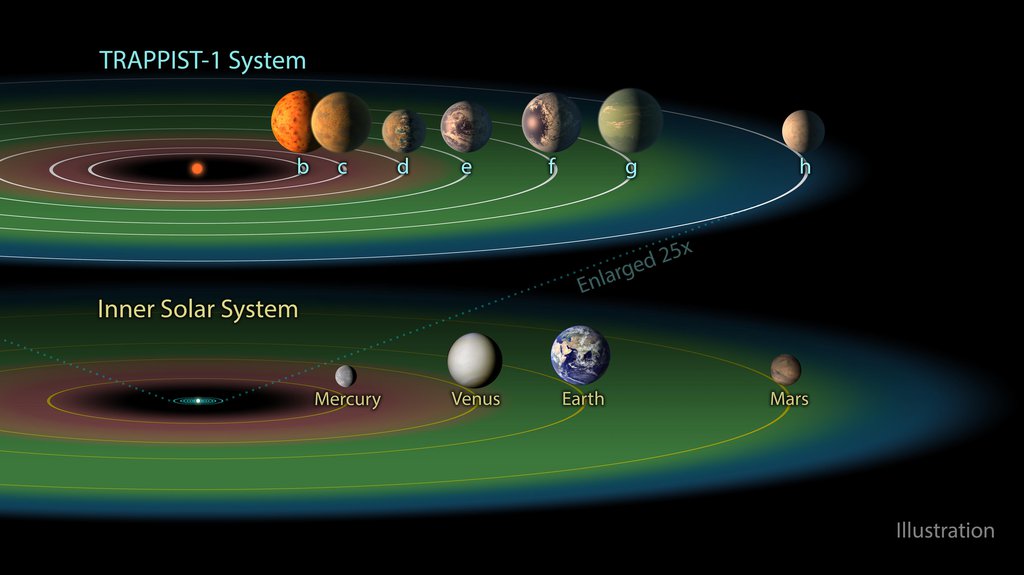
M dwarfs are of particular interest because they constitute approximately 75 percent of all stars in the Milky Way and have main-sequence lifetimes that far exceed the present age of the universe, providing an extremely long stable environment for biological evolution. However, the proximity of the habitable zone to the star in M-dwarf systems raises several concerns about habitability. Planets in the habitable zone of an M dwarf are likely to be tidally locked, presenting the same face to the star at all times, which was long thought to create extreme temperature contrasts between a scorched dayside and a frozen nightside that would freeze the atmosphere onto the dark hemisphere.11 Three-dimensional climate simulations have substantially alleviated this concern, showing that atmospheric heat transport by winds can distribute heat efficiently enough to prevent atmospheric collapse, and that thick cloud decks forming at the substellar point reflect enough starlight to keep dayside temperatures moderate.12
M dwarfs also tend to be highly magnetically active, especially during their first several hundred million to billion years, producing frequent and energetic stellar flares and strong ultraviolet and X-ray radiation that can erode planetary atmospheres. Whether a planet in the habitable zone of an M dwarf can retain its atmosphere against this bombardment long enough for life to emerge remains an open question and is one of the primary motivations for atmospheric characterization of planets in systems like TRAPPIST-1 and Proxima Centauri using the James Webb Space Telescope.11, 13, 14
Extensions beyond the classical habitable zone
The classical habitable zone, as defined by Kasting and refined by Kopparapu, assumes an Earth-like planet with a nitrogen-dominated atmosphere containing variable amounts of CO2 and water vapour. In reality, planetary atmospheres can differ radically from this template, and several lines of research have explored how alternative atmospheric compositions, greenhouse mechanisms, and energy sources can extend the range of potentially habitable conditions well beyond the classical boundaries.
In 2011, Raymond Pierrehumbert and Eric Gaidos showed that molecular hydrogen, if present in sufficient abundance, can act as a powerful greenhouse gas through collision-induced absorption, in which pairs of H2 molecules temporarily form a transient dipole that absorbs infrared radiation. A planet with a primordial hydrogen-helium atmosphere containing tens of bars of H2 could maintain surface temperatures above the freezing point of water at distances far beyond the outer edge of the classical habitable zone, potentially even in interstellar space without a host star.10 While such a thick hydrogen atmosphere would require a massive planet to retain against thermal escape, the work demonstrated that the habitable zone is not a fixed property of the star alone but depends critically on the planet's atmospheric inventory.
Sara Seager argued in 2013 that the traditional focus on CO2-H2O-N2 atmospheres may underestimate the diversity of habitable conditions. She noted that atmospheres dominated by hydrogen, by hydrogen and helium mixtures, or containing significant amounts of methane, ammonia, or other greenhouse gases could sustain liquid water at combinations of pressure and temperature that fall outside the classical habitable zone boundaries.17 These considerations are particularly relevant for sub-Neptune-mass planets, which are the most common type of planet in the galaxy and may possess thick hydrogen-rich envelopes overlying rocky or water-ice interiors.
Ramses Ramirez's 2018 review catalogued several additional extensions. Volcanic hydrogen outgassing on early Earth or Mars could have supplemented CO2 greenhouse warming, pushing the outer edge of the habitable zone farther from the star during periods of enhanced volcanic activity. CO2-CH4 atmospheres, in which methane provides additional infrared opacity in spectral windows where CO2 is transparent, can also extend the outer boundary. On the inner side, desert planets with limited surface water may resist the runaway greenhouse by restricting the amount of water vapour that can enter the atmosphere, potentially remaining habitable at stellar fluxes well above the moist greenhouse limit for a water-rich world.21
Three-dimensional climate modeling
The classical habitable zone boundaries were calculated using one-dimensional radiative-convective models that represent the atmosphere as a single vertical column and do not account for the horizontal transport of heat by atmospheric and oceanic circulation, the formation and distribution of clouds, or the effects of rotation rate and land-ocean distribution on climate. Beginning in the 2010s, three-dimensional general circulation models (GCMs) originally developed for terrestrial weather forecasting and climate projection were adapted to simulate the climates of hypothetical exoplanets, revealing that several processes absent from one-dimensional models can significantly alter the boundaries of habitability.
A landmark study by Leconte and colleagues in 2013 used a three-dimensional GCM to model the onset of the runaway greenhouse on slowly rotating Earth-like planets. Their simulations showed that the large-scale atmospheric circulation, particularly the descending branches of the Hadley cells in the subtropics, creates regions of unsaturated air that radiate heat to space more efficiently than a fully saturated atmosphere. This dynamic drying effect raises the threshold stellar flux required to trigger a runaway greenhouse, pushing the inner edge of the habitable zone closer to the star than one-dimensional models predict.8 For an Earth-like planet orbiting a Sun-like star, Leconte and colleagues estimated that the absorbed stellar flux threshold for triggering a runaway greenhouse was approximately 375 watts per square metre, substantially higher than the approximately 280 to 310 watts per square metre estimated by earlier one-dimensional models based on the Simpson-Nakajima limit.
For tidally locked planets orbiting M dwarfs, three-dimensional models have been equally revealing. Yang, Cowan, and Abbot demonstrated in 2013 that thick water clouds form preferentially over the substellar point, where intense heating drives strong convective updrafts. These clouds reflect a substantial fraction of the incoming starlight back to space, producing a stabilizing negative feedback: as the stellar flux increases, stronger convection produces thicker and more reflective clouds, keeping the surface temperature below the runaway threshold. This cloud feedback effectively doubles the stellar flux at which a tidally locked planet enters a runaway greenhouse compared to cloud-free estimates, dramatically expanding the inner edge of the habitable zone for planets around M dwarfs.12
These three-dimensional results underscore that the habitable zone is not a sharp-edged annulus but a probabilistic region whose boundaries depend on planetary properties that are, in many cases, not yet observable. A slowly rotating planet with a large ocean may have a wider habitable zone than a rapidly rotating desert world; a planet with a thick atmosphere may have a different inner edge than one with a thin atmosphere. The one-dimensional boundaries calculated by Kasting and Kopparapu remain valuable as first-order estimates and as a common reference frame, but the true range of habitable conditions is likely broader and more complex than any single set of boundaries can capture.4, 8, 12
Occurrence rates of habitable-zone planets
One of the central questions that the habitable zone concept was developed to address is: how common are potentially habitable planets? The Kepler space telescope, which observed more than 150,000 stars continuously from 2009 to 2018, provided the first statistically meaningful answer. By counting the number of transiting planets detected in different size and orbital period bins and correcting for the geometric probability of transit and the completeness of the detection pipeline, several groups estimated the occurrence rate of Earth-sized planets in the habitable zones of their host stars.
Petigura, Howard, and Marcy analyzed Kepler data for Sun-like (G- and K-type) stars in 2013 and found that approximately 22 percent of these stars host an Earth-sized planet (1 to 2 Earth radii) receiving between one-quarter and four times the stellar flux that Earth receives from the Sun. Restricting to the more conservative habitable zone, they estimated that 5.7 percent (+1.7/-2.2 percent) of Sun-like stars harbor an Earth-sized planet in the habitable zone with orbital periods between 200 and 400 days.15 Given the roughly 40 billion Sun-like stars in the Milky Way, this implies billions of potentially habitable rocky worlds orbiting Sun-like stars in our galaxy alone.
For M dwarfs, the occurrence rates appear to be even higher. Dressing and Charbonneau used the full four-year Kepler dataset in 2015 to estimate that M dwarfs host an average of 0.16 Earth-sized planets and 0.12 super-Earths per star within the conservative habitable zone. Using the more generous empirical habitable zone boundaries, these numbers rise to 0.24 Earth-sized planets and 0.21 super-Earths per M dwarf.16 Since M dwarfs vastly outnumber Sun-like stars, these rates suggest that the nearest habitable-zone rocky planet may orbit an M dwarf within a few parsecs of the Sun.
Expected number of rocky planets per star in the habitable zone15, 16
These occurrence rates carry significant uncertainties, particularly for longer-period planets where Kepler's sensitivity diminishes, and they depend on the adopted habitable zone boundaries, the definition of "Earth-sized," and the completeness corrections applied to the transit survey. Nonetheless, the basic conclusion is robust: rocky planets in the habitable zones of main-sequence stars are not rare. The galaxy hosts tens of billions of such worlds, and several are likely to be found within the nearest stellar neighborhoods as transit and radial velocity surveys continue to improve in sensitivity.15, 16
Key habitable-zone planetary systems
Several specific planetary systems have become focal points for the study of habitable-zone planets, either because of their proximity to the Sun or because of the number and arrangement of potentially habitable worlds they contain.
The TRAPPIST-1 system, located approximately 12 parsecs (39 light-years) from the Sun, contains seven roughly Earth-sized planets orbiting an ultracool M dwarf with a mass only 9 percent that of the Sun. The planets, designated TRAPPIST-1b through TRAPPIST-1h, are packed into a compact orbital configuration with periods ranging from 1.5 to approximately 19 days, and at least three of them (TRAPPIST-1e, f, and g) orbit within the habitable zone of the star as defined by the Kopparapu boundaries.13 The system's proximity, the Earth-like sizes of its planets, and the favorable transit geometry have made it one of the highest-priority targets for atmospheric characterization with the James Webb Space Telescope. Early JWST observations of the innermost planets have so far failed to detect a substantial atmosphere on TRAPPIST-1b and TRAPPIST-1c, consistent with atmospheric erosion by the star's intense ultraviolet radiation, but observations of the habitable-zone planets are ongoing.13
Proxima Centauri b, discovered in 2016 through radial velocity measurements, orbits the nearest star to the Sun at a distance of only 1.3 parsecs (4.24 light-years). The planet has a minimum mass of approximately 1.3 Earth masses and orbits within the habitable zone of its M-dwarf host with a period of approximately 11.2 days.14 Its proximity makes it a prime target for future direct-imaging missions, though the high magnetic activity of Proxima Centauri raises questions about atmospheric retention.
K2-18 b, a sub-Neptune-mass planet approximately 34 parsecs from the Sun orbiting in the habitable zone of an M dwarf, has drawn attention because of spectroscopic detections of atmospheric molecules. Observations with the Hubble Space Telescope in 2019 detected water vapour in its atmosphere, and subsequent JWST observations in 2023 identified carbon dioxide and methane, along with a tentative detection of dimethyl sulfide, a molecule produced by phytoplankton on Earth.22, 23 K2-18 b has been proposed as a candidate "hycean" world, a planet with a hydrogen-rich atmosphere overlying a global liquid water ocean, though whether such a world is truly habitable remains debated. The JWST atmospheric detections represent the first steps toward characterizing the atmospheric composition of habitable-zone planets and searching for potential biosignature gases.23, 24
The galactic habitable zone
The concept of a habitable zone has been extended from the circumstellar scale to the galactic scale. In 2001, Guillermo Gonzalez, Donald Brownlee, and Peter Ward proposed the galactic habitable zone (GHZ), an annular region of the Milky Way where conditions are most favorable for the development of complex life on terrestrial planets.19 The GHZ is defined by the intersection of several requirements: sufficient metallicity to form rocky planets (which favors the inner galaxy, where stars are more metal-rich due to a longer history of nucleosynthesis), a low enough rate of sterilizing events such as supernovae and gamma-ray bursts (which favors the outer galaxy, where the stellar density is lower), and sufficient time for biological evolution to produce complex organisms.
Lineweaver, Fenner, and Gibson refined the GHZ concept in 2004 using a detailed model of the chemical evolution of the Milky Way. They identified the GHZ as an annular region between approximately 7 and 9 kiloparsecs from the galactic center (the Sun lies at approximately 8.2 kiloparsecs) that widens with time, composed of stars that formed between approximately 8 and 4 billion years ago.20 Stars that formed much earlier lacked the heavy elements necessary to build rocky planets, while stars in the innermost regions of the galaxy are exposed to excessive radiation from the dense stellar environment. Their model estimated that approximately 10 percent of all stars ever formed in the Milky Way have had the conditions necessary for the emergence of complex life, with the peak probability occurring at roughly the Sun's galactocentric distance and at approximately the Sun's age.
The galactic habitable zone remains a more speculative and less precisely defined concept than the circumstellar habitable zone. The exact metallicity threshold for forming Earth-like planets, the sterilization radius of supernovae and gamma-ray bursts, and the timescale required for biological evolution are all uncertain. Nonetheless, the GHZ provides a useful framework for understanding why the solar system's position in the galaxy may be relevant to the emergence of life and for prioritizing regions of the galaxy in the long-term search for inhabited worlds.19, 20
Biosignatures and the search for life
The habitable zone serves as a targeting criterion for the search for life beyond Earth, but the presence of a planet within the habitable zone establishes only that liquid water is physically possible, not that life exists. Determining whether a habitable-zone planet actually supports life requires the detection of biosignatures, observable indicators of biological activity that can be measured remotely through spectroscopy of the planet's atmosphere or surface.
The most widely discussed atmospheric biosignature is molecular oxygen (O2) and its photochemical product ozone (O3). On Earth, virtually all atmospheric oxygen is produced by oxygenic photosynthesis, and the coexistence of O2 with thermodynamically incompatible reduced gases such as methane (CH4) creates a state of chemical disequilibrium that is maintained only by the continuous metabolic activity of the biosphere.18 Detecting O2 or O3 alongside CH4 in the atmosphere of a habitable-zone planet would constitute strong, though not conclusive, evidence for biological activity. However, abiotic processes such as photodissociation of water vapour and CO2 can also produce O2 under certain planetary conditions, particularly around M dwarfs with strong ultraviolet emission, making it essential to evaluate biosignature detections in the context of the full planetary environment.18
Other candidate biosignatures include nitrous oxide (N2O), produced primarily by microbial denitrification on Earth; phosphine (PH3), which has no known abiotic source in rocky-planet atmospheres; dimethyl sulfide (C2H6S), a product of marine phytoplankton; and the spectral signature of a vegetation "red edge," the sharp increase in reflectivity at near-infrared wavelengths produced by the chlorophyll in photosynthetic organisms.18 The tentative detection of dimethyl sulfide in the atmosphere of K2-18 b by JWST, while requiring confirmation, illustrates how rapidly the field is moving from theoretical speculation to observational testing.23
The James Webb Space Telescope has inaugurated the era of atmospheric characterization for habitable-zone planets by detecting CO2 in the atmosphere of the hot gas giant WASP-39b and measuring the atmospheric properties of TRAPPIST-1 system planets.24 Future missions, including proposed concepts such as the Habitable Worlds Observatory, are designed specifically to directly image Earth-like planets in the habitable zones of nearby Sun-like stars and obtain spectra of their atmospheres with sufficient sensitivity to detect O2, O3, H2O, CH4, and CO2 at Earth-like abundances. The habitable zone concept, despite its simplifications, provides the essential first filter that makes this vast observational challenge tractable: by focusing on the narrow annulus of orbital space where liquid water is thermodynamically possible, astronomers can prioritize the targets most likely to yield a detection of extraterrestrial life.17, 18
Limitations and future directions
The habitable zone concept, for all its utility, is an approximation that rests on several assumptions that may prove too restrictive or too permissive as understanding of planetary habitability deepens. The classical formulation assumes that liquid water on a planet's surface is the relevant criterion for life, but substantial bodies of liquid water exist beneath the surfaces of Solar System moons such as Europa and Enceladus, maintained by tidal heating rather than stellar radiation, well outside the habitable zone of the Sun. If subsurface oceans can host life, then the fraction of potentially habitable worlds in the galaxy is far larger than the surface-water habitable zone alone would suggest.17
The classical habitable zone also assumes a CO2-H2O-N2 atmosphere regulated by the carbonate-silicate cycle, but planets without plate tectonics, without oceans, or with exotic atmospheric compositions may still be habitable through alternative mechanisms. Conversely, a planet that falls within the habitable zone may be rendered uninhabitable by factors not captured in the one-dimensional climate models: the absence of a magnetic field to shield the atmosphere from stellar wind erosion, a catastrophic impact history, a composition too volatile-poor to sustain an atmosphere, or a runaway greenhouse triggered by the tidal heating of a planet in a tight orbit around its star.9, 21
The concept also evolves on stellar evolutionary timescales. As a main-sequence star ages, its luminosity gradually increases, pushing the habitable zone outward. A planet that begins its history near the outer edge of the habitable zone may eventually find itself in the center, while a planet initially near the inner edge may be pushed into a runaway greenhouse state. The Earth, for example, will be rendered uninhabitable by the Sun's increasing luminosity in approximately 1 to 2 billion years, well before the Sun leaves the main sequence, as the inner edge of the habitable zone migrates outward past Earth's orbit.3, 9
Despite these limitations, the habitable zone remains the most practically useful concept in the search for extraterrestrial life. It provides a physically motivated criterion for prioritizing observational targets, it is calculable from first principles for any star with known luminosity and spectral type, and it establishes a common vocabulary for a field that spans atmospheric physics, geochemistry, biology, and astronomy. As three-dimensional climate models improve, as JWST and future observatories characterize the atmospheres of habitable-zone planets, and as the diversity of planetary environments becomes better understood, the boundaries of what is considered habitable will continue to evolve, but the fundamental question that the habitable zone frames, where in the universe might conditions permit the emergence of life, will remain at the center of planetary science for the foreseeable future.9, 21
References
A negative feedback mechanism for the long-term stabilization of Earth's surface temperature
Stabilizing cloud feedback dramatically expands the habitable zone of tidally locked planets
Seven temperate terrestrial planets around the nearby ultracool dwarf star TRAPPIST-1
The occurrence of potentially habitable planets orbiting M dwarfs estimated from the full Kepler dataset and an empirical measurement of the detection sensitivity
The galactic habitable zone and the age distribution of complex life in the Milky Way