Overview
- The universe is 13.8 billion years old, a figure independently confirmed by the cosmic microwave background, the ages of the oldest stars, and the decay of radioactive heavy elements forged in ancient stellar explosions.
- The observable universe is roughly 93 billion light-years in diameter, far larger than 13.8 billion light-years, because space itself has been expanding for the entire history of the cosmos.
- A persistent discrepancy called the Hubble tension — a disagreement between two high-precision measurements of the expansion rate — represents one of the most actively studied problems in modern cosmology.
Two of the most profound numbers in science are 13.8 billion years and 93 billion light-years. The first is the age of the universe, the span of time since the Big Bang; the second is the diameter of the observable universe, the region of space from which light has had enough time to reach us. These figures are not estimates or educated guesses. They are precision measurements derived from multiple independent lines of evidence — the glow of the ancient cosmic microwave background, the ages of the oldest stars, the decay of heavy radioactive elements forged in stellar explosions, and the current rate at which space itself is expanding. Together, these methods form an interlocking case that has been confirmed and refined across decades of observation.1, 2
The Hubble constant and the expanding universe
The conceptual foundation for measuring the age and size of the universe rests on the discovery that the cosmos is expanding. In 1929, Edwin Hubble published observations showing that distant galaxies are receding from the Milky Way at speeds proportional to their distances — the farther away a galaxy, the faster it is moving away.12 This relationship, now called Hubble's law, carries a stunning implication: if everything is flying apart today, then at some point in the past everything must have been together. Running the cosmic clock backwards leads to a beginning — what cosmologists call the Big Bang.
The proportionality constant in Hubble's law, designated H₀ (H-naught), is called the Hubble constant. It describes how fast space is expanding per unit of distance and is measured in units of kilometers per second per megaparsec (km/s/Mpc), where one megaparsec is roughly 3.26 million light-years. A value of H₀ around 70 km/s/Mpc means that for every megaparsec of separation between two objects, those objects are receding from each other at 70 km per second due to the expansion of space. The Hubble constant is therefore the single most important parameter for determining the age of the universe: in the simplest models, the age is inversely proportional to H₀.12, 13
Early estimates of H₀ in the mid-twentieth century were highly uncertain, ranging from around 50 to 100 km/s/Mpc depending on the distance calibrations used. It was not until the late 1990s and early 2000s, with systematic measurements of Cepheid variable stars using the Hubble Space Telescope, that the constant was pinned down to roughly 72 km/s/Mpc with a formal uncertainty of about 10 percent.13 Subsequent measurements from two complementary directions — the cosmic microwave background and the local distance ladder — have sharpened that precision dramatically, but they have also revealed a stubborn disagreement that remains unresolved.1, 3
The cosmic microwave background and the age of the universe
The most precise route to the age of the universe runs through the cosmic microwave background (CMB), a faint thermal glow that permeates all of space. The CMB is the remnant radiation from an era roughly 380,000 years after the Big Bang, when the universe had cooled enough for electrons and protons to combine into neutral hydrogen atoms, allowing photons to travel freely for the first time. Those ancient photons — redshifted by the expansion of space over 13.8 billion years — now arrive at Earth as microwave radiation with a near-perfect blackbody spectrum at a temperature of 2.725 Kelvin.1, 2
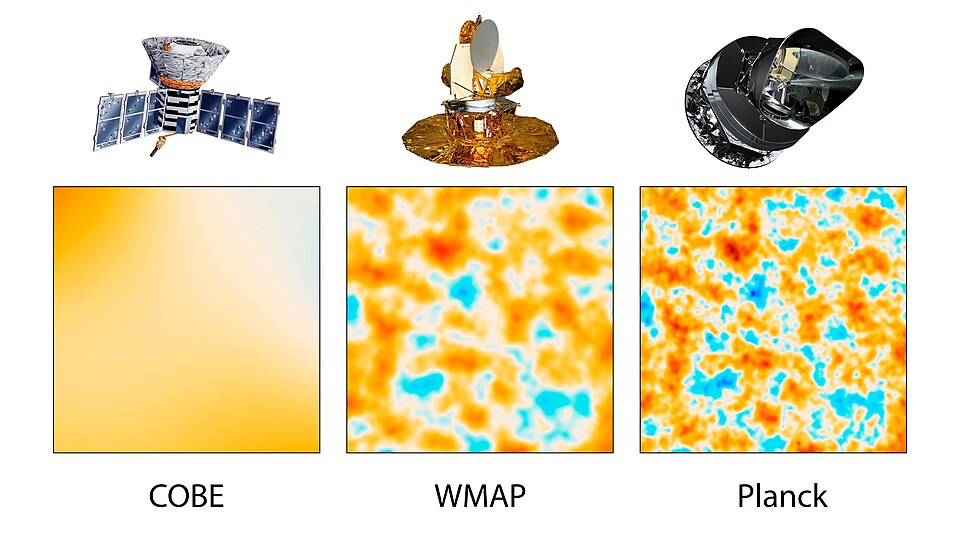

Superimposed on this nearly uniform glow are tiny temperature fluctuations at the level of one part in one hundred thousand. These fluctuations encode the density variations in the early universe that seeded the formation of galaxies and large-scale structure. Their statistical distribution — measured as a power spectrum of angular scales — acts as a precise cosmological ruler. By fitting cosmological models to the detailed pattern of these fluctuations, scientists can simultaneously determine the age of the universe, the total amount of matter and dark energy it contains, the Hubble constant, and a host of other parameters.1, 2, 4
The Wilkinson Microwave Anisotropy Probe (WMAP), a NASA satellite that operated from 2001 to 2010, produced the first high-precision full-sky maps of the CMB. Its nine-year data release placed the age of the universe at 13.77 ± 0.059 billion years and H₀ at 69.32 ± 0.80 km/s/Mpc.2 The European Space Agency's Planck satellite, which operated from 2009 to 2013 and provided far higher angular resolution, refined these numbers further. The Planck 2018 analysis — the definitive result from that mission — placed the age of the universe at 13.787 ± 0.020 billion years and H₀ at 67.4 ± 0.5 km/s/Mpc.1 This remains the most precise single determination of the universe's age available.
Stellar ages and nucleocosmochronology
Independent of the CMB, the ages of the oldest known stars provide a consistency check on the cosmological age of the universe. Stars must be younger than the universe itself, so any accurate stellar age sets a hard lower bound. If stars were found to be older than the CMB-derived age, the standard cosmological model would be in serious trouble. Instead, the oldest reliably dated stars fall comfortably below — though in some cases tantalizingly close to — 13.8 billion years.7, 8
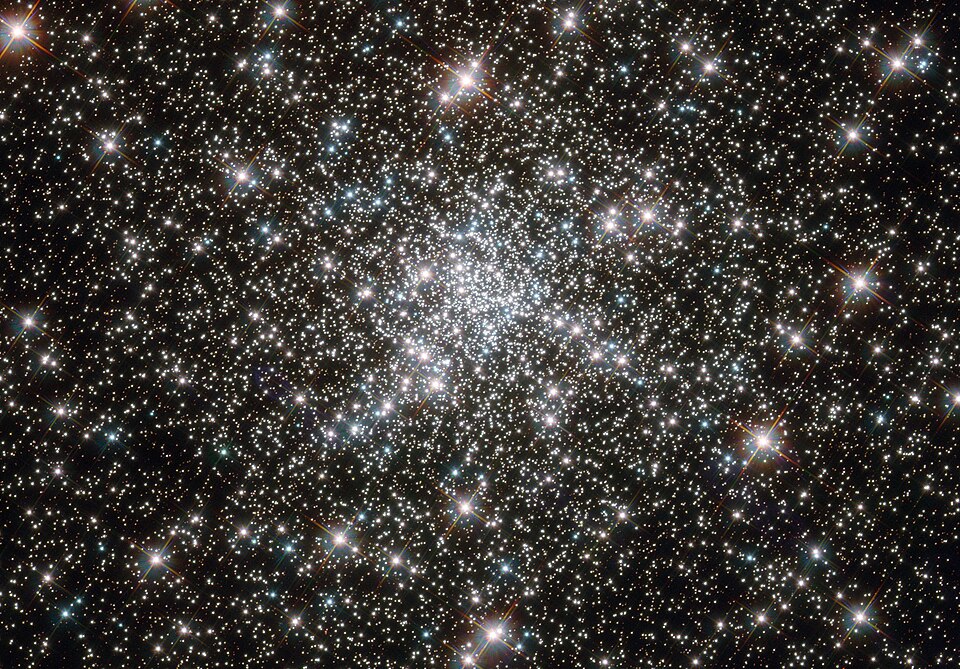

Globular clusters — ancient, gravitationally bound collections of hundreds of thousands of stars that formed in the early universe — are the primary laboratories for stellar age determinations. Their ages are estimated by comparing theoretical stellar evolution models to the observed Hertzsprung-Russell diagram of cluster members, specifically the position and morphology of the "main-sequence turnoff," the point at which the most massive surviving stars begin exhausting their hydrogen fuel and evolving into red giants. The age of the cluster is the age at which stars of that mass reach this transition point according to physics.7, 8 Careful studies of nearby globular clusters such as NGC 6752 have found ages of roughly 13.4 ± 1.4 billion years, entirely consistent with the CMB age.8
One individual star has become especially famous in this context: HD 140283, a metal-poor subgiant in the constellation Libra sometimes called the "Methuselah star." Located just 190 light-years away, it is one of the most metal-poor stars known, meaning it was born extremely early in the history of the Milky Way, before many generations of stars had enriched the interstellar medium with heavy elements. A detailed study by Bond and colleagues in 2013, using precise parallax measurements from the Hubble Space Telescope to pin down the star's luminosity and thus its mass, derived an age of 14.46 ± 0.80 billion years — a value that, at face value, appears to exceed the age of the universe.9 However, the 1-sigma error bars on this estimate overlap with 13.8 billion years, meaning the result is statistically consistent with the standard cosmological age within observational uncertainty. The Methuselah star remains a subject of ongoing study, but it does not represent a contradiction of established cosmology.9
A second and entirely independent route to stellar-based age estimates is nucleocosmochronology — the use of radioactive decay of heavy elements as a cosmic clock. Neutron-capture processes in exploding massive stars (supernovae) and neutron star mergers synthesize elements heavier than iron, including radioactive isotopes of uranium and thorium with known half-lives. Because these isotopes decay over billions of years, the ratio of uranium-238 to thorium-232, or uranium-238 to a stable r-process anchor element such as europium, encodes the time elapsed since those elements were forged.9, 10 Measurements of the uranium-to-thorium ratio in the spectrum of ancient metal-poor stars have yielded age estimates in the range of 12 to 15 billion years, consistent with but somewhat less precise than the CMB approach.6, 9
Independent methods for measuring the age of the universe1, 2, 9, 9
| Method | Key measurement | Age estimate |
|---|---|---|
| Planck CMB (2018) | CMB temperature power spectrum | 13.787 ± 0.020 Gyr |
| WMAP CMB (9-year) | CMB temperature power spectrum | 13.77 ± 0.059 Gyr |
| Globular cluster ages | Main-sequence turnoff, NGC 6752 | 13.4 ± 1.4 Gyr |
| HD 140283 (Methuselah star) | Stellar evolution modelling | 14.46 ± 0.80 Gyr |
| Nucleocosmochronology | U/Th decay in metal-poor stars | 12–15 Gyr |
Why the observable universe is 93 billion light-years across
A common source of confusion is why the observable universe is described as roughly 93 billion light-years in diameter when the universe is only 13.8 billion years old. Naively, if light travels at a fixed speed and has only been traveling for 13.8 billion years, should not the farthest visible objects be at most 13.8 billion light-years away? This intuition is incorrect because it ignores the expansion of space itself.11, 11
When light was emitted by a distant galaxy shortly after the Big Bang, that galaxy was much closer to our own location than it is today. In the time it has taken the light to travel to us, space has been stretching continuously. The galaxy from which the light originated has therefore been carried to a far greater distance than the light itself has traveled. The physical distance to that galaxy today — its proper distance, meaning the distance that would be measured by a ruler laid across space at this instant — is much larger than the distance implied by the light travel time.11, 11
The relevant boundary of the observable universe is called the particle horizon: the maximum comoving distance from which light could have reached us in the entire history of the universe, accounting for expansion at every moment along the way. Because the universe has been expanding — and for most of its history has been expanding at an accelerating rate due to dark energy — the particle horizon is far larger than the naive light-travel-distance estimate. Detailed calculations using the standard cosmological model (a flat universe with approximately 68 percent dark energy, 27 percent dark matter, and 5 percent ordinary matter) give the comoving radius of the observable universe as approximately 46.5 billion light-years, meaning the observable universe has a diameter of approximately 93 billion light-years.11, 16
A related but distinct concept is the Hubble sphere, the region within which galaxies are receding from us at less than the speed of light. Galaxies beyond the Hubble sphere are receding superluminally — not because they themselves are moving through space faster than light, which would violate special relativity, but because the space between us and them is expanding so rapidly that the cumulative recession exceeds c. General relativity permits this; it is space that is expanding, not objects moving through space. Counterintuitively, we can observe galaxies that are currently beyond the Hubble sphere because those galaxies were inside it when the relevant light was emitted.11, 11
The Hubble tension
One of the most consequential unsolved problems in contemporary physics is the Hubble tension: a statistically significant disagreement between two high-precision routes to measuring H₀. As discussed above, the Planck CMB analysis yields H₀ = 67.4 ± 0.5 km/s/Mpc.1 Measurements using the local cosmic distance ladder — an independent chain of distance calibrations that begins with parallax to nearby stars, proceeds through Cepheid variable stars in external galaxies, and culminates in the redshifts of Type Ia supernovae — give a systematically higher value. The SH0ES (Supernova, H₀, for the Equation of State of Dark Energy) collaboration, led by Adam Riess, reported H₀ = 73.04 ± 1.04 km/s/Mpc in 2022, a discrepancy of approximately 5 sigma from the Planck value — well beyond the conventional threshold for a statistically significant result in particle physics.3

The tension matters because the two methods probe different epochs of cosmic history. CMB measurements are sensitive to the physics of the early universe, roughly 380,000 years after the Big Bang, and extrapolate forward to the present using an assumed cosmological model. Local distance ladder measurements are directly empirical, anchored in the physics of the present-day universe. If both measurements are correct, then either the standard cosmological model (Lambda-CDM) is missing some ingredient that changes the expansion history between the early and late universe, or one or both measurements contain an unidentified systematic error.17, 18
Multiple research teams have sought a middle ground. Freedman and collaborators at the Carnegie-Chicago Hubble Program used the tip of the red giant branch (TRGB) — a different stellar distance calibrator with different potential systematic errors — to measure H₀ = 69.8 ± 1.7 km/s/Mpc, intermediate between the two camps but statistically consistent with both.18 A completely independent check came from gravitational wave astronomy: the detection of the binary neutron star merger GW170817 by LIGO and Virgo in 2017, combined with the optical identification of its host galaxy and the galaxy's redshift, provided the first "standard siren" measurement of H₀, yielding 70.0 (+12.0 / -8.0) km/s/Mpc — a result with large but currently unbiased uncertainties.21
The advent of the James Webb Space Telescope (JWST) was anticipated by some as a potential resolution: if the Cepheid distances used by SH0ES were systematically biased by stellar crowding in densely packed galaxy fields, then JWST's sharper infrared vision might reveal the error. The opposite occurred. A 2023 analysis by Riess and colleagues using JWST observations of Cepheids in the host galaxies of Type Ia supernovae confirmed and even slightly tightened the local distance ladder measurement, ruling out crowding as the source of the discrepancy.19 As of the mid-2020s, the Hubble tension remains unresolved, and its resolution may require new physics beyond the standard cosmological model.
Hubble constant measurements from major methods1, 3, 18, 21
What lies beyond the observable universe
The observable universe is not the universe. It is simply the portion of the universe with which we can, even in principle, have causal contact — the region from which light has had time to reach us. Beyond the particle horizon lies the rest of the universe, which may be vastly larger. Because we cannot receive any signal from beyond the horizon, its content, structure, and extent cannot be observed directly; any statements about it are necessarily inferences from physical theory and the measured geometry of the observable region.11, 23
The best available evidence suggests the universe is spatially flat, or very close to it. The CMB power spectrum is sensitive to the overall spatial curvature of the universe, and the Planck 2018 analysis finds a curvature parameter consistent with zero to within tight constraints.1 A flat universe can be either finite with a complex topology or infinite in extent. If it is infinite, then the total universe contains infinitely many regions like our observable patch, and the question of the universe's "size" in any global sense is not well defined. If it is finite, its total volume must be much larger than the observable portion, since no characteristic curvature scale has been detected.11
Inflationary cosmology — the hypothesis that the very early universe underwent a brief period of exponential expansion driven by a scalar field — predicts that the total universe is enormously larger than the observable portion. If inflation lasted even a little longer than the minimum required to solve the horizon and flatness problems, the total universe would dwarf the observable universe by many orders of magnitude. Some versions of inflationary theory predict that inflation is eternal in the global sense, generating an effectively infinite "multiverse" of causally disconnected regions. These predictions lie beyond current observational reach, but they are motivated by the same mathematical frameworks that successfully predict the observed CMB power spectrum.23
There is also a cosmological event horizon, distinct from the particle horizon: the maximum distance from which light emitted now will ever reach us. In an accelerating universe dominated by dark energy, this event horizon is finite. Light emitted today by sufficiently distant galaxies will never reach us, no matter how long we wait, because the intervening space is expanding too rapidly. The universe is, in a real physical sense, becoming lonelier over cosmological timescales as accelerating expansion continuously places more galaxies beyond the reach of future observers.14, 15
Dark energy and cosmic acceleration
The discovery in 1998 that the expansion of the universe is accelerating, made independently by two teams studying Type Ia supernovae, fundamentally changed cosmology's understanding of the universe's past and future.14, 15 Distant supernovae — standardizable candles whose intrinsic brightness can be estimated from the shape of their light curves — appeared fainter than expected in a decelerating or even coasting universe. The implication was that the expansion had been slower in the past and is speeding up now, driven by an energy component with negative pressure that has been named dark energy and tentatively identified with a cosmological constant in Einstein's field equations.20
Dark energy profoundly affects both the age and the observable size of the universe. Because dark energy accelerated the expansion relatively recently in cosmic history (becoming dominant roughly 5 billion years ago), the universe expanded more slowly in earlier epochs than a simple constant-rate extrapolation would suggest. The combination of a slower past expansion followed by an accelerating recent expansion results in an age that is moderately older than a naive estimate based solely on the current Hubble constant would imply. Simultaneously, the cumulative expansion driven by dark energy over the history of the universe is responsible for pushing the particle horizon out to 46.5 billion light-years, much farther than the 13.8 billion light-year naive estimate.11, 16, 20
The nature of dark energy is one of the central unsolved problems in fundamental physics. The cosmological constant interpretation holds that it represents the energy density of the quantum vacuum, but the value required by observation is some 120 orders of magnitude smaller than naive quantum field theory calculations predict. Alternative explanations — dynamical scalar fields called quintessence, modifications to general relativity on cosmological scales, or interactions between dark matter and dark energy — remain active areas of theoretical and observational investigation. Future surveys such as the Euclid mission and the Vera C. Rubin Observatory's Legacy Survey of Space and Time (LSST) are designed to measure the evolution of dark energy across cosmic time with sufficient precision to discriminate among these possibilities.20, 22
Convergence of independent evidence
What gives cosmologists confidence in the numbers 13.8 billion years and 93 billion light-years is not any single measurement but the convergence of independent lines of evidence. The CMB analysis, stellar ages, nucleocosmochronology, baryon acoustic oscillations in the large-scale galaxy distribution, and the supernova distance scale all point to the same cosmological framework.1, 2, 4, 14 Each method probes a different epoch of cosmic history and relies on different physical processes, yet they agree to a degree of precision that would be extraordinarily improbable if the standard model were fundamentally wrong.
Baryon acoustic oscillations (BAOs) — the frozen imprint of acoustic waves that propagated through the early universe before the CMB era — provide an independent cosmological ruler. The characteristic scale of these oscillations, visible as a preferred clustering distance in the galaxy distribution, was measured precisely by the Sloan Digital Sky Survey and its successors. Combined with CMB measurements, BAOs break degeneracies between cosmological parameters and further sharpen the age estimate.4 The resulting picture is extraordinarily self-consistent: the flat Lambda-CDM model, with a universe 13.8 billion years old, 68 percent dark energy, and 27 percent dark matter, simultaneously accounts for the CMB power spectrum, the large-scale galaxy distribution, the supernova distance-redshift relation, and the primordial abundances of hydrogen and helium produced in the first three minutes after the Big Bang.
The Hubble tension is the one significant quantitative discord in this otherwise harmonious picture. Whether it signals new physics or an underestimated systematic error is a question that ongoing and forthcoming observational programs are specifically designed to answer. The tension does not cast doubt on the age of the universe — the two competing Hubble constant values imply ages differing by only about a billion years, both consistent with stellar ages and other constraints — but it does suggest that the universe may be slightly younger (if the local distance ladder value is correct) or slightly older (if the CMB value is correct) than the canonical 13.787 billion years derived from Planck alone.3, 17, 19
References
Nine-year Wilkinson Microwave Anisotropy Probe (WMAP) observations: cosmological parameter results
A comprehensive measurement of the local value of the Hubble constant with 1 km/s/Mpc uncertainty from the Hubble Space Telescope and the SH0ES team
A 2 per cent distance to the first peak of the CMB power spectrum from baryon acoustic oscillations in the galaxy power spectrum
An improved age for the universe from the stellar populations of the globular cluster NGC 6752
Expanding confusion: common misconceptions of cosmological horizons and the superluminal expansion of the universe
A determination of the Hubble constant from Cepheid distances to the host galaxies of Type Ia supernovae
Observational evidence from supernovae for an accelerating universe and a cosmological constant
Measurements of the cosmological parameters Ω and Λ from the first seven supernovae at z ≥ 0.35