Overview
- In 1998, two independent supernova survey teams discovered that distant Type Ia supernovae were fainter than expected in a decelerating universe, demonstrating that the cosmic expansion has been accelerating for roughly the past five billion years.
- The simplest explanation is Einstein's cosmological constant Λ, which assigns a fixed energy density to empty space with an equation of state parameter w = −1, but the predicted vacuum energy from quantum field theory exceeds the observed value by some 60 to 120 orders of magnitude — arguably the worst prediction in physics.
- Multiple independent lines of evidence — baryon acoustic oscillations, the cosmic microwave background, galaxy cluster counts, and gravitational lensing — now corroborate the supernova result, and 2024 DESI data hint that dark energy may be evolving over time rather than behaving as a fixed constant.
In the late 1990s, two independent teams of astronomers set out to measure how quickly the expansion of the universe was decelerating. They expected to find that the mutual gravitational attraction of all the matter in the cosmos was gradually slowing the expansion that had been underway since the Big Bang. Instead, they discovered the opposite: distant Type Ia supernovae were dimmer than they should have been in a decelerating universe, implying that the expansion has been speeding up for roughly the past five billion years.1, 2 This discovery, announced in 1998 and honoured with the 2011 Nobel Prize in Physics, transformed cosmology and revealed that approximately 68 percent of the total energy content of the universe consists of a mysterious component — now called dark energy — that drives space apart against the pull of gravity.4, 14
The accelerating expansion is now one of the best-established facts in observational cosmology, confirmed not only by supernovae but by baryon acoustic oscillations in the distribution of galaxies, the anisotropy pattern of the cosmic microwave background, galaxy cluster counts, and gravitational lensing surveys.9, 13, 14, 15 Yet the physical origin of the acceleration remains one of the deepest unsolved problems in fundamental physics, touching on quantum field theory, general relativity, and the ultimate fate of the universe.
Type Ia supernovae as standard candles
The discovery of the accelerating expansion rested on the use of Type Ia supernovae as cosmic distance indicators. A Type Ia supernova occurs when a carbon-oxygen white dwarf in a binary system accretes matter from a companion star until it approaches the Chandrasekhar limit of approximately 1.4 solar masses, at which point thermonuclear reactions ignite throughout the star and destroy it in a titanic explosion. Because the detonation is triggered near a characteristic mass, all Type Ia supernovae reach roughly the same peak luminosity, making them approximate standard candles — objects whose intrinsic brightness is known and whose apparent brightness therefore reveals their distance.3, 9
.jpg)
.jpg)
In practice, Type Ia supernovae are not perfectly uniform. In 1993, Mark Phillips demonstrated a tight empirical correlation between the peak absolute luminosity of a Type Ia supernova and the rate at which its light curve declines after maximum: brighter supernovae fade more slowly, while fainter ones decline more rapidly.3 This relationship, parameterized by the quantity Δm15(B) — the number of magnitudes by which the supernova fades in the B band during the 15 days following peak brightness — allows astronomers to correct each supernova's observed brightness to a standardized value. Type Ia supernovae are therefore more precisely called standardizable candles: not identical in luminosity, but reducible to a common standard through a single measurable parameter.3, 22
Because Type Ia supernovae are extraordinarily luminous — briefly rivalling the combined light of an entire galaxy — they can be observed at cosmological distances, out to redshifts exceeding z = 1. By comparing the apparent brightness of a distant supernova with its standardized absolute brightness, astronomers derive its luminosity distance. Comparing that distance to the supernova's redshift then traces the expansion history of the universe: if the expansion is decelerating, distant supernovae will appear brighter than a constant-rate extrapolation would predict; if accelerating, they will appear fainter.1, 2
The 1998 discovery
Two rival groups independently pursued this measurement through the 1990s. The Supernova Cosmology Project (SCP), led by Saul Perlmutter at Lawrence Berkeley National Laboratory and initiated in 1988, pioneered the systematic search for high-redshift Type Ia supernovae using wide-field CCD imaging on large telescopes.2, 22 The High-z Supernova Search Team, assembled in 1994 under Brian Schmidt at the Australian National University with Adam Riess playing a central analytical role, independently developed similar techniques and began accumulating their own sample of distant supernovae.1
In early 1998, the High-z Team published its results first. Riess and colleagues presented spectroscopic and photometric observations of 10 Type Ia supernovae at redshifts between z = 0.16 and z = 0.62, combined with 34 nearby supernovae as a low-redshift anchor. The luminosity distances of the high-redshift supernovae were, on average, 10 to 15 percent larger than expected in a low-mass-density universe without a cosmological constant — meaning the supernovae were fainter, and therefore more distant, than any decelerating model could explain. The data required a positive cosmological constant at the 7σ to 9σ level of statistical significance, depending on the light-curve fitting method employed.1
Later that year and into 1999, the Supernova Cosmology Project published a concordant result from an independent sample of 42 high-redshift supernovae. Perlmutter and colleagues confirmed that the data were inconsistent with a matter-dominated, decelerating universe and strongly favoured a model in which the expansion has been accelerating. Their best-fit cosmology allocated roughly 28 percent of the critical density to matter and roughly 72 percent to a cosmological constant or equivalent dark energy component.2
The convergence of two independent teams using different supernovae, different telescopes, different analysis pipelines, and different light-curve fitting methods was decisive. Science magazine named the accelerating universe the "Breakthrough of the Year" for 1998. In 2011, the Nobel Prize in Physics was awarded to Saul Perlmutter (one half) and jointly to Brian Schmidt and Adam Riess (the other half) "for the discovery of the accelerating expansion of the Universe through observations of distant supernovae."4
The cosmological constant Λ
The simplest theoretical explanation for the accelerating expansion is Einstein's cosmological constant, denoted Λ. Einstein originally introduced this term in 1917 to permit a static universe within the framework of general relativity: without Λ, his field equations predicted that a homogeneous, isotropic universe must either expand or contract.5 After Edwin Hubble's 1929 observation that galaxies are receding at velocities proportional to their distances — implying an expanding universe — Einstein reportedly abandoned the cosmological constant, and it fell out of mainstream cosmology for decades.21, 6
The 1998 supernova results resurrected Λ in a new guise. In modern cosmology, the cosmological constant is interpreted not as a mathematical device to enforce a static universe but as a constant energy density of the vacuum — a uniform, positive energy that pervades all of space and exerts a negative pressure that drives the expansion to accelerate.6, 8 Within the standard ΛCDM model (Λ plus cold dark matter), the cosmological constant accounts for approximately 68.3 percent of the total energy density of the universe, dark matter accounts for roughly 26.8 percent, and ordinary baryonic matter makes up about 4.9 percent.14
The cosmological constant has a distinctive physical signature: its equation of state parameter, defined as the ratio of pressure to energy density (w = P/ρ), is exactly −1. This means that the energy density of vacuum does not dilute as the universe expands — every cubic metre of space contains the same amount of vacuum energy regardless of the scale factor. As matter and radiation thin out with expansion, Λ inevitably comes to dominate, and the expansion accelerates exponentially. Observational data from the Planck mission, combined with supernovae and baryon acoustic oscillations, constrain the present-day value of w to −1.03 ± 0.03, consistent with a cosmological constant to within measurement uncertainty.14, 17
The cosmological constant problem
Despite the observational success of ΛCDM, the cosmological constant presents a profound theoretical puzzle. In quantum field theory, the vacuum is not truly empty but seethes with virtual particle-antiparticle pairs that pop in and out of existence. Each quantum field contributes a zero-point energy to the vacuum, and summing these contributions up to a physically motivated cutoff scale yields a predicted vacuum energy density that is enormously larger than the value required by cosmological observations.7
The magnitude of the discrepancy depends on the choice of cutoff. If the calculation is truncated at the Planck scale — the energy scale at which quantum gravitational effects become important, approximately 1019 GeV — the predicted vacuum energy density exceeds the observed cosmological constant by roughly 120 orders of magnitude. Even using more conservative cutoff scales motivated by electroweak symmetry breaking (approximately 100 GeV), the discrepancy remains some 55 to 60 orders of magnitude.7, 6 This mismatch, first systematically analysed by Steven Weinberg in 1989, has been called "the worst theoretical prediction in the history of physics" and remains unresolved.7
The problem has two aspects, sometimes called the "old" and "new" cosmological constant problems. The old problem is why the vacuum energy is so small — why the positive and negative contributions from different quantum fields cancel to such extraordinary precision, leaving a residual energy density 120 orders of magnitude below the natural scale. The new problem, sharpened by the 1998 discovery, is the coincidence problem: why is the dark energy density comparable to the matter density today, given that matter dilutes with expansion while Λ remains constant? For most of cosmic history, either matter or radiation dominated the energy budget; the present epoch is a cosmologically brief window in which matter and dark energy happen to be within an order of magnitude of each other.7, 8
The cosmological constant problem: predicted vs. observed vacuum energy7, 6
| Energy scale (cutoff) | Predicted ρvac (GeV4) | Discrepancy factor |
|---|---|---|
| Planck scale (~1019 GeV) | ~1074 | ~10120 |
| GUT scale (~1016 GeV) | ~1062 | ~10108 |
| Electroweak scale (~102 GeV) | ~108 | ~1054 |
| QCD scale (~0.2 GeV) | ~10−2 | ~1044 |
| Observed value | ~10−46 | 1 (by definition) |
The equation of state and w
Because the physical nature of dark energy is unknown, cosmologists characterize it phenomenologically through the equation of state parameter w, defined as the ratio of the dark energy pressure P to its energy density ρ. For a cosmological constant, w is exactly −1 at all times. For ordinary matter, w = 0; for radiation, w = 1/3. Any component with w < −1/3 causes the expansion to accelerate, while a component with w < −1 — termed phantom energy — has the even more exotic property that its energy density increases as the universe expands.9, 11
To test whether dark energy is truly a cosmological constant or something more dynamic, observers attempt to measure w and to determine whether it varies with cosmic time. The standard parameterization, introduced by Chevallier and Polarski in 2001 and independently by Linder in 2003, expresses the equation of state as a linear function of the cosmic scale factor a: w(a) = w0 + wa(1 − a), where w0 is the present-day value and wa captures the rate of change.19, 20 In this CPL parameterization, a cosmological constant corresponds to w0 = −1 and wa = 0.
Current observational constraints are consistent with a cosmological constant but leave room for modest deviations. The Pantheon+ analysis of 1,550 Type Ia supernovae, combined with cosmic microwave background and baryon acoustic oscillation data, yields w0 = −0.978 ± 0.031 and wa = −0.65 ± 0.32, consistent with but not centred precisely on the ΛCDM values.17 The original Pantheon sample of 1,048 supernovae, combined with Planck CMB and BAO data, found w0 = −1.007 ± 0.089 and wa = −0.222 ± 0.407.16 The precision of these measurements continues to improve with larger supernova samples and more refined systematic-error control.
Corroborating evidence beyond supernovae
Although Type Ia supernovae provided the original discovery, the case for accelerating expansion now rests on multiple independent lines of evidence that are sensitive to the expansion history through different physical mechanisms.
.jpg)
.jpg)
Baryon acoustic oscillations (BAO) are a relic of sound waves that propagated through the hot plasma of the early universe before recombination. These waves imprinted a characteristic scale — approximately 150 megaparsecs in comoving coordinates — in the distribution of matter, which appears as a subtle excess of galaxy pairs separated by that distance. In 2005, Eisenstein and colleagues detected this acoustic peak in the correlation function of 46,748 luminous red galaxies from the Sloan Digital Sky Survey, providing a 4-percent measurement of the distance to redshift z = 0.35 and an independent confirmation that the expansion is accelerating.13 BAO measurements have since been extended across a wide range of redshifts using galaxies, quasars, and the Lyman-α forest, providing one of the most geometrically clean probes of dark energy because the acoustic scale serves as a standard ruler whose physical size is precisely calibrated by the physics of the early universe.9, 18
The cosmic microwave background (CMB) constrains dark energy primarily through the angular diameter distance to the last scattering surface at redshift z ≈ 1,100. The Planck satellite's final results, published in 2020, provide exquisitely precise measurements of the angular power spectrum of the CMB, which when combined with other probes yield a dark energy density parameter ΩΛ = 0.683 ± 0.007 and a dark energy equation of state consistent with w = −1.14 The CMB alone cannot distinguish between different dark energy models at low redshift, but when combined with supernova or BAO data, it breaks parameter degeneracies and substantially tightens constraints on w and its time evolution.
Galaxy cluster counts probe the expansion history and the growth rate of cosmic structure simultaneously. The abundance of massive clusters as a function of redshift depends sensitively on both the expansion rate (which governs the volume element) and the growth of density perturbations (which governs how many clusters form at each epoch). Because an accelerating expansion suppresses the growth of structure at late times, the observed cluster mass function provides an independent test of dark energy. Reviews of cluster-based cosmological constraints confirm results consistent with ΛCDM, with ΩΛ ≈ 0.7 and w ≈ −1.15
Alternative dark energy models
The theoretical discomfort surrounding the cosmological constant — particularly the vacuum energy discrepancy and the coincidence problem — has motivated a wide range of alternative models. These fall broadly into two categories: models that introduce a new dynamical field responsible for the acceleration, and models that modify general relativity itself on cosmological scales.11
Quintessence is the most extensively studied dynamical dark energy model. Proposed by Caldwell, Dave, and Steinhardt in 1998, quintessence postulates a slowly rolling scalar field φ whose potential energy V(φ) drives the acceleration. Unlike the cosmological constant, the energy density of a quintessence field evolves with time, and its equation of state parameter w lies in the range −1 < w < −1/3, potentially varying as the field rolls down its potential.10 In certain "tracker" quintessence models, the field's energy density naturally approaches the matter density at late times, offering a partial resolution of the coincidence problem.8, 11 Observationally, quintessence predicts w ≠ −1 and, crucially, wa ≠ 0, making it potentially distinguishable from a cosmological constant with sufficiently precise measurements.
Phantom energy occupies the opposite side of the cosmological constant divide. In phantom models, the equation of state parameter w < −1, which implies that the dark energy density increases as the universe expands. The scalar field driving phantom energy has a kinetic term with the "wrong" sign, leading to theoretical concerns about stability, but the possibility is not observationally excluded. In 2003, Caldwell, Kamionkowski, and Weinberg demonstrated that a universe dominated by phantom energy faces a dramatic fate: the ever-increasing dark energy density eventually overwhelms all gravitational binding — first separating galaxy clusters, then galaxies, then solar systems, and finally atoms — in a finite-time singularity called the Big Rip.12
Modified gravity theories take a fundamentally different approach, proposing that the observed acceleration is not caused by a new energy component but by a breakdown of general relativity on cosmological scales. In f(R) gravity, the Einstein-Hilbert action is generalized to include higher-order curvature terms, which can produce late-time acceleration without invoking dark energy. Braneworld models, in which our four-dimensional universe is embedded in a higher-dimensional bulk, offer another route to modified gravitational dynamics at large scales.11 A key discriminant between dark energy models and modified gravity is the growth rate of cosmic structure: dark energy and modified gravity can produce identical expansion histories but predict different rates of structure formation, a difference that upcoming surveys aim to exploit.9
The DESI 2024 results
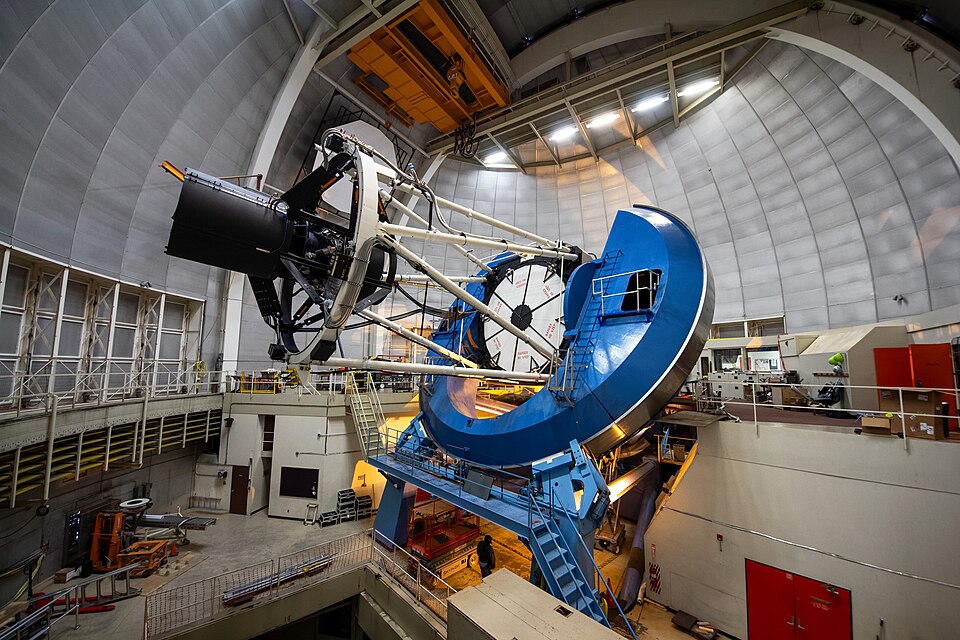
In April 2024, the Dark Energy Spectroscopic Instrument (DESI) collaboration released cosmological constraints from baryon acoustic oscillation measurements using over 5.7 million galaxy and quasar redshifts spanning the range 0.1 < z < 4.2, collected during the instrument's first year of operation. The combined precision of the BAO measurements across six redshift bins reached approximately 0.52 percent, representing the most precise BAO dataset ever assembled at the time of publication.18
_installed_on_the_Nicholas_U_Mayall_4-meter_Telescope_(noirlab-mayall-desi-1).jpg)
Within the standard flat ΛCDM model, DESI BAO data alone yield a matter density Ωm = 0.295 ± 0.015 and, when combined with a baryon density prior from Big Bang nucleosynthesis and the CMB acoustic scale, a Hubble constant H0 = 68.52 ± 0.62 km s−1 Mpc−1 — all consistent with the Planck ΛCDM cosmology.18 The most striking result, however, concerned the dark energy equation of state. In the w0waCDM model, combinations of DESI BAO with CMB data prefer w0 > −1 and wa < 0, with a combined significance of 2.5σ to 3.9σ depending on which supernova dataset is included — suggesting that dark energy may be weakening over time rather than remaining constant.18
If confirmed, this result would rule out a pure cosmological constant and point toward a dynamical dark energy component whose equation of state was more negative in the past (w < −1) and is approaching or crossing w = −1 toward less negative values today. Such behaviour is qualitatively consistent with certain quintessence or thawing dark energy models, although it is also consistent with phantom-crossing scenarios that require more exotic theoretical frameworks.11, 18 The DESI collaboration cautions that the significance remains moderate, and subsequent data releases with three and ultimately five years of observations will be required to determine whether this hint of evolving dark energy hardens into a definitive detection.
Evidence for evolving dark energy: w0 and wa constraints from major surveys14, 16, 17, 18
| Dataset combination | w0 | wa | Tension with ΛCDM |
|---|---|---|---|
| Pantheon (2018) + CMB + BAO | −1.007 ± 0.089 | −0.222 ± 0.407 | < 1σ |
| Pantheon+ (2022) + CMB + BAO | −0.978 ± 0.031 | −0.65 ± 0.32 | ~2σ |
| DESI Y1 (2024) + CMB | > −1 | < 0 | 2.6σ |
| DESI Y1 (2024) + CMB + SN Ia | > −1 | < 0 | 2.5–3.9σ |
The fate of the universe
The nature of dark energy determines the ultimate fate of the cosmos. The three principal scenarios — the Big Freeze, the Big Rip, and the Big Crunch — correspond to different values and behaviours of the equation of state parameter w.9, 12
If dark energy is a cosmological constant (w = −1), the universe enters an era of eternal exponential expansion sometimes called the Big Freeze or "heat death." Galaxies beyond our Local Group gradually recede past the cosmological event horizon, becoming forever unobservable. Star formation eventually exhausts the available gas supply, the last stars burn out, and the universe asymptotically approaches a state of maximum entropy at a temperature arbitrarily close to absolute zero. The cosmos becomes an ever-expanding, ever-cooling void populated by isolated remnants — black holes, neutron stars, white dwarfs — that themselves ultimately decay or evaporate on stupendous timescales. This is the default outcome of the ΛCDM model and is strongly favoured by current data.6, 8
If dark energy is phantom energy with w < −1, the expansion rate increases without bound, leading to the Big Rip. Caldwell, Kamionkowski, and Weinberg calculated that for a constant w = −1.5, the Big Rip would occur approximately 22 billion years from now. In the final stages, galaxy clusters are torn apart roughly one billion years before the end; galaxies disintegrate approximately 60 million years before; the Solar System becomes gravitationally unbound about three months before; and in the last fraction of a second, atoms and even atomic nuclei are ripped apart as the scale factor diverges to infinity.12 Current observations disfavour but do not exclude a mildly phantom equation of state.
If dark energy weakens sufficiently over time — as suggested tentatively by the DESI results — the equation of state could cross from w < −1 in the past toward w > −1 today and potentially approach w = 0 in the far future. In such a scenario, the acceleration would eventually cease, and the expansion would continue at a decelerating rate, yielding a less extreme version of the Big Freeze.11, 18 Conversely, if dark energy were to reverse sign entirely — a possibility entertained in some theoretical frameworks — the expansion could eventually halt and reverse, culminating in a Big Crunch in which the universe collapses back to a singularity.8 While the Big Crunch is strongly disfavoured by current data, it cannot be excluded with certainty until the nature of dark energy is understood at a fundamental level.
The accelerating expansion, discovered barely a quarter-century ago, has rewritten the expected biography of the universe. What was once assumed to be a cosmos gradually decelerating under its own gravity has been revealed as one in which space itself is being driven apart by an energy component whose origin and future evolution remain among the most consequential unsolved questions in all of science.9, 22
References
Observational evidence from supernovae for an accelerating universe and a cosmological constant
Detection of the baryon acoustic peak in the large-scale correlation function of SDSS luminous red galaxies
The complete light-curve sample of spectroscopically confirmed SNe Ia from Pan-STARRS1 and cosmological constraints from the combined Pantheon sample
DESI 2024 VI: cosmological constraints from the measurements of baryon acoustic oscillations