Overview
- Black holes are regions of spacetime where gravity is so extreme that nothing, including light, can escape once it crosses the event horizon — a boundary first described mathematically by Karl Schwarzschild in 1916 and shown to arise inevitably from the gravitational collapse of sufficiently massive stars by Oppenheimer and Snyder in 1939.
- Observational confirmation has come from multiple independent lines of evidence: X-ray binaries such as Cygnus X-1 identified in the 1970s, the direct detection of gravitational waves from merging black holes by LIGO in 2015, and the Event Horizon Telescope's resolved images of the supermassive black holes M87* in 2019 and Sagittarius A* in 2022.
- Supermassive black holes ranging from millions to billions of solar masses reside at the centres of nearly all massive galaxies, coevolving with their hosts through a tight correlation between black hole mass and stellar velocity dispersion, while JWST discoveries of massive black holes in the early universe challenge standard models of how these objects formed and grew.
A black hole is a region of spacetime where the gravitational field is so intense that nothing — not matter, light, or any other form of electromagnetic radiation — can escape once it crosses a critical boundary known as the event horizon. Predicted as a mathematical consequence of Albert Einstein's general theory of relativity, black holes have evolved over the course of a century from theoretical curiosities into some of the most thoroughly observed objects in modern astrophysics. They form through the gravitational collapse of massive stars, grow through the accretion of surrounding matter, merge with one another in events that radiate gravitational waves across the cosmos, and anchor the centres of nearly all massive galaxies in the observable universe.1, 2, 14
The study of black holes unites general relativity, quantum mechanics, and observational astronomy in ways that few other phenomena can. The first gravitational wave signal ever detected came from two merging black holes, the first image ever made of an astrophysical object's event horizon was that of a supermassive black hole, and the tension between Hawking's prediction that black holes radiate thermally and the quantum-mechanical requirement that information be preserved remains one of the deepest unsolved problems in theoretical physics.9, 11, 12
Theoretical foundations
The history of black holes begins with Karl Schwarzschild, who in 1916 — just weeks after Einstein published the field equations of general relativity — derived the first exact solution describing the gravitational field outside a spherically symmetric, non-rotating mass. The Schwarzschild solution revealed a critical radius, now called the Schwarzschild radius, at which the metric becomes singular: for any mass M, this radius is given by rs = 2GM/c2, where G is the gravitational constant and c is the speed of light. For an object compressed within its Schwarzschild radius, the solution implies that no signal can escape to an external observer.1 For the Sun, this radius would be approximately 3 kilometres; for Earth, it would be roughly 9 millimetres. Although Schwarzschild himself and many contemporaries regarded the interior solution as a mathematical artefact rather than a physical prediction, the result established the geometric framework that would ultimately define black holes.
The physical plausibility of such complete gravitational collapse was not addressed rigorously until 1939, when J. Robert Oppenheimer and Hartland Snyder published their landmark analysis of what happens when a massive star exhausts its nuclear fuel. Working with an idealised model of a uniform, pressureless, spherically symmetric dust cloud, they showed that once the cloud contracts inside its Schwarzschild radius, the collapse proceeds inexorably to a singularity — a point of infinite density and curvature at the centre.2 From the perspective of a distant observer, the surface of the collapsing star appears to slow and redden as it approaches the Schwarzschild radius, asymptotically fading from view, but for an observer falling with the surface, the collapse to the singularity occurs in a finite proper time. This paper established that general relativity predicts the formation of objects from which no light can escape as a realistic outcome of stellar evolution, although the term "black hole" would not be coined until the 1960s.
In 1965, Roger Penrose proved a singularity theorem demonstrating that once a trapped surface forms — a closed surface from which light rays are converging inward in every direction — the formation of a singularity is unavoidable under general relativity, regardless of the symmetry or specific properties of the collapsing matter.3 This result, which earned Penrose a share of the 2020 Nobel Prize in Physics, removed the worry that the Oppenheimer-Snyder singularity was an artefact of the unrealistic assumption of perfect spherical symmetry and established that black hole formation is a robust, generic prediction of general relativity.3, 24
The Schwarzschild radius and event horizon
The event horizon of a non-rotating (Schwarzschild) black hole is the spherical surface at the Schwarzschild radius where the escape velocity equals the speed of light. It is not a physical barrier or a solid surface but a causal boundary: events inside the horizon cannot influence events outside it, because any trajectory from inside the horizon, even one followed by a photon, inevitably leads further inward toward the singularity rather than outward to infinity.1 The event horizon is thus defined globally by the causal structure of the entire spacetime, not by local conditions at the surface itself. An observer crossing the event horizon of a sufficiently massive black hole would experience no locally detectable change at the moment of crossing — tidal forces at the horizon of a supermassive black hole are quite mild — though they would be unable to communicate with the outside universe thereafter.
For rotating black holes, the situation is more complex. The Kerr solution, derived by Roy Kerr in 1963, describes the spacetime around a spinning mass and features two horizons: an outer event horizon and an inner Cauchy horizon. Between the outer horizon and a larger surface called the ergosphere, spacetime itself is dragged along with the rotation of the black hole so forcefully that no object can remain stationary with respect to distant observers — a phenomenon called frame-dragging. The Penrose process exploits this frame-dragging to extract rotational energy from a Kerr black hole, and the Blandford-Znajek mechanism extends this concept electromagnetically, using magnetic fields threading the ergosphere to power the relativistic jets observed in active galactic nuclei.8 Most astrophysical black holes are expected to possess significant angular momentum, making the Kerr solution the physically relevant description.
Types of black holes
Black holes are classified primarily by mass into three categories, each with distinct formation mechanisms and observational signatures. Stellar-mass black holes, ranging from roughly 3 to 100 solar masses, form through the gravitational core collapse of massive stars at the end of their nuclear-burning lives. When a star with an initial mass exceeding approximately 20 to 25 solar masses exhausts its fuel, the iron core that accumulates at its centre eventually exceeds the Chandrasekhar limit and collapses. If the resulting compact remnant exceeds the maximum mass supportable by neutron degeneracy pressure — the Tolman-Oppenheimer-Volkoff limit, estimated at roughly 2 to 3 solar masses — no known force can halt the collapse, and a black hole forms.21 The outer layers of the star may be expelled in a core-collapse supernova, or in the most massive cases the entire star may collapse directly into the black hole with little or no observable explosion.
Supermassive black holes occupy the opposite end of the mass spectrum, with masses ranging from approximately one million to tens of billions of solar masses. These objects reside at the dynamical centres of nearly all massive galaxies.14, 16 The Milky Way's central supermassive black hole, Sagittarius A* (Sgr A*), has a mass of approximately 4 million solar masses, determined from decades of precision tracking of individual stellar orbits in the Galactic centre.17 At the other extreme, the black hole in the elliptical galaxy Messier 87 (M87) weighs approximately 6.5 billion solar masses.12 The formation of supermassive black holes remains an open question: proposed mechanisms include the growth of stellar-mass seed black holes through sustained accretion over billions of years, the direct collapse of massive primordial gas clouds into black holes of 104 to 106 solar masses without an intervening stellar phase, and the runaway merger of stars or stellar-mass black holes in dense early star clusters.22
Intermediate-mass black holes (IMBHs), with masses between roughly 100 and 100,000 solar masses, occupy the gap between stellar-mass and supermassive black holes. Despite decades of searching, definitive detections remain elusive, making IMBHs one of the most actively pursued targets in observational astrophysics. Candidate IMBHs have been identified in ultraluminous X-ray sources such as HLX-1 in the galaxy ESO 243-49, in the dynamical centres of some globular clusters, and through gravitational wave events. The LIGO-Virgo detection GW190521 in 2019 identified a merger remnant of approximately 142 solar masses, providing the most robust gravitational-wave evidence for an IMBH to date.18 If IMBHs are confirmed to exist in significant numbers, they could represent the "seeds" from which supermassive black holes grew in the early universe.
Black hole mass classes and key examples12, 17, 18, 21
| Class | Mass range | Formation mechanism | Key example |
|---|---|---|---|
| Stellar-mass | ~3–100 M⊙ | Core collapse of massive stars | Cygnus X-1 (~21 M⊙) |
| Intermediate-mass | ~102–105 M⊙ | Runaway mergers; uncertain | GW190521 remnant (~142 M⊙) |
| Supermassive | ~106–1010 M⊙ | Seed growth; direct collapse | Sgr A* (~4 × 10⁶ M⊙) |
Early observational evidence
Because black holes emit no light of their own, their existence must be inferred from their gravitational influence on nearby matter and radiation. The first strong observational candidate was Cygnus X-1, one of the brightest X-ray sources in the sky, discovered during a rocket-borne X-ray survey in 1964. In 1972, Charles Thomas Bolton at the University of Toronto and, independently, B. Louise Webster and Paul Murdin at the Royal Greenwich Observatory identified the X-ray source with the blue supergiant star HDE 226868 and measured the Doppler shifts of the star's spectral lines to determine the orbital parameters of the binary system.4, 5 The mass function derived from these measurements implied that the unseen companion had a mass substantially exceeding the maximum possible mass of a neutron star, making a black hole the only plausible identification. Cygnus X-1 thus became the first widely accepted stellar-mass black hole candidate, and it remains one of the best-studied X-ray binaries in the Galaxy.
At the opposite end of the mass scale, the discovery of quasars in the early 1960s provided the first indirect evidence for supermassive black holes. In 1963, Maarten Schmidt measured the spectrum of the radio source 3C 273 and discovered that its emission lines were redshifted by 0.158, placing it at a cosmological distance of roughly two billion light-years.6 At that distance, the source's apparent brightness implied a luminosity of approximately 1013 solar luminosities, far exceeding the total output of any known galaxy, yet emanating from a region smaller than the solar system. The only mechanism capable of producing such extreme luminosity from such a compact volume is the gravitational accretion of matter onto a supermassive black hole, a conclusion that gradually gained acceptance through the 1960s and 1970s and is now the standard model for all active galactic nuclei.6, 7
Through the 1990s and 2000s, precision measurements of stellar and gas kinematics in galaxy centres, enabled by the Hubble Space Telescope and large ground-based observatories, revealed that supermassive black holes are not exceptional objects found only in active galaxies but are instead a generic feature of massive galaxies. A landmark 1998 survey by Magorrian and colleagues used dynamical modelling of 36 nearby galaxies to conclude that massive dark objects — consistent in every case with supermassive black holes — reside in the centres of approximately 97 percent of early-type galaxies, with black hole masses averaging roughly 0.6 percent of the mass of the host galaxy's bulge.14
The Event Horizon Telescope
The most direct observational evidence for the existence of event horizons came from the Event Horizon Telescope (EHT), a planet-spanning array of millimetre-wavelength radio telescopes that operates as a single Earth-sized interferometer through the technique of very long baseline interferometry (VLBI). By synchronising observations from telescopes on four continents and in Hawaii using atomic clocks, the EHT achieves an angular resolution of approximately 20 microarcseconds — sufficient to resolve structure on the scale of the event horizon of the nearest supermassive black holes.
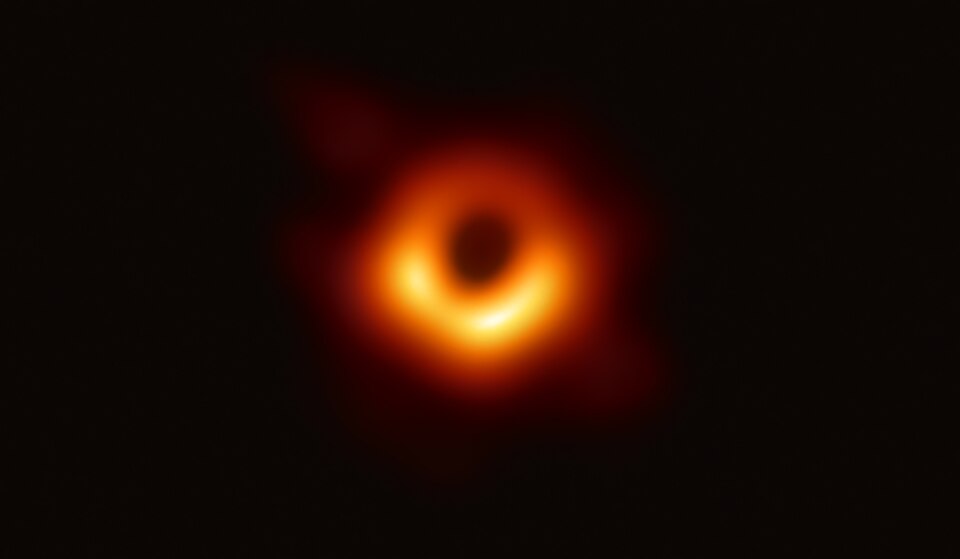

On 10 April 2019, the EHT Collaboration released the first image of a black hole: the supermassive black hole at the centre of the elliptical galaxy Messier 87, designated M87*. The image, constructed from observations taken in April 2017 at a wavelength of 1.3 millimetres, revealed a bright, asymmetric ring of emission with a diameter of 42 ± 3 microarcseconds surrounding a dark central region — the black hole shadow, a gravitationally lensed projection of the event horizon onto the observer's sky. The measured ring diameter was consistent with the predicted shadow size for a black hole of approximately 6.5 × 10⁹ solar masses, in excellent agreement with independent mass estimates from stellar dynamics, and represented a striking confirmation of the predictions of general relativity in the strong-gravity regime.12
Three years later, on 12 May 2022, the EHT Collaboration released an image of Sagittarius A*, the 4-million-solar-mass black hole at the centre of the Milky Way. Despite being over a thousand times less massive than M87*, Sgr A*'s much closer distance (approximately 27,000 light-years compared to 55 million light-years for M87) makes its angular shadow size comparable. The image showed a ring of emission with a diameter of 51.8 ± 2.3 microarcseconds, consistent with the predictions of general relativity for the known mass of Sgr A* as determined from stellar orbit measurements.13, 17 Imaging Sgr A* was significantly more challenging than imaging M87* because the much shorter orbital timescale of gas around the smaller black hole caused the source structure to change over the course of a single night's observation, requiring sophisticated time-variable imaging techniques.
Gravitational wave detection of black hole mergers
On 14 September 2015, the two detectors of the Laser Interferometer Gravitational-Wave Observatory (LIGO), located in Hanford, Washington, and Livingston, Louisiana, simultaneously recorded the transient gravitational-wave signal GW150914 — the first direct detection of gravitational waves and the first observation of a binary black hole merger. The signal, which swept upward in frequency from 35 Hz to a peak of approximately 150 Hz over roughly 0.2 seconds, matched the predictions of general relativity for the inspiral, merger, and ringdown of two black holes with masses of approximately 36 and 29 solar masses, coalescing to form a single black hole of about 62 solar masses. The difference of approximately 3 solar masses was radiated as gravitational-wave energy in a fraction of a second, corresponding to a peak luminosity of roughly 3.6 × 1056 ergs per second — briefly exceeding the combined electromagnetic luminosity of all the stars in the observable universe.11
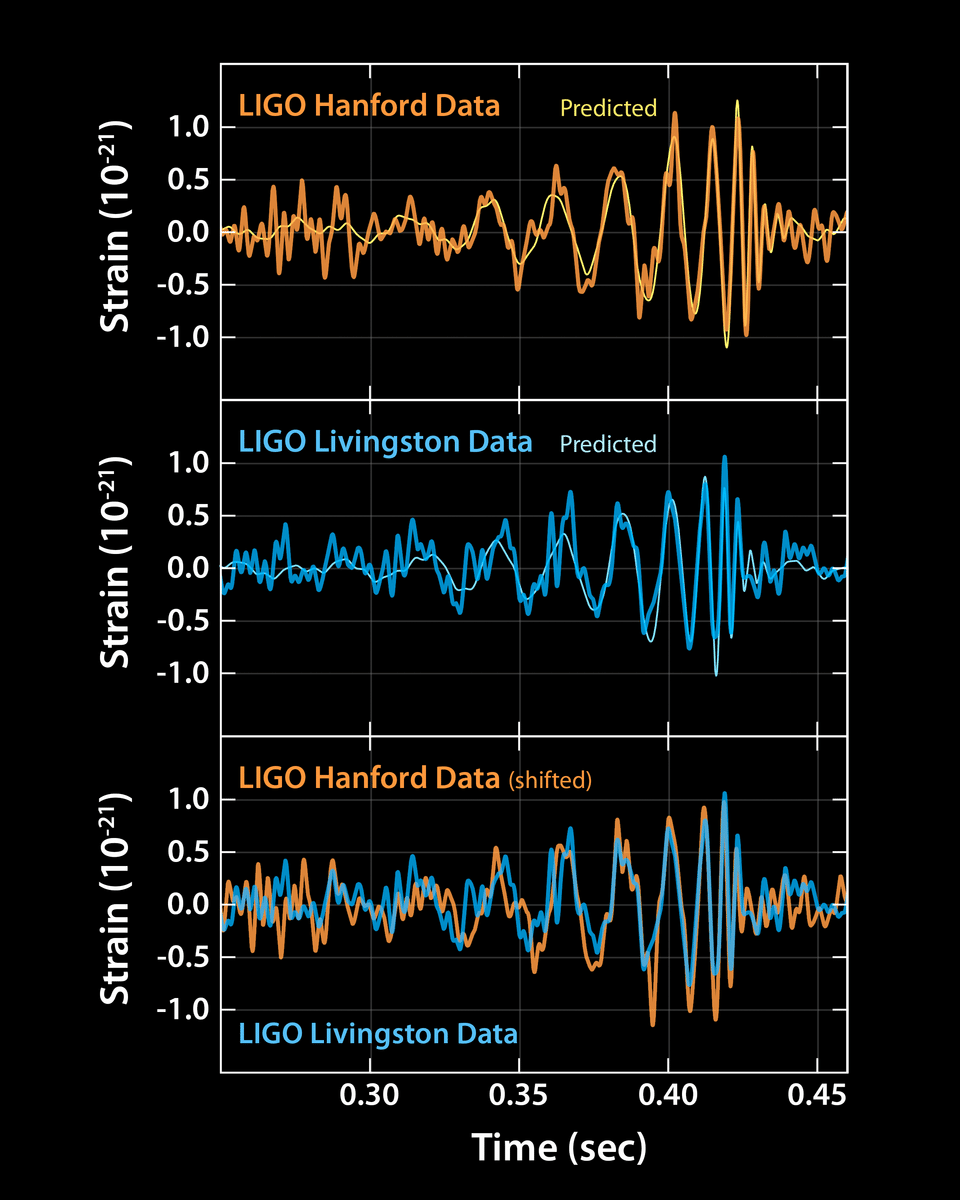

The detection of GW150914 simultaneously confirmed three predictions of general relativity that had never before been directly verified: the existence of gravitational waves themselves, the existence of binary black hole systems, and the dynamical merger of two black holes into one. The discovery was recognised with the 2017 Nobel Prize in Physics, awarded to Rainer Weiss, Barry Barish, and Kip Thorne for their decisive contributions to the LIGO detector and the observation of gravitational waves.25
Since GW150914, the LIGO-Virgo-KAGRA (LVK) collaboration has detected approximately 90 confirmed gravitational-wave events through its first three observing runs, the vast majority of which are binary black hole mergers. These detections have revealed a population of stellar-mass black holes with masses extending up to approximately 85 solar masses — significantly heavier than the black holes previously inferred from X-ray binary observations — and have provided the first measurements of black hole spin orientations, which carry information about how the binaries formed.11 The event GW190521, detected in May 2019, involved the merger of black holes with masses of approximately 85 and 66 solar masses, producing a remnant of approximately 142 solar masses and yielding the first gravitational-wave evidence for an intermediate-mass black hole.18
Accretion physics and relativistic jets
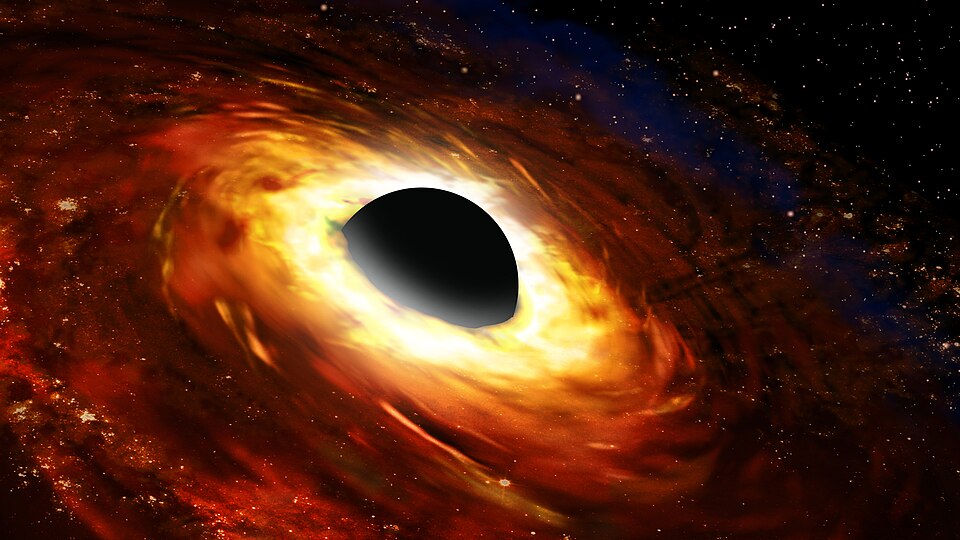
Black holes that are accreting matter from their surroundings are among the most luminous objects in the universe. As gas falls toward a black hole, conservation of angular momentum causes it to form a rotating accretion disk rather than plunging directly inward. Within the disk, viscous stresses — now understood to arise primarily from the magnetorotational instability — transport angular momentum outward, allowing matter to spiral inward while converting gravitational potential energy into thermal radiation.
.jpg)
The standard thin-disk model developed by Shakura and Sunyaev in 1973 parametrises this viscosity and predicts that for a non-rotating black hole accreting at moderate rates, the disk can convert approximately 6 percent of the rest-mass energy of the infalling material into radiation; for a maximally rotating Kerr black hole, this efficiency can reach approximately 42 percent, far exceeding the roughly 0.7 percent efficiency of hydrogen fusion in stars.7
At very low accretion rates, far below the Eddington limit, the accreting gas becomes optically thin and unable to radiate efficiently, entering a state known as a radiatively inefficient accretion flow (RIAF) or advection-dominated accretion flow (ADAF), in which the thermal energy generated by viscous dissipation is advected inward with the flow rather than radiated away. This regime applies to the supermassive black holes in quiescent galaxies, including Sgr A*, whose luminosity of roughly 1036 ergs per second is many orders of magnitude below what the Eddington luminosity would predict for its mass.23 At the opposite extreme, when the accretion rate approaches or exceeds the Eddington limit, radiation pressure puffs the inner disk into a geometrically thick structure, and outflows and winds become significant.
Many accreting black holes, across the entire mass range from stellar to supermassive, produce relativistic jets: narrowly collimated, bipolar outflows of magnetised plasma launched perpendicular to the accretion disk at velocities approaching the speed of light. The most powerful jets, seen in radio galaxies and blazars, extend for hundreds of kiloparsecs and carry kinetic luminosities that rival the radiative output of the accretion disk itself. The leading theoretical model for jet launching is the Blandford-Znajek mechanism, in which large-scale magnetic fields threading the ergosphere of a spinning black hole extract the rotational energy of the hole and channel it into a magnetically dominated outflow along the spin axis.8 The Blandford-Znajek mechanism naturally explains the observation that the most powerful jets are associated with rapidly spinning black holes, and numerical simulations of magnetised accretion flows have confirmed that this mechanism operates robustly in the general-relativistic magnetohydrodynamic regime.
Hawking radiation and the information paradox
In 1974, Stephen Hawking made the remarkable theoretical discovery that black holes are not perfectly black. Applying quantum field theory in the curved spacetime near a black hole's event horizon, Hawking showed that the vacuum fluctuations of quantum fields cause the black hole to emit a thermal spectrum of particles — now called Hawking radiation — with a temperature inversely proportional to the black hole's mass. For a stellar-mass black hole, this temperature is of order 10−8 kelvin, far below the temperature of the cosmic microwave background and therefore observationally undetectable with any foreseeable technology. However, as the black hole radiates, it loses mass and grows hotter, leading to a runaway process that, in principle, results in the complete evaporation of the black hole over a timescale vastly exceeding the current age of the universe for astrophysical black holes.9
Hawking radiation created a profound theoretical crisis known as the black hole information paradox. If a black hole forms from the collapse of matter in a pure quantum state and subsequently evaporates completely into thermal radiation — which by definition carries no information beyond its temperature — then the detailed quantum information about the initial state appears to be permanently destroyed, violating a fundamental principle of quantum mechanics known as unitarity. Hawking initially argued that black hole evaporation does indeed destroy information, implying a fundamental modification of quantum mechanics, but this position was challenged by physicists who argued that unitarity must be preserved and that the information must somehow be encoded in the Hawking radiation through subtle correlations.10
The information paradox remains one of the deepest open problems at the intersection of quantum mechanics and general relativity. Proposed resolutions include black hole complementarity, which posits that information is both reflected at the horizon and passes through it depending on the observer; the firewall proposal, which argues that the horizon must be a high-energy surface rather than a benign boundary; the fuzzball conjecture from string theory, which replaces the classical event horizon with a quantum-gravitational structure that encodes the black hole's microstates; and recent work on "islands" in the gravitational path integral, which appears to reproduce the expected unitary Page curve for the entropy of Hawking radiation. None of these proposals has achieved consensus, and a complete resolution likely requires a theory of quantum gravity.10
The black hole mass gap
Theoretical models of core-collapse supernovae predict that the explosion mechanism and the amount of fallback material conspire to produce a dearth of compact remnants with masses between approximately 3 and 5 solar masses — a range lying between the heaviest neutron stars and the lightest black holes. This predicted deficit, known as the lower mass gap, was supported by early observations of X-ray binaries, which found neutron stars clustering near 1.4 solar masses and black holes beginning at approximately 5 solar masses, with few or no objects in between.21
Gravitational-wave astronomy has begun to probe this mass gap directly. The LIGO-Virgo event GW190814, detected in August 2019 and published in 2020, involved the merger of a 23-solar-mass black hole with a 2.6-solar-mass compact object — placing the lighter component squarely in the mass gap, where it represents either the heaviest known neutron star or the lightest known black hole.19 The ambiguity itself is scientifically significant, highlighting that the boundary between neutron stars and black holes is not a sharp line but a transition region whose physics — involving the equation of state of ultra-dense matter and the details of supernova fallback — is still being elucidated. Additional gravitational-wave detections are expected to populate or depopulate this mass gap, providing crucial constraints on both supernova physics and the maximum mass of neutron stars.
Supermassive black hole and galaxy coevolution
One of the most unexpected discoveries in extragalactic astronomy is the existence of tight correlations between the masses of supermassive black holes and the large-scale properties of their host galaxies. In 2000, Ferrarese and Merritt demonstrated that the mass of a galaxy's central black hole correlates with the stellar velocity dispersion σ of its bulge as MBH ∝ σ4.8, a relationship now known as the M-σ relation.15 This correlation is remarkably tight — with an intrinsic scatter of only approximately 0.3 dex — despite the enormous disparity in physical scale between the black hole (with a gravitational sphere of influence extending over parsecs) and the bulge (extending over kiloparsecs). The existence of the M-σ relation implies that the growth of the supermassive black hole and the assembly of the stellar bulge are somehow regulated by a common process, even though the black hole constitutes only roughly 0.1 to 0.5 percent of the bulge mass.15, 16
The leading theoretical framework for explaining this coevolution invokes active galactic nucleus (AGN) feedback: energy released by the accreting supermassive black hole in the form of radiation, winds, and jets heats or expels the gas in the host galaxy, suppressing star formation and further black hole accretion in a self-regulating cycle. In massive elliptical galaxies and galaxy clusters, the kinetic energy of radio jets inflates cavities in the hot intracluster medium that offset radiative cooling losses, preventing the runaway condensation of gas that would otherwise produce far more stars than are observed.16 This "maintenance-mode" feedback is directly observed in X-ray images of galaxy clusters and represents one of the strongest pieces of evidence that supermassive black holes play an active role in shaping their galactic environments.
Comprehensive reviews of the scaling relations have confirmed that black hole mass correlates not only with velocity dispersion but also with bulge luminosity, bulge mass, and the concentration of the stellar light profile, though importantly not with the properties of the galaxy's disk component in spiral galaxies.16 This distinction supports a picture in which supermassive black holes coevolve specifically with the classical bulge component — built through mergers and violent relaxation — rather than with the galaxy as a whole.
The M-σ relation: black hole mass versus bulge velocity dispersion15, 16
Black holes in the early universe
The James Webb Space Telescope (JWST), launched in December 2021, has transformed the study of black holes in the early universe by detecting accreting supermassive black holes at redshifts previously inaccessible to observation. Among the most significant early findings was the identification of an X-ray luminous quasar at a redshift of approximately 10.3, designated UHZ1, discovered behind the galaxy cluster Abell 2744 through the combined capabilities of JWST and the Chandra X-ray Observatory. The inferred black hole mass of roughly 107 to 108 solar masses at a cosmic age of only approximately 470 million years after the Big Bang is difficult to reconcile with models in which supermassive black holes grow from stellar-mass seeds through standard Eddington-limited accretion, because there is simply not enough time for a seed of 10 to 100 solar masses to grow by such a large factor.20
The UHZ1 discovery and similar JWST detections of massive black holes at redshifts of 7 to 10 have lent significant support to heavy seed models of supermassive black hole formation. In these models, black holes form directly from the collapse of massive gas clouds in the early universe, bypassing the stellar phase entirely and producing seeds of 104 to 106 solar masses that can then grow to their observed sizes through more modest accretion. The direct-collapse scenario requires specific conditions — including the suppression of molecular hydrogen cooling by a strong ultraviolet radiation field and the absence of metals and dust — but JWST observations are beginning to provide the empirical constraints needed to test whether such conditions existed in the early universe.20, 22
An alternative explanation invokes super-Eddington accretion, in which black holes accrete matter at rates exceeding the classical Eddington limit. The Eddington limit is derived from the balance between gravitational infall and outward radiation pressure for spherically symmetric accretion, but if accretion proceeds through a geometrically thick disk that can advect radiation inward, the effective accretion rate can exceed the Eddington value by factors of 10 to 100 for sustained periods.22 Whether such sustained super-Eddington accretion is physically realised in the early universe remains an active area of theoretical and observational investigation. The ongoing JWST surveys are expected to discover additional high-redshift black holes, progressively tightening the constraints on seed masses, accretion histories, and the interplay between the earliest black holes and the galaxies they inhabit.
References
First M87 Event Horizon Telescope results. I. The shadow of the supermassive black hole
First Sagittarius A* Event Horizon Telescope results. I. The shadow of the supermassive black hole in the center of the Milky Way
GW190814: gravitational waves from the coalescence of a 23 solar mass black hole with a 2.6 solar mass compact object
Evidence for heavy-seed origin of early supermassive black holes from a z ≈ 10 X-ray quasar