Overview
- Supermassive black holes, with masses ranging from one million to tens of billions of solar masses, reside at the centres of nearly all massive galaxies and power the most luminous persistent objects in the universe — active galactic nuclei and quasars — through the gravitational accretion of surrounding matter.
- Two independent teams led by Reinhard Genzel and Andrea Ghez tracked individual stellar orbits around the Milky Way's central black hole Sagittarius A* for over two decades, determining its mass at approximately 4 million solar masses and earning the 2020 Nobel Prize in Physics, while the Event Horizon Telescope produced the first direct images of the supermassive black holes in M87 (2019) and Sgr A* (2022).
- JWST discoveries of massive black holes at redshifts beyond 8 — existing when the universe was less than 650 million years old — challenge standard light-seed growth models and have intensified interest in heavy-seed formation pathways such as direct collapse of primordial gas clouds.
Supermassive black holes are black holes with masses ranging from approximately one million to tens of billions of times the mass of the Sun. They reside at the dynamical centres of nearly all massive galaxies in the observable universe and exert a gravitational influence that extends far beyond their immediate surroundings, shaping the evolution of their host galaxies across cosmic time.6, 8 When matter falls toward a supermassive black hole and forms a luminous accretion disk, the resulting energy output can outshine the entire host galaxy, producing the phenomenon known as an active galactic nucleus. The most luminous of these — quasars — are visible across most of the observable universe and serve as probes of cosmic structure at the earliest epochs.1, 2
The existence of supermassive black holes was first inferred indirectly from the extraordinary luminosities of quasars in the 1960s and has since been confirmed through increasingly precise observations: stellar orbital tracking in the Milky Way's Galactic centre, dynamical modelling of gas and stars in external galaxies, and the direct imaging of event-horizon-scale structure by the Event Horizon Telescope.18, 20 How these objects formed and grew to such extreme masses — particularly those already in place when the universe was less than a billion years old — remains one of the central open questions in modern astrophysics.12
Discovery and early evidence
The conceptual path toward supermassive black holes began with the discovery of quasars. In 1963, Maarten Schmidt measured the optical spectrum of the radio source 3C 273 and found that its emission lines were redshifted by 0.158, placing the object at a cosmological distance of roughly two billion light-years.1 At that distance, 3C 273's apparent brightness implied a luminosity of approximately 1013 solar luminosities — far exceeding the total output of any known galaxy — emanating from a region smaller than the Solar System. No known stellar process could produce such energy from such a compact volume. Within a few years, dozens of similar objects were identified at a range of redshifts, establishing quasars as a new class of extragalactic source demanding a fundamentally new energy mechanism.
In 1969, Donald Lynden-Bell proposed that quasars are powered by the gravitational accretion of matter onto supermassive black holes, and that the dormant remnants of this earlier activity should still reside at the centres of nearby galaxies as quiescent massive dark objects.2 This hypothesis — that present-day galaxy centres harbour the relics of past quasar activity — proved remarkably prescient and became the conceptual foundation for the modern understanding of galactic nuclei. In 1982, Andrzej Soltan strengthened this picture quantitatively by showing that the total energy radiated by all quasars over cosmic history, when converted to mass using a reasonable radiative efficiency, implies a total mass in remnant black holes consistent with the supermassive black hole population inferred from dynamical measurements of nearby galaxies.13 This argument — now called the Soltan argument — demonstrated that most supermassive black hole mass was accumulated through radiatively efficient accretion during active phases.
The first detection of a compact radio source at the dynamical centre of the Milky Way came in 1974, when Bruce Balick and Robert Brown identified an intense, sub-arcsecond radio source using the Green Bank interferometer, a source subsequently named Sagittarius A* (Sgr A*).3 Although its nature was initially uncertain, the combination of its precise location at the Galaxy's kinematic centre, its unusual radio spectrum, and its lack of detectable proper motion all pointed toward a massive compact object rather than a conventional stellar source.
Sagittarius A* and the Galactic centre
The most compelling evidence that Sgr A* is a supermassive black hole comes from the orbital tracking of individual stars in its immediate vicinity. Beginning in the early 1990s, two independent research programmes — one led by Reinhard Genzel at the Max Planck Institute for Extraterrestrial Physics using the European Southern Observatory's Very Large Telescope, and another led by Andrea Ghez at the University of California, Los Angeles using the W. M. Keck Observatory — monitored the proper motions and radial velocities of stars within arcseconds of Sgr A* using adaptive optics in the near-infrared.17, 18


The star S2 (also designated S0-2) proved especially informative. Over a monitoring baseline exceeding twenty years, S2 was observed to complete a full orbit around Sgr A* with a period of approximately 16 years, an orbital eccentricity of 0.88, and a closest approach of only about 120 astronomical units — roughly 1,400 Schwarzschild radii of the central mass.16 The combination of its short orbital period, high velocity at pericentre approach (approximately 7,700 kilometres per second, or roughly 2.6 percent of the speed of light), and the clean Keplerian nature of its orbit allowed both teams to determine the enclosed mass with extraordinary precision: approximately 4.0 × 10⁶ solar masses, confined within a volume so small that no stable configuration of matter other than a black hole could account for it.17, 18 This work earned Genzel and Ghez a share of the 2020 Nobel Prize in Physics.
In 2022, the Event Horizon Telescope (EHT) — a global network of millimetre-wavelength radio telescopes operating as a single Earth-sized interferometer — released the first direct image of Sgr A*, revealing a bright ring of emission surrounding a central brightness depression consistent with the shadow cast by the black hole's event horizon on the surrounding emission.19 The ring diameter of approximately 52 microarcseconds matched the prediction of general relativity for a black hole of 4 million solar masses at a distance of approximately 27,000 light-years, providing an independent confirmation of the mass derived from stellar orbits and a direct visual demonstration of the strong-gravity environment at the heart of the Milky Way.
M87* and event horizon imaging
Three years before the Sgr A* image, the EHT produced the first-ever image of a black hole shadow: that of the supermassive black hole at the centre of the giant elliptical galaxy Messier 87, designated M87*.20 Using observations at a wavelength of 1.3 millimetres taken in April 2017, the collaboration reconstructed an image showing an asymmetric ring of emission with a diameter of approximately 42 microarcseconds, encircling a central dark region. The asymmetry in the ring brightness arises from relativistic beaming: the plasma orbiting the black hole at near-light speeds appears brighter on the side of the disk where it is moving toward the observer.
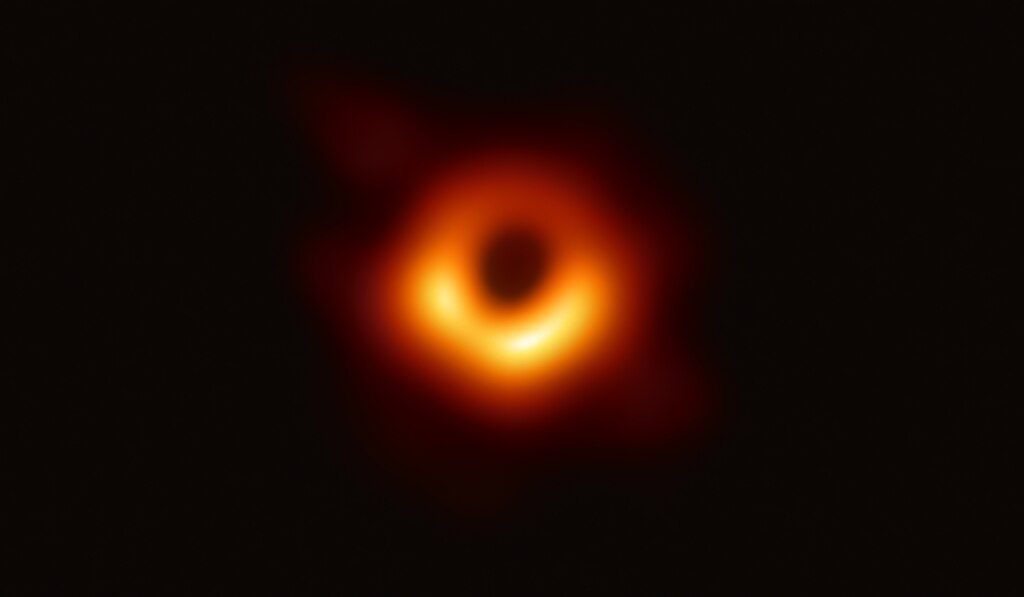

The angular size of the ring, combined with the known distance to M87 of approximately 55 million light-years, implied a black hole mass of approximately 6.5 × 10⁹ solar masses, consistent with earlier estimates from stellar dynamics.20 M87* is one of the most massive black holes known, residing in one of the largest galaxies in the local universe, and it powers a prominent relativistic jet extending more than 5,000 light-years from the nucleus. The EHT result demonstrated that the observed ring structure is consistent with the predictions of general relativity for the photon ring — the lensed image of emission orbiting near the innermost stable circular orbit — around a Kerr black hole, providing a powerful test of gravity in the strong-field regime.
Demographics and scaling relations
By the mid-1990s, dynamical surveys using the Hubble Space Telescope and ground-based spectrographs had established that supermassive black holes are not rare objects found only in active galaxies but are instead a generic feature of massive galaxies. Kormendy and Richstone's 1995 review compiled the evidence from resolved stellar and gas kinematics in dozens of nearby galaxies, concluding that most galaxies with prominent bulge components harbour central dark masses consistent with supermassive black holes.6
A breakthrough in understanding the relationship between supermassive black holes and their host galaxies came in 2000, when two independent studies by Ferrarese and Merritt and by Gebhardt and colleagues discovered a tight correlation between the mass of the central black hole and the stellar velocity dispersion (σ) of the host galaxy's bulge.4, 5 This M–σ relation, expressed approximately as MBH ∝ σ4–5, is remarkably tight: the black hole mass can be predicted from the bulge velocity dispersion alone with a scatter of only about 0.3 dex. Subsequent work by McConnell and Ma updated the relation with a larger sample and found a best-fit slope of approximately 5.6 for early-type galaxies.7
The existence of the M–σ relation and other correlations between black hole mass and host galaxy properties — including bulge luminosity, bulge mass, and Sérsic index — implies that the growth of supermassive black holes and the assembly of stellar bulges are physically linked, despite the vast difference in spatial scale between the black hole's gravitational sphere of influence and the galaxy as a whole.8 The most widely discussed mechanism for this coupling is AGN feedback: energy and momentum injected into the interstellar medium by the active black hole during accretion episodes can heat or expel gas, suppressing star formation and regulating both the growth of the bulge and the further growth of the black hole itself.15 Silk and Rees showed in 1998 that the energy output from a quasar accreting at or near the Eddington limit would be sufficient to unbind the gas in the host galaxy's potential well when the black hole reaches a mass consistent with the observed scaling relations, providing a natural self-regulation mechanism.15
The M–σ relation: black hole mass versus stellar velocity dispersion4, 7
Active galactic nuclei and quasars
A supermassive black hole that is actively accreting matter produces an active galactic nucleus (AGN), a compact central region whose luminosity can dominate the total output of its host galaxy across the electromagnetic spectrum from radio wavelengths through gamma rays. The standard model attributes this emission to the conversion of gravitational potential energy into radiation as matter spirals inward through a hot accretion disk, with radiative efficiencies of 6 to 42 percent depending on the black hole's spin — far exceeding the less than 1 percent efficiency of nuclear fusion.9
AGN are observed in a striking variety of forms — Seyfert galaxies, quasars, blazars, radio galaxies, and low-ionization nuclear emission-line regions (LINERs) — but the unified model proposed by Urry and Padovani in 1995 showed that much of this phenomenological diversity can be explained by a single underlying structure viewed at different orientations.14 In this framework, every AGN consists of a central supermassive black hole surrounded by an accretion disk, a dusty toroidal structure at larger radii, and, in radio-loud objects, a pair of relativistic jets. When the observer's line of sight lies close to the jet axis, the nucleus appears as a blazar with rapid variability and apparent superluminal motion; at intermediate angles, the broad emission-line region is visible and the object is classified as a type 1 Seyfert or quasar; and at high inclinations, the dusty torus obscures the broad-line region, yielding a type 2 Seyfert or narrow-line radio galaxy.14
Quasars represent the most luminous end of the AGN population. The most distant quasars known, at redshifts exceeding 6, are powered by black holes of more than a billion solar masses that were already in place when the universe was less than a billion years old.25 The existence of such massive objects at such early times places stringent constraints on formation and growth models, because even continuous accretion at the theoretical maximum rate — the Eddington limit, where radiation pressure balances gravity — requires seed black holes significantly more massive than those left behind by ordinary stellar evolution.12
Formation and seeding mechanisms
How supermassive black holes formed and grew to their observed masses is one of the most actively debated questions in astrophysics. The difficulty is particularly acute for the high-redshift population: a stellar-mass seed of 10 to 100 solar masses accreting continuously at the Eddington limit with a standard radiative efficiency of 10 percent requires approximately 800 million years to reach one billion solar masses — longer than the age of the universe when the most distant quasars are observed.12 Three broad categories of seed formation have been proposed.
The light-seed scenario proposes that the first supermassive black holes grew from the remnants of Population III stars — the first generation of stars, formed from metal-free primordial gas at redshifts of 20 to 30 — which may have left behind black holes of roughly 10 to 300 solar masses.9, 11 Growth from such small seeds to billions of solar masses by redshift 7 requires sustained super-Eddington accretion, extremely low radiative efficiency, or very early formation, all of which face theoretical challenges. Simulations suggest that radiative feedback from the growing black hole tends to limit accretion below the Eddington rate for much of the growth history, making it difficult for light seeds to reach the observed masses within the available time.12
The heavy-seed or direct-collapse scenario bypasses the stellar mass bottleneck by proposing that massive gas clouds in the early universe collapse directly into black holes of 104 to 106 solar masses without fragmenting into stars.10 This requires conditions that suppress molecular hydrogen cooling — the primary coolant in metal-free gas — such as an intense external ultraviolet radiation field from a nearby star-forming galaxy. Under these conditions, the gas cloud contracts quasi-isothermally at temperatures of approximately 104 kelvin, avoiding fragmentation and collapsing into a single supermassive object or an intermediary supermassive star that subsequently collapses into a black hole.10, 11 Heavy seeds can reach quasar-level masses by redshift 7 through sub-Eddington accretion alone, easing the growth-time problem considerably.
A third pathway involves the runaway merger of stars or stellar-mass black holes in dense nuclear star clusters at high redshift, producing intermediate-mass seeds of 103 to 104 solar masses that then grow through accretion.11, 12 Recent observations from JWST have provided new constraints on these scenarios, with the detection of actively accreting black holes at redshifts beyond 8 whose inferred masses and host galaxy properties are more consistent with heavy-seed origins than with light-seed growth.22
Proposed supermassive black hole seeding mechanisms11, 12
| Mechanism | Seed mass (M⊙) | Redshift of formation | Key requirement |
|---|---|---|---|
| Population III remnants (light seeds) | 10–300 | z ∼ 20–30 | Sustained super-Eddington accretion |
| Direct collapse (heavy seeds) | 104–106 | z ∼ 10–20 | Suppressed H2 cooling; strong UV field |
| Runaway stellar mergers | 103–104 | z ∼ 10–20 | Dense nuclear star cluster |
Growth through accretion and mergers
Once a seed black hole is in place, it grows primarily through two channels: the accretion of gas and the merger with other black holes following galaxy mergers.

The relative importance of these two channels has been debated extensively, but the Soltan argument provides a powerful constraint. By comparing the total energy density radiated by AGN over cosmic history (derived from quasar luminosity functions) with the local mass density in supermassive black holes (derived from the M–σ relation and galaxy surveys), Soltan showed that the bulk of supermassive black hole mass was accumulated through radiatively efficient accretion, implying that mergers play a secondary role in the overall mass budget.13
The rate at which a black hole can accrete is governed by the Eddington limit — the luminosity at which the outward radiation pressure on infalling electrons (through Thomson scattering) balances the inward gravitational force. For a black hole accreting at the Eddington rate with a radiative efficiency of 10 percent, the mass-doubling time (the Salpeter time) is approximately 45 million years.9 Sustained accretion at this rate would allow a stellar-mass seed to grow to a billion solar masses in roughly 800 million years, but maintaining such accretion without interruption is difficult: AGN feedback, galaxy interactions, and the finite supply of gas in the nuclear region all act to modulate the accretion rate over time.12, 15
Galaxy mergers contribute to supermassive black hole growth both indirectly — by funnelling gas toward the galactic centre and triggering accretion episodes — and directly, through the eventual coalescence of the two supermassive black holes that each merging galaxy contributes. After a galaxy merger, dynamical friction causes the two black holes to spiral toward the centre of the merged remnant, forming a gravitationally bound binary at a separation of roughly one parsec.8 The subsequent evolution of this binary through the "final parsec" to a separation where gravitational wave emission drives rapid inspiral and coalescence is an area of active research, with implications for both gravitational wave astronomy and the demographics of binary and recoiling supermassive black holes.
JWST and the early universe
The James Webb Space Telescope (JWST), launched in December 2021, has transformed the study of supermassive black holes in the early universe by enabling spectroscopic identification of active black holes at redshifts previously inaccessible. In 2023, Larson and colleagues reported the detection of an accreting supermassive black hole at redshift 8.7 — corresponding to a time just 570 million years after the Big Bang — identified through broad hydrogen emission lines in JWST's Near Infrared Spectrograph data as part of the Cosmic Evolution Early Release Science (CEERS) programme.21 The inferred black hole mass of approximately 10 million solar masses, residing in a relatively low-mass host galaxy, suggests rapid early growth that is difficult to reconcile with light-seed models.
Even more striking was the detection reported by Bogdán and colleagues in 2024 of an X-ray luminous quasar at redshift approximately 10.3, observed in Chandra X-ray Observatory data of a gravitationally lensed source identified by JWST.22 The inferred black hole mass is comparable to the total stellar mass of its host galaxy — a ratio far exceeding that seen in the local universe, where black holes typically constitute only about 0.1 to 0.2 percent of the host bulge mass. This extreme mass ratio is more naturally explained by heavy-seed formation, in which the black hole begins with a mass comparable to or exceeding the initial stellar mass of its host, than by light-seed models that predict the black hole should lag behind the stellar growth of its galaxy.
Maiolino and colleagues further deepened the puzzle in 2024 with JWST spectroscopy of the galaxy GN-z11 at redshift 10.6, revealing a vigorously accreting black hole of approximately 1.6 × 10⁶ solar masses just 430 million years after the Big Bang.23 Taken together, these JWST discoveries indicate that supermassive black hole formation commenced very early in cosmic history and proceeded through pathways that produced massive seeds more efficiently than previously anticipated, significantly narrowing the viable parameter space for theoretical models.
Gravitational wave signatures
The coalescence of supermassive black hole binaries following galaxy mergers produces gravitational waves at nanohertz frequencies — oscillation periods of years to decades — far below the sensitivity band of ground-based detectors like LIGO and Virgo, which are designed for stellar-mass mergers. Detection of these signals requires a fundamentally different approach: pulsar timing arrays (PTAs), which monitor the arrival times of radio pulses from an ensemble of millisecond pulsars distributed across the sky and search for the correlated timing residuals that a passing gravitational wave would imprint.24
In 2023, the NANOGrav collaboration, analysing 15 years of pulsar timing data from 67 millisecond pulsars, reported compelling evidence for a stochastic gravitational wave background at nanohertz frequencies.24 The signal, characterised by a common-spectrum red-noise process with a strain amplitude consistent with theoretical predictions for a population of inspiralling supermassive black hole binaries, was independently confirmed by the European Pulsar Timing Array, the Parkes Pulsar Timing Array, and the Chinese Pulsar Timing Array in concurrent publications. While the characteristic Hellings-Downs angular correlation pattern that would definitively identify the signal as gravitational in origin had not yet reached the conventional five-sigma detection threshold, the consistency across independent datasets and the agreement with astrophysical models strongly favoured a gravitational wave interpretation.24
The planned space-based interferometer LISA (Laser Interferometer Space Antenna), expected to launch in the mid-2030s, will observe the millihertz gravitational wave band and will be sensitive to the final inspiral and merger of supermassive black hole binaries with combined masses of 104 to 107 solar masses out to high redshifts. LISA is predicted to detect tens to hundreds of such events per year, enabling precision measurements of black hole masses, spins, and distances and providing a census of black hole mergers across cosmic history that is impossible with electromagnetic observations alone.12
Open questions
Despite remarkable observational progress, several fundamental questions about supermassive black holes remain unresolved. The formation mechanism of the first seed black holes is still debated: while JWST observations increasingly favour heavy seeds in at least some systems, the relative contributions of direct collapse, Population III remnants, and runaway mergers to the overall seed population remain unknown.12, 22 The physics of the "final parsec problem" — how two supermassive black holes in a merged galaxy lose enough angular momentum to transition from a parsec-scale binary to the sub-milliparsec separations where gravitational wave emission takes over — is not yet fully understood, though interactions with surrounding gas and stars provide plausible mechanisms.8
The detailed physics of AGN feedback and its role in galaxy evolution continues to be refined. While the correlations between black hole mass and host galaxy properties clearly indicate a physical connection, the specific mechanisms by which energy from the active nucleus couples to gas on galactic scales — whether through radiation pressure, jets, winds, or some combination — and the efficiency of this coupling remain active areas of theoretical and observational investigation.8, 15 Observations with JWST, next-generation radio observatories, and future gravitational wave detectors are expected to provide increasingly stringent constraints on these processes, offering the prospect of a comprehensive picture of how supermassive black holes and galaxies co-assemble across the full span of cosmic time.12, 24
References
Measuring distance and properties of the Milky Way's central supermassive black hole with stellar orbits
First Sagittarius A* Event Horizon Telescope results. I. The shadow of the supermassive black hole in the center of the Milky Way
First M87 Event Horizon Telescope results. I. The shadow of the supermassive black hole
A CEERS discovery of an accreting supermassive black hole 570 Myr after the Big Bang: identifying a progenitor of massive z > 6 quasars
Evidence for heavy-seed origin of early supermassive black holes from a z ≈ 10 X-ray quasar
A survey of z > 5.7 quasars in the Sloan Digital Sky Survey. II. Discovery of three additional quasars at z > 6