Overview
- Galaxies are not primordial features of the universe but grew hierarchically over billions of years, with dark matter halos providing the gravitational scaffolding within which ordinary matter collapsed, cooled, and formed stars.
- The Hubble sequence of galaxy morphologies — ellipticals, spirals, and irregulars — reflects different evolutionary histories, with mergers playing the dominant role in transforming spiral galaxies into the massive ellipticals that inhabit today's galaxy clusters.
- Every large galaxy hosts a supermassive black hole at its center, and the co-evolution of these black holes with their host galaxies, mediated by energetic feedback from active galactic nuclei, is now understood to be a key driver of cosmic star-formation history.
Galaxies are among the largest gravitationally bound structures in the universe. The Milky Way alone contains somewhere between 100 and 400 billion stars, bound together with vast clouds of gas and dust, threaded through with invisible dark matter, and anchored at its center by a supermassive black hole roughly four million times the mass of the Sun.12 Yet this architecture was not present at the beginning of cosmic time. In the first few hundred thousand years after the Big Bang, the universe was an almost featureless ocean of hot plasma, nearly uniform in every direction. The story of galaxy formation is the story of how gravity, acting on the faintest of initial irregularities over billions of years, built up every galaxy, star, and planet that exists today.1, 2
Seeds of structure: density perturbations
The foundations of every galaxy in the observable universe were laid down in the first fraction of a second of cosmic history, during the inflationary epoch. Quantum fluctuations — tiny, random variations in the energy density of the primordial universe — were stretched by the exponential expansion of inflation to macroscopic scales, imprinting a faint pattern of slightly overdense and underdense regions across the young cosmos.1 These density contrasts were extraordinarily small: overdense regions exceeded their surroundings by only about one part in one hundred thousand, a fact confirmed with extraordinary precision by measurements of the cosmic microwave background radiation.20
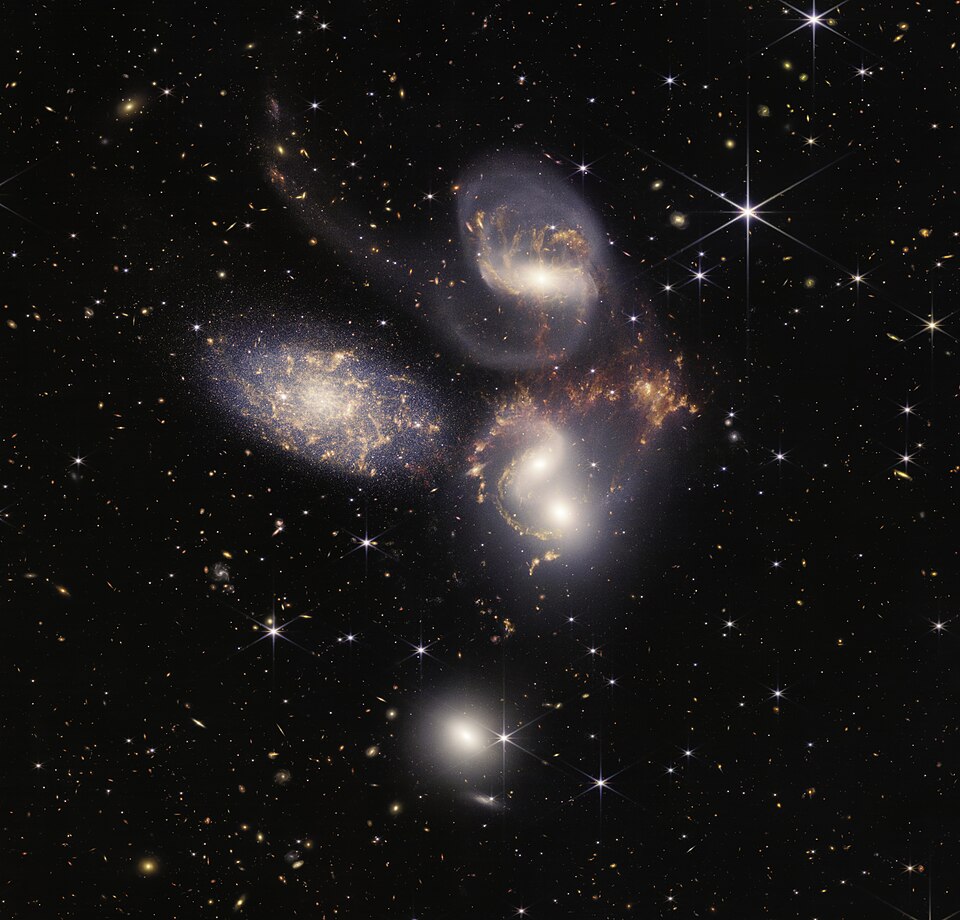

As the universe expanded and cooled following the Big Bang, gravitational instability began to amplify these primordial perturbations. Regions that were even slightly denser than average attracted more matter from their surroundings, becoming denser still, which increased their gravitational pull further. This process, described mathematically by the Jeans instability criterion, is self-reinforcing: mass begets gravity, gravity begets more mass.1 The critical question for structure formation is what kind of matter dominated this collapse, and the answer lies with dark matter.
Dark matter — a form of matter that does not interact with electromagnetic radiation and therefore emits no light — constitutes approximately 27 percent of the total energy content of the universe, compared to roughly five percent for ordinary baryonic matter.2, 20 Because dark matter does not interact with photons, it is immune to the radiation pressure that kept ordinary matter almost perfectly smooth until the epoch of recombination, around 380,000 years after the Big Bang. As a result, dark matter perturbations began growing much earlier than those in ordinary matter, giving dark matter structures a crucial head start on structure formation.4
Dark matter halos as cosmic scaffolding
The first structures to collapse under gravity in the early universe were small clumps of dark matter. As these clumps merged and accreted material over cosmic time, they built up progressively larger dark matter halos: roughly spherical, gravitationally bound concentrations of dark matter that range in mass from dwarf-galaxy-scale halos of around a million solar masses to the enormous halos of galaxy clusters containing trillions of solar masses.3, 4 This process of building large structures from the merging of smaller ones is called hierarchical structure formation, and it is a robust prediction of the cold dark matter cosmological model confirmed by decades of numerical simulations and observational evidence.2, 20
The internal density profile of dark matter halos follows a characteristic shape first described analytically by Julio Navarro, Carlos Frenk, and Simon White in 1997, now known as the NFW profile. The NFW profile predicts that dark matter density rises steeply toward the halo center and falls off as the inverse square of distance at large radii, a shape that has been confirmed observationally through gravitational lensing measurements of galaxy clusters.3
Ordinary baryonic matter — primarily hydrogen and helium gas — falls into the potential wells created by dark matter halos. As this gas collapses, it undergoes a critical physical process: it cools. The gas radiates away its thermal energy through atomic line emission and other cooling processes, allowing it to collapse further. Cooling is effective only when the gas density is high enough and the temperature is in an appropriate range, conditions that are met within the centers of dark matter halos. The cooled, dense gas eventually reaches the conditions necessary for gravitational collapse into stars, and a galaxy is born.4, 24
Galaxy morphology: the Hubble sequence
Edwin Hubble first classified the variety of galaxy shapes into an organized system in the 1920s and 1930s, producing what became known as the Hubble tuning fork diagram — so named because when drawn as a branching classification tree, it resembles a tuning fork.5, 6 The scheme divides galaxies into three broad morphological types: ellipticals, spirals, and irregulars, with lenticular (S0) galaxies occupying a transitional position between ellipticals and spirals.
Elliptical galaxies, designated E0 through E7 based on their apparent ellipticity, are smooth, featureless systems dominated by old, red stars with little ongoing star formation and little cold gas or dust.6 They range in size from compact dwarf ellipticals smaller than globular clusters to the enormous cD galaxies at the centers of rich galaxy clusters, which can contain several trillion solar masses of stars. Their stellar orbits are largely random and chaotic rather than organized into a rotating disk, and their three-dimensional shapes are thought to be triaxial ellipsoids rather than simple oblate spheroids.8
Spiral galaxies, by contrast, are organized into a flattened, rotating disk with a central bulge of older stars and a surrounding halo. The disk contains younger, bluer stars, abundant gas and dust, and active ongoing star formation.6, 25 They are subdivided into normal spirals (S) and barred spirals (SB), based on whether a bar-shaped structure of stars crosses the nucleus. The subclassifications a, b, and c indicate the tightness of the spiral arms and the relative prominence of the central bulge: Sa/SBa galaxies have tightly wound arms and large bulges, while Sc/SBc galaxies have loosely wound arms and small bulges.6 Irregular galaxies, the third major category, lack the organized symmetry of ellipticals or spirals and include systems distorted by interactions with neighboring galaxies as well as genuinely chaotic dwarf systems.25
The Hubble sequence does not represent an evolutionary sequence in any simple sense — ellipticals do not evolve into spirals or vice versa in a straightforward progression. Rather, the different morphological types reflect different formation histories, different amounts of angular momentum in the gas from which they formed, and different merger and interaction histories.22, 25
Summary of the Hubble morphological sequence6, 25
| Type | Key features | Star formation | Typical stellar population |
|---|---|---|---|
| Elliptical (E0–E7) | Smooth, no disk, little gas or dust | Minimal | Old, red stars |
| Lenticular (S0/SB0) | Disk + bulge, no spiral arms, little gas | Very low | Predominantly old |
| Spiral (Sa–Sc) | Disk, bulge, spiral arms, gas and dust | Active | Mixed young and old |
| Barred spiral (SBa–SBc) | Bar through center, disk, spiral arms | Active | Mixed young and old |
| Irregular (Irr) | No defined structure | Often vigorous | Variable |
Spiral arm formation and density wave theory
The spiral arms of disk galaxies present an elegant physical puzzle. Stars and gas orbit the galactic center at speeds that vary with distance from the center — inner regions orbit faster than outer regions in most galaxies. If spiral arms were composed of fixed groups of stars, differential rotation would wind the arms tighter and tighter until they disappeared within a few galactic orbits. Yet spiral galaxies maintain their beautiful arms for billions of years. This is the "winding problem," and its resolution was provided by the density wave theory developed by C. C. Lin and Frank Shu in 1964.7
According to density wave theory, spiral arms are not fixed collections of stars but rather wave-like regions of enhanced density — essentially traffic jams — that rotate more slowly than the stars and gas that pass through them. Stars and interstellar gas clouds orbit the galactic center and encounter the denser spiral arm regions, slowing down temporarily as they pass through the denser region before speeding up again as they emerge from the other side.7 The spiral arm pattern persists even as individual stars continuously flow through it, much as a traffic jam persists on a highway even as individual cars pass through and continue on their way.
The observational consequence of this mechanism is that spiral arms are sites of enhanced star formation. As interstellar gas clouds enter the compressed region of a spiral arm, they are shocked and compressed to higher densities, triggering gravitational collapse and the formation of new stars.24 The young, hot, blue stars formed in spiral arms light up those arms from within, making them visually prominent in blue and ultraviolet light. Because these massive stars live only a few million years before exploding as supernovae, they are destroyed before they can travel far from their birthplace in the spiral arm, reinforcing the visual contrast between the young arms and the older stellar disk surrounding them.24
Galaxy mergers and interactions
Galaxies are not isolated island universes floating in isolation. They exist within the cosmic web of dark matter filaments and void regions, gathered into groups and clusters where gravitational interactions and mergers are common over cosmic timescales.8, 19 When two galaxies approach each other, their mutual gravity raises tidal forces that distort their shapes, pulling out long streamers of stars and gas known as tidal tails and bridges. These tidal distortions can be spectacular: the pair of interacting galaxies known as the Antennae (NGC 4038 and NGC 4039) displays prominent tidal tails extending more than 100 kiloparsecs from the main bodies of the merging system.9


During the merger of two comparable-mass galaxies — a major merger — the orderly disk structures of both progenitors are largely destroyed as their stars are scattered onto chaotic orbits by the rapid change in gravitational potential. Computer simulations and observations both confirm that the end product of a major merger between two spiral galaxies is typically an elliptical galaxy or a spheroid-dominated system, as the organized rotational motion of the spirals is converted into the random orbital motion characteristic of ellipticals.8, 10 This mechanism — the transformation of spirals into ellipticals through mergers — is now thought to explain why the most massive elliptical galaxies are found preferentially at the centers of galaxy clusters, environments where repeated mergers are most likely to occur over cosmic time.22
Galaxy mergers are also extraordinarily efficient at triggering star formation. As two gas-rich galaxies collide, their interstellar gas clouds collide and are compressed, producing intense bursts of star formation called starbursts. Observations of the Antennae galaxies reveal star formation rates tens to hundreds of times higher than in undisturbed spiral galaxies like the Milky Way, with numerous young star clusters formed in the densely compressed gas at the overlap region between the two galaxies.9 These merger-induced starbursts are thought to have been particularly important in the early universe, when galaxies were more gas-rich and mergers more frequent, contributing significantly to the cosmic star-formation history.23
Active galactic nuclei and supermassive black holes
At the center of nearly every large galaxy lies a supermassive black hole, with masses ranging from a few million to several billion solar masses.11 When a supermassive black hole is actively accreting material from its surroundings, the system is termed an active galactic nucleus (AGN), which encompasses quasars, Seyfert galaxies, radio galaxies, and blazars — different observational manifestations of the same underlying physical process. The accretion disk surrounding the black hole can outshine the entire stellar content of the host galaxy by a factor of thousands, making quasars visible across virtually the entire observable universe.16, 26
A pivotal discovery emerging from the 1990s and 2000s was that the masses of supermassive black holes are tightly correlated with properties of their host galaxies — specifically, the mass of the stellar bulge and the velocity dispersion of stars in that bulge. This empirical relationship, known as the M-sigma (M–σ) relation, implies that black holes and their host galaxies did not grow independently but co-evolved through processes linking them across vastly different physical scales.11
The physical mechanism linking black holes to their hosts is now understood to operate through AGN feedback. As a supermassive black hole accretes gas, it releases enormous amounts of energy in the form of radiation and powerful jets of plasma. This energy couples to the surrounding gas in the galaxy, heating it, driving galactic-scale winds, and ultimately quenching star formation by expelling or heating the cold gas that would otherwise collapse into new stars.10 Numerical simulations have demonstrated that without AGN feedback, cosmological models predict far more massive galaxies than are actually observed — confirming that black hole feedback is a necessary ingredient in any realistic model of galaxy formation.10, 20
Cosmic star formation rate density as a function of redshift (lookback time)23
The cosmic web and large-scale structure
Galaxies are not distributed randomly throughout space. On the largest scales accessible to observation, the universe exhibits a complex, sponge-like architecture known as the cosmic web: dense filaments and sheets of galaxies surrounding vast, nearly empty regions called voids.19
Galaxy clusters — the most massive gravitationally bound structures in the universe, containing hundreds to thousands of galaxies embedded in hot X-ray-emitting gas and dark matter — sit at the nodes where multiple filaments intersect. The filaments themselves are highways along which galaxies and intergalactic gas flow toward the cluster nodes, feeding their continued growth.20
The cosmic web was predicted by theoretical models of gravitational instability long before it was confirmed observationally. The first clear observational evidence came from early galaxy redshift surveys in the 1980s, which revealed the filamentary and void structure of the nearby universe.19 Subsequent surveys, culminating in large programs such as the Sloan Digital Sky Survey (SDSS), mapped millions of galaxies across billions of light-years, confirming in extraordinary detail the predictions of cold dark matter cosmological models.22 The Millennium Simulation, published in 2005, demonstrated that a single cold dark matter cosmological model could reproduce the statistical properties of the observed cosmic web, galaxy clustering, and galaxy morphologies with remarkable fidelity.20
The environment in which a galaxy lives within the cosmic web has profound consequences for its properties. Galaxies in dense cluster environments are more likely to be elliptical in morphology, red in color, and deficient in star formation compared to galaxies in lower-density field environments — a relationship known as morphology-density relation.22, 25 This environmental dependence arises from several physical processes unique to the cluster environment, including the stripping of cold gas from disk galaxies by the hot intracluster medium (ram-pressure stripping), tidal interactions between galaxies, and the quenching effects of AGN feedback.8
The Milky Way: a case study in galactic archaeology
The Milky Way offers the unique opportunity to study galaxy formation from the inside, examining individual stars in exquisite detail impossible for any other galaxy. It is a barred spiral galaxy of intermediate mass, containing approximately 50–60 billion solar masses in stars and a dark matter halo extending to roughly 250 kiloparsecs from the galactic center.12 The Galaxy is organized into several distinct structural components: the thin disk, where most of the young stars, gas, and dust reside; the thick disk, an older, kinematically hotter stellar population; the central bulge and bar; and the stellar halo, an extended spherical component of old, metal-poor stars and globular clusters.12
A transformative breakthrough in understanding the Milky Way's formation history came from the Gaia space mission, which measured the positions and velocities of over one billion stars with unprecedented precision. Analysis of Gaia data in 2018 revealed a large population of stars in the inner stellar halo that share a common origin, moving on highly radial (plunging) orbits with a distinct chemical composition. This stellar population, named the Gaia-Enceladus merger (also called Gaia-Sausage), represents the debris of a large dwarf galaxy that merged with the proto-Milky Way approximately 8–11 billion years ago.13 The Gaia-Enceladus merger is thought to have been a major merger event that significantly heated the ancient thin disk into the thick disk observed today, and deposited a large fraction of the Milky Way's stellar halo.13
Two well-known scaling relations connect the internal properties of galaxies to their total mass. The Tully-Fisher relation, established by Brent Tully and J. Richard Fisher in 1977, demonstrates that the rotation speed of a spiral galaxy correlates tightly with its luminosity: more massive, more luminous spirals rotate faster.14 The analogous relation for elliptical galaxies is the Faber-Jackson relation, discovered by Sandra Faber and Robert Jackson in 1976, which shows that the velocity dispersion of stars in an elliptical galaxy — a measure of the random orbital speeds — correlates with the galaxy's luminosity.15 Both relations reflect the underlying connection between a galaxy's total mass (dominated by dark matter) and its observable stellar properties, and both are used as distance indicators to map the three-dimensional distribution of galaxies in the universe.14, 15
JWST and the surprising early universe
The James Webb Space Telescope (JWST), launched in December 2021 and achieving full science operations in 2022, has delivered the most detailed observations of the early universe ever obtained, and has prompted significant discussion about the pace of galaxy formation in the first billion years of cosmic history. JWST's infrared sensitivity and unprecedented spatial resolution allow it to detect and characterize galaxies at redshifts of ten and beyond, corresponding to light emitted less than 500 million years after the Big Bang.17, 18
Early JWST observations revealed a population of candidate massive galaxies at redshifts between eight and twelve that appeared surprisingly luminous and numerous compared to the predictions of standard galaxy formation models.17 Spectroscopic follow-up confirmed the redshifts of several of these systems, including galaxies spectroscopically confirmed at redshifts between 10.3 and 13.2 — among the most distant galaxies with confirmed spectroscopic redshifts, corresponding to epochs when the universe was less than 400 million years old.18 A particularly striking result from 2023 identified a population of red, compact galaxies at redshifts around seven to ten with estimated stellar masses suggesting they had assembled billions of solar masses of stars within the first few hundred million years of cosmic history.17
These observations do not necessarily require revising the fundamental framework of cold dark matter cosmology, but they do suggest that some physical processes in the early universe — perhaps a higher star formation efficiency, reduced AGN feedback, or reduced dust attenuation — allowed early galaxies to build stellar mass more rapidly than most pre-JWST models predicted.17, 26 Ongoing JWST programs continue to refine measurements of the galaxy stellar mass function, the star formation rate history, and the chemical enrichment of early galaxies, steadily improving the picture of how the first galaxies assembled.18, 26
The cosmic star formation history
When integrated over all galaxies, the rate at which stars form across the entire universe has varied dramatically over cosmic time. The cosmic star formation rate density — the total mass of stars formed per year per unit volume of the universe — rose steeply from the earliest epochs, reached a broad peak around redshift two to three (corresponding to approximately ten billion years ago, when the universe was roughly three billion years old), and has since declined by a factor of roughly ten to its current relatively quiescent level.23 This peak epoch of cosmic star formation is sometimes called cosmic noon, and more than half of all stars that exist today were formed during the few billion years surrounding it.21, 23
The decline in star formation since cosmic noon reflects a combination of processes: the depletion of cold gas reservoirs within galaxies, the quenching of star formation by AGN feedback, the heating of gas in galaxy clusters by the intracluster medium, and the simple fact that the expanding universe has lowered the density of matter everywhere, making gravitational collapse progressively less efficient.10, 23 The Milky Way itself forms stars at a rate of roughly one to two solar masses per year, a modest level compared to the vigorous starburst activity of the cosmic noon era, when galaxies of similar mass were forming ten to one hundred times more stars per year.12, 24
The picture of galaxy formation and evolution that has emerged from five decades of theoretical and observational work is one of extraordinary complexity interacting with simple underlying physical laws. Gravity assembles dark matter halos. Gas falls in and cools. Stars ignite. Feedback from massive stars and accreting black holes regulates the process. Mergers transform morphology and trigger starbursts. Environment sculpts the final product. The Milky Way, with its four-armed spiral structure, its ancient thick disk, and the ghostly tidal debris of a galaxy it consumed billions of years ago, is not a static object but the living record of a dynamic, violent, and ongoing cosmic history.12, 13, 20
References
The merger that led to the formation of the Milky Way's inner stellar halo and thick disk
The Millennium Simulation: Cosmological simulations of the formation of large-scale structure
The star formation history of the universe from the stellar populations of nearby galaxies
Stellar mass and star formation histories for 105 galaxies from the Sloan Digital Sky Survey