Overview
- The Andromeda galaxy (M31) is the nearest large spiral galaxy to the Milky Way at a distance of approximately 2.5 million light-years, containing roughly one trillion stars and a supermassive black hole of 100 to 230 million solar masses at its center, making it the most massive member of the Local Group.
- Its rich system of satellite galaxies, stellar streams from past mergers, and an enormous gaseous halo extending halfway to the Milky Way reveal a complex assembly history dominated by hierarchical accretion of smaller systems over billions of years.
- Andromeda and the Milky Way are approaching each other at approximately 110 kilometres per second and are expected to undergo a major merger in roughly 4.5 billion years, producing an elliptical galaxy informally designated Milkomeda.
The Andromeda galaxy, also known as Messier 31 or M31, is the nearest large spiral galaxy to the Milky Way and the most massive member of the Local Group, the gravitationally bound collection of more than 80 galaxies that includes our own.14 Located at a distance of approximately 2.5 million light-years (770 kiloparsecs) in the constellation Andromeda, it is one of the most distant objects visible to the unaided eye, appearing as a faint, elongated smudge of light on clear, dark nights. For centuries this nebulous patch was catalogued merely as a "nebula," and its true nature as an independent stellar system comparable in scale to the Milky Way was not established until Edwin Hubble resolved individual Cepheid variable stars in its outer regions in the 1920s, thereby demonstrating that it lay far beyond the boundaries of our own galaxy.1
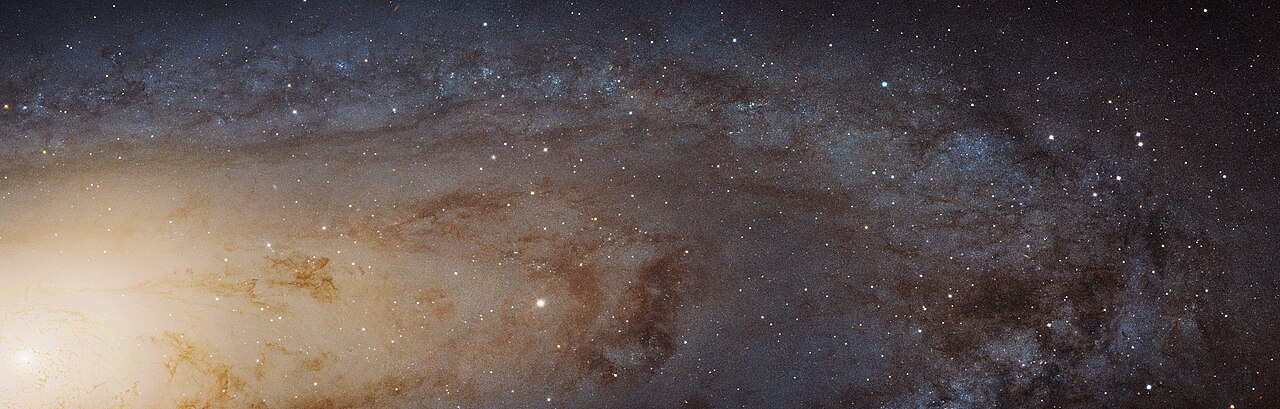

Andromeda is a massive spiral galaxy containing on the order of one trillion stars, with a total mass estimated between 0.8 and 1.5 trillion solar masses depending on the method used to trace its dark matter halo.7 Its disk spans roughly 220,000 light-years in diameter when measured to the faintest detectable isophotes, making it significantly larger in visible extent than the Milky Way. The galaxy possesses a rich system of satellite galaxies, an enormous circumgalactic gaseous halo, stellar streams recording ancient mergers, a distinctive double nucleus, and a supermassive black hole of 100 to 230 million solar masses — all features that make it an indispensable laboratory for studying galaxy formation and evolution in the nearby universe.10, 17
Discovery and observation history
The earliest known reference to the Andromeda galaxy as a distinct celestial object comes from the Persian astronomer Abd al-Rahman al-Sufi, who described it as a "small cloud" in his Book of Fixed Stars around 964 CE. European astronomers independently noted the object in the seventeenth century; Simon Marius provided a telescopic description in 1612, and Charles Messier catalogued it as the thirty-first entry in his famous list of nebulae in 1764. Throughout the eighteenth and nineteenth centuries, M31 was regarded as a nebula within the Milky Way, its nature a matter of vigorous debate. William Herschel estimated its distance at no more than 2,000 times the distance of Sirius, a value far too small, while others speculated that spiral nebulae might be "island universes" comparable to the Milky Way, an idea first articulated by Immanuel Kant in 1755.
The decisive breakthrough came in the 1920s. In 1923 and 1924, Edwin Hubble used the 100-inch Hooker telescope at Mount Wilson to photograph the outer regions of M31 with sufficient resolution to identify individual stars, including several Cepheid variables whose period-luminosity relation provided a direct distance estimate.1 Hubble's initial distance of approximately 900,000 light-years was a significant underestimate (later corrected when Walter Baade recalibrated the Cepheid distance scale in the 1950s), but it was nevertheless large enough to place M31 unambiguously beyond the Milky Way and thereby settle the "Great Debate" over whether spiral nebulae were extragalactic systems. This discovery fundamentally transformed humanity's understanding of the scale of the universe, revealing that the Milky Way was merely one galaxy among billions.
Modern distance measurements, incorporating multiple independent techniques including Cepheid variables, the tip of the red giant branch (TRGB) method, and eclipsing binaries, converge on a distance of approximately 2.5 million light-years (770 ± 40 kiloparsecs).5 The Panchromatic Hubble Andromeda Treasury (PHAT) survey, which imaged roughly one-third of M31's disk using the Hubble Space Telescope across ultraviolet, optical, and near-infrared wavelengths, resolved over 100 million individual stars and provided the most detailed census of stellar populations in any external galaxy.5
Structure and morphology
Andromeda is classified as an SA(s)b galaxy in the de Vaucouleurs system, meaning it is a spiral galaxy without a prominent bar (though some evidence for a weak bar or box-peanut structure has been reported), with moderately tightly wound spiral arms. The galaxy is inclined at approximately 77 degrees to our line of sight, so that we view it nearly edge-on, a perspective that compresses the apparent width of its disk and makes the spiral pattern less obvious in optical images than it would be if seen face-on.5
The disk of M31 extends to a visible radius of at least 25 kiloparsecs along the major axis, with faint stellar populations detected out to 40 kiloparsecs or beyond.18 Infrared and ultraviolet imaging reveals that the star-forming regions of the disk are concentrated in a prominent ring-like structure at a radius of approximately 10 kiloparsecs from the center, with a secondary ring near 15 kiloparsecs. This ring morphology is unusual for a classical spiral galaxy and may reflect the gravitational perturbation caused by a past close passage of one of Andromeda's satellite galaxies, most likely M32, which could have plunged through the disk and triggered a density wave that propagated outward as an expanding ring.15, 16
The bulge of M31 is a large, luminous spheroidal component extending roughly 3 to 4 kiloparsecs from the center. Unlike the Milky Way's pseudo-bulge, which formed through secular evolution of the disk, M31's bulge appears to be a classical bulge with properties consistent with formation through early mergers. The bulge is dominated by old, metal-rich stars with ages exceeding 8 billion years, and it contributes a substantial fraction of the galaxy's total luminosity.5
One of the most remarkable features of M31 is its double nucleus, discovered by Todd Lauer and colleagues using the Hubble Space Telescope in 1993. The nucleus appears to consist of two brightness peaks (designated P1 and P2) separated by approximately 0.5 arcseconds (roughly 2 parsecs in projection). The leading explanation, proposed by Scott Tremaine, is that the double appearance arises from an eccentric disk of stars orbiting the central supermassive black hole; the brighter peak (P1) corresponds to the apocenter of the disk where stars move more slowly and pile up, while the fainter peak (P2) marks the location of the black hole itself.9
The supermassive black hole
The center of M31 harbours a supermassive black hole whose mass has been estimated through stellar dynamical modelling of the nuclear region. Early estimates based on ground-based spectroscopy suggested a mass of approximately 30 million solar masses, but subsequent analyses incorporating the high spatial resolution of the Hubble Space Telescope and three-integral dynamical models have revised this figure substantially upward. Bender and collaborators in 2005 derived a mass of approximately 140 million solar masses, with a confidence range extending from 100 to 230 million solar masses depending on the assumed inclination of the eccentric nuclear disk.10
This black hole mass is significantly larger than that of Sagittarius A* at the center of the Milky Way (approximately 4 million solar masses) and places M31's black hole among the more massive examples found in galaxies of similar luminosity. The black hole is remarkably quiescent in the present epoch; X-ray observations detect only faint emission from the nuclear region, indicating a very low accretion rate. This dormancy is typical of supermassive black holes in the local universe, where the supply of infalling gas has diminished compared to the active epoch of galaxy assembly at higher redshifts.10
The relationship between the black hole mass and the properties of the host bulge (the M-sigma relation) has been a key topic in extragalactic astronomy. M31's black hole appears to be somewhat over-massive relative to the mean M-sigma relation, a finding that may reflect the galaxy's specific merger history, as major mergers are known to drive gas toward the nucleus and fuel rapid black hole growth.10
Satellite galaxies and the Local Group
Andromeda possesses the richest known satellite system of any galaxy in the Local Group. As of the most recent surveys, at least 36 confirmed satellite galaxies have been identified, with the number continuing to grow as deeper surveys push the detection threshold to fainter and more diffuse systems.8, 12 The two brightest companions, M32 and NGC 205 (also designated M110), have been known since the eighteenth century and are visible in even modest amateur telescopes.
M32 is a compact elliptical galaxy of unusual properties. It is remarkably dense for its luminosity, with a stellar mass of approximately 3 billion solar masses concentrated into a half-light radius of only about 100 parsecs. Its compactness has led to the hypothesis that M32 is the stripped remnant of a once much larger galaxy that lost its outer envelope through tidal interactions with M31. This stripping event may also be responsible for the ring-like star-forming structure observed in M31's disk.15
NGC 205 (M110) is a dwarf elliptical galaxy with a small amount of recent star formation near its center, an unusual feature for early-type dwarf galaxies. It lies at a projected distance of approximately 40 arcminutes from M31's center, corresponding to roughly 8 kiloparsecs in projection, and shows clear signs of tidal distortion.
In 2013, Ibata and collaborators reported the discovery that a significant fraction of M31's satellite galaxies are arranged in a vast, thin plane roughly 400 kiloparsecs in diameter and only about 14 kiloparsecs in thickness, with the satellites within this plane showing a pattern of co-rotation.13 This "great plane of Andromeda" presents a challenge to standard cosmological models based on Lambda-CDM, which predict that satellite galaxies should be distributed more isotropically around their host. The significance and persistence of this planar structure remain subjects of active debate.
Major satellite galaxies of M318, 14
| Satellite | Type | Distance from M31 (kpc) | Absolute magnitude (MV) |
|---|---|---|---|
| M32 | Compact elliptical | ~5 (projected) | −16.5 |
| NGC 205 (M110) | Dwarf elliptical | ~42 (projected) | −16.5 |
| NGC 185 | Dwarf elliptical | ~187 | −15.6 |
| NGC 147 | Dwarf spheroidal | ~142 | −15.1 |
| And I | Dwarf spheroidal | ~59 | −11.8 |
| And II | Dwarf spheroidal | ~185 | −12.6 |
| And III | Dwarf spheroidal | ~75 | −10.2 |
Stellar streams and merger history
One of the most significant discoveries about M31 in the past two decades has been the detection of extensive stellar streams and substructures in its outer halo, providing direct evidence that the galaxy has been built up in part through the hierarchical accretion of smaller systems. The most prominent of these is the Giant Stellar Stream (also called the Giant Southern Stream), discovered by Ibata and collaborators in 2001 using wide-field imaging of resolved red giant branch stars in M31's halo.6 This stream extends at least 100 kiloparsecs in projection from M31's center and contains stars that are remarkably metal-rich for a halo population, with metallicities approaching solar values. The stream is interpreted as the tidal debris of a dwarf galaxy that was disrupted during one or more passages through M31's inner regions within the past one to two billion years.6, 19
The Pan-Andromeda Archaeological Survey (PAndAS), conducted using the Canada-France-Hawaii Telescope, mapped the resolved stellar populations of the M31 halo out to projected distances of approximately 150 kiloparsecs. The survey revealed a remarkably complex landscape of stellar substructures, including the Giant Stream, the North-West Stream, the South-West Cloud, and numerous other arc-like and shelf-like features.2, 12 The sheer number and variety of these features indicate that M31 has experienced a more active recent merger history than the Milky Way, consistent with the presence of its classical bulge and the larger mass of its central black hole.
Numerical simulations by Fardal and collaborators have modelled the Giant Stream as the debris of a single progenitor galaxy with a stellar mass of roughly 2 to 5 billion solar masses that fell into M31 on a highly radial orbit. The same interaction that produced the stream may also explain several of the "shelf" structures observed in M31's inner halo, as the progenitor would have wrapped multiple times around M31 before being fully disrupted.19
The metallicity distribution of M31's stellar halo, as revealed by PAndAS, shows that the halo is significantly more metal-rich on average than the Milky Way's halo. The median metallicity of M31's halo field stars is approximately [Fe/H] = −0.7, compared to [Fe/H] = −1.5 for the Milky Way's halo.2 This difference is consistent with M31 having accreted more massive satellite galaxies, which, being more luminous and chemically enriched, deposited metal-rich stars into the halo upon disruption.
Globular clusters
Andromeda possesses an exceptionally rich globular cluster system, with approximately 450 to 500 confirmed globular clusters and potentially many more awaiting discovery in crowded or obscured regions of the galaxy.11 This is roughly three times the number of globular clusters in the Milky Way (approximately 150 to 160), and the difference likely reflects M31's larger total stellar mass and more active merger history, since accreted satellite galaxies bring their own globular clusters into the host system.
The globular cluster population of M31 spans a wide range of metallicities, from extremely metal-poor clusters with [Fe/H] below −2.0 to metal-rich clusters with near-solar abundances. As in the Milky Way, the metallicity distribution appears bimodal, with a metal-poor peak around [Fe/H] = −1.5 and a metal-rich peak around [Fe/H] = −0.4. The metal-poor clusters tend to be distributed more spherically in the halo, while the metal-rich clusters are concentrated toward the disk and bulge.11
Among the most remarkable individual clusters is G1 (also known as Mayall II), the brightest globular cluster in the Local Group. With an absolute magnitude of approximately MV = −10.9 and an estimated mass of roughly 10 million solar masses, G1 is far more luminous and massive than any Milky Way globular cluster and has sometimes been suggested to be the stripped nucleus of a dwarf galaxy rather than a true globular cluster. Spectroscopic studies have revealed that G1 has a spread in stellar metallicities and may harbour a central black hole of several tens of thousands of solar masses, lending support to the stripped nucleus hypothesis.11
Several globular clusters in M31's outer halo have been found to be spatially and kinematically associated with the stellar streams identified by PAndAS, providing further evidence that these clusters were donated by accreted satellite galaxies. The ability to connect individual globular clusters to specific accretion events represents a powerful tool for reconstructing the assembly history of the galaxy.2, 12
The circumgalactic medium
Surrounding the visible disk and halo of M31 is an enormous gaseous envelope known as the circumgalactic medium (CGM). Lehner and collaborators used the Hubble Space Telescope's Cosmic Origins Spectrograph to detect absorption from ionized gas in the spectra of background quasars whose sightlines pass through the halo of M31 at various projected distances. Their results revealed a massive, extended halo of ionized gas stretching to projected distances of at least 569 kiloparsecs from M31's center — roughly halfway to the Milky Way.17
The detected absorption was dominated by silicon ions (Si II, Si III, Si IV) and carbon ions (C II, C IV), indicating a multi-phase medium with temperatures ranging from roughly 10,000 K to several hundred thousand K. The total mass of gas in M31's CGM is estimated to be at least several billion solar masses and may be substantially larger if the medium extends to lower column densities not yet detectable.17
The existence of such an extended gaseous halo has important implications for galaxy evolution. The CGM serves as the reservoir from which gas accretes onto the disk to fuel ongoing star formation, and it also receives gas expelled by stellar winds and supernova-driven outflows. The discovery that M31's CGM extends to such great distances raises the intriguing possibility that the gaseous halos of M31 and the Milky Way may already overlap, meaning that the two galaxies are in some sense already in contact even though their stellar disks are separated by 2.5 million light-years.17
Stellar populations and star formation
The stellar populations of M31 span a wide range of ages and metallicities, reflecting the galaxy's complex formation history. The bulge is dominated by old stars with ages typically exceeding 8 billion years, consistent with the properties of classical bulges formed through early mergers. The disk, by contrast, contains both an old underlying population and regions of active star formation concentrated in the ring structures at 10 and 15 kiloparsecs from the center.5
The PHAT survey resolved more than 100 million individual stars in roughly one-third of M31's disk, allowing detailed colour-magnitude diagram analysis of stellar populations at a level of detail previously achievable only in the Milky Way and its nearest dwarf satellites. The survey revealed a complex star formation history in which the disk has experienced both periods of elevated star formation and relative quiescence. The current star formation rate of M31 is estimated at approximately 0.3 to 0.7 solar masses per year, significantly lower than the Milky Way's rate of approximately 1.5 to 2 solar masses per year, despite M31's larger total stellar mass.5, 15
Ultraviolet imaging from the GALEX satellite revealed that M31's star-forming regions are concentrated in the ring structures, with the inter-ring and inner disk regions being remarkably devoid of recent star formation. This ring-dominated morphology contrasts with the more pervasive spiral arm star formation seen in the Milky Way and many other spiral galaxies.16 The suppression of star formation in the inner disk may be related to the dynamical influence of the bulge, which stabilizes the gas against gravitational collapse, or to past interactions that removed or heated the gas in those regions.
The outer disk of M31, at radii beyond 25 kiloparsecs, contains an extended population of old, metal-poor stars that likely formed in situ at early times or were deposited by accreted dwarf galaxies. Ibata and collaborators detected this extended disk component out to radii of roughly 40 kiloparsecs, well beyond the conventionally defined optical edge of the galaxy.18
Local Group dynamics and the Milky Way collision
Andromeda and the Milky Way are the two dominant galaxies of the Local Group, a gravitationally bound association of more than 80 galaxies spanning a volume roughly 3 megaparsecs in diameter.14 The two giants together account for the vast majority of the Local Group's total luminous and dark matter mass, and their mutual gravitational attraction governs the dynamics of the entire system.
Spectroscopic measurements have long established that M31 is approaching the Milky Way at a radial velocity of approximately 110 kilometres per second (blueshifted, in contrast to the cosmological redshift observed for virtually all other galaxies outside the Local Group). However, the key question for predicting the future encounter is the tangential (sideways) component of M31's velocity relative to the Milky Way. Van der Marel and collaborators used Hubble Space Telescope observations spanning a baseline of 5 to 7 years to measure the proper motion of M31 for the first time in 2012, finding a tangential velocity of approximately 17 kilometres per second — small enough to confirm that M31 is on a nearly head-on collision course with the Milky Way.3
Subsequent measurements from the Gaia Data Release 2 refined M31's proper motion and broadly confirmed the Hubble result, while also providing the first proper motion measurement of M33 (the Triangulum Galaxy), the third-largest member of the Local Group. The Gaia data suggest that M33 may be on its first infall into M31's halo, having not yet completed an orbit around M31, though the uncertainties remain large enough to permit alternative orbital histories.4
Numerical simulations of the future orbital evolution of the Milky Way–M31 system predict that the first close passage will occur in approximately 4.5 billion years, with a full merger and relaxation into a single elliptical galaxy (informally called "Milkomeda" or "Milkdromeda") completing over the subsequent 1 to 2 billion years.3 During the merger, the spiral structure and thin disks of both galaxies will be destroyed by violent gravitational interactions, the gas will be driven inward triggering bursts of star formation, and the two supermassive black holes will eventually sink to the center of the merged remnant through dynamical friction and coalesce. The Sun, located in the outer disk of the Milky Way, will likely be flung to a larger radius in the merged system but is not expected to be ejected entirely; the probability of close stellar encounters that would disrupt the Solar System is negligibly small given the vast distances between individual stars even during the merger.3
The Milky Way–Andromeda merger will represent a relatively minor event in cosmic terms — galaxy mergers of this scale are common throughout the history of the universe and are a fundamental mechanism by which galaxies grow within the standard Lambda-CDM cosmological framework.20 Nevertheless, it will transform the local galactic environment from one dominated by two large spiral galaxies to one dominated by a single, massive elliptical galaxy, fundamentally altering the night sky as seen from any surviving planetary systems.
Andromeda in the context of galaxy evolution
The comparison between Andromeda and the Milky Way offers an unusually detailed case study of how galaxies with similar masses and environments can follow different evolutionary paths. Despite their membership in the same group and their broadly comparable masses, the two galaxies differ in several important respects. M31 has a classical bulge, a larger and more massive central black hole, a more metal-rich stellar halo, a richer globular cluster system, a more extensive set of stellar streams, and a lower current star formation rate. These differences collectively suggest that M31 has experienced a more active merger history than the Milky Way, with at least one significant merger event within the past several billion years that built up the bulge, grew the black hole, enriched the halo, and may have disrupted the gas supply in the inner disk.2, 5, 10
This comparison is scientifically valuable precisely because it is so detailed. For more distant galaxies, astronomers must rely on integrated light measurements that blend together the contributions of billions of stars, making it impossible to disentangle the complex superposition of stellar populations with different ages, metallicities, and kinematics. In M31, the ability to resolve individual stars means that the archaeological record of the galaxy's assembly is accessible star by star and cluster by cluster, providing constraints on theoretical models of galaxy formation that are unattainable for any other massive galaxy.5
The ongoing and planned surveys of M31 — including deep imaging with the James Webb Space Telescope, wide-field spectroscopic surveys of individual stars, and continued monitoring of the satellite system — will continue to refine our understanding of this nearest galactic neighbour and, by extension, of the processes that shape all galaxies in the universe. Andromeda remains, as it has been since Hubble's time, one of the most important single objects in all of observational astronomy.
References
The Large-Scale Structure of the Halo of the Andromeda Galaxy. I. Global Stellar Density, Morphology, and Metallicity Properties
The M31 velocity vector. III. Future Milky Way–M31–M33 orbital evolution, merging, and fate of the Sun
First Gaia dynamics of the Andromeda system: DR2 proper motions, orbits, and rotation of M31 and M33
The PAndAS field of streams: stellar structures in the Milky Way halo toward Andromeda and Triangulum